
Latest News
New York, new challenges as Sri Lanka begin a long road


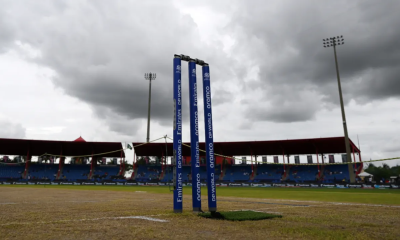
Puff of dust. Not on the pitch but on the outfield. That’s the first thing you notice about cricket at the Nassau County International Cricket Ground just outside New York City. The next thing you see is that the ball plugs in it. It doesn’t zip off like we are used to seeing in pretty standard conditions in cricket on TV these days. It is a sandy outfield where fielders won’t be queuing up to dive.
Then there is the drop-in pitch. In the warm-up game between India and Bangladesh held two days before the ground hosts its first World Cup match, the ball seamed around and also sat in the surface. Yet again, these are anything but standard conditions. And because of reasons not explained to the South Africa and Sri Lanka teams, they go into the match without any training session at the actual venue.
This is precisely why South Africa requested for at least a fielding session on the actual outfield after they were done with their nets at the Cantiague Park, another facility outside New York City. Even during the India-Bangladesh match, their coach Rob Walter and bowling coach Eric Simons made it a point to come to the venue and check the conditions out.
Sri Lanka, on the other hand, will visit the venue for the first time when they come in for the match. They even cancelled their nets session at the Cantiague Park. They have decided what they saw of the warm-up game on the TV is all they need to know. That is not as dramatic as it sounds because conditions are a little similar to Sri Lanka: sticky pitch, heavy outfield. That is what they have seen in their other practice sessions as well.
“First of all, we prepared really well,” Sri Lanka’s captain Wanidu Hasaranga said. “We came two weeks early to North Carolina, and we had practice sessions there. And we played two practice matches in Florida. And I think as a team, we prepared really well. And conditions are similar to Sri Lanka. So, I think as a team we have prepared really well.”
You can detect some sulkiness with Sri Lanka, though. Firstly, their flight into New York was delayed by seven hours. Then, unlike India and South Africa, they are staying in downtown Brooklyn, which makes it quite a trek to the ground. In fact when asked about adjusting to early-morning starts this World Cup – to cater to the TV audience in India – Hasaranga didn’t omit to mention the travel to the ground.
“No, if we played under lights, then we have to prepare, with the field and everything under the lights,” Hasaranga said when asked if they needed to make adjustments to early starts. “Then the only concern is we have to come early to the ground. We have to come at 7.30 in the morning because we are so far from the ground. It will take like one-and-a-half hours to the ground. That’s the only concern we have.”
Hasaranga is not incorrect. During the warm-up match, almost everyone had trouble getting to the ground with the police closing down the entrances to Eisenhower Park, which houses the stadium. Everyone is hopeful there is better co-ordination between the police and the ICC come match day when the roads will be closed at 7.30am for everyone except the team buses.
And then there is the frequent travel for them. Along with Netherlands, Sri Lanka are one of the only two teams that will play all their four first-round matches in four different venues. So they will be in a loop of match-travel-train-optional train-match through then first round.
We can sometimes not appreciate the small little challenges that can accumulate with these daily things. For example, when you are asked to train at another venue a day before the match, this is what happens: you load the cricket kits in the hotel at the team bus, then you unload them at the training facility, then you load again and go to your hotel, then you unload in the morning at the ground and load again because you have to travel immediately and don’t have the luxury of playing another match at the same venue.
South Africa were more philosophical with the logistical challenges that are part of coming to a new country, which on top of that is not used to hosting cricket, but they do get to play three matches in New York. Even they were bemused they had to train elsewhere. They didn’t know a reason why. Asked if they would have rather they trained at the venue of the match, their captain Aiden Markram said: “It’s hard to say because I’m not sure what [training facility] is there [at the venue of the match], because I haven’t been there. This facility is incredible to be honest, so we don’t mind training here either.”
[Cricinfo]











Latest News
Sun directly overhead Anamaduwa, Moragollagama, Dambulla, Manampitiya and Valaichchenai, at about 12.10 noon today (02)

The sun is going to be directly over the latitudes of Sri Lanka from 28th of August to 07th of September due to its apparent southward relative motion.
The nearest places of Sri Lanka over which the sun is overhead today (02) are Anamaduwa, Moragollagama, Dambulla, Manampitiya and Valaichchenai, at about 12.10 noon.
Latest News
Signing agreement for the establishment of BIMSTEC Technology Transfer Facility in Sri Lanka

It has been decided to establish a BIMSTEC technology transfer facility in Sri Lanka by entering into a Host Country Agreement at the second leaders’ summit of BIMSTEC (Bay of Bengal
Initiative for Multi-Sectoral Technical and Economic Cooperation) held in New Delhi, India, in 2008, with the objective of enhancing regional cooperation.
The relevant cooperation agreement was signed by the member countries at the 5th BIMSTEC summit on 30-03-2022 in Colombo.
The prime objective of this technology transfer facility is to provide technology, capacity building, and management of intellectual property for the micro, small, and medium-scale
enterprises of the BIMSTEC member countries.
According to the cooperation agreement, an agreement should be entered into between Sri Lanka, as the host country, and BIMSTEC Secretariat for formalizing the legal status, privileges, and immunities of the technology transfer facility.
The drafted agreement has received the relevant institutional approval and legal clearance.
Accordingly, the Cabinet of Ministers has approved the resolution furnished by the Minister of Science and Technology to sign the proposed agreement.

Misbah ul Haq has offered his resignation from the Pak7stan men’s national selection committee the day after the PCB made wholesalw changes to the Teat squad and team management midway through the ongoing tour of England. Misbah has also decided to step down from his role as a batting consultant at the National Cricket Academy in Lahore.
After going 2-0 down in the three-match series by losing at Lord’s by 194 runs, the PCB removed seven players from the Test squad and also released Sarfaraz Ahmed and Umar Gul as head coach and bowling coach ahead of the third Test at Edgbaston from September 9.
Mohammad Rizwan, Imam-ul-Haq, Salman Agha, Ali Usman, Aamer Jamal, Awais Zafar, and Khurram Shahzad were the seven players released. Five uncapped players – Arafat Minhas, Mohammad Imran Jnr, Saad Baig, Mohammad Imran Randhawa, and Razaullah – will join the Test squad along with Saim Ayub and Abdullah Fazal. Mike Hesson and Ashley Noffke – the head coach and bowling coach of the white-ball set-up – have joined the Test coaching staff.
Cricinfo understands the PCB served a notice to members of the selection committee following the Lord’s defeat seeking a written explanation regarding the selections of Rizwan and Imam in the squads for the tours of West Indies and England.
The notice was sent on Monday, the same day the board announced its decision to send home the seven players and two coaches, ahead of the third Test at Edgbaston from September 9. The notice asked for a written explanation outlining the reasons for their selections and the process through which it was arrived at, within 24 hours of the receipt of notice. From the start of 2024 until the West Indies tour, Rizwan was Pakistan’s top Test run-scorer with the highest average. Imam had only played two Tests in that period but was a heavy domestic run-scorer.
Since retiring as Pakistan’s most successful Test captain in 2017, Misbah has served in various capacities in the PCB. He was appointed in the dual role of head coach and chief selector in 2019. He served in both roles until October 2020, when he resigned as the chief selector to focus entirely on the head coaching responsibilities, from which he ultimately resigned the next year.
Two years later, he was brought in as an advisor by the then chief of ad-hoc management committee Zaka Ashraf and had since remained involved with the PCB. He was announced as one of five mentors for the now-defunct men’s Champions Cup after the current management took over in 2024, and he also mentored women’s teams in domestic competitions. He was the coach of the Pakistan Gold side which won the 50-over National Champions Cup in Multan last month under Shaheen Afridi’s captaincy.
Misbah was made part of the four-member selection committee which includes Aaqib Javed, Sarfaraz Ahmed, and Asad Shafiq in March this year and had also been on a 180-days-a-year contract with the PCB as a batting consultant.
(Cricinfo)

Showers will occur in the Western and Sabaragamuwa provinces and in Galle, Matara, Kandy and Nuwara-Eliya districts

Sun directly overhead Anamaduwa, Moragollagama, Dambulla, Manampitiya and Valaichchenai, at about 12.10 noon today (02)

SC rejects petitioners’ request for full bench

Seven years RI for former Civil Aviation Minister Piyankara Jayaratne

40 professional organisations and TU oppose proposed 22A

Ai-CHA expands Lankan footprint with new Negombo outlet

‘Dates have the highest sugar content to fight Coronavirus’

Sunday Island 27 December – Headlines

#SundayIsland 17th December – Headlines

Sunday Island – 28th March

Sunday Island Headlines – 21 March

Sunday Island – 21st February – Headlines
-

 News5 days ago
Eight politicians in drug kingpin probe
-

 Features3 days ago
“Wrap Me Up in My Blazer”— A Gentlemanly Bradby Reminiscence
-

 Business5 days ago
Sri Lanka opens up: A new season of direct connectivity
-

 Features5 days ago
Redefining ageing in Sri Lanka
-

 Latest News6 days ago
Nepal-Tibet floods: What happened, what caused them and who is missing?
-

 Editorial6 days ago
Unfolding El Niño and burning issues
-
 Foreign News7 days ago
At least eight killed, hundreds missing after Nepal flash flood
-
 Latest News7 days ago
Advisory for High Waves for the sea areas extending from Colombo to Pottuvil via Galle, Matara and Hambantota