
Opinion
Buddhist meditation for the tech-savvy generation


By Geewananda Gunawardana, Ph.D.
Meditation is a two-billion-dollar industry in the USA; it includes retreats, corporate training classes, apps, and many variations in between. It is estimated that 14% of adults have participated in meditation at least once in their lifetime. A survey found that 22% of the participants meditate to connect with their “true self” and 10% to connect with something larger than themselves, i.e., spiritual reasons. It is fair to assume that most of the Sri Lankan Buddhists would belong to this category. Another 16% meditate for health and enjoyment; the other reasons are improving energy, aiding memory or concentration, anxiety, stress, addiction, and depression (Science Reports 2016). The corporations do it to increase the productivity of their employees, i.e., to make more money.
While some participants have reported positive outcomes, others claim disappointments, misunderstandings, and undesired outcomes. Bhikkhu Sujato explained all this when he wrote: “While the intensive retreat has given many people, including myself, a crucial kick-start in their Dhamma practice, it is not without its drawbacks. It is normal that meditators will get a high on the retreat and then fall back to earth. The extreme exertion invites over-estimation, and such retreats are full of people who convince themselves they have attained jhāna or awakening. Even worse, intensive practice with inadequate preparation and guidance can trigger psychosis, which is extremely dangerous. Many meditation retreats are run without the grounding in psychological understanding to recognize or handle these breakdowns, and meditators may be told simply to continue, or even that their psychosis is a sign of insight” (Bhikkhu Sujato, Sutta Central 2013).
My meditating colleagues who know my Theravada background often ask about my opinion on the ‘Mindfulness” sessions we were offered. What miracle is expected to happen when you focus on your breath or some other object while sitting still, they ask. I am no meditation guru, and I am as conflicted as they are; as I understand it, the Buddhist meditation is based on the fundamentals of Buddha’s teaching. It has a clear goal, but no mystery or magic of any kind. Numerous other methods have been added over the years. It is no wonder that one can become confused if one gets into meditation without knowing the fundamentals. That is the case with most American meditators, just as Bhikkhu Sujato has explained, but are we Sri Lankans any better?
The Buddha’s mission was to eliminate doubts and mysticism from traditional explanations and theories of life that existed during his time, and his solution is expressed as “Seeing things as they really are” (yathabutha nanadassana). This is further elaborated as to “Understand the nature of the universe and the humans’ place in it, without subscribing to superhuman powers or mysticism” (Kalupahana 1992). Therefore, the goal is to understand this at the supreme level, which is Nibbana. The method is described in the Fourth Noble Truth, the Eightfold Path.
This is where the technologically savvy generation can step up. While earlier generations used perceptions and logical inferences to understand the nature of the universe and humans’ place in it, today, science is using experimental methods to achieve the same goal. This effort has generated a vast amount of information on subjects relevant to Buddhist meditation and described them in terms relatable to the present generation. Even high schoolers learn some of these facts, but unfortunately, they are not trained to see their relevance to real life beyond box checking at the examination. Therefore, the challenge for the tech savvy generation is to convert that information into knowledge and knowledge into wisdom, or insight, a form of meditation, as I was told by my mentors.
The traditionalists will scoff at this idea, but the Buddha himself used parables, similes, and stories appropriate for the times to get the message across. He acknowledged that while there is only one truth, there are many ways to reach it. Today, scientific knowledge is the best and most accessible tool to relate to Buddha’s teaching. What is wrong with adding one more to the forty plus existing methods if it works? The Pali term bhavana means mental culture or mental development to be able to see things as they really are. Various methods for the development of mental concentration (samatha or samadhi) existed before Buddha’s time, which he practiced under various teachers before the enlightenment. Buddha found them to be unsatisfactory as they did not lead to the realization of the truth, so he discovered his own method, the insight meditation (vipassana).
There is one more point to remember. Most meditation practices being popularized were originally meant for monastics and not for the laity (Sujato, 2013), and others were developed by 20th century meditation experts. The Pali Canon and the exegesis are transmitted over the millennia by the male monastic community, and as a result, what was meant for the laity has been mostly deemphasized or completely omitted from current practices (B. Rahula 2008). Furthermore, those methods were developed based on conclusions drawn by applying critical thinking and reasoning to information available at the time. On the other hand, modern science has added vast amounts of empirical information about the nature of things that were not available to the previous generations, which can be used for meditation. That does not mean that the other methods are invalid, or the Buddhist thinking is inferior to science. It is quite the opposite: science is only beginning to rediscover what the Buddha described two and a half millennia ago, without the benefit of ‘sophisticated’ technology, especially about the human perception and mind. Therefore, scientific understanding of the human body, mind, and the universe offers the technologically savvy generation yet another way to relate to Buddhist ideals without subscribing to conjecture, mysticism or beliefs.
The Buddhist meditation is aimed at gaining insight, which is described as paying attention or observation (anupassana) into the true nature of the body (kaya), perception (vedana), mind (citta), and several other phenomena (dhamma) that include the three characteristics of life and factors governing morals or ethics (DN 22, and MN 10). Except for the subject of mind, science has explored and explained every detail of these subjects going down to subatomic particles level. While Buddhist teaching is way ahead in explaining the mind, science has made great advances in catching up during the last two decades, and their findings are astonishingly in agreement with what the Buddha taught.
The relevant facts that would emerge from the investigation of scientific information can be summarized as follows. All phenomena, animate and inanimate, in this universe, except one, arise due to causes and conditions, and as a result, they are all interrelated (hethuphala vada). Therefore, all such phenomena are in flux (anicca), and have no substance (anatta), i.e., they are all processes. The human sensory system is evolved for the sole purpose of perpetuating their DNA, and as a result their perception (vedana) is imperfect and not suited for seeing the reality. The brain processes (citta) this incomplete information received as electro-chemical signals and constructs a mental image of the universe. We have no way of knowing how accurate that model is, except that it is good enough for the intended purpose, which is the propagation of DNA. This limitation of observing reality is further elaborated in quantum mechanics.
Humans are compelled to navigate through this world, of which they have only a mental construct of unknown quality, using tools built for different purposes. This is like a blindfolded man on a bullock cart with a broken axel is asked to navigate through a busy modern city. However unsatisfactory and beyond control the situation is, evolutionary processes have made humans cling to this situation (tanha). As a result of this clinging, humans continue to plod through it, assuming it is fun, again a trick of the DNA; this is referred to as the human condition (dukkha). While the immediate cause of this condition is the clinging, Buddha explained that the cause of clinging is ignorance (avijja), and the way to be free from this human condition is to eliminate ignorance and see things as they really are. The mental culture or development (vipassana bhavana) is the necessary mechanism to achieve this wisdom.
The Noble Eight-fold Path is interpreted by scholars as having two meanings: it is the way to become a noble, i.e., one with wisdom, and it is the way the nobles behave. As the name implies, the path has eight categories, which must be followed and practiced concurrently. These eight divisions belong to three types: wisdom (panna), mental discipline (samadhi), and ethical conduct (sila). Wisdom includes having the right thoughts (sankappa) and understanding, or view (ditthi) of the above-described processes. Having mental discipline includes striving (vayama) to be focused (samadhi) and mindful (sati) of all actions. In other words, know how the universe functions and ensure one’s speech (vaca), actions (kammanata), and livelihood (ajiva) are in harmony with the universe, which is ethical conduct.
None of the above processes have anything to do with beliefs, mysticism, or ideology. All these phenomena are explained based on empirical evidence by the theory of molecular evolution, biology, neuroscience, and physics. The premise is that one who understands these phenomena in wisdom will live a happy and a harmonious life as they know that all phenomena are interconnected and his or her actions have consequences, not only for the individual, but all beings. This is not a mere hypothesis but an empirically proven fact. Today, in this technologically advanced society, where information is freely available, individuals can access all the relevant information at levels befitting to their individual needs, including original publications in scientific journals. One does not have to retreat from daily life, sit in a particular posture, or take the words of someone else to verify these facts. Recall the Buddha’s advice to Kalalmas.
While the Buddha did not rule out the ability of laity to achieve insight at the supreme level, he gave a more pragmatic option for them: an ethical and moral code of conduct referred to as the Five Precepts, for leading a happy and harmonious life. There is a particularly important reason for giving two different prescriptions for monastics and laity. Laity must deal with a variety of responsibilities and chores constantly and require interacting with a larger community, whereas monastics remain mostly isolated from such hassles and chores. Therefore, for the laity to live a harmonious life, the entire community must abide by rules, regulations, and conduct accepted by the community. Buddhist ethics, especially the five precepts, are not based on some doctrinal principles, but are formulated for the welfare of the community at large and its needs and wants. These secular principles are based on the following rationale: If someone were to do “this thing to me,” I would not like it. But if I were to do it to them, they would not like it either. The thing that is disliked by me is also disliked by another. Since I dislike this thing, how can I inflict it on another (SN 55.7).
Unfortunately, many Buddhists believe that the consequences of either following or breaking the five precepts will come to fruition only in the next life. That is not the case, they are related to the wellbeing of a society here and now. Imagine where Sri Lanka would be today if the elected officials and bureaucrats had observed the second precept of refraining from taking what is not given to them. What if the religious leaders had used their authority to stop these blatant violations or at least condemn them, instead of bestowing their blessings? If the same people had followed the fourth precept of refraining from false speech, would there be a need to fight for transparency? Following the five precepts can help solve most of the ills of society; but one must see the science behind it and act, accordingly, merely parroting them in a dead language will not help. Furthermore, it is necessary to interpret the Buddhist code of conduct in the current context. If the tech savvy generation cannot see it, what is the use of all that knowledge?
For example, most Theravadin Buddhists assume that eating meat does not violate the first of the five precepts: refraining from depriving a living being of its life. Their reasoning is that I did not kill the animal, and meat is always available in the market. That is an erroneous assumption; free market economist will explain that the animals are slaughtered specifically for the customers’ needs. The point is that the negative consequences of meat eating are severe and far reaching. It is an extremely inefficient way of gaining nutriment. It takes seven kilograms of grains to produce one kilogram of beef. The worldwide grain harvest used for animal feed is sufficient to feed ten billion people, which is the expected world population in the year 2050. The land and water use, deforestation, antibiotic use, habitat loss, and the contribution to greenhouse gas emissions of animal farming are already beyond sustainable levels.
The best and the easiest way to help reduce global warming is to reduce meat consumption so that burning of fossil fuels can be continued until an alternative is found. The negative health effects and associated costs, especially in societies that have taken up the habit due to newfound wealth, should be considered as well. The West has seen it, and they are acting on it. Practicing the first precept could be our only, and the least disruptive contribution to achieving carbon neutrality by 2050.
Sri Lanka is one of the most corrupt countries, we scored thirty-four out of one hundred (Transparency International 2023). It is not necessary to explain the consequences of not refraining from taking what is not given by others and false speech. Sadly, our culture has a long history of pleasing those in positions of power or authority (Knox 1681) and it has now become a national norm with disastrous results.
Sri Lanka’s alcohol consumption is 4.1 litres per capita. However, when corrected for the drinking population, which is 34.8%, it becomes a staggering number. This has been identified as a major obstacle to achieving the country’s Sustainable Development Goals (PLoS One. 2018; 13(6). Asides from adverse economic and health issues – no, there are no known health benefits from moderate drinking whatsoever, abuse of mind-altering substances can have devastating effects on families, especially children, friends, and the community in general. It is important to know that it is not only alcohol, tobacco, and illicit drugs that come under this category, but the harmless betel nut too can alter the mind to a certain degree; they all hinder the rational thinking ability, quite the opposite of culture or development of mind.
Next to the second and fourth precepts, the most damage to society results from disregarding the third precept: renouncing sexual misconduct. This is often interpreted as refraining from adultery, which is incorrect. English translations of the Pali verse use misconduct, illicit, unacceptable, and misuse; therefore, a better interpretation would be “not to use sexuality in any way that can cause harm to others, self, or society.” A number of other social ills prevalent in the country fall under this definition: According to a UN report, 90% of the women surveyed report being sexually harassed at least once in their lifetime. That number for late adolescent school children is 78%. A survey of men found that 28% of them were sexually abused during childhood. The actual numbers could be higher; many victims remain silent as they do not wish to re-live the trauma. This is a disgusting situation; how can a society function if half of its members must live in constant fear of the other half? That is a pathetic commentary for a nation claiming to have a proud civilization and be the protectors of the Buddha’s teaching. A civilization, really?
How did a society that has access to a wealth of information that is ahead of modern science get into this situation? It is a multifactorial issue. We carry a lot of baggage, and old habits are hard to change; for example, offering gifts to nobility to get things done is not new (Knox 1681), but now it has grown into a dangerous cancer consuming the nation. Recall that both giver and taker are committing crimes. In the context of this discussion, I attribute the responsibility to failures of the education system and the inability of the monastic society to accept and admit that their tradition has been hijacked by external forces and transformed it beyond recognition (Is the Buddha’s teaching lost on us? Island 05/12/2023). Teaching children to recite the five precepts in a dead language without emphasizing the science behind it serves no purpose. Only when one knows the true meaning of them, he or she will have no doubt about the validity of observing them to the letter.
The generation brought up with emphasis on STEM education has a chance to change the system; in reality, they have no other choice. Yes, the governance system must be changed, but ethics and morals cannot be legalized (legal positivism). Even though it is neglected and desecrated, they have access to the teachings of the greatest ethicists the world has known. Buddha’s teaching is a true user manual for the human. Unfortunately, it is used as a “manthra” that imparts good luck or mystic powers. Instead of memorizing Asvagosha’s poem, for example, the tech savvy generation must see the pragmatism of the Dhamma that gives the knowledge and the tools to deal with the mental and physical challenges humans face while navigating through the complex world they have inherited.
Buddha dhamma is an exploration of the universe and the humans’ place in it. It is a highly scientific explanation of the human body, mind, and other related phenomena, but one must see it in wisdom, without the mysticism, rituals, and misguided commentaries. The tech savvy generation has a wonderful opportunity to see the science behind it and gain the skill set to solve the problems at hand. As I was told, that is the Buddhist mediation is all about. If one can see the said processes that constitute the body and mind “without word or label,” they have succeeded. At that point, they will also see the relevance of morals in the Buddhist concept of continuity. Unfortunately, we cannot expect any help in this effort from those who advocate kayanu passana but oppose teaching children how to use their body and mind. To be fair, it is not reasonable for us to expect them to have an in-depth knowledge of biochemistry or neuroscience.



By Lilani (Appadurai) Jayatilaka
Yesterday, we received the sad news that Professor Thiru Kandiah had passed on. In a letter that he had been crafting to my husband Tissa, but which remained unsent in his drafts folder until his daughter Shivanthi shared it with us today, he had referred to Dylan Thomas’ moving poem to his ageing father ‘Do not go gently into that good night’. Though Prof Kandiah acknowledged the innate desire to ‘rage, rage against the dying of the light’, he accepts that such an attitude to ageing and death, could be both a ‘blessing’ and a ‘curse’ and that ‘the more sensible course would most likely be to recognize it as simply inevitable and learn to live with it’. Perhaps that is true, but it is a truth that is hard to accept, especially when we know that the world is that much smaller, that much poorer with the passing of this gentle, intellectual giant.
I first met Prof Kandiah in my first year as a student of English at Peradeniya. At the time he was a relatively young lecturer and he seemed to fill the lecture room with his presence. He was never still; he never sat down. He strode from one end of the room to the other as he delivered his first lecture. That first lecture was on the Word Stock of English. Almost 50 years later, I can remember every word of that lecture along with the diagram he drew on the blackboard to illustrate the relationship between core words and borrowed or constructed words in the English language.
As someone whose special area of expertise was linguistics, he had, in my opinion, the driest of topics to handle. But Prof Kandiah was so engaged with the topics he had to teach, that he was able to make them interesting to us as well. And his concern for the welfare of his students did not end in the lecture room at the end of the day. Both he and Prof. Halpe took a lively interest in our welfare and in our performance as their students. We were invited several times to Prof. Kandiah’s home during the four years we were at Peradeniya, when both he and Mrs. Kandiah made us welcome and treated us to some delicious home-cooked meals. As we were away from home and subject to the vagaries of indifferent cooks at our halls of residence, these dinner invitations were greatly appreciated.
Prof Kandiah’s areas of interest extended well beyond the sphere of linguistics. As the lecturer in charge of the MusicSoc and DramSoc at Peradeniya, we were all roped into the activities of these two societies. When Edward Albee’s play, ‘Who’s Afraid of Virginia Woolf?’ was brought to Peradeniya from Colombo with (I believe) the McIntyre duo taking lead roles, we were ferried by Prof Kandiah across campus grounds to sell tickets for the play. I was President of the DramSoc that year and was in charge of seeing that the stage set was ready for the actors. A crucial prop for this play was a sofa which I had failed to procure in time for the performance. Panic stricken, I coerced my bemused aunt who lived in Kandy to part with hers, so that the play could run smoothly. Throughout this fiasco, Prof Kandiah remained calm and comforting, a rock amidst the chaos, never uttering a single word of blame, though I well deserved it.
But linguistics was his passion and he was so invested in teaching it, that he would continue to teach even when he was beset by migraines. We could see that his eyes were screwed up in pain, but he would carry on nevertheless. Apart from linguistics, he also taught us practical criticism on occasion, when he, in the manner of F.R Leavis, would dissect a poem word by word until he had extracted its essence and its every nuance.
My friends and I were inspired and excited by the intellectual stimulation provided by the English Department, and somehow, the very environs of Peradeniya seemed to enhance our understanding and appreciation of English literature. We were dazed and dazzled by all that Peradeniya had to offer: intellectual stimulation of the formal kind in lecture halls and of the less formal kind in debates and discussions late at night with close friends in the privacy of our halls of residence; plays and musical performances to be watched on stage or at the Wala, sitting on the damp steps of the open air theatre surrounded by flares while we watched a performance of ‘Maname’ or ‘Sinhabahu’; trekking half way uphill to the Anglican church for Sunday services or further uphill on Mahasivarathri for an all- night vigil of sorts at the Hindu Kovil; bathing in the nearby Mahaweli river – an action that was strictly forbidden by university authorities and thereby all the sweeter; watching movies at the American Centre in town; or taking the bus into town for a welcome respite from hall food at Lyons’ Café. The list is endless and its joys cannot be quantified.
In sampling all that Peradeniya had to offer, I had spread myself thin and Prof. Kandiah became concerned that I might be losing focus. He called me home to give me a gentle ‘talking to’ which had the desired effect. In the years since, my husband Tissa and I, along with some of my closest friends, have maintained a close relationship with Prof and Mrs. Kandiah. Whenever they visited Sri Lanka, they made it a point to meet us for a meal. Through the years, he has continued to hold our attention with his intellectual prowess, his facility with the language and his knowledge.
Nothing had changed. When he wrote to us, we could be sure that there would be one or two words that we had never come across before; when he spoke to us, we would listen spell-bound as he declaimed on various topics of interest. His letters were specially crafted missives -compassionate and warm, yet intellectually stimulating and thought provoking. The last time he visited Sri Lanka was to attend his brother- in -law’s memorial service, and though we chatted briefly after the service, we were not able to share a meal as was our usual wont. But on his previous visit, we watched as Prof Kandiah, older, slightly stooped and noticeably frailer than before, walked away holding Mrs. Kandiah’s hand for support. It is a tableau that haunts us to this day, for we could clearly see the ‘dying of the light’ in his physical deterioration and we could not but ‘rage’ at its inevitability.
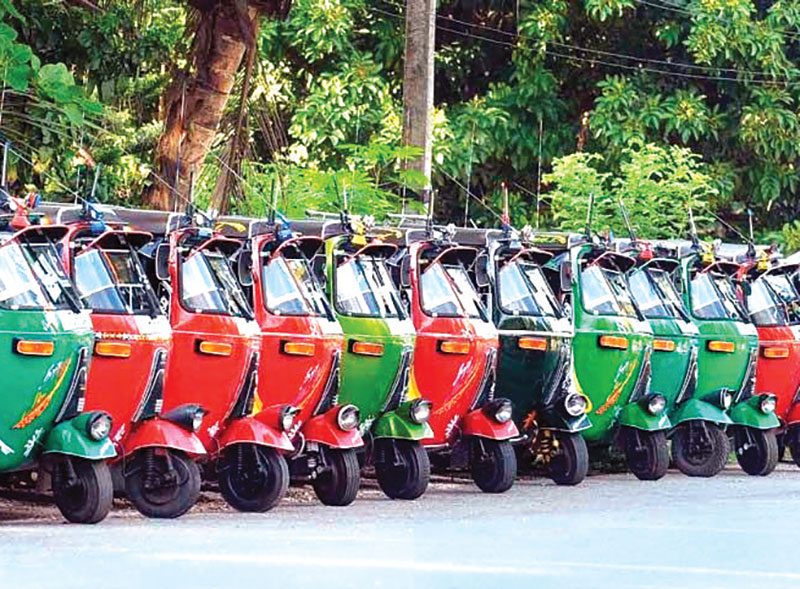
by Sampath Perera
An ordinary journey through Colombo raises uncomfortable questions about road discipline, passenger safety and our tendency to judge motorists by the vehicles they drive.
It was a little past noon when I finished attending a court matter and remembered that I had to visit a nearby bank before returning to my other work. The bank was hardly a kilometer away, a distance I would normally have walked without giving it much thought. However, anyone who has walked through Colombo in formal court attire under the scorching midday sun would appreciate why I was reluctant to do so. Taking my own vehicle was not particularly appealing either, as finding a parking space near a bank during business hours can sometimes take longer than the transaction itself.
After considering my options, I decided to take a three-wheeler, a perfectly ordinary decision that unexpectedly left me reflecting on the way we judge those who drive them. Within minutes, I was seated in the rear, travelling through the usual Colombo traffic. It was convenient, reasonably priced and saved me the trouble of searching for parking or arriving at the bank drenched in sweat. As we approached a busy junction, however, a car suddenly cut across our path without any indication. Its driver appeared determined to squeeze into a narrow gap, apparently unconcerned about the vehicles already occupying the road. Our three-wheeler driver immediately applied his brakes, throwing me slightly forward in my seat. Fortunately, he reacted quickly enough to avoid a collision, while the car continued on its way as though nothing unusual had happened.
The incident itself was hardly extraordinary by Colombo’s standards, but it made me consider how differently we might have reacted had the situation been reversed. If a three-wheeler had suddenly cut across a car in the same manner, the driver would probably have been subjected to angry horns, harsh words and the familiar accusation that three-wheeler drivers have no respect for road rules. Yet when someone driving a comfortable, air-conditioned car behaves just as irresponsibly, we tend to treat it as another unpleasant encounter in traffic. It seems that, in our public discussions about road discipline, the seriousness of an offence sometimes depends not so much on what a driver does, but on the vehicle he happens to be driving.
This is not an attempt to portray three-wheeler drivers as innocent victims of unfair criticism. Anyone who regularly travels on Sri Lankan roads knows that some drivers behave recklessly, stopping without warning, making dangerous U-turns, disregarding traffic signals and squeezing through gaps that sensible motorists would avoid. Such conduct deserves criticism and, where appropriate, legal action. Nevertheless, it would be equally dishonest to pretend that these practices are confined to three-wheelers. A few minutes spent observing traffic at a busy Colombo junction would reveal expensive cars changing lanes without indicating, SUVs obstructing pedestrian crossings, motorcycles weaving dangerously between vehicles and buses stopping wherever passengers signal them to do so.
What is troubling is our tendency to turn the misconduct of an individual three-wheeler driver into an indictment of an entire profession. A badly parked three-wheeler becomes another example of everything wrong with the industry, while a luxury car obstructing a pavement is generally treated as the irresponsible conduct of its particular driver. Perhaps this difference in perception has become so familiar that we rarely question it. Yet the law makes no distinction between an illegally parked vehicle costing several million rupees and one purchased through a modest leasing arrangement. Both can obstruct traffic, inconvenience pedestrians and create dangerous situations for other road users.
There is also considerable irony in our relationship with three-wheelers. We complain about their presence on the roads, accuse them of contributing to congestion and criticise the behaviour of their drivers, but the moment we need to reach somewhere quickly, avoid a parking problem or transport an elderly relative to a nearby hospital, we often turn to the very vehicles we complain about. In many rural communities, where public transport remains inadequate, three-wheelers provide an essential connection between homes, hospitals, markets and bus routes. Their contribution to everyday mobility is difficult to dismiss, particularly for people who cannot afford private vehicles or have limited transport alternatives.
The driver who took me to the bank that afternoon was simply earning his living. For him, the three-wheeler was not a symbol of traffic disorder or a subject for public debate, but a means of supporting himself and possibly a family. He had provided a useful service and, when confronted with another motorist’s carelessness, demonstrated the kind of defensive driving that we should expect from everyone using our roads. By the time I paid the fare and stepped out near the bank, I found myself wondering whether our criticism of three-wheelers sometimes says as much about our own prejudices as it does about genuine concerns over road safety.
That question becomes particularly relevant when we consider one of the strongest arguments made against three-wheelers: passenger safety. There is no denying that a conventional three-wheeler offers considerably less protection in a collision than a modern passenger car equipped with airbags, seat belts and a reinforced passenger compartment. Its lightweight construction and limited structural protection expose occupants to risks that should never be underestimated. But acknowledging those limitations is quite different from suggesting that such vehicles have no legitimate place on our roads. If the absence of a protective passenger compartment is sufficient reason to question a vehicle’s acceptability, we must also consider motorcycles and bicycles, whose riders are even more exposed to the consequences of a collision.
A motorcyclist has little protection beyond a helmet and appropriate riding equipment, while a cyclist has neither airbags nor a surrounding metal structure to absorb the impact of an accident. Pedestrians are more vulnerable still, particularly on roads where pavements are obstructed or entirely absent. Yet nobody would seriously argue that walking or cycling should be discouraged simply because these activities involve greater physical exposure. The sensible response is to improve road conditions, regulate speeds, strengthen vehicle standards and ensure that motorists respect vulnerable road users. The World Health Organization has consistently emphasised this broader approach to road safety, recognising that pedestrians, cyclists and motorcyclists account for a substantial proportion of road traffic deaths worldwide.
The comparison does not mean that all vehicles are equally safe, nor should it be used to minimise the genuine risks associated with three-wheelers. Different vehicles offer different levels of protection, and their safety depends on design, maintenance, speed, road conditions and the circumstances of a collision. However, there is something fundamentally flawed in assuming that a vehicle becomes unacceptable merely because it cannot provide the protection available in a modern car. If that were the standard, we would have to reconsider the place of several widely used forms of transport. More importantly, we would risk overlooking the responsibility of drivers whose behaviour can turn an otherwise ordinary journey into a dangerous encounter.
There is an equally questionable assumption that travelling in a larger or more expensive vehicle somehow reflects greater responsibility on the road. A modern car may provide better protection to its occupants, but its safety features cannot compensate for the arrogance or carelessness of the person behind the steering wheel. An SUV equipped with advanced braking systems and multiple airbags can still be driven recklessly, and its greater weight may increase the danger to pedestrians, cyclists and smaller vehicles in certain collisions. Road safety cannot therefore be measured solely by how effectively a vehicle protects its occupants. It must also consider the risks that vehicle presents to everyone else sharing the road.
Perhaps what we need is a more balanced understanding of road safety, one that recognises the limitations of three-wheelers without turning their drivers into convenient villains. There is every reason to demand better vehicle standards, responsible driving and stronger enforcement, but those expectations must apply equally to motorists operating cars, buses, motorcycles and commercial vehicles. A reckless driver does not become less dangerous because he is seated inside an expensive car, just as a responsible three-wheeler driver should not be treated with suspicion merely because his vehicle has one wheel fewer.
The experience of that afternoon reminded me that our roads are shared public spaces, not a hierarchy determined by the price, size or appearance of the vehicles using them. The three-wheeler that took me to the bank served a practical purpose, while the driver of a more expensive vehicle created the only dangerous moment of the journey. It would be unreasonable to draw conclusions about all car drivers from that single incident, just as it would be unfair to judge an entire profession by the misconduct of a few three-wheeler drivers. If we genuinely want safer roads, perhaps we should begin by judging people according to how they drive rather than what they drive.
——————————————
Sampath Perera, LL.M. (UK), is an Attorney-at-Law and former Commissioner of the Office on Missing Persons (OMP). He has served as Legal Adviser to the Ministry of Justice and the Ministry of Higher Education.

by Bishop Duleep de Chickera
The Valiant
Centuries ago, the intervention of a Persian king, restored a degree of balance of power in the West Asian region. In the 6thc, BCE, Cyrus the Great of Persia, put a stop to the aggressive expansionism of the Babylonian empire and set the exiled Jews free.
After Cyrus’s death, his successor Darius was made aware of his predecessors’ plans to do even more. Commissioning some competent Jews, he fulfilled Cyrus’s intentions by restoring the ravaged city of Jerusalem and its venerated temple.
The Jews were overwhelmed. They would remember the valiant one who revived the essence of their nationhood. And so, the story of Cyrus the Persian, acknowledged as the ‘Anointed Deliverer’, the ‘Messiah’, came to be etched in the Jewish Scriptures (The Bible-Ezra 1- 6:15, Isaiah 44: 28, 45: 1-13).
Empire and Empires
This stirring story impacted Christianity as well. As former Jews, the earliest Christians were familiar with the hardship experienced under Babylonian imperialism. This led to the secret identification of the then brutal Roman Empire, as ‘Babylon’. The pseudonym worked so well that some Christian writings and communities applied it to other marauding forces that crushed peoples and looted their lands.
Vain politics
Today the world witnesses an ironic alliance of relentless bullying between the progeny of ‘Babylon’ and Jew. Together the US and Israel do to others what Babylon did to the Jews, and what their Book tells the Jews they are never to do to others.
The alliance’s agenda is straightforward. While one randomly ridicules and threatens sovereign nations, the other is quick to fabricate evidence that leads to the decimation of infants, children and unarmed civilians; all on the pretext of self-defence. Thereafter, security zones carved out on other people’s property mock what is left of International law, ‘friendly’ nations are intimidated into buying killing devices at thumping profits and military bases emerge on these territories in exchange for protection. The war with Iran, Cyrus’ Persia of today, is integral to this agenda.
Enter the villain
Iran, one of the most ancient and advanced civilisations of the world, has since its Islamic revolution of 1979 come under a despotic theocratic governance. It has crushed internal dissent and the clamour for participatory governance among its own people, prevented the growth of democratic institutions, trained and financed para-military forces to resist Israel’s settler colonialism and challenged the influx of western interests in the region. In return Iran has been relentlessly caricatured as global villain and subject to the wrath of the western mind- set and its propaganda industry.
The campaign to demonise Iran has been so clever that many of her neighbours who share a long cultural history, stand shoulder to shoulder today with vain intruders bent on crushing the only nation it cannot subdue, in a region they have no business to meddle in.
The nerve to be
Wars do strange things. They slaughter good men and women on all sides, cause chaos and misery wherever it spreads and never stops to explain to the children who survive, that this madness was simply to satisfy the egos of the vain.
But wars also change human perception. And there are signs that the current war on Iran, (It must never be the ‘Iranian war’, as it should never have been the ‘Korean war’, the ‘Vietnam war’, the ‘Afghanistan war’ and so on), is changing global perception.
Slowly, the devious stereotype of global saviours versus regional villain, is being redefined. While the hard questions on participatory, good governance must remain to haunt and transform Iran, the villain is now being acknowledged, however grudgingly, as the one nation that refused to back down in the face of global bullying. This too at tremendous personal cost to the lives of its people, infra-structure and future stability. In a world of cowardly political expediency, costly resistance attracts attention; even admiration.
There is more. The resilience of the vilified villain in the current war appears to have strengthened the nerve of the repeatedly humiliated European and British allies of the alliance, who at last learnt to say ‘no’. A first, to an ‘order’ to join an unprovoked and senseless far away war, backed with a second, when pressed to police the Straits of Hormuz. Typical of handling the playground bully, all it takes is for one little girl to hold her ground.
It does not stop here. Sheer desperation at Iran’s unsettling tenacity shamelessly drove Babylon into the arms of other neutral powers that it repeatedly ridicules and badgers with threats of tariffs and more tariffs. Regardless of a sudden demonstration of charming diplomacy, these nations would have no part in twisting Iran’s arm. Some instead, seized the opportunity to address Babylon on its arbitrary violation of International Law and warned it to refrain from global bullying. Since then, there have been less threats on the annexation of Greenland and interference in Cuba’s internal affairs.
The right balance
Like war does, resistance to war also does strange things. While the refusal to yield stimulates active defiance among some, and strongly worded objections from others, the outcome of the current conflict is hugely unpredictable. An independent, safe and stable region, made up of independent, safe and stable nations, is many, many courageous interventions and many, many wise negotiations away.
But one thing is clear. Isolated from its traditional allies, subject to straight talk from neutral nations and under growing pressure from saner elements at home, the vain find themselves uncomfortably seated as equals at one table. Here, Iranian geo- political strategies coupled with a measured readiness to return to arms in the event that table agreements are violated, will hold them; but for a while.
Given this footpath to a balance of power that Cyrus’s Persia of today has paved, it is now left to all who value the sovereignty and dignity of all nations, theirs included, and the indispensability of International law, to step out and help steer this momentum.
In the event that this happens, dismantling the visible acts of global bullying alone, will not be enough. The impulse of this crime, flourishing brazenly in the big businesses and assembly halls in the big cities of the world, and more subtly tucked away in the fabric of reputed places of learning, religiosity and leisure, will also have to be called out and neutralised.
Postscript
At the time of writing, a humanitarian crisis looms over Lanka’s southern seas. Historically renowned for her spontaneous hospitality even in the worst of times, Lanka finds herself constrained from responding to the desperate cries for supplies; water, food and fuel, from a stranded fleet of Commercial ships, simply because they fly the Iranian flag. Regrettably, Babylon’s typical threat of sanctions appears to be driving our economically vulnerable Island nation, to the brink of compromising our time tested right to be humane.
With peace and blessings to all

Pakistan quicks seal win after Salman Agha ton sets tone

Record 1,600 students take Russian Classical Ballet examination in Sri Lanka

Half a million people join protests in France, but some turn violent

Deadly fire breaks out at Canada military base

Showers or thundershowers will occur in most parts of the island after 1.00 p.m.

Buddhist hierarchy demands prison perks for monk convicts

‘Dates have the highest sugar content to fight Coronavirus’

Sunday Island 27 December – Headlines

#SundayIsland 17th December – Headlines

Sunday Island – 28th March

Sunday Island Headlines – 21 March

Sunday Island – 21st February – Headlines
-

 Latest News6 days ago
Nissanka’s return headlines Sri Lanka’s Test squad against Pakistan
-

 Latest News7 days ago
Farhan and Sadaqat help Pakistan seal series in style
-

 Features7 days ago
Intake 16: 45 years of duty and honour
-

 News7 days ago
Malwathu Chapter issues statement on talks with President over Gnanasara Thera’s robes
-

 News7 days ago
CP alleges NPP has taken the blame for illegal US sanctions on Iranian vessels
-

 News5 days ago
Sri Lanka, India caught in US-Iran ship crisis
-

 Opinion7 days ago
How long can Sri Lanka remain silent on its demographic crisis?
-

 Latest News5 days ago
Kusal Mendis’ unbeaten 87 hands Sri Lanka consolation win