
News
HSBC warns of crypto currency racketeers in Sri Lanka


The HSBC Bank in Sri Lanka has warned constituents to beware of scammers actively promoting unauthorized crypto currency investment schemes through compromised or hacked social media profiles. In some cases, there have been false notifications appearing to be from HSBC, referring to a crypto investment credit, he bank said.
“We wish to clarify that HSBC does not support or endorse such transactions in compliance with the restrictions imposed by the Central Bank of Sri Lanka on crypto investments.
“Please be advised that scammers often pose as legitimate individuals or organizations, using compromised profiles to lure unsuspecting victims into fraudulent crypto schemes. Moreover, they use notifications appearing to be from global brands such as HSBC, to mislead the general public, and promote products with malicious intent via unauthorized sources.
“We urge all our customers to remain vigilant and exercise caution regarding any suspicious social media posts and communications claiming to be from HSBC.”
The bank offered some tips to customers to protect themselves against such deceptive messages.
Always verify the identity of individuals and organizations promoting investment opportunities, and authenticate any communication claiming to be from HSBC. Check for official websites and contact information to confirm if they are legitimate, and look for consistent, genuine branding.
Exercise caution on investment offers that promise unusually high returns or guaranteed profits. If it sounds too good to be true, it probably is.
Avoid sharing sensitive information such as account details, passwords, or One Time Passwords (OTPs) in response to either unsolicited messages, or on social media posts. Avoid clicking on any links provided if they are unexpected or seem suspicious.









By Shamindra Ferdinando
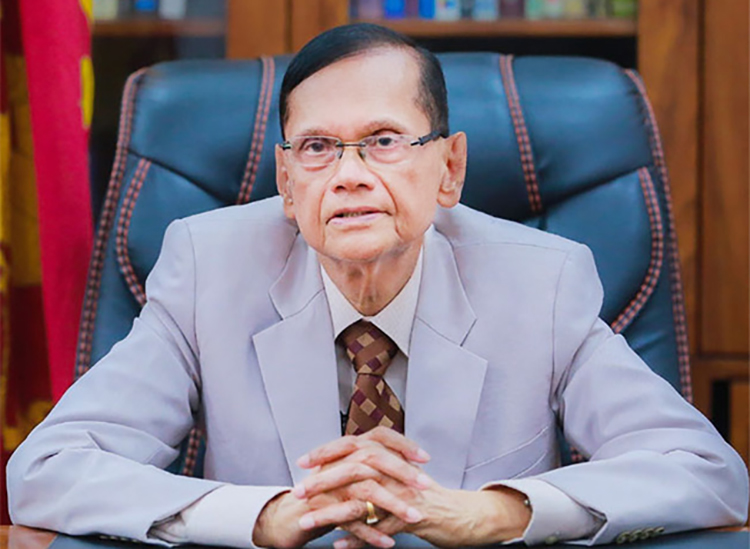
Prof. G. L. Peiris yesterday said he had not been concerned at all about being arrested when the Commission to Investigate Allegations of Bribery or Corruption (CIABOC) summoned him to record a statement regarding an ongoing investigation.
Addressing the media outside the CIABOC, the former External Affairs Minister emphasised that his family had never taken anything from people but contributed to their welfare. The internationally renowned academic said that he didn’t accept lucrative opportunities abroad but remained committed to do whatever possible for the public here.
The CIABOC questioned Prof. Peiris on the launch of the Shangri-La Hotel project here. The Convener of the Janathawadi Joint Opposition said that when the top management of the hotel got in touch with
him, he had brought the matter to the notice of the then President Mahinda Rajapaksa, who promptly gave the go ahead.
Shangri-La was opened in Nov. 2017 with the participation of the then President Maithripala Sirisena and Prime Minister Ranil Wickremesinghe.
Prof. Peiris said that he had been appointed External Affairs Minister nearly a year after the successful conclusion of the war against the LTTE in May 2009. Shangri-La, which owned over 100 hotels at that time, was keen to explore the possibility of opening a hotel here and the government had swiftly grabbed the opportunity. Referring to the opening of ITC Ratnadeepa, in late April 2024, Prof. Peiris explained the importance of foreign investment, particularly after the end of the 30-year war that caused massive devastation.
Responding to media queries, Prof. Peiris said that he strongly opposed efforts to silence political opponents but accepted the need to investigate waste, corruption and irregularities. “People shouldn’t be targeted over their political stand,” the ex-lawmaker said, adding that he as the Minister tasked with attracting such special investments worked in line with the overall government policy.

The Presidential Commission of Inquiry probing alleged irregularities in Sri Lanka’s coal imports and coal-fired power generation has been granted an extension until December 16, 2026, to submit its final report. President Anura Kumara Dissanayake extended the deadline under Section 4 of the Special Presidential Commissions of Inquiry Law, No. 7 of 1978.
The Commission was established on April 17, 2026, by Gazette Extraordinary No. 2484/08. It is chaired by Supreme Court Justice Gihan Kulatunga, with Court of Appeal Justice Aditya Patabendige and High Court Judge Sanjeewa Somaratne serving as members. Former Ministry Secretary P. V. Bandulasena is its secretary.
The inquiry covers the period from the commencement of coal-based power generation in Sri Lanka until April 16, 2026. It is tasked with determining whether irregularities or unlawful acts occurred in importing coal and generating electricity through the state-owned Lanka Coal Company (Pvt) Ltd or its successor entities.
The Commission will examine coal procurement procedures and determine whether the government suffered financial losses. It will also investigate allegations that substandard coal was imported, scrutinising the entire process from procurement and supply to quality testing, power plant operations and coal utilisation.
It must assess whether power plants using imported coal achieved their expected levels of efficiency and investigate any legal, financial or other wrongdoing associated with the use of poor-quality coal.
The inquiry will also establish whether contractual obligations were breached and, if so, whether payments were withheld or other corrective measures taken.
The Commission is required to identify those responsible for any wrongdoing, including political authorities, public officials, Lanka Coal Company officers, suppliers and their representatives, and recommend appropriate action against them.
It will also propose reforms to prevent a recurrence of such irregularities and strengthen governance in coal procurement and power generation. The Commission may investigate any other irregularities it uncovers in these areas during the period under review.

The proposed Prevention of Organised Crime legislation could be used to suppress dissent rather than combat organised crime, Frontline Socialist Party (FSP) Education Secretary Pubudu Jayagoda says..
Addressing a media briefing at the FSP office in Nugegoda, Jayagoda said the Bill, gazetted on October 6, had been presented to Parliament along with other legislation which, he claimed, would expand the State’s powers of repression.
He said the Prevention of Organised Crime Bill, the proposed State Terrorism Bill (PSTB) and the 22nd Amendment should be taken together when assessing the government’s approach to civil liberties.
According to Jayagoda, the Bill’s definition of an “organised criminal group” was broad enough to permit arbitrary interpretation. It defines such a group as a structured group of three or more persons acting together over a period of time to commit one or more serious offences for financial or other material gain.
He said a “serious offence” was defined as an offence carrying a prison sentence of four years or more, with the Schedule including offences such as obstructing a police officer, theft, copyright infringement, unlicensed gambling and certain offences under the Fauna and Flora Protection Ordinance.
Jayagoda also criticised Section 4(2), which he said could permit a person to be identified as a member of a criminal group based on clothing, gestures, language or tattoos allegedly associated with such groups.
He questioned whether young people with long hair or tattoos could consequently face arbitrary arrest and detention.
Jayagoda said the Bill contained several provisions that raised serious concerns about personal liberty. Under Section 20(1), he said, police could detain a suspect for up to 72 hours without producing the person before a Magistrate.
He said Section 21 would permit the Secretary to the Ministry of Public Security or the ministry responsible for police, on a police request, to issue detention orders for periods of two months at a time, up to a maximum of one year.
He further pointed out that Section 23 removed the Magistrate’s power to grant bail to a person arrested under the proposed law, while Section 25 would allow a suspect remanded by court to be kept in isolation at a police station for up to six months.
Jayagoda also alleged that Section 47 effectively reintroduced a provision allowing a confession made by a suspect to police to be used as evidence against that person.
He accused the Government of attempting to create a climate of fear and said the proposed laws should be examined on the basis of their actual provisions rather than their titles.
Referring to a recent Police social media post urging people to “think twice” before speaking, Jayagoda questioned the Government’s commitment to freedom of expression.
He said the FSP would oppose what he described as attempts to suppress public dissent and called on the people to resist such measures.
“Do not judge these Bills by their names or covers. We must examine their real purpose and content,” he said.

GL stresses importance of post-war Shangri-La investment after CIABOC questions him

Coal inquiry gets extension until 16 December

Dilshan, Hirupama named best athletes at All Island Schools Games Athletics Championships

Saudi Vision 2030 offers new economic opportunities for Sri Lanka

The quiet habits behind wealth: Without chasing appearances

Power cuts, low-grade coal and hypocrisy

‘Dates have the highest sugar content to fight Coronavirus’

Sunday Island 27 December – Headlines

#SundayIsland 17th December – Headlines

Sunday Island – 28th March

Sunday Island Headlines – 21 March

Sunday Island – 21st February – Headlines
-

 Features3 days ago
Kotahena:A Small Enclave, An Extraordinary Legacy
-

 News7 days ago
Sri Lanka, India caught in US-Iran ship crisis
-
 News4 days ago
Asgiri Mahanayake calls for immediate release of Gnanasara Thera
-

 News3 days ago
Record 1,600 students take Russian Classical Ballet examination in Sri Lanka
-
 News6 days ago
AC President recuses himself from hearing prison attire case pertaining to Gnanasara Thera
-
 News5 days ago
Naval officer testifies Yoshitha received Rs. 5.15 mn in salaries during SLN service
-

 Latest News7 days ago
Heavy showers above 100 mm are likely at some places in the Western, Sabaragamuwa, Southern, Central, and North-western provinces and in Anuradhapura district.
-

 News3 days ago
Karannagoda pushed for £24,536 for Yoshitha’s UK training, Court told