
News
Police chasing some vital leads into Dutch monk’s death to ‘clear some doubts’

by Suresh Perera
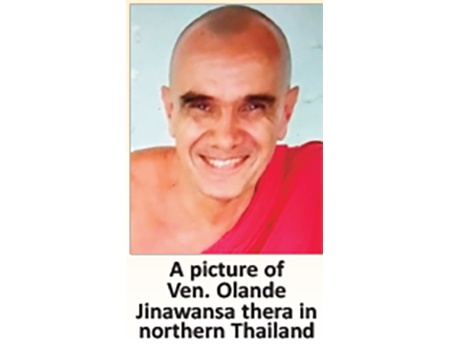
Police investigators are pursuing some important leads to figure out the circumstances which led to the death of the Dutch monk at the Dodanduwa Polgasduwa forest monastery, a high-ranking police official in the region said on Friday.
“Though preliminary investigations suggest the possibility of suicide, we are working on some vital clues to clear some doubts that have emerged”, says Senior DIG Rohan Silva in charge of the Southern province.
“We are probing the case with an open mind”, he noted, while declining to divulge more information on the leads police sleuths are chasing as it will hamper ongoing investigations.
The body of Ven. Olande Jinawansa thera was found floating in the Ratgama lagoon on December 8. At the time the body was fished out, two stones were found tied to the 59-year-old monk’s legs.
The police and the STF searched the island, where the monastery is situated, plus an adjoining island, but nothing suspicious was found, the senior police official said.
Asked about social media reports that the monk had opposed the construction of a hotel in a near-by island as it disturbed the serenity of the monastery, and this may have led to his untimely death, he explained that there was no such hotel being built in the locality.
The Dutch monk was, however, not in favor of a Dharma Salawa that was being built within the precincts of the monastery as he believed there was no need for such a facility as devotees in large numbers did not visit the Aramaya, the senior DIG Silva said.
“He had protested that the din caused by the construction disturbed the meditating monks. Apart from that, there was no hotel being built in the vicinity for the bhikku to have opposed it”, he added.
Earlier, there was a move to build a bridge to link the island but the idea was dropped as it didn’t find favor with the monks at the monastery, he further said.
“We also inspected the monk’s kutiya (small hut), where he meditated, but there was nothing amiss”, he continued.
The Government Analyst visited the scene and also examined the knots on the rope with which the stones were found tied to the monk’s legs.
The autopsy revealed that there was no water or sand in the prelate’s lungs, which indicated that he had been alive at the time he was in the lagoon. This raised the possibility of the monk taking his own life, he said.
An open verdict was returned at the magisterial inquiry into his death.
Senior DIG Silva said that body parts have been sent to the Government Analyst for examination to ascertain, amongst other factors, whether the monk was poisoned.
He said the Dutch monk, who settled in Sri Lanka 12 years ago, was basically a loner. He kept to himself and went on pindapatha alone. As a lover of animals, he set aside a part of the alms he received to feed them. He even reared a young injured animal in his Kutiya.
Asked whether any arrests have been made or are imminent, the senior police official replied, “it depends on the outcome of the continuing investigations. We need to clear some existing doubts surrounding the prelate’s death”.
Meanwhile, a close associate, who now lives in New Zealand, said the Dutch monk was residing in northern Thailand and left for Sri Lanka in 2008.
“I was very close to Ven. Tone Jinawamso thera, as he was known there”, he said.
Requesting anonymity, he told The Sunday Island from Auckland that as a well established monk, who had even translated a Thai Buddhist publication into English, he didn’t see any reason why the prelate should commit suicide.
“As a bhikku very close to me, I can assure you that he was content with the simple, uncomplicated life he led and would have never contemplated suicide”, he asserted.
The Dutch monk’s death is suspicious, he claimed. “The police should get to the bottom of it”.

News
Cabinet nod to increase the number of new automated passenger clearance gates at the Bandaranayake International Airport to 12

Approval of the Cabinet of Ministers was granted at their meeting held on 19.05.2025 to purchase four (04) automated passenger clearance gates for Bandaranayake International Airport.
In addition, it is expected to extend the automated passenger clearance gates facility so far given only to the Sri Lankans
parallel to the e – passport issuance system to be introduced in the year 2027 also to the foreigners who travel to and from this country.
Furthermore, considering also the number of air passengers rapidly increasing with the fast – forwarding business and tourism field, the appropriateness to increase the total automated passenger clearance gates up to twelve (12) in number has been recognized.
Accordingly, the Cabinet of Ministers, approved the resolution furnished by the Minister of Public Security and Parliamentary Affairs to initiate the procurement and installation of 12
automated passenger clearance gates altogether with the already approved four (04) and another eight (08) automated passenger clearance gates adhering to the formal procurement procedure
Based on the observations submitted by the Task Force on Prevention of Money Laundering and Financing for Terrorism, approval of the Cabinet of Ministers was granted at their meeting held on 18.12.2024 to amend the Trust Ordinance No. 9 of 1917 including amendments proposed by the Financial
Intelligence Unit of the Central Bank of Sri Lanka.
Accordingly, clearance of the Attorney General has been granted for the Trust (Amendment) Draft Bill formulated by the Legal Draftsman.
Therefore, the Cabinet of Ministers approved the resolution furnished by the Minister of Justice and National Integration
to publish the said draft bill in the government gazette notification and thereby, submit the same to the Parliament for its concurrence.
Action was taken to provide a fuel relief for the fuel consumers during the months of April, May and June of 2026 to redress by minimizing the impact caused to the day today life of the citizens of this country as well as the entire economy due to the price hike of petroleum fuel in the global market resulting from the war situation in the Middle East.
Government mediation is essential for minimizing the impact on the day to today life of citizens in this country due to that war situation not being ended further. Therefore, it has been planned to redress on the sale price for Auto Diesel and Industrial Diesel for a period of 03 months by the Government to provide relief to the public as well as to maintain the prices at a bearable level to the consumers without escalating the fuel prices in this country compared to the escalation of fuel prices
in the international market.
Therefore, the Cabinet of Ministers granted approval for the resolution furnished by the President in his capacity as the Minister of Finance, Planning and Economic Development to
allocate provisions subject to the monthly limitations respectively as rupees 15 billion for the month of October, rupees 13.5 billion for the month of November and rupees 12.15 billion for the month of December to provide the said relief

Cabinet nod to increase the number of new automated passenger clearance gates at the Bandaranayake International Airport to 12
Draft Bill for amending the Trust Ordinance
Implementing further relief programme to Public sffected by the Middle East conflict situation
Establishment of a Spectrum Management and Monitoring System and a Quality of Service and Quality of Experience System for the Telecommunications Regulatory Commission of Sri Lanka
Appointment of a Committee for the Restitution of Sri Lankan Cultural Heritage Held Abroad
Ten-Year National Action Plan on the Social Protection Sector (2026–2035)

‘Dates have the highest sugar content to fight Coronavirus’

Sunday Island 27 December – Headlines

#SundayIsland 17th December – Headlines

Sunday Island – 28th March

Sunday Island Headlines – 21 March

Sunday Island – 21st February – Headlines
-

 News7 days ago
Mastermind Naufer Moulavi among 15 found guilty
-
 Midweek Review7 days ago
Thileepan’s fast unto death: An authentic narrative that many missed
-

 Latest News6 days ago
Showers above 100 mm are likely at some places in the Western, Sabaragamuwa, Central and North-western provinces and in Galle and Matara Districts
-

 Editorial7 days ago
Big Bad Bills
-
Editorial6 days ago
Crimes punished and unpunished
-

 Features5 days ago
Beyond traditional jobs: Why Sri Lanka needs to facilitate the gig economy
-

 News7 days ago
One clause in Anti-Corruption (Amendment) Bill requires referendu: SC
-

 News7 days ago
No referendum needed for passage of 22 A: SC