
Business
Visa sees 35%+ surge in debit card spends; trend expected to continue in the upcoming Avurudu season


Out of the total domestic spends on debit cards, the share of in-store spending is 7 times that of ecommerce.
Last holiday season saw over 20% growth in Visa debit transactions vis-à-vis 2022
Visa (NYSE: V), the global leader in digital payments, today announced that Visa debit card spends saw a significant increase of over 35% in the past year, indicating healthy growth of digital payments in Sri Lanka. This increase is buoyed by a 30%+ increase in face-to-face spends and over 40% increase in ecommerce spends.
As the Tamil & Sinhala New Year celebrations commence in the country, retail transactions are picking up with more active shoppers during the festive period. Consumers are increasingly paying by debit card, opting for safer, simpler and more convenient transactions.
Avanthi Colombage, Country Manager – Sri Lanka and Maldives said, “We are excited to see the jump in debit card usage by consumers in Sri Lanka lately. While this is skewed towards in-store spends, ecommerce growth too has been heartening and we expect this momentum to continue during the Sinhala and Tamil New Year. We also saw a robust over 35% growth in debit spends in 2023 over 2022, in the year-ending holiday season. This festive season too, we believe cardholders will gravitate towards secure and faster ways to pay like tapping or dipping their cards. We have also been working closely with our issuing and acquiring partners to boost card usage and its acceptance, so that consumers can use their Visa cards anytime anywhere – conveniently, easily and safely.”
Recent data by Visa Consulting & Analytics shows that Visa debit cards have largely been used at face-to-face or ‘in-store’ channels like merchant outlets and shops. Proportion of instore spend of the overall domestic debit card usage is 7 times of what is spent on ecommerce. The top in-store categories where consumers shopped have been Food and Grocery, Apparel, Fuel and Restaurants. Ecommerce spending was mostly for telecom and utility services, education, government payments and insurance.
Avanthi Colombage points out, “This indicates the rising usage of debit cards, one of the most familiar, simple and quick ways to pay digitally. Geographically, we saw urban centres such as Colombo and Gampaha recording over 50% of in-store transactions. We are working with partners to create regional roadshows beyond the western province to increase awareness of debit cards among consumers and merchants.”
This increase in debit card usage among Sri Lankans is seen in many developing countries as more consumers are opting for a seamless and secure payment experience with cards vis-à-vis using cash.
With the promising growth in tourism as well, digital transactions by tourists also played an important role in increased spends. Compared to 2022, Visa data shows that the share of tourism in total cross-border spends during the holiday season grew by 15 percentage points. In terms of volume and value both, tourism-related spends have increased by over 100% on Visa credentials”, confirms Avanthi Colombage.
Visa further shared that over 50% of tourism-related spends in Sri Lanka came from the USA, India, UK, UAE and Australia. Tourists have spent largely on lodging and retail goods, which contributed to over 60% of tourism spends during the holiday season.
“We are committed towards raising awareness of the benefits of using debit cards for safety and ease of use” says Avanthi Colombage. Visa has tied up with its clients and conducted awareness initiatives for merchants on debit cards, as well as promotional activities, cash back offers and discounts for Visa cardholders. It is also focusing on increasing the acceptance of Visa cards and digital transactions across Sri Lanka.









The SLT Group reported a massive turnaround in profitability as of December 2024, driven by strong operational performance and successful cost optimization across fixed and mobile segments, with momentum accelerating steadily during the year.
The Group recorded a Profit after Tax (PAT) of Rs. 3.1 billion for 2024, compared to a loss of Rs. 3.9 billion in 2023, representing a substantial turnaround of Rs. 7 billion. Annual revenue for the Group in 2024 grew by 4.4% to Rs. 111.1 billion, with Gross Profit showing robust growth of 19.6% to reach Rs. 46.1 billion.
The Group’s focus on operational efficiency resulted in a 4% reduction in operating expenses to Rs. 71.2 billion, contributing to a 23.7% improvement in EBITDA to Rs. 40 billion, and a considerable 172.8% increase in operating profit to Rs. 11.2 billion. Finance costs were also reduced by 20.5% to Rs. 9 billion, supporting the Group’s outstanding turnaround.
SLT Group demonstrated strong financial performance with robust results in the fourth quarter. Revenue reached Rs. 29.1 billion, showing impressive growth of 11.9% compared to Q4 2023 and maintaining momentum with 1.8% sequential growth from Q3 2024. The quarter saw important improvements across key metrics for the Group, with gross profit rising to Rs. 12.9 billion, up 50% year-on-year, EBITDA growing to Rs. 11.5 billion, an increase of 28.9%, and operating profit more than doubling to Rs. 4 billion.
SLT Group’s Q4 2024 also delivered a notable PAT of Rs. 2.4 billion, representing a significant improvement from the Rs. 1.1 billion in Q3 2024, a 115% growth and an even more dramatic turnaround from the loss of Rs. 1.2 billion in Q4 2023. The quarterly performance contributed to a strong finish for the year, showcasing the success of the Group’s strategic initiatives in operational efficiency and cost management.
SLT Group remained a key contributor to the state revenues, delivering a total of Rs. 31.5 billion to the Government of Sri Lanka (GoSL) as taxes and levies during the year 2024.
At company level, SLT delivered steady growth as of December 2024 with an increase of revenue by 2.3% to Rs. 71.3 billion. The company’s broadband segment grew by 5.4%, led by FTTH services, while enterprise revenue surged by 11.8%. Government sector and SME segments showed strong growth of 11.0% and 23.6% respectively. Cost optimization efforts yielded considerable results, with a 2.2% reduction in operating expenses, including notable savings in AMC costs and internet backbone charges. The company reported a net profit of Rs. 2.1 billion for the FY 2024.
SLT delivered a strong performance in the fourth quarter of 2024, with revenue reaching to Rs. 18.3 billion, representing a 3.9% increase compared to Q4 2023. The growth was primarily driven by multiple revenue streams, with broadband revenue increasing by 10.2%, led by FTTH services. The Enterprise sector revenue grew by 11%, supported by increased earnings from networking, Internet, and managed services. The government sector showed impressive growth of 14.3%, while the SME sector revenue rose by 20.9%.
During the quarter, the company’s operational efficiency improved significantly, with operating profit growing by 17% to Rs. 1.8 billion, supported by effective cost management and a 4.6% reduction in depreciation. As a result, SLT recorded a net profit of Rs. 909 million for Q4 2024.
The Group’s mobile segment, Mobitel, achieved a significant turnaround in 2024, with revenue growing 7.4% to Rs. 45.8 billion compared to 2023, driven by broadband growth. EBITDA margin improved significantly to 30%, up 9 percentage points from 2023, reflecting both revenue growth and successful cost optimization strategies, further supported by a 4.9% reduction in operating costs through targeted optimizations across all functions including marketing, distribution and admin.
Mobitel reversed its operating loss, recording an operating profit of Rs. 2.9 billion in 2024 and achieving a positive net profit of Rs. 0.1 billion compared to Rs. 3.7 billion losses in 2023.
During Q4 2024, Mobitel delivered exceptional results with revenue growing 14.3% year-on-year to Rs. 12.3 billion. EBITDA rose by 137.1% to Rs. 4.6 billion, with margin improving to 37%. Operating profit showed substantial growth of 478% year-on-year to Rs. 1.8 billion, while net profit reached Rs. 1.2 billion, a 191.8% improvement. The quarter demonstrated strong momentum with 12.5% reduction in operating costs and continued improvement across all key metrics.
By Hiran H Senewiratne
The stock market yesterday remained positive despite seeing low level investor participation and below average turnover as investors continued to be concerned over IMF review projections that are to be released in the near future, market analysts said.
Amid those developments both indices moved upwards. The All Share Price Index went up by 76.79 points while the S and P SL20 rose by 42.2 points.
Turnover stood at Rs 1.7 billion with two crossings. Those crossings were reported in Commercial Bank, which crossed 650,000 shares to the tune of Rs 95.5 million and Sampath Bank 500,000 shares crossed to the tune of Rs 61 million; its shares traded at Rs 122.
In the retail market top six companies that mainly contributed to the turnover were; Sampath Bank Rs 214 million (1.9 million shares traded), HNB Rs 168 million (521,000 shares traded), Hemas Holdings Rs 76.7 million (650,000 shares traded), JKH Rs 75.6 million (3.5 million shares traded), Dialog Rs 64.1 million (447,000 shares traded) and HNTB Rs 69.9 million (316,000 shares traded). During the day 58.89 million shares volumes changed hands in 12000 transactions.
It is said that the banking sector was the main contributor to the turnover, especially Sampath Bank, while the manufacturing sector was the second largest contributor to the turnover.
Yesterday, Sri Lanka’s rupee was quoted at Rs 295.40/50 to the US dollar in the spot market, from Rs 295.40/70 Thursday, dealers said, while bond yields were slightly up.
A bond maturing on 15.03.2028 was quoted at 10.02/08 percent.
A bond maturing on 01.07.2028 was quoted at 10.20/25 percent.
A bond maturing on 15.10.2028 was quoted at 10.32/37 percent.
A bond maturing on 15.09.2029 was quoted at 10.70/75 percent.
Business
Sri Lanka strengthens protection for local products with launch of Geographical Indications Registry
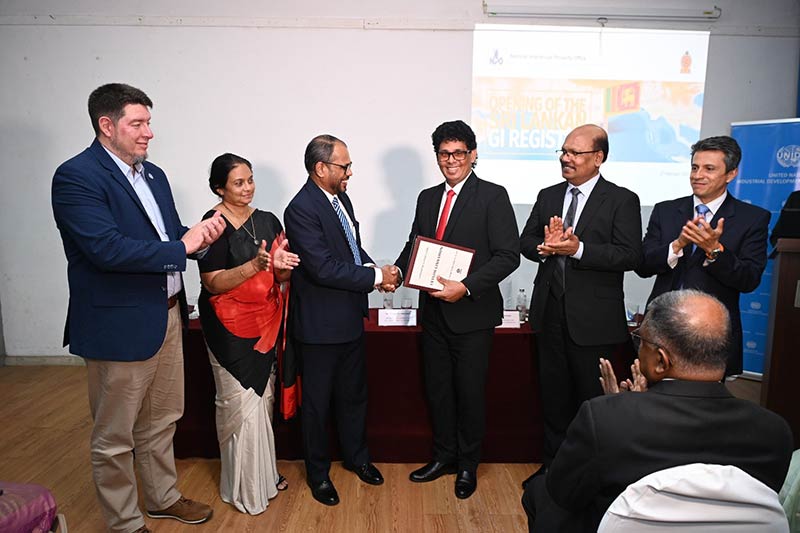
The National Intellectual Property Office (NIPO), under the patronage of the Ministry of Trade, Commerce, Food Security, and Co-operative Development, officially opened the Local Geographical Indications (GI) Registry, a landmark initiative to safeguard Sri Lanka’s unique local products and enhance their global marketability.
The registry, formally declared open on 27 February 2025, marks a significant milestone in strengthening intellectual property rights in the country. By providing legal protection for products linked to a specific geographic origin, the initiative aims to preserve authenticity and increase the commercial value of Sri Lanka’s renowned goods, such as Ceylon Cinnamon and Ceylon Tea. Prior to this, local products lacked domestic legal safeguards, even if they had obtained international recognition, such as Ceylon Cinnamon’s European Union GI status.
Wasantha Samarasinghe, Minister of Trade, Commerce, Food Security, and Co-operative Development, emphasized the significance of the initiative, stating: “Opening the Local GI Registry is a crucial first step towards protecting Sri Lanka’s geographic advantage, enhancing market access, and contributing to the economic empowerment of local communities. We acknowledge the contribution made by the European Union (EU) and the United Nations Industrial Development Organization (UNIDO), which have been working together since 2017 with the Ministry and the government to advance this initiative.”


JMSDF ASAHI arrives at port of Colombo

Three dead as ‘brutal’ cyclone sweeps through Reunion

CPC Chairman explains cause for fuel issue, but queues continue


-

 Business5 days ago
Sri Lanka’s 1st Culinary Studio opened by The Hungryislander
-

 Sports6 days ago
How Sri Lanka fumbled their Champions Trophy spot
-

 Features6 days ago
The Murder of a Journalist
-

 Sports6 days ago
Mahinda earn long awaited Tier ‘A’ promotion
-

 Features6 days ago
Excellent Budget by AKD, NPP Inexperience is the Government’s Enemy
-

 Sports5 days ago
Air Force Rugby on the path to its glorious past
-

 News6 days ago
Sri Lanka’s first ever “Water Battery”
-

 Features5 days ago
Rani’s struggle and plight of many mothers