
Business
Aitken Spence wins Best Corporate Citizen Sustainability Awards for Diversified and Best Presentation

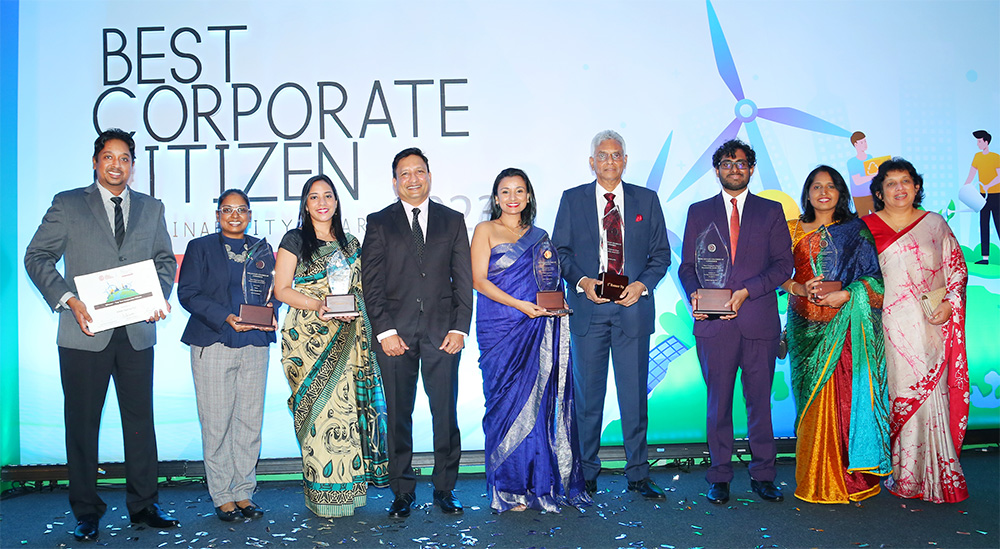
Aitken Spence emerged overall first runner up at the Best Corporate Citizen Sustainability Awards 2023 organised by the Ceylon Chamber of Commerce. The company also walked away with multiple awards from the main categories. Aitken Spence was also the winner in the Diversified Holdings category and for the Best Presented Application. The latter is a noteworthy accomplishment considering their application was developed entirely with in-house capacity.
Aitken Spence is the only company recognised for the 18th consecutive year among the Top 10 Corporate Citizens and is the 9th occasion that Aitken Spence has been ranked among the Top 3. These achievements demonstrate the comprehensive and consistent efforts of the Group within their sustainability strategy. The leadership and their teams have shown unwavering commitment to sustainability, even in the face of significant challenges.














Organizations should act now to stay ahead of new regulations
SRI LANKAN EXPORTERS targeting the European Union are being urged to prepare immediately for sweeping new sustainability regulations that will fundamentally change how businesses market products, manage supply chains and demonstrate environmental and social responsibility.
Beginning September 27, 2026, companies selling goods and services into the EU will face tougher scrutiny under the Empowering Consumers for the Green Transition Directive (EmpCo), which is designed to eliminate misleading environmental claims commonly known as “greenwashing.”
Businesses found making unsubstantiated sustainability claims could face penalties of up to €2 million or 4% of annual turnover in the relevant EU member state, together with reputational damage and possible restrictions on market access.
According to Peterson Solutions Sri Lanka, many exporters remain unaware that the new rules extend well beyond product labels, applying equally to websites, social media, advertisements, sustainability reports and other promotional material carrying environmental claims.
“The era of simply saying a product is ‘green’, ‘eco-friendly’ or ‘sustainably produced’ is coming to an end,” said Dr. Rukshan Gunatilaka (PhD), Asia Pacific Regional Manager of Peterson Solutions Sri Lanka. “Businesses must now be able to produce credible evidence supporting every sustainability claim they make. Compliance is no longer just a regulatory obligation. It’s becoming an absolute necessity for access to EU markets.”
He said sustainability has evolved from a voluntary corporate initiative into a core business requirement as governments, investors and consumers increasingly demand transparency and accountability throughout global supply chains.
“Doing business and protecting the planet can no longer be treated as separate objectives,” Dr. Gunatilaka said. “Environmental, social and governance performance now has a direct impact on a company’s reputation, shareholder value and long-term commercial success. Companies that fail to address these issues risk losing both customers and market confidence.”
The EU’s regulatory reforms form part of a broader shift towards more responsible global trade. Besides EmpCo, exporters must also prepare for the Packaging and Packaging Waste Regulation (PPWR), which begins applying from August 12, 2026, with further requirements phased in through 2030, and the EU Deforestation Regulation (EUDR), whose due diligence obligations take effect for larger companies on December 30, 2026.
The regulations affect a wide range of Sri Lankan export sectors, including food and agriculture, tea, spices, rubber products, apparel and textiles, fisheries, plastics, tourism-related products and even certain service industries supplying European clients.
Peterson Solutions says one of the biggest misconceptions among businesses is that these regulations apply only to European companies. In reality, any organization exporting to Europe, or making sustainability claims reaching European consumers, may be required to demonstrate compliance.
“The European market remains one of Sri Lanka’s most valuable export destinations,” Dr. Gunatilaka said. “Companies that prepare early will not only avoid regulatory risks but also strengthen customer trust, improve competitiveness and position themselves for long-term growth.”
Dulini Wijeratne, Assistant Manager – Business Communications and Marketing at Peterson Solutions Sri Lanka said, “Businesses should view compliance as a strategic investment rather than merely an additional cost.”
“Many established exporters already regard sustainability compliance as an essential part of doing business in Europe,” she said. “Companies planning to enter the EU market are also beginning preparations early because they recognize that robust sustainability systems create long-term commercial advantages.”
Part of the Netherlands-headquartered PCU group, established in 1920, the company operates in more than 80 countries, delivers projects across 120 countries and serves a global client base exceeding 40,000 clients.
Peterson Solutions provides certification support, sustainability consulting, responsible sourcing, supply chain traceability, ESG advisory services, academy solutions and technology-based solutions. Its digital platforms help organizations monitor carbon emissions, manage ESG performance, strengthen due diligence systems and maintain documentation required for increasingly complex international regulations.
In Sri Lanka, Peterson Solutions works across food and agriculture, apparel, plastics, rubber manufacturing, fisheries, aquaculture, tourism and other export-oriented industries. It also supports clients in Cambodia, Myanmar and the Maldives.
The company advises organizations to begin reviewing their sustainability communications, supply chains and governance systems now, rather than waiting until regulatory deadlines approach.
“The question regulators, investors and consumers are increasingly asking is no longer whether a company has sustainability ambitions,” Dulini Wijeratne said. “The question is: Can you prove it?”
To support organizations preparing for these evolving requirements, Peterson Solutions Sri Lanka will conduct a complimentary webinar titled “ESG Reporting Basics: Why, When & How” on 29 July 2026 from 3.30 p.m. to 4.30 p.m. (Sri Lanka Time).
Interested participants may register at: https://app.livestorm.co/peterson-solutions/esg-reporting-basics-why-when-and-how
Many organizations understand that sustainability is becoming important but are often unsure where to begin. The webinar is designed to provide practical guidance and help businesses take their first steps towards effective ESG reporting,” said Dulini Wijeratne.
Peterson Solutions Sri Lanka said businesses seeking to understand how the evolving EU sustainability framework may affect their operations can obtain guidance on compliance requirements, risk assessments, supply chain traceability, ESG implementation and evidence-based sustainability reporting.

TikTok announced a new set of initiatives to help people better identify and understand AI-generated content on the platform to ensure that they have a safe digital experience. As generative AI continues to transform how content is created and shared, the company is expanding its efforts to promote transparency through new educational resources, enhanced spam detection, and deeper collaboration with industry partners.
As AI unlocks new opportunities for creativity and self-expression, TikTok continues to invest in the tools, partnerships, and safeguards that help people confidently navigate AI-powered experiences while supporting authentic content and creator trust.
Helping people make informed decisions starts with education. To strengthen AI literacy, TikTok has partnered with the News & Media Literacy Alliance (NAMLE) and renowned deepfake researcher Henry Ajder to develop a practical guide that helps people better understand AI technologies, recognize AI-generated content, and use AI tools responsibly. In the coming weeks, TikTok will be launching an in-app AI literacy hub in Sri Lanka, providing educational resources whenever users search for AI-related topics. The hub will offer practical guidance on identifying AI-generated content and navigating AI-powered experiences with greater confidence.
“We believe people should have context, confidence and control over their experiences with AI on TikTok. We continue to invest in technologies, partnerships and educational resources that help people spot AI-generated content, understand how it’s created, and use these tools creatively and responsibly,” said Tom Varghese, AI Lead for TikTok’s Global Public Policy team.
TikTok is also continuing to invest in trusted organizations that promote AI literacy. Since launching the initiative in November 2025, partners including No Filtr and Raspberry Pi have produced educational content that has collectively generated more than 200 million views. TikTok has committed over US$4 million to the program to date and will continue expanding its investment to reach more communities worldwide.
Business
Sri Lankan gemological scientist innovates ‘one of world’s most powerful’ gem analysis microscopes


A Sri Lankan gemological scientist has unveiled a high-magnification digital microscope designed to enhance analysis speed and reveal internal features far beyond the reach of conventional dimensions. The innovator believes this innovation could strengthen transparency throughout the country’s gem and jewellery industry. Milinda Edirisinghe, founder of the Gemological Report of Ceylon (GRC) laboratory in Colombo, said the microscope is the result of two years of research and development to overcome the optical limitations of conventional gemological microscopes.
According to Edirisinghe, the new system consists of four digital microscope models capable of magnifications of 450x, 600x, 1000x, and 1440x, allowing gemologists to examine microscopic internal features, or inclusions, with substantially greater clarity than conventional laboratory equipment. These models are named by Edirisinghe as the Don Berry 450x, Don Berry 600x, Don Berry 3rd Eye 1000x, and Don Berry 3rd Eye 1440x.

Milinda Edirisinghe
“The biggest limitation in gemology has always been what the microscope could actually reveal,” Edirisinghe said in an interview. “Simply increasing magnification was not enough. Many internal features remained difficult to observe clearly, forcing laboratories to rely on indirect analytical techniques and expert interpretation.”
He further stated that these advanced microscopes will reveal many previously undiscovered aspects of gemology to the world. Gemological laboratories routinely use advanced analytical methods such as Fourier Transform Infrared (FTIR) spectroscopy, Raman spectroscopy and other spectroscopic techniques to identify gemstones, determine treatments and analyse internal characteristics that cannot easily be resolved through optical examination alone. Edirisinghe said this innovation enables much clearer visual observation of inclusions, crystal structures and other internal characteristics.
One of the other significant benefits, he said, is the ability to dramatically reduce examination time, as the system’s ultra-high magnification and exceptionally clear images allow gemologists to swiftly analyze stones and identify internal inclusions.
“Microscopic examination of a single gemstone could previously take anywhere from 2-3 minutes to few hours, often hampered by poor vision and forcing us to guess the inclusion type most of the time,” he said. “With the new system, a complete examination can often be completed in less than a minute.”
The microscope incorporates high-resolution digital imaging, allowing photographs and video recordings of internal gemstone features to be captured, archived and incorporated into laboratory reports. Edirisinghe said the digital records also improve traceability and provide permanent documentation for future references. The system is also designed to integrate artificial intelligence-assisted image analysis. It captures exceptionally clear, ultra-high-quality images of inclusion structures, which are fed into the AI system to be precisely tallied and matched with existing images. According to Edirisinghe, the AI software compares these captured inclusion patterns with an expanding database of reference images to assist gemologists in identifying mineral inclusions and geological characteristics associated with particular gemstone types and origins.
Edirisinghe believes the technology could have implications beyond laboratory testing. More detailed identification of internal features may enable jewellery manufacturers to classify gemstones with greater confidence, improve quality assurance and adopt more transparent pricing strategies for premium jewellery, he said. He also says that improved documentation could increase consumer confidence by providing more comprehensive certification of high-value gemstones and diamonds.
According to Edirisinghe, most gemological laboratories in Sri Lanka currently use microscopes offering optical magnification ranging from around 90x to 180x, although microscope configurations and capabilities vary between laboratories. His new system combines optical and digital technologies to achieve higher effective magnification while simultaneously capturing digital images.
As a veteran gemological scientist with over two decades of experience in gemstone mining, trading and geological research, Edirisinghe said he developed the microscope using specially imported Japanese optical components after numerous prototype modifications. He has also collaborated with gemological laboratories in Thailand during his research.
He said the newly established GRC laboratory aims to raise the standard of gem certification in Sri Lanka by combining advanced microscopy, digital documentation and AI-supported analysis to produce more detailed laboratory reports.
Edirisinghe invites gemologists, jewellers, exporters and researchers to evaluate the technology through live demonstrations, saying independent assessment by industry professionals will ultimately determine its value to the sector.

Showers will occur in the Western, Sabaragamuwa and North-western provinces and in Kandy, Nuwara-Eliya, Galle and Matara districts

Merchant Shipping Secretariat probes bribery scandal

Theft of USD 2.5 mn: Dinana Dakuna claims COPF trying to protect mastermind

COPF chief slams security sticker scam

CAA urged to protect soap users

Man who resisted search shot and arrested

‘Dates have the highest sugar content to fight Coronavirus’

Sunday Island 27 December – Headlines

#SundayIsland 17th December – Headlines

Sunday Island – 28th March

Sunday Island Headlines – 21 March

Sunday Island – 21st February – Headlines
-

 Business1 day ago
‘Giving up was never an option’: The fisherman who fought back after losing millions in SL
-

 Features1 day ago
Two memorable excerpts from a former SLAF commander’s memoir
-

 Latest News2 days ago
Davis cup Asia/Oceania Group IV 2026 to be held in Colombo from 20th to 25th July
-

 Features1 day ago
Erdoğan’s New Republic
-

 Life style1 day ago
Taste of the Swiss Alps comes to Colombo
-
 Features5 days ago
Dirty Money
-

 News2 days ago
Dengue outbreak gallops ahead: Infections surpasses 73,455, leaving 50 dead
-

 News2 days ago
Evidence recorded in money laundering case against Yoshitha Rajapaksa