
News
Prez champions digital infrastructure for Lanka’s economic renaissance


By Harischandra Gunaratna
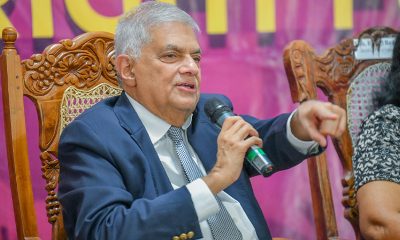
President Ranil Wickremesinghe recently delivering the keynote address at the Digital Public Infrastructure Conference organized by the Indian High Commission in Colombo at the Taj Samudra Hotel, underscored the importance of digital infrastructure in modernizing agriculture, addressing multi-dimensional poverty and reforming the education system.
Wickremesinghe characterized the country’s economy as a ‘patchwork economy’ calling it a symphony of desperate elements stitched together.
Acknowledging the importance of digitization, the President highlighted the significance of discussions on the digital public economy whilst outlining the government’s plans to establish a new institutional framework to facilitate this transition, moving away from the existing structures such as IT Councils and focusing on creating a Digital Transformation Agency and AI Centre, allocated with a budget of one billion rupees. He said the agency would be building a robust economy, departing from the previous approaches which failed to yield the desired results.
The President expressed gratitude to the Indian government for its support, in advancing Sri Lanka’s digital economy, highlighting plants to collaborate with Indian institutions and leverage their expertise, particularly establishing a campus of the Chennai Indian Institute of Technology(IIT) and additionally planning to launch three universities, two of which will focus on technology.
Indian High Commissioner to Sri Lanka Santosh Jha in his welcome address said India’s own journey stands as testimony to the power of Digital Public Infrastructure (DPI). The digital transformation in India over the last decade or so has been driven by these inter operable and open protocols of DPI.
The High Commissioner said that India’s DPI journey started with the basic need to provide direct access to public services and Government benefits to its citizen.
“This what gave birth to India’s Digital Identity Number AADHAAR- and the Unique Identification Authority of India in 2016. This became the foundational building block of DPI and the magic began.
At the heart of this magic is what we call India Stack: – government-backed APIs, or Application Programming Interfaces, upon which third parties can build software with access to government IDs, payment networks and data Jha said.
This digital infrastructure in inter operable and “stacked together – meaning that private private companies can build apps integrated with state services to provide consumers with seamless access to everything from welfare payments to loan applications and making investments, the High Commissioner stressed.
“Probably even the architects of of AADHAAR didn’t envisage that India was on path to finding a world-beating solution for building out and regulating the online commons that is more equitable than laissez-fare approach, more transparent and more innovative than some of the regulation-heavy models.” he said.









Latest News
Heat Index at Caution Level in the Northern, North-central, Eastern, Sabaragamuwa and North-western provinces and in Colombo, Gampaha, Hambantota and Monaragala districts during the day time

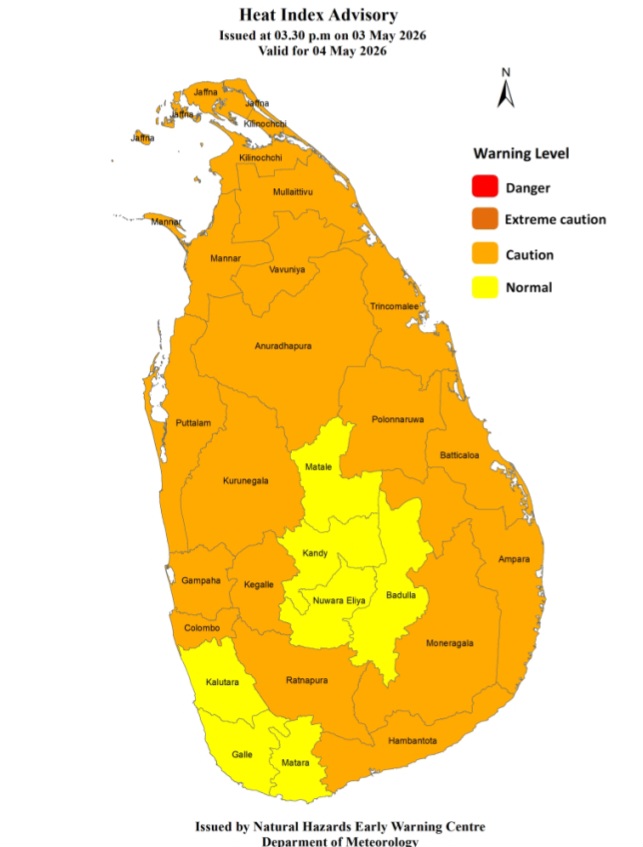
Warm Weather Advisory
Issued by the Natural Hazards Early Warning Centre
Issued at 3.30 p.m. on 03 May 2026, valid for 04 May 2026.
The Heat index, the temperature felt on human body is likely to increase up to ‘Caution level’ at some places in the Northern, North-central, Eastern, Sabaragamuwa and North-western provinces and in Colombo, Gampaha, Hambantota and Monaragala districts during the day time.
The Heat Index Forecast is calculated by using relative humidity and maximum temperature and this is the condition that is felt on your body. This is not the forecast of maximum temperature. It is generated by the Department of Meteorology for the next day period and prepared by using global numerical weather prediction model data.

Effect of the heat index on the human body is mentioned in the above table and it is prepared on the advice of the Ministry of Health and Indigenous Medical Services.
ACTION REQUIRED
Job sites: Stay hydrated and takes breaks in the shade as often as possible.
Indoors: Check up on the elderly and the sick.
Vehicles: Never leave children unattended.
Outdoors: Limit strenuous outdoor activities, find shade and stay hydrated.
Dress: Wear lightweight and white or light-colored clothing.
Note:
In addition, please refer to advisories issued by the Disaster Preparedness & Response Division, Ministry of Health in this regard as well. For further clarifications please contact 011-7446491.
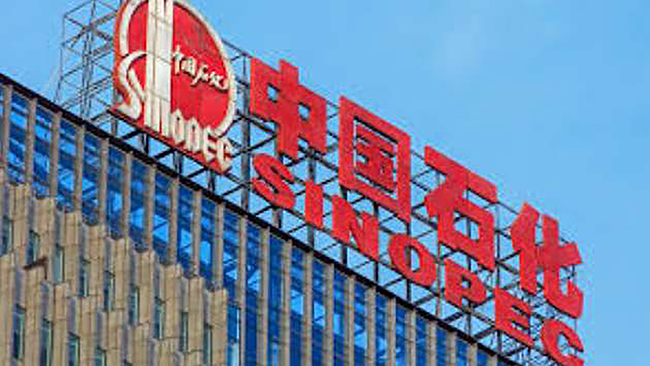
China has declared that China Petroleum and Chemical Corporation (SINOPEC) will not proceed with the USD 3.7 bn Hambantota oil refinery project unless a consensus could be reached on the percentage of the output that could be sold in the local market.
China has informed the NPP government that SINOPECwill not be able to sustain the project in terms of the original agreement that stipulated that 80% of the output be exported and 20 % sold in the Sri Lankan market, according to sources familiar with the issue.
Once fully operational, the strategic facility will be able to process 200,000 barrels of crude oil a day. The proposed facility, together with the Hambantota International port, which was taken over by China in 2017 on a 99-year lease, emphasise significant Chinese presence in the country.
SINOPEC with about 12% market share is among the foreign companies engaged in fuel distribution in Sri Lanka at the moment. Other foreign players are Lanka India Oil Company (LIOC) and joint venture by Shell Brands International AG (Shell) and RM Parks (Private) Limited, the latter being the latest entrant.
LIOC entered the market way back in 2003 during Ranil Wickremesinghe’s tenure as the Prime Minister. LIOC holds the second biggest market share with 211 fuel stations with SINOPEC being third and joint Shell Brands International AG (Shell) and RM Parks (Private) Limited in fourth place. CPC remains the market leader with some 800 odd fuel stations countrywide.
Sources said that whatever the Chinese and Sri Lankan government representatives said in public the launch of the project primarily would depend on a new formula. The Island learns that the Chinese expect to sell 30% of the output here. “The Chinese are of the view that 20% share is not sufficient to sustain the project,” sources said.
Sri Lanka and China in January 2025 announced plans for the SINOPEC project dubbed the largest single Chinese direct investment here following President Anura Kumara Dissanayake’s three-day state visit to Beijing. Dissanayake’s delegation included Minister of Foreign Affairs, Employment and Tourism Vijitha Herath, Minister of Transport, Highways, Ports and Civil Aviation Bimal Rathnayake, and Sri Lankan Ambassador to China, Majintha Jayesinghe. Outspoken Chinese Ambassador to Sri Lanka Qi Zhenhong was also present at all key meetings with representatives of China Petrochemical Corporation (SINOPEC Group), China Communications Construction Company Ltd (CCCC), China Merchants Group (CMG), Huawei, and BYD Auto, a leading company in the automobile manufacturing sector.
Pointing out that Sri Lanka and China hadn’t been able to resolve the knotty problem for about 15 months, sources said that Sri Lanka was also under pressure from India to expedite the Trincomalee oil tank farm development project. Sri Lanka finalized an agreement with India and United Arab Emirates (UAE) in early April 2025 to develop Trincomalee as an energy hub.
Sources said that in line with the overall plans involving China as well as India-UAE, Sri Lanka was required to enhance the fuel storage facilities as soon as possible. The ongoing West Asia conflict underscored the responsibility on the part of the incumbent dispensation to take tangible measures to enhance storage facilities.
The Trincomalee and Hambantota projects could be on a collision course, sources said. The likelihood of Indo-Lanka agreements in respect of WW two era oil tank farms in Trincomalee, particularly the one negotiated during Gotabaya Rajapaksa’s presidency having animpact on the Hambantota oil refinery couldn’t be ruled out, sources said.
President Dissanayake during his May Day address disclosed the crisis faced by his government in ensuring uninterrupted oil supplies. Dissanayake said that the government had no option but to increase fuel quotas given to various categories in view of the arrival of fuel ships in Colombo as Sri Lanka lacked storage facilities.
Sources said that energy insecurity was at stake due to the continuing instability in the global markets caused by US actions in Hormuz Strait.
Newly-appointed Energy Minister Anura Karunathilake is believed to be engaged in consultations with relevant parties. Earlier Punyakumara Dissanayake who resigned recently over the coal scam handled the Hambantota refinery matter.
by Shamindra Ferdinando
News
Administrators oppose govt. move to deploy Clean Sri Lanka agents in District and Divisional Secretariats
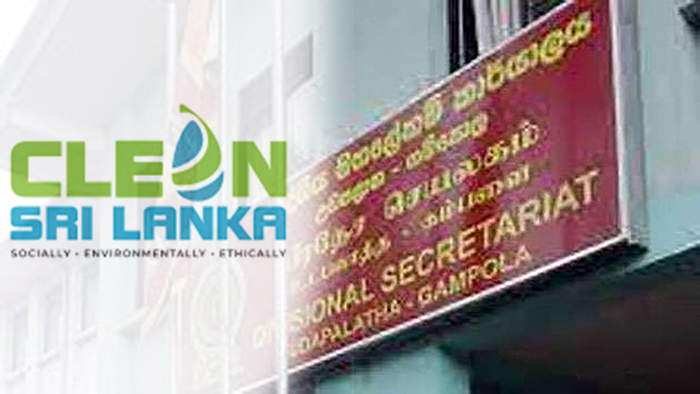
The Sri Lanka Association of Divisional Secretaries and Assistant Divisional Secretaries (SLADA) has written to the Secretary to the President requesting the withdrawal of a decision to appoint “Clean Sri Lanka” coordinators at provincial, district and divisional levels, warning that it could seriously undermine the independence of the public service.
In a letter, signed by SLADA President R. Senthil and Secretary R. M. Nuwan C. Hemakumara, the Association has referred to a directive issued by the Secretary to the President, dated March 20, 2026, instructing District Secretaries to appoint coordinators for the programme and to provide them with facilities within Divisional Secretariat offices.
The Association has noted that Sri Lanka already has a long-established administrative framework to ensure effective public service delivery, spanning ministries, departments, provincial councils, district and divisional secretariats down to Grama Niladhari divisions. This system is supported by internal audit units, the National Audit Office, and coordination committees at divisional, district and national levels, which oversee and review programme implementation.
The SLADA has acknowledged that specific officers have already been assigned at divisional level to implement activities under the government’s Clean Sri Lanka initiative, which is being monitored
through existing community development committees and coordination mechanisms.
The association has expressed concern over the appointment of separate coordinators at district and divisional levels and the instruction to allocate office space and attach public officials to support them. It has argued that divisional secretariats are neutral public service institutions that provide services to all citizens without political, religious or ethnic bias, and that their independence must be safeguarded.
While acknowledging some isolated instances of politically influenced conduct by a small number of officials, SLADA stressed that the overall administrative structure has functioned as an independent and depoliticised system that has earned public trust.
The association further pointed out that the current government’s policy framework emphasises efficient and impartial public service delivery without interference in the independence of state institutions.
It has warned that appointing politically connected coordinators within divisional secretariats and attaching government-paid officials to them could seriously compromise administrative neutrality and may also raise legal concerns.
SLADA said previous attempts to introduce similar arrangements had been resisted, adding that the current system already allows for effective coordination, monitoring and review of government programmes, including Clean Sri Lanka.
Accordingly, the Association urged the President’s Secretary to revoke the decision and allow existing administrative mechanisms to handle programme implementation. It warned that any such precedent could have long-term adverse implications for the independence of the public service, and expressed hope for a reconsideration of the directive, stating that it would not cooperate with the current arrangement unless the request is addressed.

Holder and Washington star in Gujarat Titans’ nervy last-over win

Varun and Narine push Sunrisers Hyderabad’s off switch

Aaron Hardie owns big stage to help Peshawar Zalmi lift second PSL title

Showers expected in the the Western, Sabaragamuwa, Central, North-western and Eastern provinces and in Polonnaruwa, Galle and Matara districts after 2.00 pm.

Heat Index at Caution Level in the Northern, North-central, Eastern, Sabaragamuwa and North-western provinces and in Colombo, Gampaha, Hambantota and Monaragala districts during the day time

USD 3.7 bn H’tota refinery: China won’t launch project without bigger local market share

‘Dates have the highest sugar content to fight Coronavirus’

Sunday Island 27 December – Headlines

#SundayIsland 17th December – Headlines

Sunday Island – 28th March

Sunday Island Headlines – 21 March

Sunday Island – 21st February – Headlines
-
 News5 days ago
Treasury chief’s citizenship details sought from Australia
-

 News4 days ago
Rooftop Solar at Crossroads as Sri Lanka Shifts to Distributed Energy Future
-
 News6 days ago
Govt. assures UN of readiness to introduce ‘vetting process’ for troops on overseas missions
-
 News3 days ago
“Three-in-one blood pressure pill can significantly reduce risk of recurrent strokes”
-
 Business6 days ago
ADB-backed grid upgrade tender signals next phase of Sri Lanka’s energy transition
-

 News5 days ago
Central Province one before last in AL results
-

 Sports5 days ago
Well done AKD!
-
 Business6 days ago
Update on independent forensic review