
Sports
St. Thomas’ meet St. Servatius’ in the 124th Battle of the Blues

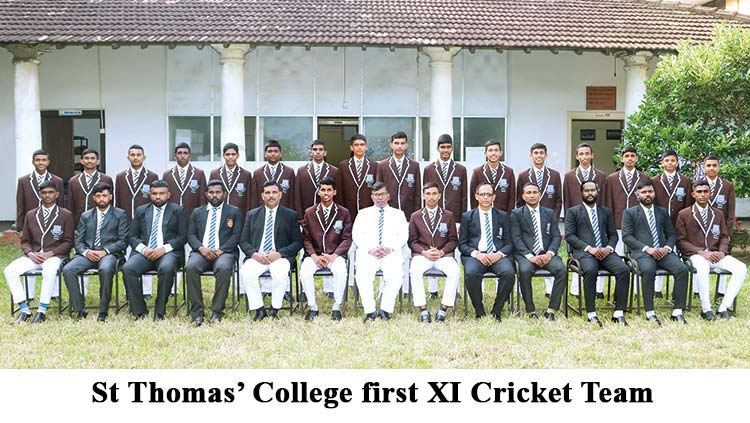
Striving for victory is not the only task when arch rivals St. Thomas’ and St. Servatius’ meet in the 124th Battle of the Blues as the three-day Big Match starting today will act as the dress rehearsal for the crucial relegation match between the two teams in the Under 19 Division I Tier ‘A’ tournament.
Both teams finished among the last four teams in their respective groups in the Division I Tier ‘A’ tournament and now their place in the top Tier is in danger. Incidentally, the standings in their respective groups have resulted in the two teams being drawn against each other for relegation matches.

With the winners remaining in the top Tier and the losing team relegated to Tier ‘B” the two teams will be playing in two separate Tiers next season.
St. Thomas’ captained by Navija de Seram are slight favourites in the Big Match. De Seram is their leading bowler and will have his deputy Pesandu Sanjan sharing a bigger responsibility in the bowling department alongside Manuga Guruge.
Their pace attack is spearheaded by Bhanuka Insamal.The captain and his deputy will also play a lead role in the bating department.
For St. Servatius’ skipper Diniru Abeywickramasinghe is the leading batsman, while Viran Chamuditha, Vishwa Supun, Chamarindu Nethsara, Risinu Kithmuka and Raveen Kavintha rally around him to form the base of their batting department.In the bowling attack Sunny Dulshan and Chalana Indusha shared new ball duties, while Chamuditha is the leading spinner.
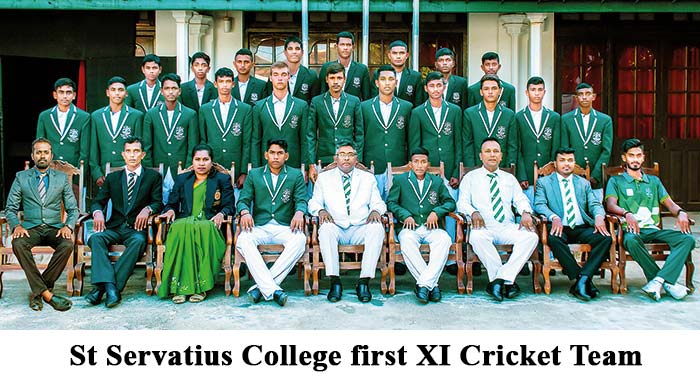
Front row from left: Priyantha Abeysekera (Coach), P I W Jayasekera (Head Coach), Ruvini Rubsinghe (Prefect of Games), Diniru Abeywickremesinghe (Captain), H K L B Virajith (Principal), Vishwa Supun (Vice Captain), Indika Deerasinghe (Vice Principal), W Hansa Sandaruwan (Master in Charge), Charith Dayarathna ( Assistant Coach) Middle row from left: Binal Nethmaka, Raveen Kavintha, Viran Chamuditha, Ahamad Sajid, Ivan Zholobitskyi, Chamarindu Nethsara, Risinu Kithmuka, Chalana Indusha, Sunny Perera, Heshan Madushanka, Samiru Gimhan Back row from left: Nethmal Bndara, Praveen Madushanka, Shalindu Nadushan, Gevin Sasanka, Oshada Nawarathne, Sanju Dilshan, Chamod Mihiranga, Praneeth Mihiranga
(RF)







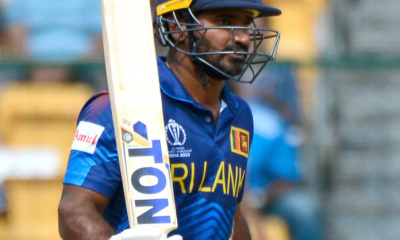




Sri Lanka’s women had to settle for silver at the 2026 Asian Games after India proved far too strong in the cricket final, romping to a 147-run victory.
India produced a commanding batting display after taking first lease of the wicket, piling up 216 for three from their 20 overs before dismissing Sri Lanka for just 69 in 15.4 overs.
Smriti Mandhana laid the foundation for India’s imposing total with a sparkling 79 off 45 balls before Richa Ghosh applied the finishing touches with an unbeaten 49 off only 22 deliveries.
Sri Lanka struggled to contain the Indian batting onslaught, with Chamudi Praboda and Kavisha Dilhari claiming a wicket apiece.
Faced with a daunting target of 217, Sri Lanka needed a flying start but instead found themselves tied down by a disciplined Indian attack.
Captain Chamari Atapattu attempted to lead the resistance with 29 off 21 balls, but there was little support around her. Kaushini Nuthyangana was the only other batter to reach double figures, making 14.
Once Chamari departed, Sri Lanka’s challenge quickly faded as wickets tumbled at regular intervals.
Deepti Sharma was the pick of the Indian bowlers, returning outstanding figures of three for six, while Shafali Verma chipped in with two for three as Sri Lanka were bundled out well inside their allotted 20 overs.
The emphatic victory handed India the gold medal, while Sri Lanka ended their Asian Games campaign with silver.
Caption: Chamari Atapattu couldn’t see her side through in the cricket final of Asian Games as Sri Lanka had to settle for silver medal.
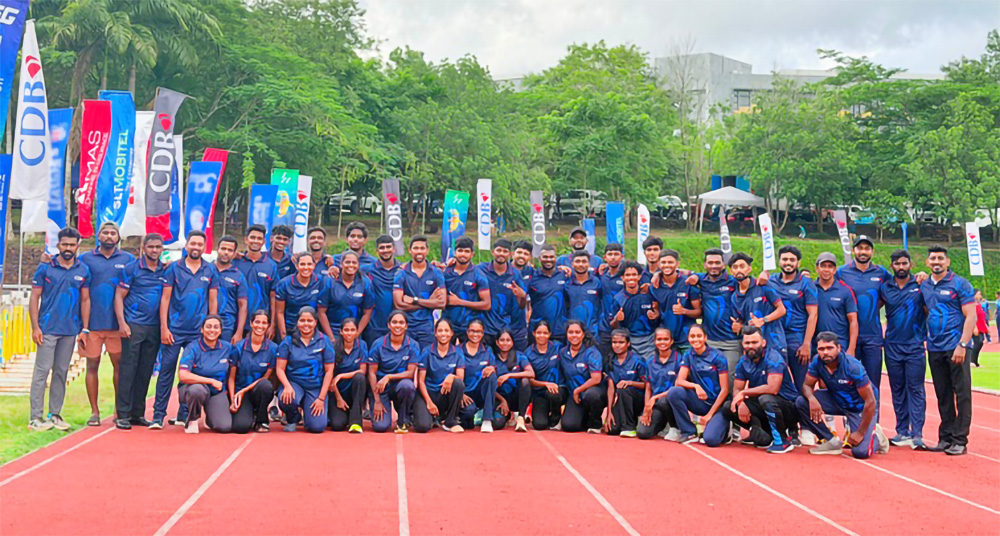
In a dominant show of talent, teamwork and discipline, Citizens Development Business Finance PLC delivered a commanding performance at the 41st Mercantile Athletic Federation (MAF) Meet held a few weeks ago at the Mahinda Rajapaksa International Stadium, Diyagama. CDB clinched the Men’s and Women’s Overall Championship titles and the Men’s Overall Novices Championship, showcasing a clean sweep across categories that underscored the strength and depth of CDB’s sporting talent.
In one of the most keenly contested fixtures in Sri Lanka’s corporate sporting calendar, CDB’s athletes took full command from the first day of the meet, with the team’s novices and seniors setting the pace across a demanding field of competitors from the country’s leading mercantile organisations.
CDB’s individual stars were equally decisive. Members of the team established four meet records – Race Walk Men’s Novices: Kandhasami Sham, Women’s 30+ Triple Jump: Bhakthi Wijesinghe, Men’s Championship High Jump: Kamod de Silva and Women’s Championships 400 meters Hurdles: Umaya Rathnayake. Shakila Wijesekara was named Best Athlete – Novices Men, while Umaya Rathnayake claimed a rare double, being named both Best Athlete – Championship Women and Best Athlete – Women. Team CDB rounded off the meet in fourth place overall, capping a campaign that reflected months of disciplined training and preparation — training that CDB’s athletes balanced alongside their day-to-day roles across the organisation.
That balance is central to what the win represents for CDB. Behind every medal is an employee who spent early mornings and weekends training, while continuing to meet their professional commitments — a reflection of the culture CDB has built around encouraging its people to pursue what they are passionate about, without having to compromise on their contribution to the company’s growth and success.
“This result is a proud moment for CDB,” says Executive Director – Corporate Finance Roshan Abeygoonewardena. “Our athletes trained with real discipline and heart over the past several months, balancing that commitment with their day jobs, and to see it translate into a clean sweep of the Men’s and Women’s Championship titles is a testament to who they are as individuals and as professionals.” Going beyond the medals, he credited the wider effort that went into the win. “We must also congratulate the coaches and support team who worked just as hard behind the scenes because at CDB, we believe that the same values that drive success on the track — discipline, resilience and teamwork — are what drive success in our business every day. We’re incredibly proud of the multi-talented youth who encompass Team CDB.”
CDB’s continued investment in workplace sports reflects the same culture of discipline, excellence and team spirit that underpins the CDB brand more broadly. It is part of a deliberate effort to create an environment where employees can grow both personally and professionally — one that recognises that a well-rounded, motivated workforce is built by encouraging people to maintain a healthy balance between their corporate lives and personal interests, not in spite of it. This continued success at the MAF Meet reaffirms CDB’s identity as an employer that nurtures talent both on and off the job, and reinforces the company’s growing reputation as a serious contender on the corporate sporting stage.

England had moved to 119 for two at the end of 20 overs after electing to bat first in the first ODI against Sri Lanka at Chester-le-Street yesterday.
Captain Kusal Mendis returned to the side after a long injury lay off while Sri Lanka handed over debut to leg-spin bowler Sachindu Colombage.
Captain Harry Brook was unbeaten on 35 with Joe Root on 41.

Mastermind Naufer Moulavi among 15 found guilty

No referendum needed for passage of 22 A: SC

One clause in Anti-Corruption (Amendment) Bill requires referendu: SC

NSC issues humanitarian appeal on behalf of Sri Lankan facing death sentence in Saudi Arabia

Vote on 22 A on Friday

Sri Lanka settle for silver as India strike gold in cricket

‘Dates have the highest sugar content to fight Coronavirus’

Sunday Island 27 December – Headlines

#SundayIsland 17th December – Headlines

Sunday Island – 28th March

Sunday Island Headlines – 21 March

Sunday Island – 21st February – Headlines
-

 News6 days ago
US embassy won’t comment on IGP’s probe into joint drug raid
-

 News4 days ago
Shanakiyan urges urgent action over reported death sentence for Lankan in Saudi Arabia
-

 News5 days ago
Bid for Basil’s extradition nears final stage: Police
-

 Business6 days ago
All-new Bolero MaXX unveiled in Sri Lanka
-

 News3 days ago
Namal Rajapaksa Buddhist gambit fails, bail denied
-

 Opinion6 days ago
A journalist who wrote across the divide
-

 Features3 days ago
Why the spelling Sri Lankan names in English vary
-

 Features3 days ago
Three bands, a new identity: Sri Lankan wolf snake recognised as distinct species