
News
Zuhair takes up right of Muslims killed by COVID-19 to be buried according to their religion

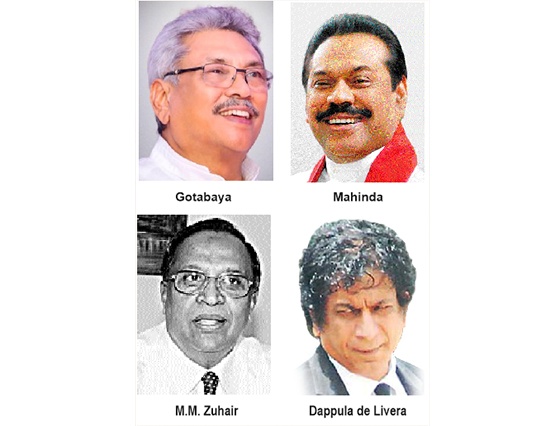
Former lawmaker M. M. Zuhair, PC, has strongly opposed what he calls forcible cremation of Covid-19 victims on a directive given by Attorney General Dappula de Livera, PC.
The following is the text of a letter by former Senior State Counsel Zuhair to President Gotabaya Rajapaksa and Prime Minister Mahinda Rajapaksa:
This is further to my previous representation dated 06th May 2020.
According to media reports the Hon Attorney General has directed the Director-General of Health Services that the dead bodies of Covid-19 victims unclaimed by the immediate members of the family to be cremated. (Ada Derana. Lk-09/12/2020 at 15.07 hrs. and AFP “Sri Lanka cremates Muslim Covid-19 victims against religious wishes” 09/12/2020 7.40 pm).
Firstly it is well known that the right to accord a dignified burial to a deceased person is an internationally recognized right. This is a right available to every person not merely to Muslims.
Secondly it is equally well known that the kith and kin of the deceased Muslims in particular have refused to accept the dead bodies as a protest against the unlawful refusal by the health authorities of our country to allow Covid 19 deceased persons a dignified burial. In the circumstances the Attorney General ought not to have directed the forcible cremation without hearing the kith and kin of the deceased persons. Such direction is in violation of the principles of natural justice, which principles the Attorney General is bound to uphold.
Thirdly, the direction has been made in terms of the Quarantine and Prevention of Deceases ordinance. If that be the case, the Attorney General would have seen that section 3(1)(i) of the Quarantine Ordinance provides for both options of burial and cremation and that he ought not to become a party to directing solely the cremation of the ‘under protest’ bodies without the consent of the kith and kin and in violation of the provisions of the Quarantine Ordinance read with section 17 (1) (c) of the Interpretation Ordinance. He ought not to expose the illustrious office of the Attorney General and the State to possible claims of damages.
Fourthly, Professor Tissa Vitharana has been quoted in the media last week that the expert panel appointed by the Minister of Health to advise her on the quarantine measures does not have a single virologist and hence not a competent panel, though the country has many eminent experts, virologists, epidemiologists, etc. Whereas 190 countries in the world had permitted burial of Covid-19 deceased persons following the World Health Organisation (WHO) guidelines, Sri Lanka and China are said to be the two countries that do not allow burials. The excellent work otherwise done by the countries health authorities and the armed forces are being brought into disrepute world-wide by the panel’s undue delay in resolving the problem by giving convincing scientific reasons as to why the WHO guidelines cannot be followed here.
Fifthly, if in fact and in science Covid- 19 will spread through contamination of water, I wish to state that no one, Muslim or otherwise will ask for burial of their victims. According to WHO any virus contaminated water may cause diarrhea but will not spread Covid-19.
Sixthly recent judicial decisions have kept the matter open to be decided by the Cabinet based on expert opinion which is anxiously awaited. Courts have not restrained the government or the experts from taking necessary decisions.
Permit me also to point out the following matters. Two Ministers Hon. Chamal Rajapaksa and Hon. Mahinda Amaraweera said recently that the government is favourably considering restoring the 27th March 2020 gazette allowing both burial and cremation for Covid-19 deceased persons and a third Minister Hon. Keheliya Rambukwella said a final decision will be taken after the experts give their opinion to the Health Minister Pavithra Wanniarachchi. The country’s accredited experts on the subject must not delay giving the opinion and they must do so with convincing scientific reasons for the public to know, because the government’s pursuit to restore burials in line with the opinion of the experts of the country as well as the World Health Organisation (WHO) guidelines are being perceived as being delayed unreasonably.
According to the WHO, water contaminated by any virus may cause diarrhoea but not Covid 19. If the local experts on virology and epidemiology have scientific reasons to establish that Covid-19 will spread through contamination of water to the living cell of a host, they also need to explain that apart from human beings animals, birds and fish will not be infected and will not host the virus and transmit them to human beings who may consume or handle them. There is thus an urgent need for the Sri Lankan experts to clear with scientific reasons all possible misconceptions.
The main protective measures that the public have been presently made aware of, to restrict the spread of Covid-19 are related to contamination through inhalation of infected droplets or by touching infected surfaces but not to Covid-19 contaminated water being consumed by living cells and getting transmitted to human beings. Experts in the relative field must clarify these matters on an urgent basis with scientific reasoning and evidence.
The composition of the committee of experts and their expertise in the relevant field to override WHO guidelines and the meetings or discussions they are engaged in need to be publicized in the interest of transparency. These representations are being made in the interest of the country’s best interests, its global reputation particularly in the Middle-Eastern countries which provide the highest foreign exchange earnings of US $ 7,000 million per year and in establishing acceptable scientific reasoning in the process of decision making affecting the fundamental rights of persons both living and dead.”
A copy has been also sent to the AG.



More than 1,600 students sat this year’s Russian Classical Ballet Examination, the largest number ever to take part in the examination in Sri Lanka. Exams were held in Colombo from 5, to 18, October and in Galle on 10 October.
Students aged four and above came from across the island, including Colombo, Galle, Gampaha, Negombo, Matara, Kelaniya, Panadura, Wattala, Kiribathgoda, Ratnapura, Kandy, Kurunegala, Bandarawela and Badulla. They are taught by 15 dedicated teachers trained in the Vaganova method, the renowned Russian system of classical ballet training.
They were examined by Dr. Oxana Karnovich of the Moscow State Academy of Choreography, a distinguished academic and curator.
The Russian School of Ballet and Dancing was established in 2001 by Michael Ustinov, Buddhapriya Ramanayake and Mrs Chandi Aluvihare, with Mrs Galina Pleshakova as its founding instructor. Today the School is led by Director Madam Maria Popova, Counsellor of the Embassy of the Russian Federation in Sri Lanka.


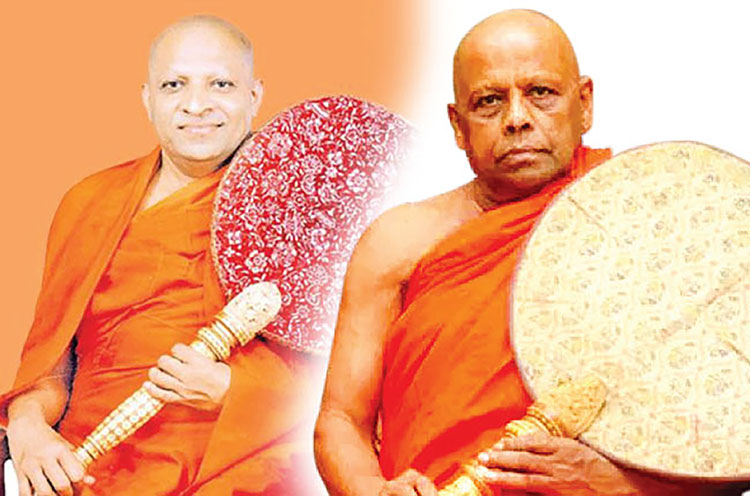
MONETABRIEF– Sri Lanka’s two most senior Buddhist chapters, Malwatte and Asgiriya, demanded special concessions for monks serving prison sentences, following the disrobing of convicted monk Ven. Galagodaatte Gnanasara in line with established procedures.
The chief prelate of the Asgiriya chapter, Most Venerable Warakagoda Sri Gnanarathana, told Prisons Commissioner Senaka Palletenna that Ven. Gnanasara, who is serving a six-year sentence for contempt of court, must be released immediately.
Prison authorities have no power to release or pardon convicts, but Palletenna told the monk in Kandy on Friday that he would convey his request to the relevant government authorities.
“There is no point in talking about this and that… The entire country has been shaken (??????? ) . He must be released,” the Asgiriya chief prelate said.
The Malwatte chief prelate, Most Venerable Thibbatuwawe Sri Siddhartha Sumangala, appeared to accept the court verdict against Ven. Gnanasara, but asked the prisons chief whether a separate section could be established for convicted monks.
Palletenna noted that a special ward for the clergy already existed at Welikada Prison.
At least 63 convicted Buddhist monks are currently incarcerated within Sri Lanka’s criminal justice system.
Meanwhile, a group of 34 Buddhist monks named in a Colombo Fort Magistrate’s Court order to vacate the vicinity of the Presidential Secretariat ended their protest and dispersed after lunch on Friday.The monks are demanding an unconditional pardon for Ven. Gnanasara, who has previously been imprisoned, making him a reconvicted prisoner.
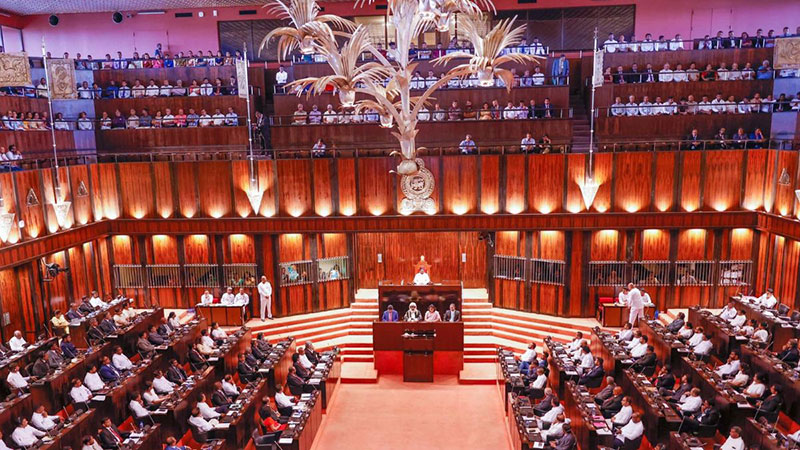
The debate on the no-confidence motion against Speaker Dr. Jagath Wickramaratne, submitted by the Samagi Jana Balawegaya (SJB), has been postponed indefinitely pending the Attorney General’s opinion on certain technical issues in the motion.
Government representatives raised the matter at a meeting of the Committee on Parliamentary Business, pointing out that several provisions of the motion required clarification and that the Attorney General’s advice should be obtained.
As obtaining the opinion would take time, the debate could not be scheduled for the next parliamentary week, parliamentary sources said.
Chief Opposition Whip Gayantha Karunatilaka said a date for the debate would be decided after the Attorney General’s advice was received.
Meanwhile, Parliament is scheduled to meet from October 20 to 23, Secretary General of Parliament Kushani Rohanadeera announced.
The parliamentary business for the week was finalised at a meeting of the Committee on Parliamentary Business held on Friday (16) under the chairmanship of Deputy Speaker Dr. Rizvie Salih.
On each sitting day, the period from 9.30 a.m. to 10 a.m. will be allocated for parliamentary business under Items 1 to 6 of Standing Order 22. Questions for Oral Answers will be taken up from 10 a.m. to 11 a.m., followed by questions under Standing Order 27(2) from 11 a.m. to 11.30 a.m.
On Tuesday, October 20, an Opposition-sponsored Adjournment Motion will be debated from 11.30 a.m. to 5.30 p.m.
On Wednesday, October 21, a resolution under the Public Debt Management Act and a Supplementary Estimate will be taken up for debate and approval from 11.30 a.m. to 5 p.m. The annual reports of five statutory institutions will subsequently be presented for approval without debate, while questions at the Adjournment Time will be taken up from 5 p.m. to 5.30 p.m.
On Thursday, October 22, the Second Reading debates on two Bills to amend the Poisons, Opium and Dangerous Drugs Ordinance (Bills Nos. 79 and 80) will be held from 11.30 a.m. to 5 p.m.
The annual reports of five statutory institutions will then be taken up for approval without debate, followed by an Opposition-sponsored Adjournment Motion from 5 p.m. to 5.30 p.m.
On Friday, October 23, the Second Reading debate on the Elimination of Rabies and Registration of Dogs Bill will be held from 11.30 a.m. to 5 p.m. A Government-sponsored Adjournment Motion will be debated during the final half-hour of the sitting.

Record 1,600 students take Russian Classical Ballet examination in Sri Lanka

Half a million people join protests in France, but some turn violent

Deadly fire breaks out at Canada military base

Showers or thundershowers will occur in most parts of the island after 1.00 p.m.

Buddhist hierarchy demands prison perks for monk convicts

Debate on NCM against Speaker postponed indefinitely

‘Dates have the highest sugar content to fight Coronavirus’

Sunday Island 27 December – Headlines

#SundayIsland 17th December – Headlines

Sunday Island – 28th March

Sunday Island Headlines – 21 March

Sunday Island – 21st February – Headlines
-

 Latest News5 days ago
Nissanka’s return headlines Sri Lanka’s Test squad against Pakistan
-

 Latest News7 days ago
Farhan and Sadaqat help Pakistan seal series in style
-

 Features7 days ago
Intake 16: 45 years of duty and honour
-

 News7 days ago
Malwathu Chapter issues statement on talks with President over Gnanasara Thera’s robes
-

 News7 days ago
CP alleges NPP has taken the blame for illegal US sanctions on Iranian vessels
-

 News5 days ago
Sri Lanka, India caught in US-Iran ship crisis
-

 Opinion7 days ago
How long can Sri Lanka remain silent on its demographic crisis?
-

 Latest News5 days ago
Kusal Mendis’ unbeaten 87 hands Sri Lanka consolation win