
Opinion
Presidential politics of economic recovery

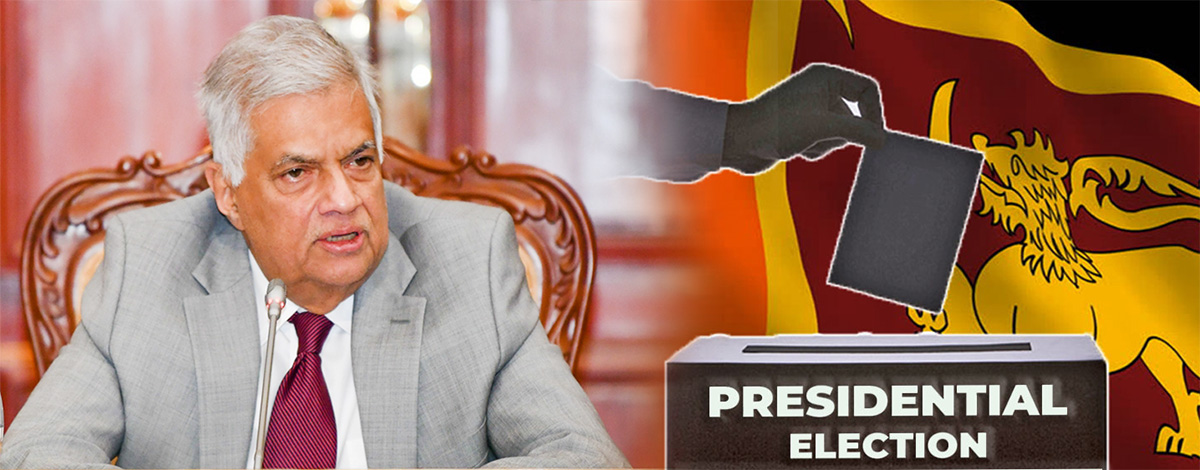
By Harim Peiris
The year 2024, is an election year in Sri Lanka, with the president’s term of office ending on 17th November 2024 and accordingly the conduct of a presidential election constitutionally mandated upon the Election Commission between September and October, this year. The ousting of former president Gotabaya Rajapaksa, through the mass protests of the aragalaya two years ago, has been raised a fresh in the public consciousness through the publications of his memoirs, “The Conspiracy – to oust me from the presidency”, a rather blatant attempt at blaming everyone but the Rajapaksa’s gross mismanagement of the country, for the mass uprising which resulted in the end of his short lived and unlamented administration. The presidential election of 2024, is the first and most decisive of Sri Lankan democracy’s attempt, since 2022 to publicly elect and grant a popular mandate to the office of president of the republic.
The politics of 2024 are being clearly laid out as a three corned race. As incumbent in office, the first contender is President Ranil Wickremesinghe, propped up and kept in power by the rump parliamentary majority of the Rajapaksa’s SLPP, a political formation that lost its popular mandate along with their president in 2022 but continues to control parliament and back the single seat UNP’s president. The official opposition led by the Leader of the Opposition in Parliament, Sajith Premadasa and his Samagi Jana Balawegaya (SJB) is the obvious alternative to an administration lacking a popular mandate. To his credit Mr. Premadasa has succeeded in preventing a takeover of his party by the UNP, which party he decimated in the general elections of 2020 in the maiden electoral outing of his SJB. By all accounts, the various attempts by President Wickremesinghe and the UNP to dump the SLPP and pivot to the SJB for the presidential poll has now been ended.
However, the JVP says its leader Anura Kumara Dissanayake is the front runner in the 2024 presidential poll. Polling just above 3% of the popular vote in the 2019 presidential election, the JVP was always a distant third and very much an “also ran” in prior elections and Sri Lankan politics in general. Garnering about 4% of the vote in the parliamentary elections of 2020, it secured just three seats. However, as voters repudiate Rajapaksa governance and its associated politics, which brough about national economic collapse, in just two short years, ironically based on a promise of creating splendour and prosperity, the beneficiary of much of the Rajapaksa’s self-implosion seems to have been the JVP, much more so than the main opposition SJB. Some of the dynamics at play are worth examining. We are more than six months away from the presidential election, a near eternity in politics. Much can change in the relatively unchartered terrain of the new three-way race of Sri Lankan politics and the large number of undecided voters, who would be really the deciding factor at the coming election.
The presidential election of November 2019 was all about national security after the coordinated Easter bomb attacks of April 2019. Ironically, we went from national security to national collapse in two years, with no real justice or truth about the perpetrators of the Easter bomb attack, except for a growing belief in the country that these attacks had the sanction and support of the deep state, especially after the UK Channel 4 expose’ alleging the same. However, the aragalaya and the economic collapse changed the political discourse in the country. We went from racial dog whistling and openly anti-minority politics to the politics of social justice. The real and lasting political problem for the Rajapaksa’s and the SLPP is not just that they destroyed the economy, but that their political ideology of majoritarian nationalism was discredited and discarded by the public, along with their governance.
The JVP, rather than the SJB, was the beneficiary of this new post racial, social justice political ethos. Almost overtly racist during their violent second insurrection of 1988/89, through a rejection of even the provincial councils, the JVP over the years more mainstreamed their ethnic policies along communist ideology, which emphasizes socio political class divides over ethnic ones. This didn’t hold much sway in the ethnically polarised Sri Lanka of the past, but the economic collapse of 2022 was much like the Tsunami of 2004, a massive shock to the system, which resulted in swift and significant changes to the popular consciousness and ethos.
The JVP tapped into the mass suffering and pain of the vast majority of the Sri Lankan populace. While our economy has stabilised and recovered, its benefits have been largely to the first and second percentiles or twenty percent of Sri Lanka’s population who earn close to about two thirds of our national income, in an economy with an extremely skewed income distribution. The UNP / SLPP administration has been tone deaf to the pain of the majority, with high malnutrition, huge drops in purchasing power and quality of life from public education and health to rural electrification. Over half a million households had electricity disconnected during the year. We are taking people off the national grid. Not adding new consumers. The JVP, better than the SJB, has tapped into that pain and suffering.
But these are early days in the presidential election race of 2024 and the election is still Opposition Leader Sajith Premadasa’s to lose. He much more so, than the old traditional UNP elites, comes from a political tradition and track record of feeling the common man’s pain, of working towards universal housing and social security for all with much more credibility than the JVP. However, one thing is certain, the repudiation of the Rajapaksa political brand in 2024, would be fairly decisive.
(The writer served as Advisor to the President, from 2002-2005)


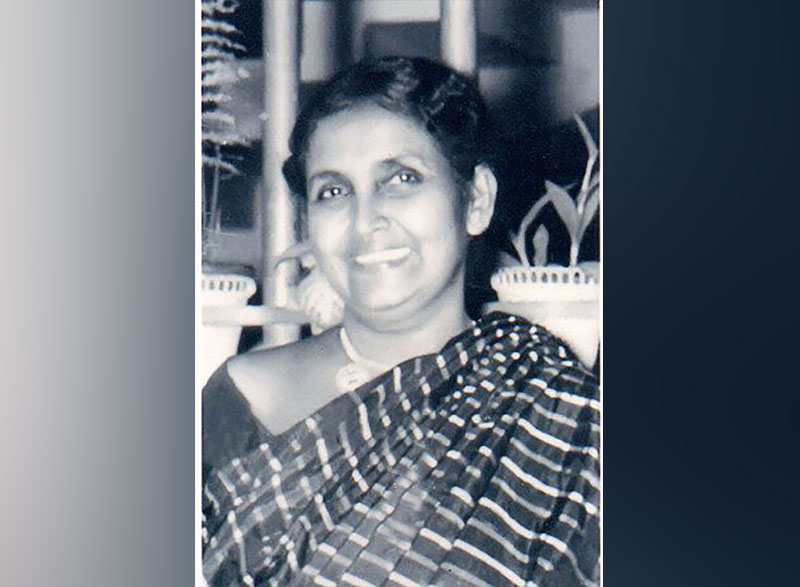
(Written by the late Lakshmi Nimalasuriya in July 1986 and published to mark Lucille’s 40th death anniversary)
She was a special friend. We first met when she was president and I was honorary secretary of a voluntary organization. We worked together in great harmony. She was a person of outstanding merit and enmeshed in dreams and goals which she pursued with unflagging zeal.
Her wealth and position made no impact of exclusiveness, nor the advantages she had as a politician’s wife make her dominating.
She was intelligent, receptive and warm hearted and an indispensable member of the All-Ceylon Buddhist Women’s Association and the All-Ceylon Buddhist Congress. She had the ability to respond to any situation and act with confidence – the criterion of leadership.
She was invited to serve on national councils sponsored by the government and was successful in redistributing the allocation of grants which had continued to be unequal and favoured. She was an active member of the Inner Wheel Club adept at fund-raising and was in great demand. She worked long hours in preparation and enlisted all she knew to make the Flag Days successful. She wooed the wives of diplomats for charity performances and the press for publicity. By her tireless efforts she enriched the ever-depleting coffers of these voluntary organizations.
The spiritual growth of young people was a subject close to her heart. She initiated the Youth Forum of the ACBC. She was indeed a happy mother at the time of her death as all her children had grown up to become good citizens.
She was a gifted and versatile person who could sing, write, draw, paint, design, sew and make lovely handicrafts with effortless ease. So, be it an important occasion like her children’s weddings, or mundane functions, fetes, annual general meetings, or at a simple pinkama in the temple or nunnery, or on a sacred day, her lovely creations which she spent hours in making in silent enjoyment would add that splash of gaiety and festivity which delighted us. She told me she learnt this love of decoration from her father who was an eminent Buddhist worker. Underlying all her work was her dedication to the Buddha Sasana.
The death of her teenage daughter early in life, and the death of her husband, who pre-deceased her by a few years, left her inconsolable and she with great difficulty reconciled herself to their loss.
She relives again in memory – Here she comes, a winsome smile on her lovely face, of graceful stature, her wavy hair drawn back, her favourite throatlet around her neck; with friendly charm, her hand out-stretched to help and bound to a generous heart, so she rightly claimed her name of endearment – she was to all Lucilla akka, sister Lucille.
May she soon attain her goal – the end of suffering – Nibbana.
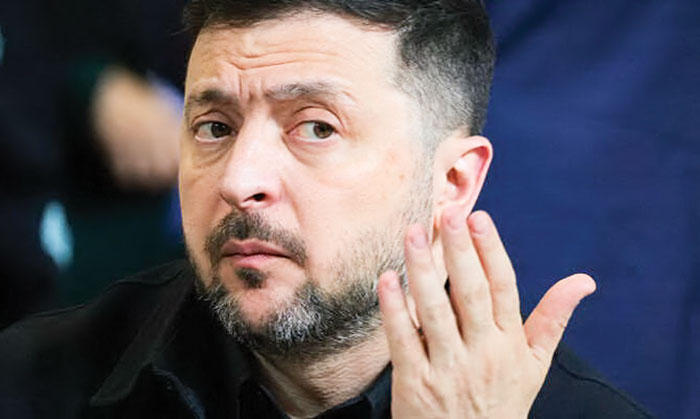
A leadership crisis that exposes the strategic fault lines of Ukraine’s war effort—and the competing imperatives of domestic command, Western pressure, and battlefield reality.
Ukrainian President Volodymyr Zelensky’s abrupt dismissal of Defence Minister Mykhailo Fedorov and his broader cabinet reshuffle have exposed a deep fracture within Ukraine’s wartime power structure. This extends far beyond personalities and into the strategic orientation of the state itself. What is unfolding is not merely a bureaucratic dispute but a crisis of command in a country prosecuting a high intensity, NATO-supported war against Russia.
On 16 July, protests broke out in Kyiv demanding the removal of Commander in Chief Oleksandr Syrskyi and the reinstatement of Fedorov. Smaller demonstrations occurred in Odessa, Lviv, Kharkiv, Lutsk, Dnipro, and other cities. These protests, which have continued for a week, signal a rupture within the prowar bloc that has sustained the Zelensky administration since 2022.
Antiwar sentiment did not drive the demonstrations, in which the “usual suspects” of US-backed “Colour Revolutions” took part. In this case, veterans, territorial defence networks, and upper middleclass “civil society” actors, who remain committed to the war’s continuation. Their demand for Fedorov’s reinstatement reflects a belief that Zelensky has lost operational coherence and strategic clarity. Placards bearing Fedorov’s name were, in effect, endorsements of escalating long range warfare against Russia, despite the catastrophic human toll already borne by both sides.
The political shock waves have reverberated through Ukraine’s Western patrons. The Mayor of Kyiv, Vitaly Klitschko, a major player in the 2014 “Maidan Coup” who is aligned with German strategic interests, condemned the firing publicly as a “big mistake,” while major Western media outlets described the move as “destabilising.” Behind the scenes, officials in Washington and Brussels viewed the sudden change with alarm. Such reactions reveal the degree to which Fedorov had become embedded in Western military technical planning, particularly in the domain of drone warfare, where Ukraine’s operations increasingly intersect with NATO intelligence and logistical support.
This conflict has emerged precisely as Ukraine intensifies drone strikes deep inside Russian territory and escalates operations against Crimea. Fedorov, appointed only six months ago, became the face of this strategy, celebrated by Western media as a “drone warfare mastermind” and criticised domestically for sidelining artillery procurement. His approach aligned closely with NATO’s interest in testing and refining asymmetric strike capabilities against Russia.
Zelensky’s subsequent hints that he may reconsider the decision underscore the precariousness of his position. His authority now rests on a fragile balance between Western expectations, domestic military factions, and a society exhausted by mobilisation. His consultations with both Syrskyi and Fedorov suggest an attempt to reassert control over a command structure that is no longer unified.
Fedorov’s postdismissal revelations sharpen the picture. His claim that Syrskyi and Chief of the General Staff Andrii Hnatov blocked reform initiatives systematically, and that Syrskyi enabled corruption, points to a structural clash between two models of warfare. The Western media has analysed the row as one in which Fedorov represents a Westernaligned, technologydriven paradigm emphasising drones, automation, and longrange strikes. It portrays Syrskyi as embodying an entrenched Sovietera command culture, reliant on artillery, mass mobilisation, and hierarchical control. Zelensky’s decision to side with Syrskyi is presented as a political calculation, preserving the loyalty of the traditional military establishment at the expense of the “reformist” faction.
However, Fedorov’s political alliances complicate this narrative. His cultivation of farright networks, including neo Nazi blogger Serhii Sternenko, reveals the darker undercurrents of Ukraine’s wartime coalition. Sternenko’s role in the 2014 Odessa massacre underscores how extremist actors continue to intersect with state structures, especially in moments of institutional fragmentation.
In actual fact, the power struggle reflects a contradiction between two elite strategies for managing subordination. Ukraine is a subaltern national state embedded in a wider hierarchy of imperialist power. Fedorov is tied to global centi-billionaires and Western technology platforms. His camp can look “more Western” because it is more integrated into transnational circuits of capital and war-tech. The apparent modernity of that model still carries dependency: it improves efficiency while deepening reliance on external monopolies. The war state becomes dependent on foreign-owned infrastructure, satellite systems, software, and elite relationships, which gives external capital leverage over military coordination and political priorities.
Syrskyi, by contrast, is closer to an older form of domestic elite power: the military-bureaucratic order linked to native oligarchic interests, procurement channels, and patronage. This is a more nationally rooted fraction of the bourgeois bloc, but not necessarily a more independent one, because Ukrainian oligarchic power has long been intertwined with Western finance, arms flows, and state restructuring.
The struggle between Syrskyi and Fedorov therefore reflects competing modes of dependency, and (although clearly the Western establishment favours the latter) not a clean split between “national” and “Western” camps. One route passes through transnational tech capital and managerial reform; the other through entrenched oligarchic-military command and domestic networks of influence. The clash is therefore not an isolated dispute but a symptom of an intra-elite struggle over how Ukraine should be governed as a dependent war economy. Neither side points beyond bourgeois rule; they are different management styles of the same subordinated state form.
Taken together, the crisis reflects a deeper geopolitical reality: Ukraine’s war effort is no longer anchored by a unified elite consensus. Instead, it is being pulled apart by competing military doctrines, Western strategic pressures, corruption scandals, and the exhaustion of a society asked to sustain indefinite mobilisation.
Vinod Moonesinghe, formerly chair of the Ceylon German Technical Training Institute and of the National Institute for Language Education and Training, serves as Convenor of the Asia Progress Forum.
By Vinod Moonesinghe ✍️
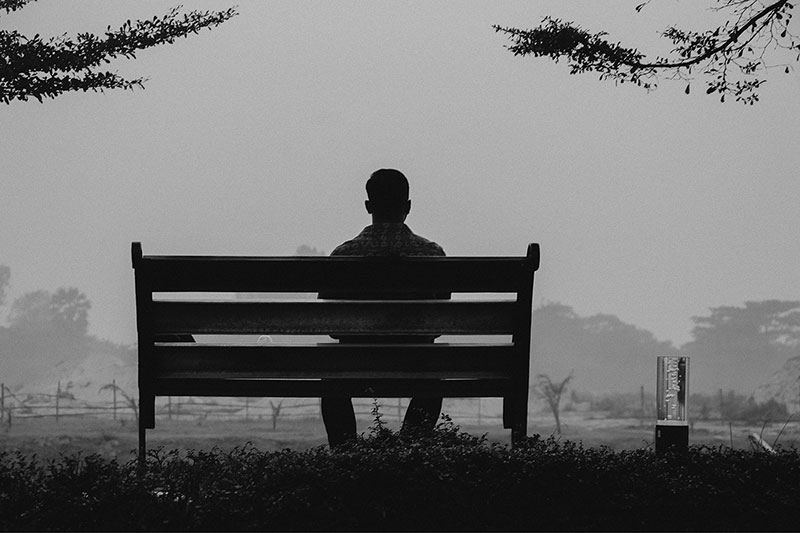
I never learned how to communicate my emotions properly, even with my closest friends. It was only when a friend of mine called to tell me about the immense pressure and struggles he was experiencing that I realised how deeply ingrained this issue truly is in us. We are all taught, whether subliminally or explicitly, that expressing our emotions and seeking help are weaknesses. Even when talking to those close to us, it is the norm to keep our feelings secondary. That phone call revealed something I had sensed but never named: young men like us are experiencing an epidemic of loneliness, and our society has left us to face it alone.
Male loneliness and disengagement among young men aged 15 to 29 has emerged as a critical social and political crisis. As a young man, I have witnessed how pervasive disconnection isolates my peers, leaving them vulnerable to harmful online influences. The lack of emotional support systems, positive male role models, and societal permission for vulnerability drives young men toward toxic ideologies that further increase their isolation and threaten societal connection. This failure is a deeply systemic one, and it demands urgent action.
I think often about that phone call from my friend. Here was someone I had known for years, someone I considered close, and yet neither of us had ever truly discussed what we were going through. We had talked about sports, school, and superficial matters, but never the weight we carried. When he finally opened up, I realised I had been waiting for permission to do the same. This is the tragedy of male socialisation: we are surrounded by others who share our struggles, yet we are conditioned to suffer in silence. The statistics confirm what I experienced personally: we are a generation in crisis.
I am 17 years old, and I write this as a Sri Lankan-American trying to make sense of two worlds. My father was born in Colombo, and my grandparents, after 35 years in Washington, D.C., returned to Sri Lanka a decade ago, drawn by a homeland that continues to shape our family’s identity. On a visit to see them, we made a pilgrimage to Kataragama, one of the holiest sites on the island. Watching the devotees there, people from every background, every faith, my grandmother spoke to me about anukampā. It’s a Sinhala word that’s hard to translate exactly. She described it as what happens when your heart trembles because someone else is suffering. Not pity, not sympathy from a distance, but actually feeling it with them, and being moved to do something about it.
That idea stayed with me. When I think about what young men need, what I needed when I was struggling and didn’t know how to ask for help, it’s exactly that. Not judgment. Not being told to toughen up. Just someone whose heart trembles with ours, who sees our pain and responds. This essay argues that the epidemic of male loneliness stems from systemic failures in education and community support, pushing young men toward radical online communities. We need schools, governments, and communities to respond with the kind of compassion my grandmother described, and we need it now.
A Global Epidemic in Numbers
Recent data underscores the severity of male loneliness. A 2021 survey by the American Enterprise Institute found that 15 percent of men report having no close friends, a sharp rise from just 3 percent in 1990 (Cox, 2021). For young men aged 18 to 29, this isolation is particularly acute, with 27 percent reporting no meaningful social connections (American Enterprise Institute, 2021). This disconnection correlates with declining mental health: the National Institute of Mental Health reports that men aged 18 to 25 have suicide rates three times higher than their female counterparts (NIMH, 2023). These statistics reveal a generation of young men struggling to find belonging in a society that often equates emotional expression with weakness.
The World Health Organization’s 2025 Commission on Social Connection confirms that loneliness has become a defining public health crisis of our era. The WHO reports that one in six people worldwide is affected by loneliness, with the phenomenon linked to an estimated 871,000 deaths annually, more than 100 deaths every hour (WHO, 2025). Young people bear a disproportionate burden: between 17 and 21 percent of individuals aged 13 to 29 report feeling lonely, with the highest rates among teenagers (WHO, 2025). Gallup’s 2025 data reveals that 25 percent of American men aged 15 to 34 experience daily loneliness, significantly higher than the 18 percent national average and notably higher than their female peers, who also report 18 percent (Gallup, 2025). The United States stands out among wealthy nations: nowhere else is the gap between young male loneliness and the rest of the population as pronounced.
The Absence of Role Models
I attribute this crisis to the absence of positive, accessible male role models. Traditional notions of masculinity emphasise stoicism and competition, leaving young men without guidance on emotional health or self-awareness. Schools and communities rarely provide structured environments for boys to develop emotional literacy, unlike programs often available for girls, such as mentorship initiatives or social-emotional learning curricula tailored to female experiences (Brooks, 2022). This systemic oversight leaves young men to navigate their emotional lives alone, often turning to the internet for answers.
The cultural norms that stigmatise male vulnerability are not accidental; they are reinforced from childhood through adulthood. Phrases like “man up” and “boys don’t cry” communicate a clear message: emotional expression is weakness (Pollack, 1998). Moreover, mental health services remain inaccessible due to cost or stigma, with only 27 percent of men seeking therapy compared to 45 percent of women (American Psychological Association, 2021). Blaming individuals for their isolation overlooks the systemic failures that leave young men without the tools or spaces to address their emotional needs.
The Lure of Toxic Online Communities
In the absence of real-world support, young men are drawn to online communities, particularly those within the “Red Pill” movement, which promise belonging but often promote harmful
ideologies. Influencers like Andrew Tate or “Red Pill” podcast hosts offer messages of discipline and strength that resonate with isolated young men.
They are effective in their messaging because they feel relatable to millions of men across the country. Unlike celebrities and professional athletes, who can feel distant, these influencers are often everyday people, making their messages more direct and effective. Their content creates a one-on-one experience that speaks individually to every viewer and listener. As an example, when a multi-millionaire singer addresses their audience about an issue, it can feel impersonal and disconnected because their message is directed to hundreds of millions of people. On the other hand, when a young man can call into an influencer’s show, be heard and his views validated, this creates a powerful sense of belonging. It becomes less like watching content and more like talking to your friends.
However, the danger lies in the unchecked spread of misogyny, conspiracy theories, and radical beliefs. A 2022 study by the Anti-Defamation League found that 60 percent of young men exposed to “Red Pill” content reported increased hostility toward women, with many endorsing views that frame vulnerability as weakness (ADL, 2022). These influencers exploit the emotional void in young men’s lives, offering a sense of community while reinforcing the very isolation they claim to address. By presenting their ideologies as undeniable truths, they radicalize vulnerable audiences, with real-world consequences.
Political Ramifications
The political ramifications of this crisis are undeniable. In the 2024 U.S. presidential election, Donald Trump secured 56 percent of the young male vote, a significant increase from 41 percent in 2020 (AP VoteCast, 2024). This shift aligns with the rise of far-right movements, including MAGA, which capitalise on young men’s disillusionment by promoting narratives of dominance and control. Political scientist John Sides argues that these movements fill an emotional void by offering a sense of purpose and identity to disaffected men (Sides, 2024). Meanwhile, progressive voices often dismiss young men’s struggles as entitlement, failing to engage them with empathy or provide alternative spaces for connection. This imbalance allows far-right ideologies to dominate the narrative, further alienating young men from constructive societal participation.
Sri Lanka’s Parallel Challenge
This crisis is not confined to American shores. Sri Lanka, a nation that has endured decades of civil conflict, a devastating tsunami, and recent economic upheaval, faces its own youth mental health emergency. A WHO Global School-based Health Survey found that 30.8 percent of Sri Lankan adolescents report loneliness, while 40.3 percent experienced some form of mental health difficulty in the year preceding the survey (Rasalingam et al., 2022). The data is stark:
20.2 percent of adolescents experienced anxiety, and 3.7 percent reported suicidal ideation.
A separate study published in BJPsych International revealed that 9.5 percent of Sri Lankan school children aged 13 to 17 had seriously considered attempting suicide, with nearly 39 percent experiencing bullying within the preceding month (Wickramaseckara Rajapakshe et
al., 2023). Sri Lanka has historically had one of the highest suicide rates in the world, and while pesticide regulation has reduced overall numbers, the underlying mental health crisis, particularly among young people, remains insufficiently addressed. The country has approximately 170 board-certified psychiatrists serving a population of over 22 million, with adolescent mental health services only recently beginning to develop.
The parallels between American and Sri Lankan young men are instructive. Both face traditional cultural expectations around masculinity that discourage emotional expression. Both navigate economic uncertainty and rapidly changing social landscapes. Both are increasingly exposed to global digital platforms that can either connect or isolate, and both deserve better than what their societies currently offer. In both countries, the old ways of raising boys, telling them to be tough, to hide their feelings, to figure it out on their own, are failing a new generation.
What Compassion Looks Like in Practice
When my grandmother explained anukampā to me, she wasn’t giving a philosophy lecture. She was telling me how to be a good person. Your heart should tremble when you see someone suffering, she said. Then, you do something. That’s the difference between feeling bad for someone and actually caring: one keeps you comfortable, the other demands action.
To address this crisis, society must prioritise emotional literacy and community-building for young men. Schools should implement mandatory social-emotional learning programmes tailored to boys, teaching communication and vulnerability as strengths, not weaknesses. Community organisations can create mentorship programmes pairing young men with positive role models who model healthy masculinity: men who demonstrate that strength includes the courage to be vulnerable, that leadership includes the wisdom to listen, and that success includes the capacity to form meaningful relationships.
Additionally, policymakers must invest in accessible mental health resources, reducing financial and cultural barriers to care. The WHO’s 2025 report emphasises that solutions exist at national, community, and individual levels, from policy reform to strengthening social infrastructure like parks, libraries, and community centres where genuine human connection can flourish (WHO, 2025). These interventions can counteract the allure of toxic online spaces by providing young men with real-world support and belonging.
Sri Lanka, with its deep Buddhist roots, has something to offer to this global conversation. The concept of anukampā isn’t just a religious idea, it’s a practical one. It asks us to feel what others feel and then act on it. I call on leaders in Sri Lanka and around the world, teachers, politicians, religious figures, and community elders, to take this seriously. Young men are not a problem to be solved. They are people who are hurting, and they deserve to be met with hearts that tremble alongside theirs.
A Personal Plea
Young men’s loneliness isn’t a personal failing; it’s a societal one. The concept of “just toughen up” no longer works. This perspective ignores the structural barriers that discourage emotional expression. When people tell us to simply try harder, they overlook the fact that we were never given the tools to begin with.
What gave my friend the courage to reach out that day? What would have happened if he hadn’t? How many other young men are carrying that same weight in silence, waiting for permission that may never come? I have seen how policy and community engagement can make a difference. But policy alone is not enough. We need a cultural shift and a willingness to actually feel the pain of this generation and respond to it.
By neglecting to provide young men with emotional tools and supportive communities, we drive them toward radical ideologies that perpetuate division and harm. The evidence, from rising isolation rates to political shifts, demands urgent action. By fostering emotional literacy, creating mentorship opportunities, and challenging outdated notions of masculinity, society can empower young men to build meaningful connections and reject toxic influences.
If we fail to act, we risk creating a more divided and hostile world. But if we respond with real compassion, if our hearts tremble with the suffering of this generation and we are moved to action, we offer young men what they most need: the knowledge that their struggles are seen, their suffering is shared, and they are not alone. That is what my friend gave me when he called. That is what I hope to give others, and that is what I ask of you.
References
American Enterprise Institute. (2021). The Decline of Friendship in America. Retrieved from AEI.org
American Psychological Association. (2021). Mental Health Service Utilization by Gender. Retrieved from APA.org
Anti-Defamation League. (2022). Online Hate and Its Impact on Young Men. Retrieved from ADL.org AP VoteCast. (2024). 2024 Presidential Election Voter Demographics. Associated Press.
Brooks, D. (2022). The Boy Crisis: Why Our Boys Are Struggling and What We Can Do About It. Basic Books.
Cox, D. A. (2021). Men’s Social Circles Are Shrinking. American Enterprise Institute.
Gallup. (2025). Younger Men in the U.S. Among the Loneliest in West. Gallup World Poll. Retrieved from https://news.gallup.com/poll/690788/younger-men-among-loneliest-west.aspx
National Institute of Mental Health. (2023). Suicide Statistics by Demographics. Retrieved from NIMH.nih.gov
Pollack, W. (1998). Real Boys: Rescuing Our Sons from the Myths of Boyhood. Random House.
Rasalingam, A., et al. (2022). Assessment of mental health problems among adolescents in Sri Lanka: Findings from the cross-sectional Global School-based Health Survey. Health Science Reports, 5(6), e886. Retrieved from https://pmc.ncbi.nlm.nih.gov/articles/PMC9576112/
Sides, J. (2024). The Political Appeal of Far-Right Movements to Young Men. Journal of Political Science, 45(3), 112–130.
Smith, R. (2023). The Rise of Red Pill Influencers and Their Impact on Youth. Social Media Studies, 12(4), 89–104.
Wickramaseckara Rajapakshe, O. B., Mohan, M., & Singh, S. P. (2023). Development of adolescent mental health services in Sri Lanka. BJPsych International, 20(2), 41–43. Retrieved from https://pmc.ncbi.nlm.nih.gov/articles/PMC10895478/
World Health Organization. (2025). WHO Commission on Social Connection: Global Report on Loneliness and Social Isolation. Geneva: WHO. Retrieved from https://www.who.int/news/item/30-06-2025-social-connection-linked-to-improved-heath-and-reduced-risk-of-early-death
by Nikhil de Silva ✍️

Typhoon Noul makes landfall in China, with hundreds of thousands evacuated

Colombo Kaps down Dambulla Sixers by 21 runs

Kandy Royals win by 11 runs
Showers will occur in the Western, Sabaragamuwa and North-western provinces and in Galle, Matara, Kandy and Nuwara-Eliya districts

Govt. launches EPF, ETF shake-up

SLPI concerned over the proposed Chartered Institute of Media Professionals of Sri Lanka

‘Dates have the highest sugar content to fight Coronavirus’

Sunday Island 27 December – Headlines

#SundayIsland 17th December – Headlines

Sunday Island – 28th March

Sunday Island Headlines – 21 March

Sunday Island – 21st February – Headlines
-
 Midweek Review5 days ago
Three high-profile alleged suicides shaping key investigations
-

 News2 days ago
Fort Magistrate orders arrest of MP Archchuna
-

 Editorial2 days ago
An indictment of all parties
-

 News5 days ago
Customs asked to resume probe or face legal action
-
Editorial6 days ago
Welcome bid to tackle rolling death traps
-
 Opinion3 days ago
Ukraine’s power struggle spills on to the streets
-

 News2 days ago
National-level cybersecurity facility Lab established
-

 Features16 hours ago
MBS: The Man of the Last Laugh