
News
PM suggests Covid-19 burials in dry zone, receives warning virus remains active in bodies for 36 days

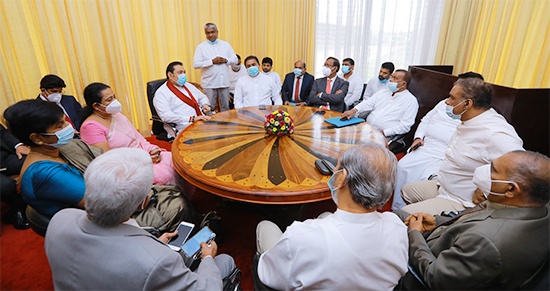
PM Mahinda Rajapaksa consults lawmakers and health officials regarding burials (pic courtesy PM’s Office)
By Shamindra Ferdinando
Medical authorities had cautioned Prime Minister Mahinda Rajapaksa that transmission of coronavirus from bodies was possible for 36 days, the PM’s Office said, yesterday (11).
According to the statement issued by Rohan Weliwita, Media Secretary to the Prime Minister, the medical experts issued the warning at a meeting convened at the Prime Minister’s Office in Parliament to explore ways and means of burying Covid-19 victims.
Issuing instructions to relevant authorities to choose a suitable land in consultations with medical authorities in a dry zone with ground water level extremely low, Prime Minister Mahinda Rajapaksa requested Muslim lawmakers present to support the current health guidelines.
Prime Minister has emphasized that in matters concerning health decisions couldn’t be made on the basis of religious sentiments.
Among those present were Justice Minister Ali Sabry, PC, Health Minister Pavitra Wanniarachchi and Health Secretary retired Maj. Gen. Dr. Sanjeewa Munasinghe.
Except Mohammed Muzammil of the National Freedom Front (NFF) appointed on the SLPP National List, all other Muslim lawmakers are united in their demand for burial of Muslim coronavirus victims.
A senior spokesperson for Samagi Jana Balavegaya told The Island that the Premier’s Office invited only government members and those who switched their allegiance to the SLPP government for their personal benefit.
The spokesman alleged that the government was making an attempt to hoodwink the Muslim community. In spite of promises given by various government representatives at different times, the Health Ministry stood firm in its original decision to cremate all regardless of strong objections on religious grounds.
Meanwhile, Police Spokesman DIG Ajith Rohana said that close to 100,000 people were home quarantined as authorities battled the rampaging corona epidemic. According to attorney-at-law Rohana, 95,825 persons belonging to 35,114 families had been quarantined at their homes with the Gampaha administrative district being the worst affected. DIG Rohana said that there were 14,332 quarantined persons in the Gampaha district.
Warning that tough measures were required to bring the situation under control, DIG Rohana said that those found to have violated quarantine rules and regulations would be severely dealt with. The police spokesman warned the public to follow health guidelines or face the consequences. Courts could sentence violators up to three years RI.
The police headquarters said that nine police areas in Colombo and 25 Grama Seva areas had been isolated pending further investigations and examination of the situation.
SJB lawmaker Mujibur Rahman alleged that the government was playing politics with an extremely sensitive issue. A sensible government would have responded to our passionate pleas for respect and dignity for Muslim victims of covid, he said.



The Sri Lanka Navy successfully recovered its Fast Attack Craft P 4447 following a successful salvage operation, bringing a multi-stage emergency response to a close.
The craft, which ran into distress during a routine patrol on 15th August 2026 off Angulana, was brought to the surface on 11th September, from a depth of approximately 80 feet. It was
subsequently towed to the Colombo Dockyard premises.
The initial phase of the operation immediately following the incident focused on search and rescue. A joint effort involving the Navy, Air Force, Police, and local fishermen from Angulana
resulted in the rescue of 11 crew members. The search and rescue phase drew to a close with the recovery of the remains of the Second in Command of the craft, on 4th September.
Following the search and rescue phase, specialized Navy diving and salvage teams launched a dedicated recovery phase against rough sea conditions and underwater challenges, adhering to
strict safety protocols. The Navy’s marine, hull, electrical, and electronic engineering teams utilized specialized technical know-how and equipment to raise the vessel in stages.
Thus, the salvage operation marked an outstanding achievement attained through the professionalism, technical expertise of Navy divers, and coordinated contribution of all
engineering and technical branches of the Sri Lanka Navy. Technical support and specialized expertise were also extended by the Sri Lanka Ports Authority and Colombo Dockyard PLC.


By Shamindra Ferdinando
The Opposition should intensity its focus on the forthcoming selection of a member of the Commission to Investigate Allegations of Bribery or Corruption (CIABOC) and remain vigilant as Speaker Dr. Jagath Wickremaratne, MP, the head of the Constitutional Council (CC) tasked with making the relevant recommendation, is under investigation by the CIABOC, sources familiar with the ongoing inquiry told The Island.
Chethiya Goonasekara, PC, is expected to complete his three-year term on Dec 31, 2026. Sources pointed out that CIABOC Commissioners are appointed by the President on the recommendation made by the 10-member Constitutional Council.
The CIABOC initiated the investigation following a complaint lodged by suspended Chief of Staff and Deputy Secretary General of Parliament Chaminda Kularatne in early February this year. Sources said that as Goonasekera is scheduled to complete his term toward the end of 2026, the CC would have to call applications soon to choose the successor.
Goonasekara received his appointment from President Ranil Wickremesinghe in January 2024. A Justice W. M. N. P. Iddawala was appointed Chairman of the CIABOC. The other commissioner is K. Bernard Rajapakse.
Asked whether Iddawala and Rajapakse, too, would complete their terms soon, sources said that in terms of the Anti-Corruption Act No 09 of 2023, the Chairman of CIABOC would hold office for a period of five years, second commissioner (K. Bernard Rajapakse) for four years and the third commissioner (Chethiya Goonasekara) for a period of three years.
Sources said that the Opposition as well as civil society representatives in the CC should take up the issue of Speaker facing an investigation by the CIABOC taking part in the forthcoming selection process. Responding to queries, sources emphasized that the issue was whether in terms of Section 107 of the Anti-Corruption Act the participation of the Speaker in the selection process amounted to a violation of the Act itself.
The current members of the CC are Dr Jagath Wickramaratne, Speaker and Chairman of the Constitutional Council, Dr. Harini Amarasuriya, Prime Minister, Sajith Premadasa, Leader of the Opposition, Bimal Rathnayake, MP, Aboobucker Athambawa, MP, Ajith P. Perera, MP, Sivagnanam Shritharan, MP, Austin Fernando, Civil society representative, Prof. Wasantha Seneviratne, Civil society representative and Ranjith Ariyaratne, Civil society representative.
Sources pointed out that in spite of the sensitivity of the case, the CIABOC recorded Kularatne’s statement in the second week of August, six months after he lodged the complaint.
The CIABOC on 3, 8 and 10 Sept recorded the statements from the Transport Officer, Deputy Director, Administration and Assistant Director, Finance regarding the use of facilities by the Speaker, those assigned to his staff and other relevant matters.
The NPP named Dr. Wickramaratne as the Speaker after Asoka Ranwala resigned over controversy regarding his higher education qualifications.
SJB lawmaker Dayasiri Jayaskera has repeatedly raised the issues concerning the Speaker with the focus also on the Speaker using two government-managed residences, relevant staff in addition to expenditure on food, transport and fuel provided to the Speaker’s private secretary.
Political sources said that trouble erupted after the Parliamentary Staff Advisory Council in late January sacked Kularatne accusing him of providing false information to secure his appointment. Before being appointed as the Deputy Secretary-General of Parliament in 2023, Kularatne held several high-ranking positions, including Secretary to the Chief Government Whip, Additional Secretary to the President, Additional Secretary to the Prime Minister, and Additional Secretary to the Leader of the Opposition.
The SJB declared in Parliament that Ranwala should be brought back as the Speaker as they have no faith in Wickramaratne. MP Mujibur Rahuman jokingly told parliament that the Opposition wouldn’t raise Ranwala’s educational qualifications.

The Government Medical Officers’ Association (GMOA) has stressed the need to conduct a comprehensive countrywide cadre revision urgently.
GMOA spokesman Dr. Lasitha Dhammika told The Island that the failure on the part of successive governments to conduct cadre revision caused the deterioration of the public sector health services. Due to the absence of required statistics, they hadn’t been able to fully comprehend the situation on the ground and to ascertain the requirements of the public.
Dr. Dhammika pointed out the expansion of the services without supporting statistics and the need to initiate an immediate cadre revision. According to him, the GMOA had raised this issue with successive governments without success. The GMOA spokesman said that they also sought relevant information from the Health Ministry in terms of the Right to Information (RTI) Act two weeks ago but was yet to receive response.
(SF)

Fast Attack Craft P 4447 recovered in successful salvage operation

Showers above 100 mm are likely at some places in the Western, Central, Sabaragamuwa, Southern, North-central and North-western provinces

Shafali, Mandhana power India to eighth Asia Cup title

Tharanga wins Ultimate Javelin title

CIABOC member’s appointment: Controversy over Speaker under probe heading selection process

GMOA: Countrywide cadre revision not done since 2015

‘Dates have the highest sugar content to fight Coronavirus’

Sunday Island 27 December – Headlines

#SundayIsland 17th December – Headlines

Sunday Island – 28th March

Sunday Island Headlines – 21 March

Sunday Island – 21st February – Headlines
-

 Sports4 days ago
DDS set to lose Test captaincy
-

 News7 days ago
Thailand shuts door on undesirables from Sri Lanka
-

 News4 days ago
Sri Lanka faces new grid challenge as rooftop solar surges: former CEB GM
-

 Latest News4 days ago
Shafali, Deepti power India into sixth T20 Asia Cup final
-
 Business7 days ago
CEB successor company breaks into top three in competitive BESS tender
-

 Opinion6 days ago
Navigating Sri Lanka’s Israeli Dilemma
-

 Latest News3 days ago
Sri Lanka thwart Fatima Sana challenge to secure Asia Cup final spot
-
 Features5 days ago
Lost for 90 years: Rare Goby resurfaces in Jaffna