Latest News
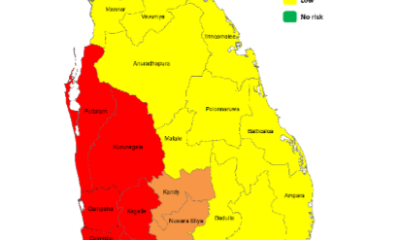
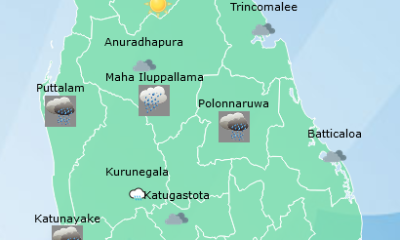
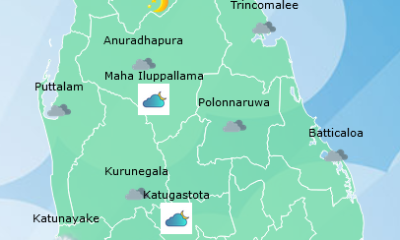
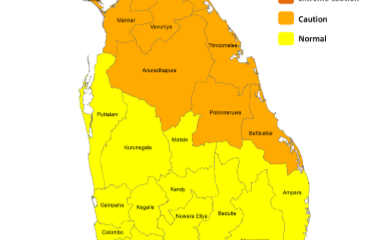
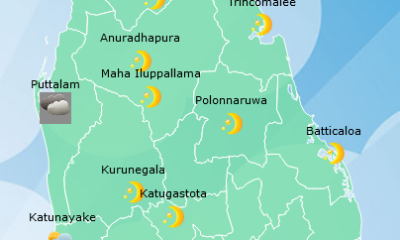
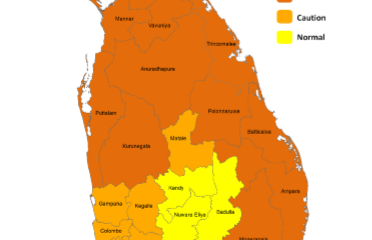
Heat index at ‘Caution’ level in North-western, Western and Southern provinces and Ratnapura and Mannar Districts
Heat index Advisory Issued by the Natural Hazards Early Warning Centre At 03.30 p.m. 29 February 2024, valid for 01 March 2024
The Natural Hazards Early Warning Center of the Department of Meteorology has warned that the Heat index (the temperature felt on the human body) is expected to increase up to ‘Caution’ level at some places in North-western, Western and Southern provinces and Ratnapura District.
The Heat Index Forecast is calculated by using relative humidity and maximum temperature and this is the condition that is felt on your body. This is not the forecast of maximum temperature. It is generated by the Department of Meteorology for the next day period and prepared by using global numerical weather prediction model data.
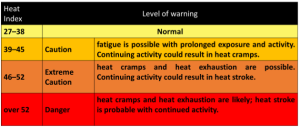
Effect of the heat index on human body is mentioned in the above table and it is prepared on the advice of the Ministry of Health and Indigenous Medical Services.
ACTION REQUIRED
Job sites: Stay hydrated and take breaks in the shade as often as possible.
Indoors: Check up on the elderly and the sick.
Vehicles: Never leave children unattended.
Outdoors: Limit strenuous outdoor activities, find shade and stay hydrated. Dress: Wear lightweight and white or light-colored clothing.
Note:
In addition, please refer to advisories issued by the Disaster Preparedness & Response Division, Ministry of Health in this regard as well. For further clarifications please contact 011-7446491

Latest News
Moscow hit by largest Ukrainian attack since start of Russia’s full-scale war
Moscow has come under the largest Ukrainian attack since the start of the full-scale war, with close to 200 drones hitting targets around the Russian capital and setting columns of thick smoke billowing high into the sky.
Seventeen people were wounded in the Moscow region, according to local governor Andrei Vorobyov.
Almost 1,000 drones and four Ukrainian cruise missiles were intercepted and destroyed across the country in 24 hours, Russia’s defence ministry was quoted as saying. An oil depot was struck in the southern Rostov region, where one person was killed.
Volodymyr Zelensky said Kyiv had once again hit the Moscow region with “long-range sanctions” – a euphemism for Ukrainian long-distance strikes on Russia.
“It’s time to end this war, and Russia must take the necessary steps in diplomacy,” he added.
He said the massive drone strike was in response to last week’s Russian attack on Kyiv, which set a major religious landmark ablaze.
“We don’t want this war and have never wanted it,” Zelensky said. “But if Ukraine burns, your Moscow will burn too.”
Fires broke out as the Kapotnya refinery in south-east Moscow was hit for the third time in a month and the second time this week, colouring the sky black with smoke. Numerous videos showed the lid of a large oil storage tank blown dozens of metres into the air by the force of an explosion.
A nearby shopping centre was also burning, reportedly after drone debris fell on the building, and several residential high-rise blocks were evacuated.
Moscow’s four airports were temporarily shut and more than 500 flights were cancelled or delayed.
Although local authorities across Russia have banned publication of images of the aftermath of drone strikes, dozens of videos were posted on social media showing drones flying across the sky in broad daylight and explosions over industrial areas on the outskirts of Moscow.
Four and a half years since Moscow launched its full-scale invasion of Ukraine, the war of attrition on the front line in Ukraine grinds on, out of sight for many ordinary Russians.
Kyiv’s long-range strikes on targets across Russia as well as Moscow and St Petersburg are an indication of Zelensky’s aim of “bringing the war home” to Russians.
Drone attacks on Moscow – about 500km (310 miles) from the Ukrainian border – have become more frequent as Kyiv has developed its long-range capabilities. Ukraine’s first successful drone strikes reached the Russian capital in spring 2023, although they were sporadic and rarely involved more than a handful of drones.
Since then, extensive air defences have been set up around Moscow – but the number of drones used by Ukraine in its attacks has also multiplied and some have penetrated those defences.
Meanwhile, Russia launched more than 200 drones and multiple ballistic missiles at Ukraine overnight, Kyiv said.
Vladimir Putin, who is hosting southeast Asian leaders for a summit in the central city of Kazan, has not commented on the large-scale attack on the Russian capital.
Writing on X, Ukrainian Foreign Minister Andriy Sybiha said: “One of the most popular questions asked by Muscovites this morning is ‘What is going on?'”
“I can answer. Your country started a war of aggression against ours. For years, it has been killing our people,” Sybiha wrote.
“Now that you know what’s going on, ask Putin when he is planning to end it.”
[BBC]
Business
Oil prices fall, stocks rally as US, Iran sign framework to end war
Oil prices have dropped following the United States and Iran’s signing of an interim peace agreement, resuming a slide interrupted by US President Donald Trump’s warning that he could restart his military campaign.
Brent crude fell 2.3 percent on Thursday in Asia, returning the international benchmark to near to where it was 24 hours previously
Brent futures for delivery in August stood at $77.73 as of 05:30 GMT, only about 7 percent higher than before the US and Israel launched their war on Iran on February 28.
After several days of declines, Brent briefly spiked above $81 a barrel on Wednesday after Trump warned that the US could “go right back to dropping bombs” on Iran if it doesn’t “behave”.
Shrugging off losses on Wall Street overnight, Asian stock markets rallied on renewed optimism for an end to nearly four months of disruption to global energy supply chains.
Japan’s benchmark Nikkei 225 and South Korea’s Kospi both hit all-time highs, gaining more than 2 percent and 1.7 percent, respectively.
Taiwan’s Taiex rose as much as 1.3 percent.
Hong Kong’s Hang Seng Index bucked the trend, dropping 1.7 percent.
US stock futures, which are traded outside of regular market hours and often foreshadow the next day’s performance, climbed, with those tied to the benchmark S&P 500 and the tech-heavy Nasdaq Composite climbing about 0.8 percent and 1.3 percent, respectively.
“Putting aside the contents of the MoU, markets are likely to be welcoming the fact that both the US and Iran signed it sooner than initially expected,” Norihiro Yamaguchi, lead economist for Japan at Oxford Economics, told Al Jazeera.
“The timing is also supportive, as the major central bank policy meetings have now passed, reducing a key source of uncertainty,” Yamaguchi said.
“For Asian markets, the renewed strength in US semiconductor stocks should provide an additional boost, given the region’s heavy exposure to tech shares.”

Pakistani Prime Minister Shehbaz Sharif, who mediated the negotiations between Washington and Tehran, said on Wednesday that the US-Iran memorandum of understanding (MoU) had entered into force with “immediate effect”.
Sharif said Iran would “instantly reopen” the Strait of Hormuz and the US would “immediately” lift its naval blockade of Iranian ports, though it was not immediately clear if the announcement had any effect on boosting maritime traffic in the critical waterway.
Shipping in the strait has been reduced to a fraction of peacetime levels due to the threat of Iranian missiles, drones and mines, as well as the US blockade.
The blockage has resulted in an estimated daily shortfall of 14 million barrels in the global oil market, according to the International Energy Agency (IEA).
Fabien Yip, a market analyst at IG in Sydney, said that while markets have responded to the MoU with optimism, the relief is “largely priced in” as practical issues such as the backlog of vessels in the Gulf and mine clearing operations must still be resolved.
“There is a notable divergence between sentiment and physical supply – production ramp-up and logistics normalisation will take time,” Yip told Al Jazeera.
While more than 500 vessels are estimated to be waiting to exit the Gulf through the strait, shipping companies have expressed concern about the lack of clarity on how to ensure the safety of their vessels and crews in the channel.
In a statement earlier this week, the Baltic and International Maritime Council (BIMCO), one of the world’s largest associations for shipowners, said the US and Iran had yet to provide information about “key aspects such as timings and safe routes”.
“Due to lack of details and a history of overly optimistic reassurances, we believe the security situation for the shipping industry remains volatile, and we still consider it very risky for ships to commence transits at this point,” Jakob Larsen, chief safety and security officer at BIMCO, said in a statement on Monday, responding to the initial announcement of the MoU.
“We advise shipowners to continue doing thorough risk assessments and appeal to all parties to put the safety of seafarers first.”
[Aljazeera]
Latest News
G7 leaders to boost Ukraine air defences, tighten sanctions on Russia
Leaders of the G7 have pledged at a summit in France to strengthen Ukraine’s air defences and increase pressure on Moscow’s war economy, including by tightening sanctions on the Russian oil and gas sectors.
“We, the Leaders of the G7, stand united in our unwavering support for Ukraine in defending its freedom, sovereignty, and territorial integrity,” a statement released on Wednesday said.
“To support and accelerate this new momentum, we agree to increase the delivery of air defence capacities, additional systems and interceptors, and long-range capabilities.”
They added that the bloc, which includes Canada, France, Germany, Italy, Japan, the United Kingdom, the United States and the European Union, was “ready to consider extending to Ukraine the benefit of licenses to allow for an increase in Ukraine’s military production”.
President Volodymyr Zelenskyy, who joined the summit on Tuesday and also held bilateral talks with US President Donald Trump and Secretary of State Marco Rubio, has been pressing allies for more than a year to allow Ukraine to produce its own interceptors because of a shortage of US anti-ballistic systems and interceptors.
The G7 said that following a deal between the United States and Iran to reopen the Strait of Hormuz, sanctions could be strengthened on Russian oil and gas.
“We commit to increase the pressure on the Russian war economy,” the leaders’ statement said.
“In this context, we will strengthen our sanctions, including those on the oil and gas sectors. We consider this the right moment to proceed with additional measures, as President Trump has delivered a deal that we support in reopening the Strait of Hormuz.”
Taking his seat on the final day of G7 talks on Wednesday, Trump told the assembled leaders: “I’m the boss.”
Trump had been widely viewed as sceptical about pursuing a peace agreement between Russia and Ukraine, but told reporters on Tuesday that he would try to help.
“Look, Russia should make a deal,” he said. “I settled eight wars. This was the one I thought was going to be the easiest to settle.” Trump’s claim to have ended eight wars has been widely disputed.
“There has been a change in position on the part of the United States and President Trump,” Canadian Prime Minister Mark Carney told reporters. “There is a position that is harder toward Russia and more realistic, in our view, of the situation on the ground of the war.”
Zelenskyy said he had received important commitments from the G7. “More air defence missiles along with licenses to produce them, winter support package, and cranking up pressure on Russia. Importantly, the US is ready to provide backstop across these lines of effort,” he wrote on X.
“It is key that everything discussed be implemented. Russia must come to learn that its war will never be normalised. I thank everyone who’s helping.”
The G7 welcomed the deal between the US and Iran, with Britain and France offering help with resuming maritime traffic.
“We reaffirm that the right of transit passage without restrictions or tolls is the bedrock of international trade,” the statement said. “We agree that the multinational, independent, and defensive initiative led by France and the UK can play an important role to facilitate the resumption of maritime traffic in the Strait of Hormuz by protecting merchant vessels, reassuring commercial shipping operators, and supporting verification that all mines are removed.”
The leaders also called for “an immediate robust ceasefire” in Lebanon, to enable “the Lebanese leadership’s efforts to achieve the disarmament of Hezbollah and the monopoly of arms, and to protect Lebanon’s territorial integrity and sovereignty with the appropriate international security guarantees”.
Later on Wednesday, in a central theme of France’s G7 presidency, leaders will turn their attention to critical minerals and global economic imbalances.
France is pushing partners to agree on a statement on critical minerals that could include measures to help the West reduce its reliance on China and shield investors from countermeasures and dumping, diplomats said.
G7 leaders were also due to discuss artificial intelligence over lunch on Wednesday. OpenAI founder Sam Altman and Anthropic CEO Dario Amodei were expected to attend.
[Aljazeera]
-
News6 days agoCIABOC summons Yoshitha over his participation in British Navy training programme
-
News4 days agoRelease of 2025 O/L results likely to be delayed
-
News6 days agoJustice Minister responds to social media claims he represented Easter Sunday ringleader
-
Sports4 days agoTharanga set for high-profile javelin clash in Ostrava
-
Features5 days agoPolitics of protected species
-
News2 days agoBeijing Capital Airlines to resume flights to Colombo signalling boost to tourism
-
News3 days agoTheft of USD 2.5 mn from Treasury: CoPF accused of complicity in NPP cover-up
-
News5 days agoCommonwealth lawyers urge Lanka to uphold rule of law