
Sports
Bridge: Connecting people, challenging minds

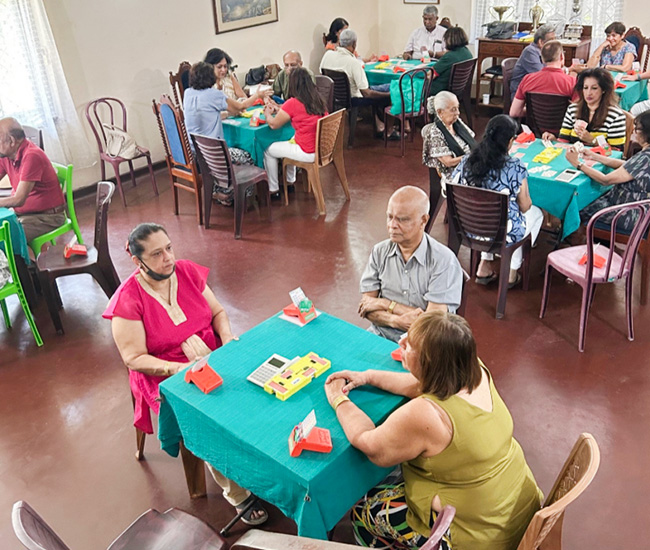
The sport of Bridge arrived in Sri Lanka during the period of British colonial rule. It quickly spread amongst the elite society of Colombo and amongst the rich planters in the upcountry regions. The sport continues to immerse many intellectuals and professionals today. However, few are aware of the virtues that have propelled the game to be recognized by the International Olympic Committee as a sport. Although assisted by a pack of cards Bridge is by no means a mere card game. ‘’It is more similar to the game of chess,’’ says Rex Perera who runs a Bridge Center in Colombo. Chess is more linear, Bridge on the other hand, maneuvers one’s mind in many directions and provides a well-rounded experience, he adds.
In recent years, Bridge has resurfaced into prominence, amongst players the world over. The game requires intellectual acumen, strategic thinking, and precision in execution enabling the sharpening of players’ minds. The International Mind Sports Association is currently trying to elevate Bridge to the status of a medal event in the Olympics.
“It is time that we in our small nation also rise and join this movement,’’ says Rex Perera, a ‘Grand Master’ in bridge. A few years ago, his passion for the sport led Perera to establish the Vajira Bridge Centre for the sole purpose of teaching and conducting tournaments for bridge players. Situated in a peaceful setting at no. 141 Vajira Road, Colombo 5, the Centre is easily accessible via private or public transport and has ample parking space. ‘’We have an open space and welcome both old and young people players including those who would like to learn the sport’’.
Benefits for the young
“At present the education system in Sri Lanka is mostly insular and is slow to promote free thinking. This mind sport on the other hand encourages a young mind to think logically, analytically and most importantly make educated well thought out conclusions in a short time period,” says Perera.
It also improves the arithmetic knowledge, of the competitor, who is compelled to calculate the points each player around the playing table holds in his /her hand whilst the game is in progress. Another benefit is that it encourages social interaction, respect and tolerance towards the opponents and partner, a good discipline that the player can take forth into his or her community.
Bridge is a partnership game and is played by four participants. The persons on ones right and left are the opponents. The aim is to gain the optimum number of tricks using tact and manipulation. This sport is affiliated and categorized as a mind game and tournaments are conducted internationally. There is no age limit or category, all ages are eligible for participation.
This mind game is a good opportunity for parents who are looking to further the experience of their children, as this avenue has been relatively obscure to young ones, and not many youngsters are involved in the game. “This is an opportunity to encourage children so that they too can represent the country in Bridge, and let the lion flag unfurl in lands far ashore, says Rex Perera.
Benefits for the elderly
As people age, a fair amount of the population tends to become lethargic in brain activity. Their analytical prowess and memory decline mainly due to the lack of metal stimulation after retirement. Recent findings have indicated that Bridge can help fight illnesses such as Alzheimer’s and dementia, thus benefitting older players. Bridge is therefore a very good buddy to keep the brain cells ticking.
“In our own experience, we have found some daily participants at the centre who have been diagnosed with early stages of dementia but have found themselves much improved after a couple of months play,” says Rex Perera.
Ready to bridge
The Vajira Bridge Centre is well equipped and can accommodate over 40 players at a time. The facilities meet high standards with the availability of online result sheets, the latest computer software and equipment, as well as cutting edge teaching. It currently has over 100 members. The center is open every day and tournaments are conducted on Saturdays. It also serves as a gathering place and social center for the bridge playing community. Members have bridge excursions, around the country, at least once every few months, enabling members to spend time together and bond.
You can learn more about the Vajira Bridge Centre on their website: www.bridgewebs.com/vajira.
Details about activities and tournament results are posted every playing day on the website. Online tournaments are conducted on Bridge Base Online (BBO) on an American platform; every evening at 6.30pm, under the name Big Rexy.
Gamini Kannangara


An animal rights group is urging Crystal Palace to retire their live bald eagle mascot with immediate effect, saying a “bright stadium filled with boisterous fans is no place for animals”.
In a letter to Palace CEO Sharon Lacey, People for the Ethical Treatment of Animals (Peta) asked the Premier League club to stop using the eagle, named Phoenix, in pre-match displays at Selhurst Park and to never use live animal mascots again.
The London team, known as the Eagles since 1973, introduced a live eagle to matchdays in 2010. Kayla, who died in 2020, performed the role for 10 years and her replacement Phoenix made her debut against West Ham in August 2024.
Peta says birds can become “frightened, disoriented and panicked” in stadium environments, putting themselves and fans at risk.
Using them for displays and entertainment also denies the animals, who “would naturally avoid humans”, the opportunity to engage with their natural instincts, leading to “frustration and stress”, the group said.
The organisation has “detailed records” of incidents involving live mascots, including birds, being injured or killed in collisions with walls, windows and match balls, as well as a falcon embedding its talons in a spectator’s scalp after landing on his head.
In 2017, a Charlton Athletic fan was found guilty of trying to punch Kayla the eagle at a League Cup fixture two years earlier.
“Many professional sports teams use only willing humans as mascots and the club already has Pete the Eagle to excite the crowd,” said Dr Carys Bennett, Peta’s senior corporate projects manager.
“Bald eagles are widely recognised as symbols of freedom. They deserve better than to be used as an entertainment prop to amuse the Eagles’ fans.
[BBC]

Without Mark Chapman and Rachin Ravindra, the hosts have a top-three spot for Devon Conway. They have as many as six seamers in the squad to pick from, with Glenn Phillips and Michael Bracewell offering part-time spin in a fairly stacked bowling attack.
[Cricbuzz]
Latest News
Bangladesh and Nepal to host Women’s Under-19 T20 World Cup from January 21 to February 6


Four venues in Bangladesh and Nepal will host the 2027 Under-19 Women’s T20 World Cup, which is set to run from January 21 to February 6. Chattogram, Sylhet, Kirtipur and Mulpani are the four venues, with Chattogram set to host the two semi-finals on February 4 as well as the final on February 6.
The 16-team event will feature four groups of four teams each, with the group stage set to be followed by a two-group Super Six stage, and then the semi-finals and final.
This is the third edition of the tournament, with India having won the first two back-to-back in 2023 and 2025. The defending champions have been drawn in group A alongside Ireland, West Indies and Nepal. Group B has 2025 runners-up South Africa as well as New Zealand, Pakistan and Samoa.
Australia, Bangladesh, Nigeria and UAE make up Group C, while England, Sri Lanka, USA and Scotland have been drawn in Group D.
The tournament will kick off with four matches on January 21, with Sylhet hosting Bangladesh vs UAE and Australia vs Nigeria, and Mulpani hosting Sri Lanka vs Scotland and England vs USA. The other two venues and other eight teams will be involved on January 22: New Zealand vs Samoa and South Africa vs Pakistan in Chattogram, and Nepal vs Ireland and India vs West Indies in Kirtipur.
All 41 games of the tournament will be played during the day. Morning matches will begin at 9.30am local time, and afternoon games at 1.30pm local time.
“The ICC U19 World Cup is the stage that showcases the future of our sport and serves as the ultimate platform for young players to make the leap towards elite careers representing their countries,” ICC CEO Sanjog Gupta said. “These future stars representing 16 teams will garner the world’s attention and become relatable role models for many young girls playing the sport, serving inspiration for their continued cricket journeys.
“The choice of our hosts – Bangladesh and Nepal – is also reflective of the ICC’s belief and investment in the future of the cricket ecosystem. With deep passion for cricket and nearly 40% of the two countries’ populations below the age of 20, they serve as the ideal hosts for one of the world’s biggest youth sporting events.”
(Cricinfo)

Crystal Palace urged to retire bald eagle mascot

Little time to unpack as India open in Christchurch

Senior England players to miss Sri Lanka T20Is for WPL 2027

Bangladesh and Nepal to host Women’s Under-19 T20 World Cup from January 21 to February 6

Showers above 100 mm are likely at some places in the Western, Sabaragamuwa, Central, North-western, Northern and Southern provinces and in Anuradhapura district.

Low-quality coal causes power cuts: Ex-LECO Chief

‘Dates have the highest sugar content to fight Coronavirus’

Sunday Island 27 December – Headlines

#SundayIsland 17th December – Headlines

Sunday Island – 28th March

Sunday Island Headlines – 21 March

Sunday Island – 21st February – Headlines
-

 Features4 days ago
Kotahena:A Small Enclave, An Extraordinary Legacy
-
 News5 days ago
Asgiri Mahanayake calls for immediate release of Gnanasara Thera
-

 News3 days ago
Record 1,600 students take Russian Classical Ballet examination in Sri Lanka
-

 News7 days ago
AC President recuses himself from hearing prison attire case pertaining to Gnanasara Thera
-

 News6 days ago
Naval officer testifies Yoshitha received Rs. 5.15 mn in salaries during SLN service
-

 News4 days ago
Karannagoda pushed for £24,536 for Yoshitha’s UK training, Court told
-

 Editorial6 days ago
Saving Anojan: Beyond Executioner’s Blade
-

 News7 days ago
CID informs Fort Magistrate’s Court investigation into money laundering case against Namal completed