
News
Chung stresses need to stabilise business environment here ahead of national election

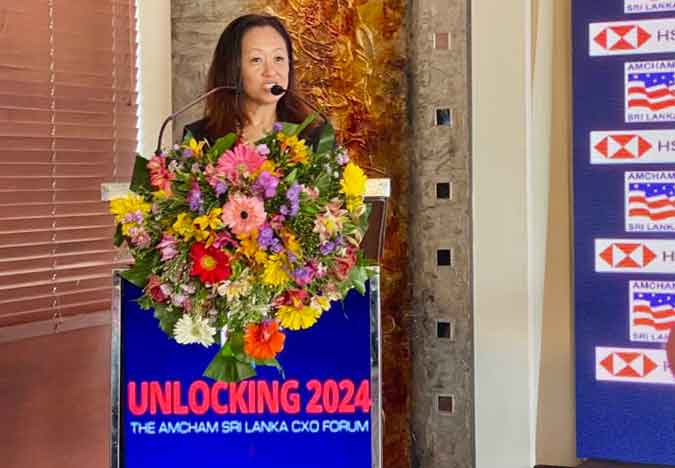
… asks for transparent governance with zero corruption
Reminding that the US and Sri Lanka will have national elections this year, US Ambassador Julie Chung recently emphasised the responsibility on the part of relevant authorities to stabilise the business environment here.
Pointing out a resurgence of interest in two-way investment, Ambassador Chung underscored challenges ahead that will require leadership. She invited Sri Lankan companies to explore ways and means of investing in the US by attending the SelectUSA Investment Summit in June at Baltimore’s national Harbour.
Ambassador Chung said so at Amcham CXO Forum “75 years and Beyond: US– Sri Lankan Business Relations in 2024”
The US Ambassador said: “As leaders, we need to think about both the medium-term and the long-term. In the medium term, we need to create an environment that’s conducive to trade, investment, and business expansion. One with transparent governance, where corruption is no longer tolerated.
In the long-term, we need to raise up a generation of leaders to take our place. There are several ways we should be doing this. Prabhash Subasinghe provides one example: he brought his daughter Saanya into GRI’s marketing leadership. Saanya was educated in the United States, at my alma mater Columbia University, and returned to Sri Lanka to work with GRI. I had the chance to talk with her about six months ago at the U.S. Embassy, where we talked about empowering women leaders. And Harry Jayawardena has similarly recruited his daughter Stasshani to work with him at Aitken Spence.
Stasshani, another impressive up-and-coming leader whom I’ve also met with, is another beneficiary of U.S. training and education. Other leaders are looking to middle ranks to find successors to mentor. Every one of our organizations needs to think more about tomorrow’s leaders. To do that, we need to use our proactive priority-setting power to drive our organizations to identify and train future leaders – both women and men– at all levels. They will, after all, inherit the world we have worked so hard to build.
Commenting on a major US investment in Colombo, Ambassador Chung said: “Just a few months ago, we were proud to announce the International Development Finance Corporation’s investment of $553 million in the Western Container Terminal at the Port of Colombo. Why was this so incredibly important? Beyond the large dollar amount, which is DFC’s second largest exposure in the entire Indo Pacific region; beyond the critical injection of private sector financing this country needs; beyond the confidence building signal it sends to potential investors and financiers that we believe in Sri Lanka’s future, it demonstrates the United States’s continuing commitment to the prosperity of Sri Lanka.”
She also dealt with the challenges posed in the wake of Sri Lanka’s agreement with the IMF. “The commitments required by the IMF as part of the Extended Fund Facility programme call for government reform measures in both tax compliance and combatting corruption. These are hard steps, and not always popular. Sri Lanka has taken difficult measures to put the country on a long-term sustainable footing and comply with the IMF commitments. But the people of Sri Lanka deserve and continue to demand openness, transparency, and accountability from their leaders as the process of reforms moves forward.
The new higher VAT rates have been a hit on the average Sri Lankan and your businesses. We understand that while there may be short term necessary pains, the public deserves to know that such measures are being taken looking at the wholeness of the problem and endemic issues that must be addressed in a structural, sustainable way, fair and transparent to all.
That includes not just raising taxes but eliminating tax loopholes, addressing government inefficiencies, particularly in state owned enterprises. It means digitalizing customs to raise revenue and reduce corruption. Creating predictable customs duties and streamlined processes would encourage importers, who want to import more to Sri Lanka but are worried about the uncertainty in the import process. Unpredictable customs fees discourage importers and limit the amount of customs revenue the Sri Lankan government can collect.
This shifts the burden of tax revenue further onto the shoulders of the people, who can’t bear much more. Earlier this week, I met with the National Chamber of Exporters who relayed some of their challenges – red tape, regulatory challenges, and unpredictability that impact their businesses. Exports and private sector growth will be the engine of recovery, but they need the space and support to thrive. As the largest export market for Sri Lanka, the United States can help be part of the solution.”
She advised the Wickremesinghe-Rajapaksa government on the need for reforms while urging the leadership to be mindful of public concerns. She said: “It’s important that the government of Sri Lanka carry out reforms. But it’s also important to explain those reforms to the people in a clear manner. It makes for slower, but better legislation and reforms. One example is the Online Safety Bill. The Centre for Policy Alternatives reported from a poll earlier this month that more than 70 percent of Sri Lankans were unaware of the Bill before its passage.
When major global tech companies characterize the Bill as “unworkable” and stifling innovation and democracy, instead of actually addressing online crimes, frankly this sends a negative signal in Sri Lanka’s path towards reform and recovery. Previous bills, such as the Personal Data Protection Act, took much longer to craft, but did a better job of taking stakeholder feedback into account. To work on legislation and reforms that will be durable, enforceable, and wise, the Sri Lankan government will need to do better in the future. This will be key to improving the business climate.”





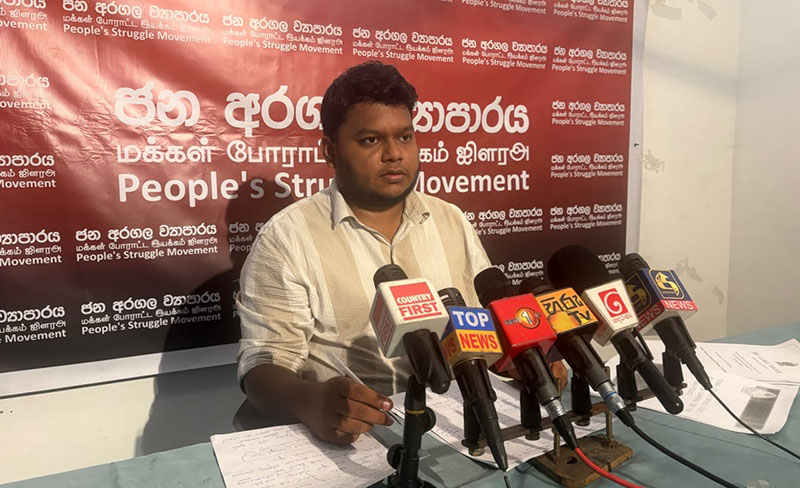
People’s Struggle Movement activist Wasantha Mudalige yesterday alleged that there were serious irregularities in the tender process initiated to purchase 500 body cameras for police officers and called for the procurement process to be cancelled and restarted.
Addressing a press conference at the Frontline Socialist Party headquarters in Nugegoda, Mudalige said the decision to equip police officers with body cameras was necessary, but questioned the manner in which the procurement process was being conducted.
He said body cameras should not be limited to police officers performing duties outside police stations, pointing out that security cameras were also needed inside police stations, amid continuing reports of alleged torture and deaths following assaults in police custody.
Mudalige claimed that the tender document contained several technical shortcomings and alleged that parts of its Terms of Reference (TOR) appeared to have been generated using artificial intelligence.
He questioned why such content had not been reviewed and corrected before the document was issued, saying technical specifications should have been carefully prepared, based on the requirements of the Sri Lanka Police and international standards.
He also cited what he described as a significant disparity in the prices quoted by bidders, ranging from around Rs. 50 million to Rs. 360 million for the 500 cameras.
While a state-owned telecommunications company had reportedly submitted a bid of around Rs. 170 million, Mudalige said a subsidiary of the same entity had submitted a bid of approximately Rs. 60 million.
He argued that the wide variation in bids raised questions about whether the technical specifications and required standards had been adequately defined.
Mudalige also questioned why only 500 cameras were being procured and whether the project was intended as a pilot scheme before a larger procurement.
He further raised concerns about the proposed provision of internet facilities for the cameras and questioned the involvement of a company, he alleged, was linked to a government digitalisation adviser.
Mudalige said this could raise a potential conflict-of-interest issue and questioned whether the procurement was connected to the government’s wider digitalisation programme.He called for the tender to be cancelled and a fresh procurement process initiated following a thorough review and consultation with technical experts.
By Norman Palihawadane
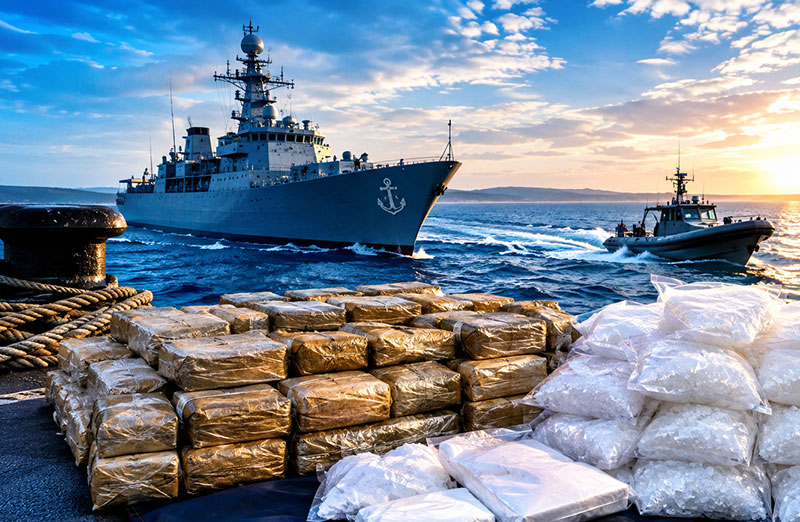
The Navy has seized nearly 81 kilos of narcotics with a street value of Rs. 1.5 billion, during a special operation off the Kusumanthurai coast in Mathagal, in the North, Deputy Defence Minister Aruna Jayasekara said yesterday.
Addressing a special media briefing on the seizure, Jayasekara said the narcotics haul comprised nearly 35 kg of heroin and around 45 kg of crystal methamphetamine (‘Ice’).
He described it as the largest drug seizure made in the North in recent years.
Jayasekara said narcotics seized by the Navy during operations in 2025 had an estimated street value of around Rs. 75 billion, while the street value of drugs seized so far this year stood at approximately Rs. 56 billion.
Navy Commander Vice Admiral Damien Fernando said the latest operation had been launched following intelligence received by the Northern Naval Command.
Several teams, including personnel from the Sri Lanka Naval Ship Agbo establishment, and the Deployment Division, took part in the operation, he said.
Fernando said the seized narcotics had been handed over for further examination with the assistance of the Police Narcotics Bureau in Jaffna.
He said the Navy was conducting anti-narcotics operations through specialised teams and would further intensify such operations.
The Navy was operating in a complex environment and planned to make greater use of technology in future operations, Fernando said.He added that the Navy was already receiving the equipment required for this purpose, enabling it to expand the scope of its operations.

By Norman Palihawadane
Two people were killed when unidentified gunmen opened fire on a three-wheeler in the Halpathota area of Baddegama, yesterday morning, police said.
The three-wheeler was travelling from Baddegama towards Ambalangoda when a car, carrying the gunmen, reportedly blocked its path and one of the assailants opened fire with a T-56 rifle.
The driver of the three-wheeler was killed on the spot, while two women, travelling in the three-wheeler, sustained serious injuries.
One of the injured women died after being admitted to the Baddegama Hospital. The other woman was transferred to the Galle National Hospital, where she is receiving treatment in the Intensive Care Unit (ICU), a hospital spokesperson said.
All three victims were reportedly residents of Ambalangoda. The deceased woman was pregnant, according to police.
The victims were returning after appearing before the Galle Crime Division in Baddegama to record their signatures in connection with a bail condition in a narcotics case, pending before court, police said.
The gunmen fled the scene after the shooting. CCTV footage has reportedly captured the attack, including the gunman getting out of the car and opening fire at the moving three-wheeler.
Two police teams have been deployed to investigate the incident and identify and apprehend those responsible.

Mudalige alleges irregularities in police body-camera tender

Navy seizes Rs. 1.5 bn drug haul off northern coast

Two killed in Baddegama shooting

From Marx to Modi: JVP heads to BJP

The 22nd Amendment, constitutional recovery and illiberal slippage

Commercial Bank scales up ADB credit line to empower Jaffna SMEs

‘Dates have the highest sugar content to fight Coronavirus’

Sunday Island 27 December – Headlines

#SundayIsland 17th December – Headlines

Sunday Island – 28th March

Sunday Island Headlines – 21 March

Sunday Island – 21st February – Headlines
-
 News5 days ago
Mastermind Naufer Moulavi among 15 found guilty
-
 News7 days ago
Mahaweli rises as heavy rain triggers flood, landslide fears
-
 News6 days ago
Protest against setting up of cement factory in highly populated area near BIA
-
 Midweek Review5 days ago
Thileepan’s fast unto death: An authentic narrative that many missed
-

 Latest News4 days ago
Showers above 100 mm are likely at some places in the Western, Sabaragamuwa, Central and North-western provinces and in Galle and Matara Districts
-

 Editorial6 days ago
Trouble beginning in earnest
-
Editorial5 days ago
Big Bad Bills
-

 Weather7 days ago
Showers about 100 mm are likely at times in the Western, Sabaragamuwa and North-western provinces and in Galle, Matara, Kandy and Nuwara-Eliya Districts