
News
Economic crisis: Treasury Chief frowns on home-grown remedy tried by GR regime


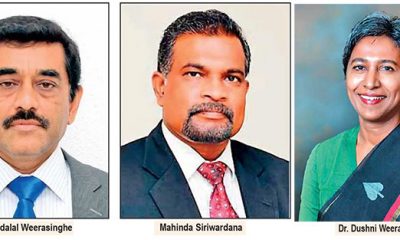
Secretary to the Treasury and Finance Ministry Mahinda Siriwardana has said that even if Sri Lanka achieves the goal of zero corruption, tax revenue will still have to be increased to bridge the budget deficit and lessen the country’s debt burden.
Referring to the Supreme Court ruling pertaining to economic management delivered on Nov 14, 2023, Siriwardena said it was imperative that elected representatives and state officials ensure proper econmic management.
Pointing out that Sri Lanka’s government revenue as a percentage of GDP had been as low as 8.3 percent in 2021, Siriwardana said that the situation was so bad that the government found it difficult to meet day-to-day expenses.
The SC judgment had said the state officials under any circumstances couldn’t absolve themselves of the responsibility for acting in the best interests of the public and were entrusted with significant powers to uphold public trust, requiring them to adhere to the directives of the Constitution, Siriwardana said.
The Treasury Secretary said so delivering the inaugural Prof. K. Dharmasena memorial lecture at the Kelaniya University on Monday (Jan 30) close on the heels of undergraduates storming the main administrative building there to protest against a planned visit by President Ranil Wickremesinghe the following day.
Siriwardana succeeded S.R Attygalle in early April 2022 amidst the worst-ever economic crisis.
The Treasury Secretary explained why President Gotabaya Rajapaksa’s government had failed to secure a Rapid Financing Instrument (RFI) at the early staes of the crisis.
Although President Gotabaya Rajapaksa sought RFI from the International Monetary Fund (IMF) in April 2020, five months after being elected, his administration failed to accept the IMF prescribed immediate debt restructuring. Instead of adopting a strategy of macroeconomic reforms to restore fiscal and external buffers supported by the IMF, the government had opted for what Siriwardana called a home-grown solution.’
Sri Lanka sought RFI in the wake of significant tax reforms with sharp reductions in VAT (Value-Added Tax) and income tax rates and large increases in tax free thresholds. “When taxes were reduced at the end of 2019, nobody questioned how public services would be funded. The result was an unprecedented escalation in debt, leading to this economic crisis.
Siriwardana pointed out that for want of cohesive corrective measures to address the issues at hand, credit ratings continued to deteriorate. By September 2020, Moody’s had downgraded Sri Lanka to Caa1, Fitch downgraded Sri Lanka to CCC by November 2020, and S&P downgraded Sri Lanka to CCC by December 2020, Siriwardana pointed out.
“There have been long-standing structural weaknesses in the Sri Lankan economy which have been neglected for many decades, given the pain associated with remedying these issues. The weaknesses include fiscal sector imbalances, inadequate external policy buffers, financial and monetary sector vulnerabilities, deficiencies in governance, and shortcomings in the legal and institutional framework in the country. The recent external shocks faced by the country, including the Easter Sunday attacks, the COVID-19 pandemic, the Russia-Ukraine conflict, coupled with significant domestic policy errors, exposed these macroeconomic vulnerabilities and triggered the prevailing economic crisis.”
In macroeconomic terms, the crux of the problem has always been the persistent twin deficits – budget deficits in the fiscal account and current account deficits in the balance of payments (BOP) accounts, Siriwardana added.
The Treasury Secretary said that the country should have changed its unsustainable practices, beginning 2006/2007, when the opportunity to access concessional foreign financing diminished in the wake of Sri Lanka’s per capita GDP crossed the middle income threshold. Instead of gradually and significantly reducing its deficits and borrowing requirements, the then government shifted to commercial borrowings, primarily in the form of international sovereign bonds (ISBs). “Most of these bonds have up to a 10-year maturity periods, so, until around 2019, Sri Lanka did not face much difficulty in terms of repayment pressures for external debt.”
Siriwardana also discussed the often raised issue of whether ISBs caused the debt crisis. In fact, the government at the time made a conscious decision to raise additional funds amounting to USD 2.4 billion in long term ISBs to ensure Sri Lanka would have sufficient reserve buffers to get through a period of volatility amidst the election cycles of 2019 and 2020, Siriwwardana said. ” There have been claims that this increase in ISB borrowings was a cause of the debt crisis – however in reality, it was the additional reserve buffers created by those ISBs that enabled the government to avoid a crash in the economy during the worst of the COVID-19 pandemic.
“The government maintained primary surpluses in 2017 and 2018, indicating that the ISB borrowings were not driven by budget deficits, but in order to build up reserves and to improve the quality of reserves by converting maturing short term debt into longer term stable instruments such as ISBs and syndicated loans. The fundamental drivers of the economic crisis were fiscal and debt unsustainability, whereas ISBs were just one of many financing instruments.”
Siriwardana said: “There have been various theories as to what caused the economic crisis, including the COVID-19 pandemic, ISB borrowings, the Debt Standstill policy. However, it is clear that the fundamental cause has been long standing macroeconomic vulnerabilities and domestic policy errors. There have also been various alternative proposals and theories as to how the country can recover without the citizens having to bear a burden. But, we have seen today that measures such as asset recovery, collection of taxes in arrears, elimination of corruption, while all being essential actions, do not serve as an alternative to the macroeconomic reforms being implemented today. Those are reforms that were known to all of us for years if not decades. But, those much needed reforms were delayed mainly due to political reasons. In the past, and up to now, the present generation lived a better life by borrowing thereby sacrificing the lives of the future generations.
“However, it is critical to understand that now we have come to a situation where the present generation should make sacrifices for the betterment of the lives of the future generations.” (SF)




News
China, Lanka intensify cooperation to fight cross-border crimes spreading across Asia and beyond


China and Sri Lanka have intensified joint law enforcement efforts to combat cross-border online gambling and telecom fraud, crimes that authorities warn are increasingly spreading across Asia and beyond.
The Chinese Embassy in Colombo said both countries are working closely to dismantle scam centres and fraud networks that have relocated to Sri Lanka from other parts of Southeast Asia. The Embassy noted that such operations often intertwine with human trafficking and other serious crimes, posing grave risks to public security and social stability.
China’s position on cross-border gambling remains firm: Chinese capital is prohibited from investing in overseas casinos, citizens are barred from operating them, and foreign casinos are forbidden from soliciting Chinese nationals. The Embassy stressed that gambling “almost invariably leads to financial ruin,” with tens of thousands of Chinese citizens suffering losses and harm. Recent amendments to China’s Criminal Law have criminalised cross-border gambling activities.
The Embassy pointed out that Sri Lankan authorities have carried out multiple raids in recent months, dismantling gambling and fraud dens and arresting suspects from several countries. Several Chinese nationals, involved in fraud-related crimes, have been handed over to Chinese authorities, producing what officials described as a strong deterrent effect.
The Chinese Embassy praised the efforts of Sri Lanka’s ministries of Foreign Affairs, Finance, and Public Security, particularly immigration and police officials, for their cooperation.
It warned that without firm and immediate measures, the spread of illegal gambling and fraud could damage Sri Lanka’s international image, undermine social stability, and harm the safety and security of its people.
China has already conducted similar law enforcement cooperation with countries including Spain, the UAE, Myanmar, and Cambodia, leading to arrests and repatriations of overseas fraud suspects. It has also proposed the creation of an international alliance against telecom and online fraud to coordinate global efforts, it said.
Going forward, China pledged to actively implement the Global Security Initiative and Global Civilization Initiative, while continuing to deepen law enforcement and security cooperation with Sri Lanka.
The Embassy said these efforts aim to safeguard lives and property, protect financial security, and build a “clean, safe, and beautiful Sri Lanka,” while contributing to a new global framework for combating transnational crime.

An assistant manager and a security officer, attached to a state bank branch in Horana, have been arrested in connection with the robbery of more than Rs. 30 million that was being transported to replenish automated teller machines (ATMs), Police said.
The two suspects were taken into custody on Friday after statements were recorded from them regarding the incident, which occurred on Wednesday afternoon at the Horana branch of the People’s Bank.
According to Police, a bank employee was carrying two bags containing cash through the rear entrance of the bank at around 2.45 p.m. when an individual, who had arrived on foot, allegedly snatched the bags and fled the scene.
The stolen money, amounting to approximately Rs. 30.5 million, had been prepared for distribution to ATM machines and transportation to other bank branches. Earlier reports had estimated the loss at around Rs. 35 million.
Investigators subsequently arrested a suspect believed to have been directly involved in the robbery and recovered Rs. 17 million of the stolen cash.
Police have not disclosed the exact circumstances that led to the arrest of the assistant manager and security officer but said investigations uncovered information linking them to the incident.
The Western Province North Crime Division is conducting further investigations to determine whether additional suspects were involved and to recover the remaining stolen money.
The daring daylight robbery has raised concerns over security procedures employed during transportation of large sums of cash to/from banking institutions.Further investigations are continuing.
by Norman Palihawadane
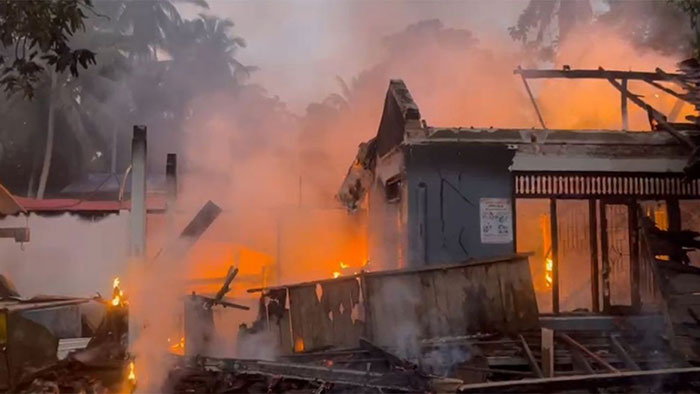
The death toll from the fire at an elders’ home in Batagoda, Anguruwatota, has risen to 13 after another resident succumbed to injuries while receiving treatment at the Horana Hospital, Police said yesterday.
Six others remain hospitalised with serious injuries.
The fire, which broke out on June 3 at the facility housing nearly 70 elderly residents, left 10 people dead on the spot after they were trapped inside the building, according to Police. A total of 51 occupants were rescued as firefighters brought the blaze under control.
Following the incident, approximately 50 survivors were initially accommodated at Batagoda Junior School before being relocated, with the assistance of Sri Lanka Army personnel, to another branch of the same care organisation in Galpatha.
Police said a Magistrate’s inquiry was conducted at the scene on June 4, during which burnt remains were recovered, under judicial supervision.
Meanwhile, the director of the elders’ home was arrested in connection with the incident and produced before the Horana Magistrate’s Court. He was remanded until June 11.Investigations are continuing into the cause of the fire.
by Norman Palihawadane

Anthropic urges AI labs to pause, warns humans risk losing control

Iran footballers issued US visas for World Cup, says White House

Showers will occur at times in the Western, Sabaragamuwa and North-western provinces and in Galle, Matara, Kandy and Nuwara-Eliya districts

China, Lanka intensify cooperation to fight cross-border crimes spreading across Asia and beyond

Asst. Manager, security officer arrested over Rs 30 mn snatch at Horana PB branch

Anguruwatota elders’ home fire death toll rises to 13

‘Dates have the highest sugar content to fight Coronavirus’

Sunday Island 27 December – Headlines

#SundayIsland 17th December – Headlines

Sunday Island – 28th March

Sunday Island Headlines – 21 March

Sunday Island – 21st February – Headlines
-

 News4 days ago
Lankan duo emerge winners in Latin dance championship held in Blackpool, UK
-

 Business5 days ago
IMF’s unstated rate:Sri Lanka’s $695m loan costs about 5.33% per annum
-

 Latest News2 days ago
Kusal Mendis, Pathum Nissanka, bowlers put Sri Lanka 1-0 up
-
 News2 days ago
New US tariffs proposed on 60 countries, including Sri Lanka
-

 Business5 days ago
Sri Lankan scientist-innovator Milinda Edirisinghe introduces AI-integrated gem testing system to gemological world
-

 Features6 days ago
Are threats to Buddha Sasana external or from within?
-

 News5 days ago
UNP challenges NPP move to amend Vihara – Devalagam Act
-

 News4 days ago
Sri Lankan teen killed in Chennai clash; three arrested