
Sports
Foakes brings back memories of a painful series loss


by Rex Clementine
Who is your favourte England wicketkeeper? Godfrey Evans, Jim Parks, Alan Knott, Bob Taylor, Bruce French, Jack Russell and Alec Stewart have all had their moments and left an indelible mark in the sport. But the gloveman to impress us most in recent years is Ben Foakes. The Surrey keeper has made a comeback into the England side in the ongoing Test series against India.
Foakes debuted against us in that 2018 series. He was in Galle only to make up numbers we thought. But injury to Jonny Bairstow meant that he was a last minute replacement. The Sri Lankan camp was perhaps relieved for Bairstow was a proven player and obviously a rookie like Foakes would struggle on debut that too in Galle where conditions for wicketkeepers in particular are demanding.
But how well Foakes adapted. First there was a hundred on debut and then he showcased his neat glove work. He was Man of the Match as England won in Galle. Subsequently when Bairstow returned, the gloves weren’t taken away from Foakes. He was retained and made quite an impact effecting ten dismissals and scored 277 runs, most by a batter from either side. That won him Player of the Series award. How did his opposite number Niroshan Dickwella fare – eight dismissals and 128 runs! You expected much more from Dickwella, given his experience and that he was playing on home turf. Not to be so.
Not that Foakes’ batting was exceptional like that of Adam Gilchrist’s when the Aussies were here in 2004 or similar to that of Andy Flower’s when Zimbabwe toured Sri Lanka in 2001.
Foakes’ batting was effective as he stitched some valuable partnerships with the tail and was spot on with his recommendations to the captain with reviews. Dickwella on the other hand was awful with his reviews. Often, Sri Lanka found that their reviews were exhausted even before Rangana Herath, their best bowler came into the attack.
Foakes survived several chances as Sri Lanka had run out of reviews and were not in a position to overturn a decision. He made Sri Lanka pay, dearly.
Sadly, the team failed to address their review problems throughout the series. Dickwella was too impulsive with his calls and a vital aspect of the modern game was dismayingly overlooked. The press brought up the issue with the coaching staff, but flimsy excuses were given and the burning issue was buried under the carpet. The result, Sri Lanka suffered a humiliating 3-0 whitewash.
Dickwella’s horror reviews played a pivotal role in Sri Lanka losing all three Tests. The Head Coach was more worried that his bowlers weren’t creating opportunities. He was wrong. The bowlers were creating enough chances but there were umpiring errors. Sri Lanka simply didn’t have the means to get decisions in their favour for their keeper had busted all reviews too early in the innings. It wasn’t smart cricket at all. No body could get the keeper to reign in his instincts.
When Dickwella first came into the side, a bright future was predicted for him. He had good pedigree as Trinity College had won several titles under his captaincy including the Big Match. The sight of him unafraid and prepared to scoop Kagiso Rabada’s 150kmph thunderbolts were further proof that here was a special player. There were sparkling cameos but not match winning ones. The early promises remained unfulfilled although his keeping was largely flawless.
In fairness, the selectors, the team management and captain Dimuth Karunaratne gave him the long rope hoping that he will turn a corner soon as they had invested on him quite heavily. However, the patience ran out when the team toured New Zealand not so long ago and Dickwella was eventually dumped. Today he is not able to represent the country in any format. His was another case of talent not making the most. There are many of them that have gone down the drain.
In Dickwella’s case in particular it is quite puzzling that he could not get his act together. To start with he is a smart young man and represents a club where players have largely remained grounded. The culture at NCC is such that they mentor their players well. Club stalwarts like Ranjit Fernando and Leo Wijesinghe are father figures while former captains like Ranjan Madugalle, Aravinda de Silva, Hashan Tillakaratne and Kumar Sangakkara are ever willing to help young players. Sadly, they missed out on Dickwella.













Javelin thrower Themiya Thabrew led a strong contingent of emerging athletes who bettered qualifying standards for the World Athletics Under-20 Championships during the Junior National Athletics Championships, which concluded at Diyagama on Thursday.
Thabrew produced one of the standout performances of the meet, setting a new championship record of 69.85 metres to claim the boys’ Under-20 javelin title. The Lyceum International School, Wattala athlete not only secured the gold medal but also comfortably surpassed the World Under-20 Championship qualifying mark. Having narrowly missed the standard a couple of months back, Thabrew made amends in emphatic fashion, producing a throw that came close to the national junior record held by Rumesh Tharanga.
The one-lap events also yielded impressive results. I.M. Bogoda of St. Joseph Vaz College clocked 47.18 seconds to beat the qualifying mark in the boys’ 400 metres, while Lyceum International School, Wattala athlete Irosha Edirisinghe followed with a qualifying performance of 47.38 seconds.
The boys’ 400 metres hurdles produced three World Under-20 qualifiers. M.M.S. Nimasha of Sri Dewananda College led the field in 51.74 seconds, while Trinity College, Kandy athletes M.A. Riffai (52.78 seconds) and K.H. Uyanwaththa (52.92 seconds) also dipped below the qualifying standard.
In the field events, Pavan Nethya of Maris Stella College, Thimbirigaskatuwa cleared 2.13 metres in the high jump to achieve the qualifying mark, underlining his potential on the international stage.
The triple jump witnessed another pair of outstanding performances. S. Thehara Ravishka Fernando of Maris Stella College leapt 15.83 metres with the assistance of a legal +2.0 m/s wind, while I.D.S.H. Jayasinghe of St. Benedict’s College, Kotahena followed closely with a jump of 15.71 metres. Both athletes comfortably exceeded the qualifying standard for the World Under-20 Championships.
The performances at Diyagama highlighted the growing depth of talent in the junior category, with athletes across both track and field disciplines earning the opportunity to compete against the world’s best young athletes at the upcoming World Athletics Under-20 Championships in Eugene, Oregon.
(RF)

It is a crucial week for Sri Lankan cricket. The men’s team has been in the doldrums for more than a decade. Since winning the T20 World Cup in 2014, Sri Lanka have struggled to make an impact on the global stage. Reaching the semi-finals of an ICC event has proved elusive, while there have been occasions when the team was forced to play qualifying rounds alongside Associate nations. Last year, they even failed to qualify for the Champions Trophy, underlining how far standards had slipped.
In contrast, Sri Lanka’s women’s cricket has been on a remarkable upward trajectory and this week could well prove to be a defining one.
Earlier this week, Chamari Atapattu’s side created history when they defeated New Zealand for the first time in a Women’s T20 World Cup. The White Ferns are the defending champions and among the favourites for the title, but Sri Lanka pulled off one of the biggest upsets of the tournament with a stunning come from behind victory. Sunday’s clash against West Indies in Bristol has now assumed enormous significance, with a win greatly enhancing their hopes of reaching the semi-finals.
Sri Lanka’s remaining group games are against Ireland and Scotland and on paper, they should start as favourites. Should they progress to the last four, it will mark the first time Sri Lanka women have reached the semi-finals of an ICC event. Exciting times indeed lie ahead.
A place in the semi-finals would not only elevate Sri Lanka’s standing in world cricket but also bring substantial financial rewards. The prize money for reaching the last four stands at USD 800,000, meaning each player could receive around USD 50,000. For many of these players, that money would be life changing.
Most of them hail from far flung towns and villages such as Buttala, Nivitigala, Seenigama, Kantale, Anamaduwa and Akuressa. One can only imagine the difference such a windfall would make to their families. They richly deserve the rewards and their success will undoubtedly inspire many more young girls to take up the game.
While Sri Lanka Cricket deserves immense credit for investing heavily in women’s cricket, introducing central contracts and providing respectable match fees, one man has quietly gone about his work without seeking the limelight; former SLC Secretary Kushil Gunasekara.
The former Ananda College cricketer runs a charitable foundation in his hometown of Seenigama that has transformed hundreds of lives. Sport is at the heart of the project. Not just cricket, but badminton, table tennis and swimming are all actively promoted. In cricket, while the boys’ teams have sprung surprises against traditional powerhouses such as S. Thomas’ College and Royal College, the girls have made an even greater impact. Nearly half of Sri Lanka’s Under-19 women’s team are graduates of the Seenigama academy.
Philanthropist Gunasekara’s contribution has not gone unnoticed overseas. English counties Surrey and Middlesex have funded his projects while the Marylebone Cricket Club has also recognised his outstanding service to the game by making him an honorary member.
As Sri Lanka’s women stand on the brink of history, there are many unsung heroes who have helped lay the foundations. Their time in the spotlight may finally have arrived.
Rex Clementine in Bristol

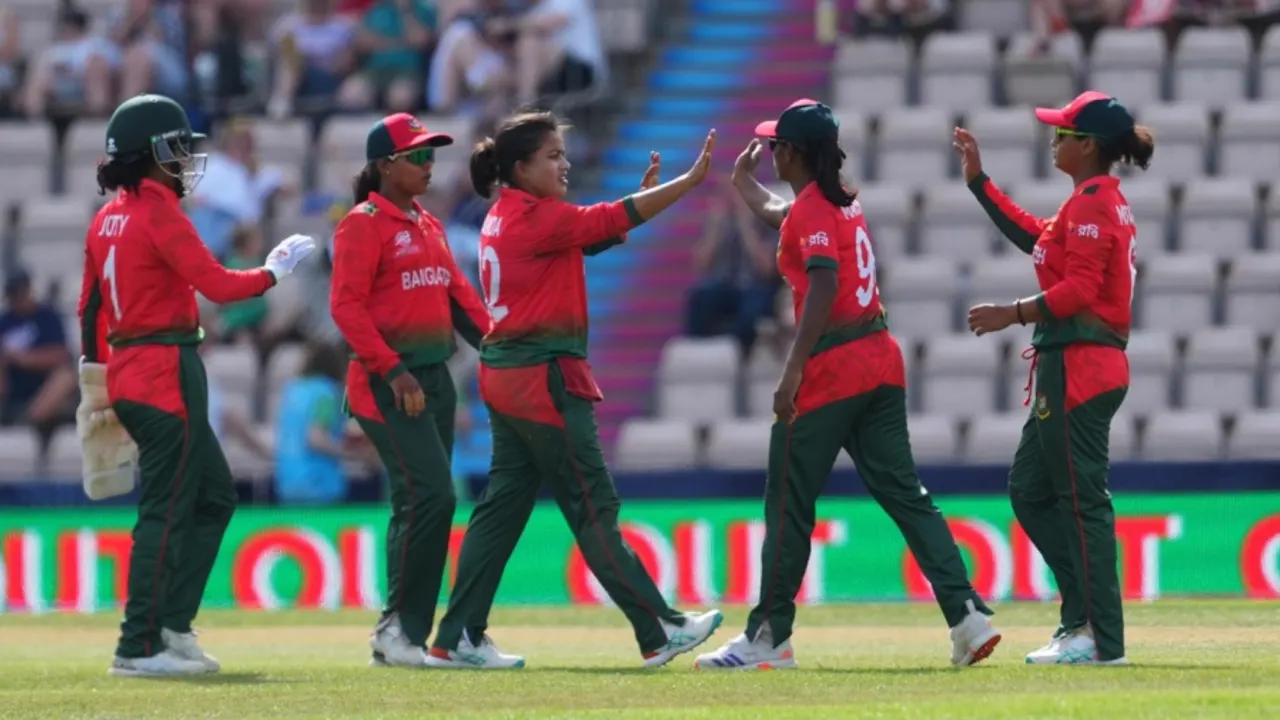
Bangladesh left Pakistan shell-shocked with a magnificent come-from-behind win during their Women’s T20 World Cup 2026 meeting in Southampton. It was Pakistan’s third defeat in as many games in the competition, and the result eliminated them from the tournament with two group-stage games remaining.
Bangladesh’s spinners made a contest out of the match despite Pakistan needing a mere 124 to win. Their middle-overs stranglehold turned what looked to be certain defeat into a memorable 23-run victory.
From 49 for 0 two balls into the eighth over, Pakistan lost 8 for 35 within the next ten overs. Nahida Akter and Sanjida Akter Meghla, whose inclusion was the sole change in Bangladesh’s line-up from their defeat to Australia, bagged three wickets each during that phase.
Earlier in the match, Bangladesh made a similar comeback with the bat with steady contributions from captain Nigar Sultana (36 off 38 balls) and Sobhana Mostary (22 off 19), and a blazing 22-ball 39 not out from Shorna Akter. Those knocks came after a brilliant opening burst from Pakistan captain Fatima Sana and Tasmia Rubab had left Bangladesh stuttering at 13 for 3 in the fifth over.
Bangladesh eventually put up 123, and victory helped them leapfrog South Africa and move to No. 3 in Group 1, although South Africa have a game in hand. Pakistan, meanwhile, continued to languish at No. 5, with Netherlands, the T20 World Cup debutants, the only team below them.
Sultana wanted Bangladesh’s top order to make the most of the batting-friendly conditions in Southampton, but her counterpart Sana made sure that was not the case with a double-strike in her first over. Sana accounted for Dilara Akter off the second ball of the second over as the batter top-edged one to mid-on while going for a wild hack across the line.
Three balls later, Sana produced a gem. She got the ball to jag back into Sharmin Akter from good length, beat her inside edge, and thud her onto the pads right in front of the stumps. Bangladesh could not score off her first ten balls. Her opening burst (3-1-9-2) left a severe dent in Bangladesh’s innings as they managed only 23 for 3 in the first six overs.
While the first Bangladesh wicket provided an early opening for Pakistan, it must have also come as a relief for them as a chance was safely held on to rather than being shelled as had mostly been the case with them over this tournament. Nashra Sandhu, who took the catch to dismiss Dilara, was in action again when she caught Juairiya Ferdous off Rubab to leave Bangladesh reeling at 13 for 3.
But the grab that must have provided the most respite to Pakistan’s fielding coach came right after the drinks interval when Aliya Riaz, who has been under the scanner for her hapless fielding, took Ritu Moni’s catch at long-on. While there were lapses in the ground fielding as a few regulation stops burst through the hands of the fielders, Pakistan overall looked a much improved fielding side from their defeats against India and South Africa.
When Sultana fell to Sadia Iqbal off a poor shot, Bangladesh were 92 for 6 two balls into the 18th over. But a late display of sensational shots from Shorna made sure the Bangladesh bowlers had a competitive total to work with. Shorna hit five boundaries and top-scored in the innings as Bangladesh smashed 43 runs off the last four overs. With the off-side packed, she often backed away to hit the ball over the fielders or scythe it through the gaps.
Pakistan were going smoothly at 49 for 0 in the eighth over before Gull Feroza cut Nahida’s half-tracker right into the hands of point. In Nahida’s next over, the tenth of the chase, Muneeba smashed what was another long hop to deep square leg. The two had laid the foundations astutely by seeing off Marufa Akter, who had taken two first-over wickets against Pakistan in the 2025 ODI World Cup match in Colombo.
But once the openers were dismissed, none of the Pakistan batters took responsibility. They lost six wickets from overs eight to 16. Meghla ran through Pakistan’s middle order with the wickets of Ayesha Zafar and Aliya Riaz in the 12th over, before removing Saira Jabeen for nought in her next.
It seemed Pakistan had solely pinned hopes on their captain to deliver yet another heroic innings. When Sana holed out to long-on at the start of the 18th over, Bangladesh erupted in celebration.
Scores:
Bangladesh Women 123 for 6 in 20 overs (Nigar Sultana 36, Sobhana Mostary 22, Shorna Akter 39*; Sadia Iqbal 1-21, Fatima Sana 2-18, Tasmia Rubab 1-40, Nashra Sandhu 1-14, Tuba Hassan 1-30) beat Pakistan Women 100 for 8 in 20 overs (Muneeba Ali 25, Gull Feroza 23, Fatima Sana 10; Nahida Akter 3-18, Sanjida Akter Meghla 3-21, Rabeya Khan 1-17, Ritu Moni 1-24) by 23 runs
[Cricinfo]

Govt. seeks INTERPOL assistance to bring Basil Rajapaksa back

Ravi warns against attempts to stir communal tensions over Easter attacks probe

AG undertakes High Court Judge will not be summoned over Yoshitha Rajapaksa case

Rs. 75 million worth of ‘Kush’ seized at BIA

Eknaligoda disappearance case hearing fixed for June 26

Dengue cases exceed 44,000

‘Dates have the highest sugar content to fight Coronavirus’

Sunday Island 27 December – Headlines

#SundayIsland 17th December – Headlines

Sunday Island – 28th March

Sunday Island Headlines – 21 March

Sunday Island – 21st February – Headlines
-

 News6 days ago
Release of 2025 O/L results likely to be delayed
-

 Sports6 days ago
Tharanga set for high-profile javelin clash in Ostrava
-

 News5 days ago
Beijing Capital Airlines to resume flights to Colombo signalling boost to tourism
-

 News6 days ago
Theft of USD 2.5 mn from Treasury: CoPF accused of complicity in NPP cover-up
-

 Features4 days ago
Killing of Colombo’s ancient trees — a warning on UN’s World Desertification Day – 17 June
-

 Opinion6 days ago
Decoding Trump’s 12.5% “Forced Labor Tariff” on Sri Lanka
-

 Opinion6 days ago
Palm leaf manuscripts of Sri Lanka – Part V
-

 News1 day ago
Creditor not yet paid