
Features
Retreat from Sanity in the Power Sector

by Parakrama Jayasinghe
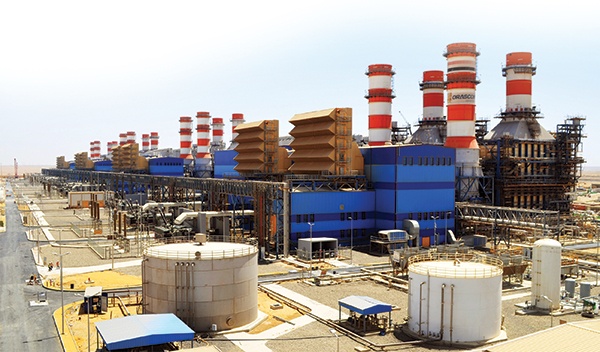
“Sanity has Prevailed No More Coal Power Plants” . This is the title of my article in the Sunday Island in October 2016 ( ) after the Secretary, Ministry of Power and Energy gave an undertaking to the Supreme Court on September 13, 2016 , that the proposed Sampur coal power plant will not be built. This undertaking did not result from the Ministry or the CEB exercising any rational reasoning of the insanity of continuing to push for more and more coal power plants, but due to the undeniable and obvious negative impacts of the proposed coal power plant laid before the Supreme Court. The writing was on the wall that if the plea by the Environmental Foundation Ltd supported by many other concerned organizations and individuals, if heard by the court would have resulted in the same outcome.
The euphoria felt by the country at large was spelled out by the first paragraph of my above article
“Sri Lanka and those of us who have battled for decades to highlight the dangers posed by use of coal for power generation, both for the environment in general and the health of the people without exception, can at last heave a sigh of relief. It is hardly necessary to emphasize that Sri Lanka not having any indigenous coal reserves, had no compulsion to even consider this option until all other options are exhausted.”
That was back in 2016. Anyone who has even a nodding acquaintance with the recent trends in the power sector in the rest of the world, would therefore be aghast to listen to Prime Minister Mahinda Rajapaksa declaring in the recent budget speech that a 300 MW coal power plant is proposed to be built at Norochcholai. It will be recalled that Rajapaksa in his Presidential Election Manifesto ” Vision for the Future ” declared
Indigenous energy resources will be developed to the optimum levels to minimise dependence on non-indigenous resources, subject to economic, environmental and social constraints. (Page 5)
This was in 2010. The changes in the last decade on all “economic, environmental and social constraints” without exception have made even consideration of any coal power plants totally insane._
And President Gotabaya Rajapakse went even further to declare a goal of achieving 80% renewable contribution to the energy sector by year 2030. As such there is absolutely no room for any more coal power plants as the present three are expected to continue to operate and limp along till then.
So we, the citizens are nonplussed by this turn of events with the Minister for Power and Energy Dulles Alahapperuma bragging in parliament (Nov 28, 2020) that work on the fourth coal power plant at Norochchloai will commence in two weeks.
Even though the Sampur coal power plant was shelved, the CEB never accepted that Sri Lanka could have a secure and reliable power supply in the future without depending on more coal power plants. Enough has been said about the harm being done by this power plant to the environment and the health of the people and will not be repeated here. The CEB continued its campaign to do further harm by proposing to add some 2,700 MW if coal power in their proposed Long Term Generation Plan for 2018-2037.
Fortunately the totally false assumptions and forecasts used to portray coal power as the least cost option was debunked by many and the PUCSL approved an amended proposal which had 4500 MW Natural Gas power plants instead of any more coal power plants. ( )
The CEB was not ready to accept this decision of the regulator, which is its legal responsibility and through its Engineers Union launched a campaign to discredit the PUCSL, the legally constituted regulator. The government did not have the backbone to lay down the law and tell the CEB authorities to abide by the LTEGP approved by the PUCSL. This would have been the procedure in any country when any licensee flouts the regulator’s orders and faces revoking of the permits issued to them. While in Sri Lanka, the country like no other irrespective of the government in power, such stipulations apply only to private sector developers of renewable energy.
Or does this portend the future way of doing things when there are rumblings of the Electricity Act to be changed to take away the powers of the PUCSL. The PUCSL has done yeoman service in past years to protect the rights of the consumers as well as the country, by debunking the totally fallacious arguments set forth by the utility, trying to pretend that coal power is the least cost option. Without an independent regulator for the sector, the CEB with the monopoly status could continue their totally irresponsible plans and programs.
It is unfortunate to see that they have managed to hoodwink the present government and the Ministry of Power and Energy as well, as they have continued to do so for several decades. The newest ploy was to propagate a myth of ” Clean Coal ” The fact that there is no such animal was clearly explained in the Article Dirty Coal Raising its Head disguised as “Clean Coal” ()
If these unwarranted and totally unwise power projects are permitted to go through, “The Vision for Prosperity and Splendour” of President Gotabaya Rajapaksa which the country hoped would embody the national policy of the present government, would be relegated to just an election manifesto like many others in the past, just promises with no intention of fulfilling.
But all that is required to reach a clear vision for the future of coal for electricity, is to view the dozens of postings on the internet. Many countries with vast indigenous coal resources are shelving plans for any more coal power plants and increasing numbers of existing coal power plants are being closed down. A few of these news item out of hundreds are listed below.
The World Scene – New Coal Plants canceled
Bangladesh’s Ministry of Power, Energy and Mineral Resources proposed 350 MW Gazaria coal plant be dropped. Bangladeshi government officials have confirmed almost 90 per cent of proposed coal power plants may be scrapped,
Coal power is no more a cheap option and it’s becoming more expensive for imported coal. -Mohammad Hossain, the Director General of the Bangladesh Power, Energy and Mineral Resources research body.
Maharashtra’s Minister for Energy, Nitin Raut, rejected construction of a new 660 megawatt (MW) coal unit at the aging 910 MW Nasik plant owned by the Maharashtra State Power Generation Company
Canada:
Donkin mine in Nova Scotia, which opened in 2017, closes
UK:
The 2000 MW Fiddler’s Ferry and the 1725 MW Aberthaw power stations have closed
Global coal power capacity declined by 21,200 megawatts (MW) in the first half of 2020 with the largest changes being the closure of 8300 MW in European Union countries and 5400 MW in the US,
Poland Could Phase Out Coal by 2030 in Business As Usual
French will close its 600 megawatt (MW) Provence coal plant in France two years earlier than planned.
Other countries shouldn’t settle for dirtier, high-carbon power projects now that China has decided to phase them out domestically, Han Chen in China Dialogue.
Romanian Government confirms no more coal plants to be built:
Marubeni Corporation, will exit from the consortium proposing to build the 630 MW Thabametsi coal plant in South Africa.
NGO groups in the Philippines have welcomed the decision by the South Korean utility KEPCO that it will not proceed with the proposed Sual 2 coal plant,
Prime Minister, Yoshihide Suga, said he would “fundamentally change Japan’s long-term reliance on coal fired energy” as the country moved to be carbon neutral by 2050
South Korea unveils 2050 carbon neutrality target. “We will create new markets and industries and create jobs by replacing coal power generation with renewable energy,”
Pakistan: Government considers ban on new plants that rely on imported gas and coal
( The web references to these news items are available if requested)
It is seen that these decisions come from all over the world and from many countries with their own coal resources. There is no earthly reason for Sri Lanka to take an opposite view, unless driven by private agendas. Furthermore the source of funding for coal power plants are also drying out.
No more Funding for New Coal Power Plants
Sumitomo announces suspension of loans for new coal plants
Review urges Asian Development Bank to support coal phase-out…
The Industrial and Commercial Bank of China (ICBC) has decided not to finance the proposed 1050 MW Lamu coal plant in Kenya.
Samsung’s key insurance affiliates pledge to halt coal investments
Coal is no longer the Least Cost Option
Solar and Wind power are now cheaper than coal in all countries. This has been proven time and again in Sri Lanka too as indicated by the responses to the recent tenders.
In addition to the concerns on the environmental damage the very clear evidence that Renewable Energy resources such as wind and solar are now far cheaper to generate electricity than even operating existing coal power plants. Therefore even on economic grounds opting for more coal power plants for Sri Lanka is sheer lunacy, unless of course there are other reasons which do not come into the public domain. Why this haste to commence work on a power plant in blatant violation of the Electricity Act as well as the due process for evaluating the environmental impacts? Maybe the plan is to get docile agencies to formulate the Terms of Reference and for conducting the EIAs as was done in the case of existing coal power plant, as well as in case of the Sampur coal power plant. It will be interesting to see to what extent the TOR will cover the recommendations by Dr Janaka Ratnasiri in his article (). In addition the SLEMA report on the externalities clearly shows that a minimum of Rs 10.00 per unit has to be added to the cost of generation from coal to cover the impact on the environment and the health aspects.
In this situation, a ray of hope is the directive given by the Chairman of the COPE that the Central Environmental Authority should have the jurisdiction to conduct the EIA process as the possible environmental impact would affect the whole country, beyond the boundaries of the North Western Province.
But then who knows to what extent the CEB or the Ministry will abide by the directions of COPE when they regard the directives of the Regulator PUCSL in utter disdain.
There are many Renewable Energy Projects and even Natural Gas projects already approved by the government , which will ensure the future energy security without resorting to this dirty coal option, whatever the effort to whilewash it.
As such Sri Lanka can only wait in hope for sanity to return as nothing seems to have changed in the power sector, irrespective of the change in government and lofty promises given.
Eng Parakrama Jayasinghe
E Mail:
28th Nov 2020




by Rajan Philips
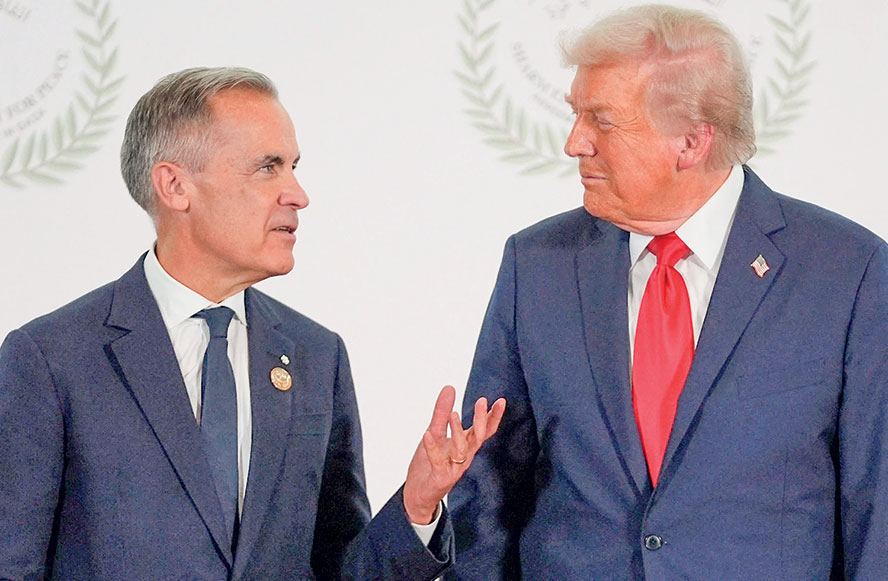
The global tariff blackmail of the Trump Administration in Washington ran into the Canadian Sheild last week at the 45th Parallel. After year-long efforts to salvage the legally binding free trade agreement between Canada, Mexico and the US, from Trump’s illegally executed tariffs, Canada’s Prime Minister Mark Carney said enough is enough and pulled out of all trade talks with the US. The cessation of talks is a shocking development in the geopolitics of world trade and will likely turnout to be the trade-equivalent of Donald Trump’s military misadventures in the Middle East.
Carney is now striking a defiant tone, virtually taking off from the departing hurrah of defiance of his predecessor Justin Trudeau. But Carney, unlike no other state or government leader anywhere, brings to his tone and text the sheer gravitas of a former Central Bank Governor of two G7 countries – Canada, during the 2008 Great Recession; and Great Britain during Brexit. His statement after the collapse of the trade talks has been universally called Davos II, the first being Mr. Carney’s January statement at the World Economic Forum in Davos, Switzerland.
Now he is discarding all the moderate abstractions – such as the US monetizing its global hegemony – and is calling Trump’s tariff offensive for what it is – a global blackmail. His remark that the Trump Administration signs its deals in pencil struck a chord in the US, not the White House. The Canadian Prime Minister even alluded to America’s mountain of $40 trillion debt, which the Trump Administration is dismissing as a mere a number, and added what markets do when one’s economic house is not in order. Tongue-in-check he added that Canada’s house is in order.
Sticking Points
One of the sticking points that led to the collapse of the US-Canada trade talks was the last-minute American insistence that Canada should follow the same tariff protocols as the US with common trading partners and that Canada should not pursue free trade agreements with others. That was too much of an ask. Ever since Trump began imposing tariffs on imports from Canada in utter violation of the existing free trade agreement, Prime Minister Carney has been warning Canadians that the old trade relationship with the US is over and that Canada must vigorously expand its trade with non-US partners to extra-compensate for the fallout with the US.
He has been remarkably successful, much to the chagrin of the White House, and Carney’s new defiance is receiving admiration and support from everyone who has had it with Trump. The Chinese are literally applauding, with China’s Global Times calling Canada and China “the only countries daring to respond to US pressure with reciprocal measures. In September, the Canadian Prime Minister is scheduled to address the European Union Parliament while attending the State of the Union address by European Commission President Ursula von der Leyen.
For over a year now, Trump has been striking deals with scores of countries, including Sri Lanka, all agreeing to his terms to avoid being hit with even higher tariff rates. Their implementation has been a nightmare and has gotten worse after the US Supreme Court ruled that the largest category of Trump tariffs was illegal. China has defied Trump tariffs from the outset and has been making bilateral arrangements from time to time. Canada and Mexico have been spared much of the Trump tariffs because of their free trade agreement with the US, but Trump selected specific industries, such as the auto sector, steel, aluminium and forestry products in Canada for imposing 25-50% tariffs. Lately, he added a plethora of Canadian exports from hockey sticks to paper plates for 50% tariff.
At USD 20 billion, the last category of exports constitutes only 5% of the $400 billion worth of Canadian goods exported to the US, but the new tariffs will disproportionately impact small industries and cause the elimination of about 90,000 jobs. In order to avert this, Canada intensified negotiations and was prepared to accept a certain level of tariff regime even though that would be in violation of the free trade agreement. The talks were seemingly going well and an agreement seemed to be in place with Trump announcing that a deal was all but ready for signing. Then all of a sudden and just before midnight on Friday, 21 August, Prime Minister Carney pulled the plug and ordered the Canadian team to return to Canada from Washington.
The Canadian version of the breakdown is that the Americans were bringing up new demands and restrictions at the last minute and that three of them were totally unacceptable to Canada. As Prime Minister Carney succinctly put it, “We cannot accept what they’ve offered, and we will not give what they’ve asked.” The three unacceptable asks were – to exclude specific trucks produced in Canada from tariff reduction; for Canada to apply to all of its trading partners the same tariffs that US was applying to them; and to remove the requirement for US online and streaming services to provide French summaries and labelling for their products entering Canada.
Free Trade or Tariffs
The free trade vs tariff debate is perhaps older than globalization vs nationalism. Neither binary is wholly incompatible. Free trade and targeted tariffs, not universal tariffs, can co-exist just as the new globalization and the old nationalism can and do co-exist. The bilateral experiences of Canada and the US are instructive on both fronts. For two quintessentially immigrant countries with similar pre-colonial, colonial, and postcolonial multi-cultural experiences, Canada and America are also an odd pair of countries.
Geographically, the two countries are almost equal at close to 10 million square kilometres each, and share the world’s longest border spanning 9,000 kilometres. The US population at 350 million is almost nine times Canada’s 40 million people. The economies and incomes are even wider – US GDP is $31T and per capita income $90,000 vs. Canada’s GDP of $2.3T and $56,000 per capita income. The national debts exceed the GDP in both countries – 125% in the US and 113% in Canada.
Politically, the US began as loose federation and evolved towards greater centralization and has now reached the point, thanks to the Roberts Court, of having a ‘unitary executive’ president in Donald Trump – apparently, not only for America but also for the rest of the world. Canada, on the other hand, began as a highly centralized polity and has considerably loosened over time to become a successful exponent of a bilingual (French and English) parliamentary federalism.
As political historians have noted, the state of Canada forged a nation along a railway stretching from the Atlantic to the Pacific. After World War II and the advent of the automobile and the freight truck, Canada’s sole east-west rail corridor has developed multiple north-south road connections to the US south of the border. The ease and flexibility of the latter has facilitated the expansion of continental trade.
What began as free trade between Canada and the US in the late 1980s has since encompassed Mexico to create the largest free trading bloc in the world. The bloc has a total population of 520 million people and a GDP of $35T. The total trilateral trade is valued at $1.9T, with Canada and the US accounting for $719T. The bloc accounts for 14% ($3T) of the world’s total exports and 18% (18%) of imports. More than quantum of trade it is the cross-border integration of production that has become the hallmark of the North American free trade regime. Nowhere more so than in the auto sector. Auto parts literally go back and forth across borders before they are assembled into a finished vehicle.
Throwing Rocks in the Harbour
The politics of US-Canada free trade has a chequered history. At the turn of the 20th century, it was the Canadian Liberals led by then Prime Minister Wilfrid Laurier who promoted free trade with America which the Conservatives denounced. In 1930, the US Congress passed the Smoot- Hawley Tariff Act to raise tariffs on some 20,000 imported goods as protection from foreign competition at the onset of the Great Depression. The sponsors of the bill were Republican Senator Reed Smoot from Utah and Republican Congressman Willis Hawley from Oregon. They were egged on by the cabinet of then President Herbert Hoover and manufacturers and industrialists. Hoover denounced the bill but was forced to sign it by vested interests.
The external reactions were swift. Canada took the lead in retaliating against the US raising tariffs under the new law. Another nine countries joined the retaliation, many others protested, and all of them found alternative trading partners to reduce trading with the US. The upshot was to aggravate the effects of the depression impacting workers, farmers and their families everywhere. Global trade fell by 66% and the tariff law was put in cold storage. Political punishment came later with vengeance. Smoot and Hawley did not return to Congress and the Republicans were badly defeated as was President Hoover in the 1932 election.
As well, over 1,250 economists had signed a petition asking President Hoover to veto the tariff legislation. Henry Ford visited the White House to make a special veto plea. The President agreed with all of them but signed the bill into law, nonetheless. This was also the time when the celebrated British welfare economist Joan Robinson, famously called retaliatory tariffs, in an appropriately titled essay: “Begger my Neighbours,” as the equivalent of throwing rocks in the harbour of one’s country in retaliation to other countries that have rocky coasts. But Robinson was not necessarily an advocate of free trade and she did not rule out the potential in retaliation in practical circumstances.
Ninety six years after the Smoot-Hawley Tariff Law was enacted and jettisoned, Donald Trump resurrected it to impose 50% tariffs on imports from Canada. The Smoot-Hawley Act allows the President to impose tariffs without Congressional approval. Unlike in 1930, the current Carney government tried negotiations that have come to naught now and precipitated retaliatory tariffs on a much wider scale than in 1930. The trilateral free trade agreement between Canada, the US and Mexico (called CUSMA in Canada) that was renewed during Trump’s first term is also in suspension and there is no indication of its renewal any time soon. The Trump Administration may try a bilateral agreement with Mexico just to spite Canada, but it will have to be on Trump’s terms.
38 years ago when the first free trade agreement was reached between Canada and the US, the Canadian public was emotionally divided over it. Then Prime Minister Brian Mulroney, a conservative and close ally of Ronald Reagan and Margaret Thatcher, was castigated by critics as “a political weather-vane and an economic comprador.” He narrowly won a bitterly fought election for the Liberals by securing a large number of seats in the two provinces of Quebec and Alberta while coming second in every other province and territory. The free trade agreement turned out to be an apparent boon for the Canadian economy but the real benefits and costs are still debated. The Trump Administration and its tariffs have reignited the old debate.
Before the 1988 free trade agreement, 68% of Canadian exports went to the US, and the proportion increased to 76% over 38 years. After Trump’s tariffs the US share of Canadian exports has quickly fallen back to the old 68% as industries and businesses found alternative markets elsewhere. One of the criticisms of the free trade agreement and its continuity has been that it lulled Canadian governments and entrepreneurs to rely on the US market without exploring alternative market opportunities.
The entire thrust of the Carney response to Trump has been to explore new markets and trade partners outside the US. Thanks to Trump, Prime Minister Carney has the political wind on his back with 80% of the public supporting him in opinion polls. A new trade deal may eventually be reached but if one could be achieved during the remainder of Trump’s term is the question. The bigger question is the implication for all the trade deals that Trump has forced other countries to sign under tariff duress.
Even as the US under Trump is getting isolated in the world, Trump himself is getting isolated in the politics of his own country. People are fed up with his lack of attention to their economic woes, made worse by tariff economics, and his preoccupation with building legacy monuments for himself in Washington. Trump’s approval ratings are down, the Republican prospects in the November mid term elections are getting worse, and almost all of Trump’s initiatives remain mired in courts with no immediate way out. On the Iran front, Trump is giving up on his military strikes that has cost the US $37.5B, and is threatening to carry out “the most crushing economic operation” targeting Iran and its trading partners. To paraphrase a more historic twist of phrase, the new threat may turn out to be – some crushing, some operation.
(Excerpted from In Pursuit of Governance, autobiography of MDD Pieris)
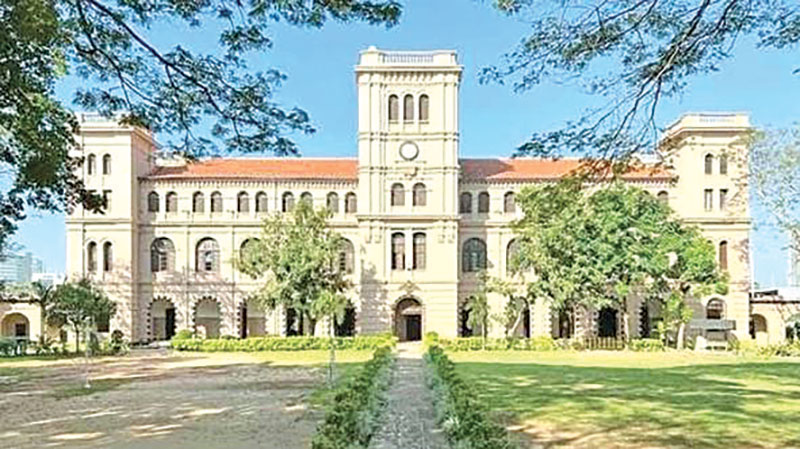
In January of 1956 I entered the second year university entrance form of St. Joseph’s College. There was a nice quiet atmosphere in the school. The discipline was good and the teaching excellent. Mr. Rajapakse who taught us European history was one of the best history teachers that I had encountered even counting the university. So was Mr. Kuruvilla who taught English literature. The English class being small we received personal attention from a fine teacher. I later found that there were few in the English Department in the University to match him, and this included a lecturer from Cambridge University attached for a period to the department.
Father Peter Pillai himself took classes on the constitutional aspects of government, where we had to read books such as “Constitutional Law” by Wade and Philips and “The Law and the Constitution” and “The Constitution of Ceylon” by Sir Ivor Jennings. Father Peter was a remarkable person. He was a Master of Arts, a Master of Science, a Doctor of Philosophy and a Doctor of Divinity. He had a clear and distinguished mind and in spite of his heavy responsibilities as Rector found the time to teach physics in one class, divinity in another and aspects of constitutional development and constitutional law in yet another.
I have been very fortunate in being taught by teachers with experience, skill and very good minds both at Thurstan and at St. Joseph’s. Just to cite one example from Thurstan, Mr. B.J. Perera who taught us history in the fourth form was a research scholar whose learned articles on Ceylon history were being published in “The Ceylon Historical Journal.” We owe a lot to these teachers.
Most schools of course had interesting teachers. They were what could be called “characters.” St. Joseph’s was not an exception. Space would not permit me to dwell at length on this subject. I would therefore mention only one such case. The teacher concerned, taught a language. It was not English. His approach to, as well as his use of the English language was innovative, picturesque and refreshing. Structure and syntax were too confining for his liking. One day therefore, he had requested a startled monitor of the class to “run up downstairs and bring the mark book,” which had been temporarily taken to the office. On another day, he had pounced upon a restless and irreverent class, and threatened them with dire consequences if they “laugh in front of my back!”
These kind of refreshingly interesting sayings naturally evoked a corresponding response from his pupils. Therefore, one day, during a more convivial moment, when this teacher had confessed to having three daughters, one of his more intrepid pupils had politely inquired, whether they were all girls! According to reports, all goodwill and conviviality had instantly vanished. He was not prepared to tolerate such detailed investigation.
Astrology
My father was a student of astrology. He pursued the subject occasionally in his spare time out of personal interest. Sometimes he used to look at my horoscope or my mother’s and say something which by and large, curiously turned out to be correct. Now, after the trauma of changing schools hurriedly he had looked at my horoscope, and one day, in his customary quiet tone said something disturbing. He said that I had entered a bad period which was going to last for five or six years. He predicted the arising of unforeseen difficulties and mental worry and went on to make the startling remark. “This is the worst period in your horoscope. After this, you will never have such a bad period right to the end.”
Finally he said “There is no threat to your life, and you will come through the difficulties, but you will undergo a great deal of mental suffering.” My parents and I have always had a frank dialogue and I understood that my father’s intention in saying all this was to forewarn me. Fortunately nature had given me a strong temperament. I was not one who could easily be demoralized.
I enjoyed a happy year at St. Joseph’s. I found the time whilst studying to play second XI cricket for the school, and thereafter to be selected to the rather small first X1 pool. Mr. John Pulle the well known All Ceylon Cricketer coached the second XI. We had a strong batting line up and he decided that my services would be more useful in the bowling department as I was tall and reasonably well built. He did not want to waste such a physique. One day at practice he took me to the middle of the pitch and said “Pieris, I am going to send you as last man.”
Then pointing to four well known land marks, he continued, “your job is to go out there and hit the ball into Darley Road, The Home for the Aged, Bonjean Hall and the swimming pool. I don’t want singles and twos.” Never had I been given such an open license for anything. He was a hard task master and was not totally satisfied with my subsequent performance. I managed to hit a few over the wall and into Darley Road, once hitting a passing bus. I also succeeded in hitting a few onto Bonjean hall. But the home for the aged and the swimming pool proved beyond me, to the disappointment of Mr. John Pulle.
A shock
With the entrance examination looming, I went for first XI practices and played in some third term matches against some clubs. The main school matches were due to commence in the New Year in January. In the meantime, I had an examination to sit. I had done steady and regular work and was reasonably confident that I would not fare too badly. In a competitive situation, whether it was sufficient to get me into the university was another matter. There perhaps some luck was also necessary.
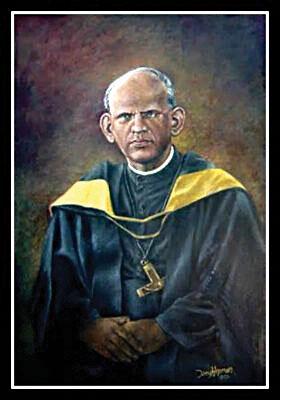
Father Peter Pillai
We were given two weeks study leave to be spent revising at home, and almost five days of this period had elapsed when one evening a classmate of mine turned up at home on his bicycle. What he had to tell me was most disconcerting. He said “Father Rector wants to see you first thing tomorrow morning.” When I anxiously inquired what the problem was, he was cagey, but under further questioning said vaguely “I think there is some problem about your subject combination for the examination.”
This was a stunning blow. Only the previous day I had quietly told my mother that I thought I was ready for the examination. Now this bolt from the blue had descended. All of us spent a tense and uncomfortable night. Early next morning I was outside the large door of Father Peter Pillars room. The time was about 7.30 a.m. Already, a queue had formed of parents and others who had come to see him. Sharp at 8.00 am. as was the custom, he personally opened the door. I stood out a little to be seen. He saw me and immediately called me in explaining to those ahead of me in the queue that this was an urgent matter.
When we were both seated, he said “I am very sorry, but your subject combination does not fit any of the combinations permissible for the examination. It is also our fault. We should have checked out your subjects, when you entered school. Evidently, Thurstan too had not checked. I have telephoned Balmond (Registrar of the University) and he says nothing can be done unless you change the combination. But it is clearly too late now. There are only a few days to go before the examination. I am really sorry.”
Then seeing the combination of shock and forlornness in my face, the Rector went on to say, “Apparently you cannot offer both Sinhalese and English as subjects for the examination. I do not know why that should be so, but those are the regulations.” Then viewing my complete stunned immobility, Father Peter Pillai, no doubt more to console me than anything else said “I notice that you had obtained a credit in Latin at the Senior School Certificate Examination. The Latin papers consist mainly of several passages in Latin and English for translation and comment. There are no text books to master. Would you like to drop Sinhalese, which is the weaker of your two subjects compared to English and try sitting for European History, Government, English and Latin? Although very late I can get Balmond to agree to a change.”
By this time I was slowly recovering from the blow and beginning to find my voice. I told Father Peter that I had substantially forgotten my Latin since I had not kept up with the subject and that I wouldn’t mind taking a shot at Ceylon History, since I believed I had a knack for History. The Rector appeared quite incredulous at this proposition and most emphatic in his reply. “You will have no chance whatsoever,” he said, adding “Do you know why we do not teach Ceylon history for the university entrance at St. Joseph’s, and teach Indian history instead?” Answering the question, he went on, “That is because of the very high failure rate in Ceylon history.”
Finally, he said, “I am sorry, but the best thing to do is to sit for the examination next year.” I had by now recovered my determination and fighting spirit. “I would like to sit for Ceylon History. In any case I have nothing to lose,” I said. The Rector looked at me in a manner of looking at a person who had completely lost all sense and judgement. “Do you realize,” he asked, “that you will have to sit for two papers of three hours each, the first paper covering the period from the very beginning to the arrival of the Portuguese in 1505, and the second paper covering the period from 1505 to the achievement of Independence in 1948? How are you going to cover two years work in a few days?” was his final and incredulous question.
I said, I realized the near impossibility but would still like to try. The Rector agreed more out of pity than any conviction. He promised to ring the Registrar and make the necessary arrangements. Since, I was in school, I met my history teacher Mr. Rajapakse and told him of my predicament. I was very good in my European history and he liked me as one of his best pupils. He spontaneously volunteered to help. He advised me to rapidly do whatever reading that was possible at home. He then gave me specific times to come to school, when he had free periods. He promised to get hold of the past papers for three years and suggested that we sit together and answer as many questions as possible in point form.
I was immensely grateful for this positive attitude and strong support. I returned home to the other pillar of strength, my mother. She had a temperament which refused to panic, which she seemed to have bequeathed to me. Her focus was not on what had happened, but what had to be done in a situation where every minute counted. Her advice was precise.
She said “Son, you told me a few days ago that you felt ready for the examination. Therefore, stop all work on the other three subjects and spend all your time on Ceylon history.” This kind of learning came later to be called total immersion. But immersion needed water. I had to quickly find some books. I searched diligently and found at home my old copies of Father S.G. Perera’s “A History of Ceylon for Schools” which included coverage of the Portuguese, Dutch and British periods, and Professor G.C. Mendis’ “Ceylon under the British.” Some of my friends found relevant books covering various aspects of the total period written by Ratnasabapathy and Horace Perera, as well as Codrington’s “Early History of Ceylon.” I also found a copy of Geiger’s translation of the “Mahawansa.”
I now gave up all thought of revision of the other three subjects and concentrated solely on Ceylon History. As I read, important sections and parts which I had studied years before came vividly to mind. Sitting with Mr. Rajapakse and answering previous question papers in point form focused attention on issues. more precisely and concentrated my mind. I was also hoping that the Ceylon history papers would come during the middle or towards the end of the examination giving me that much more time. But this was not to be. When the time table came, I found that these two papers came first out of the four subjects I had to sit, and on the same day, morning and afternoon! I was beginning to have an increased respect for my father’s reading of my horoscope!
During this difficult period my mother continued to play a pivotal role not only encouraging me, building up my confidence and providing me with extra nourishment, but also seeing to it that I did not overdo things and burn out. She strictly saw to it that I had eight hours sleep in the night. She used always to say “you must rest your brain. You must have a clear mind.” This calm support was invaluable. Ultimately when I finished sitting the two three hour papers, I felt that I stood a fighting chance of passing. So did my History teacher, who listening to me felt that I had done well enough to be at least on the border.
At that time, those who passed all four subjects at one sitting gained direct admission to the university without going through an interview. But those who had passed in three subjects and had narrowly failed in the fourth were called up before an interview board and those who fared well at the interview were admitted to the limited number of places that existed after the direct entrants were provided for. The question was, had I performed well enough in my Ceylon History to be at least called for the interview, and that too if I had done well in the other three subjects.
Strangely enough, the fact that I seemed to have done reasonably well, given the almost impossible odds added to the mental tension which indeed is a natural part of sitting for an important examination. If I had done badly, there would have at least been the relief of recognizing the inevitable. There would have been closure. But now there was the added tension, emanating from the feeling of being possibly so near, but yet so far.
It was a feeling inimical to the kind of mental stability that one would like to have had during an examination period. I sat for my two papers each, in European history and Government and was quietly confident of passing. Then, at last, amidst the gloom came a ray of light, and tidings of good cheer. At St. Joseph’s I had sat for the prize tests for the upper school history prize and the open English prize. Just the day before I was to sit for my two papers in English, which were my final papers, the school sent a message home to the effect that I had won The P.H.C. De Silva Memorial Prize for Upper School English. It was most thoughtful and kind of the school authorities to have done this.
The mental boost and the confidence it gave me just before my English papers were indescribable. Sitting in St. George’s Hall of the University of Ceylon, Colombo, I felt that I did really well. The anxious and somewhat demoralized student who sat this examination in various halls and rooms of the university did not know at the time, that over 30 years later he was to serve as a member of the governing council of the University of Colombo, a separate university by that time. Such are the twists and turns of life and fate.

by J.A.A.S.Ranasinghe
Productivity Specialist and Management Consultant
(The writer can be contacted at rathula49@gmail.com)
{An ageing population is not merely a demographic challenge; it is a strategic national resource—provided we know how to harness its accumulated experience.}
“Sri Lanka’s latest Population Census has delivered not only a demographic warning but also uncovered one of the country’s greatest untapped economic assets—the accumulated experience of its older citizens. “Sri Lanka continues to view its ageing population merely as a fiscal and social burden, it will overlook one of the nation’s greatest strategic assets. The challenge before policymakers is not simply to manage an aging society, but to transform it into a knowledge-rich, experience-driven economy where every year of accumulated wisdom becomes an investment in the nation’s future.
For decades, Sri Lanka regarded its young population as its demographic dividend. The latest Census suggests that this dividend is diminishing. The country’s next demographic dividend may therefore lie not in the number of young people entering the workforce, but in the wisdom, expertise and institutional memory of those leaving it. This ‘Experience Capital’ must be recognized, organized and productively deployed if Sri Lanka is to sustain its economic and social development.
The Census has change the context
It must be mentioned here that almost all the three eminent speakers, namely Professor Manori Weeratunga, Dr.Harischandra Yakandawala and Dr. Anoja Seneviratna of the Population Association of Sri Lanka at a workshop held at the Faculty of Indigenous Medicine emphasized the ill-effects of growing trend of the age population. They enlightened the audience that Sri Lanka is entering a completely new demographic era with the ageing as a growing fiscal burden, increased healthcare expenditure, shrinking labour force, declining tax base and a lower economic growth.
Is ageing population a burden to Sri Lanka?
It is true that the warning expressed by the experts are valid concerns, but they answered only one question. “What problems does an ageing society create?” What my concern is a much more important question. “How can an ageing society become a national asset, contributing to the much needed economic development process with the expertise they possess” without being a burden to the country at large. Hence my contention is that this ageing factor of the population trend must be looked from a total different perspective with a refreshing and constructive approach. Probably, this is the line of approach resorted by the government to retain the services of the judges of the Supreme Courts and the Courts of Appeal beyond their compulsory age of retirement,
Ageing population – Manna from heaven
It is not my contention to interpret this population conundrum as a conflict between two generations but to enlighten the policy makers and demographers the ageing syndrome as a manna from the heaven –a resource that should be harnessed for the development of the country. Undoubtedly, any country has four forms of capital – namely Financial Capital, Physical Capital, Human Capital and lastly Experience Capital. It is my honest and candid understanding is Sri Lanka has never measured or managed or utilized the fourth – Experience Capital.
Every year, thousands of highly experienced professionals – Doctors, Engineers, Administrators, Academics, Scientists, Military Officers, Teachers, Technicians, Craftsmen retire on the attainment of their compulsory age of retirement. With their retirement or along with them disappears 40 years of accumulated knowledge and expertise resulting in a massive drain of economic loss to the country. If the country shares 40 years of experience with a young entrepreneur, the country loses nothing but an added value addition. This is the only form of capital that increases when it is shared with the stakeholders. This is the central message I want to convey to the policy makers and the demographers.
An ageing population – not a demographic challenge
The recent population census is telling the policy makers that there will be fewer young citizen to drive the economy. But my strong message to the government is not to get disheartened and frustrated with this unforeseen development because Sri Lanka has a reservoir of experienced citizen even more valuable to drive the economy. It this sense, it could be definitely argued that an ageing population is not merely a demographic challenge: but a strategic national resource, provided the country knows how to harness its accumulated experience.
Policy Interventions for older people
Now my biggest concern is to make a policy proposal – national framework – to the government and demographers suggesting possible avenues for the utilization of experience capital of Sri Lankan older community, instead of simply encouraging older people to remain active.
The retired professionals of our country must step forward as catalysts of change in the face of this unbridgeable vacuum. The older people in Sri Lanka are highly qualified people in their respective fields and they, I would say, are the custodians of knowledge. They cannot remain passive observers in the light of the fact that the country expects you to discharge an inescapable duty is disseminating the knowledge they assimilated during their active period prior to retirement. They must re-imagine the delivery of higher education and practical knowledge to the larger interest of the society on the premise that the opportunity they got is not a privilege for the few but for the country and the younger generation. It Is earnestly believed that my proposal would avoid an unnecessary “young versus old” narrative and instead argue for a partnership between the two generations to strengthen national development.
Establishment of Board of Retired Experts
It is proposed to set up a Board of Retired Experts {BRE} under the purview of Department of National Planning so that the senior citizen by using this platform can disseminate the knowledge so that the following practical mechanisms which would eventually help converting experience into productivity. Every year thousands of highly experienced engineers, doctors, administrators, academics, entrepreneurs, military officers, teachers, technicians and craftsmen retire. Along with them disappears 40 years of accumulated knowledge. As the number of young workers declines, the country must deliberately cultivate an Experience Dividend—the economic and social value created when retired and semi-retired professionals continue to mentor, innovate, advise, teach, volunteer and support entrepreneurship. That is not simply a social policy; it is an economic strategy.
Knowledge Transfer Group by way of National Senior Knowledge Corps, National Skills Transfer Program, National Mentoring Network
Policy Advisory Group by way of Board of Retired Experts, Retired Professionals Advisory Service,
Innovation & Industry Group by way of Industry–University Mentor Program, Senior Volunteer Technical Corps
New dimension for the policy makers and demographers
It is to be explicitly stated here that the latest census has not merely counted people but has revealed the future of Sri Lanka. The findings of the Census have drawn our attention to two simultaneous realities.
· The country’s biological clock is slowing as fertility continues to decline.
· The proportion of older citizens is increasing at an unprecedented pace.
Much of the public discussion has understandably focused on the economic burden of an ageing population—higher healthcare costs, pension obligations, and a shrinking labour force. While these concerns are real, they represent only one side of the equation. The Census also reveals the emergence of a vast and largely untapped national resource: a rapidly growing population of experienced, educated and professionally accomplished senior citizens.
This is exactly that my concept of Experience Capital becomes more relevant and powerful. Instead of asking “How will Sri Lanka support an ageing population“, we should ask “How can an ageing population help Sri Lanka” when the population is at a crossroad. This entire question, I believe, changes the policy debate.
From Demographic Dividend to Experience Dividend
During the past 50 years, development economists and demographers spoke about the Demographic Dividend—economic growth arising from a large working-age population. Sri Lanka is now moving into a different phase.
As the number of young workers declines, the country must deliberately cultivate an Experience Dividend—the economic and social value created when retired and semi-retired professionals continue to mentor, innovate, advise, teach, volunteer and support entrepreneurship. That is not simply a social policy; it is an economic strategy. This article raises an equally important question “what should the nation do in the light of the ageing population. That progression from diagnosis to a practical national strategy is precisely what the policymakers and demographers should look for.
Gerontocracy and Wealth Accumulation – An Asset not a liability
Writing an article to a newspaper recently, Dr. Sarath Obeysekera recently argued how gerontocracy and wealth accumulation are in the hands of older generations in the United States. Drawing a parallel to the Sri Lankan situation, he contends that Sri Lanka has also become a society where wealth is increasingly concentrated among the older generation. His bone of contention is “Sri Lanka’s older generation accumulated wealth through a different set of circumstances unlike their counter parts in USA who accumulated wealth through financial markets, pensions, decades of capital appreciation etc.
“Unlike previous generations, today’s younger Sri Lankans often began life at a disadvantage. House prices have risen far beyond average incomes. Land values have become prohibitive. Many businesses are controlled by second or even third generations of established families. Without inherited assets, it has become increasingly difficult for talented young people to build capital. Consequently, wealth is becoming more concentrated rather than more widely distributed”. In addition I would go a further step more and contend that Knowledge Asset too belongs to a 60% of the generations- meaning older generation similar to the national wealth. Hence, our future will be bleak unless the knowledge asset is potentially harnessed for the benefit of the younger generation.
Today, many older Sri Lankans remain intellectually active, productive and continue making valuable contribution to the society and economy. Literally and gerontocracy “rule by the elderly”. Experience should never become a barrier to fresh ideas. Wisdom must guide the next generation rather than replace it.
Over the years, countries have spoken about Natural Capital, Human Capital, Social Capital, Intellectual Capital, and Financial Capital. It is my optimistic view that my article has the potential to introduce “Experience Capital” into Sri Lanka’s policy vocabulary as a distinct and measurable national asset. Finally, It has to be reiterated that the country’s next demographic dividend may therefore lie not in the number of young people entering the workforce, but in the wisdom, expertise and institutional memory of those leaving it.”
The future prosperity of Sri Lanka will depend not only on the children we raise today but also on the wisdom we preserve from those who built the nation yesterday. Countries that waste their experience capital impoverish themselves. Countries that harness it create a new demographic dividend founded not merely on numbers, but on knowledge, mentorship and innovation. The challenge before Sri Lanka is therefore not how to support an ageing population, but how to transform that population into one of the country’s greatest productive assets.

“Rathuwewi Mihimadala” Book Launched with the Participation of the Prime Minister

Turkiye, Somalia forces free cargo vessel hijacked by pirates

Ferry carrying 260 people capsizes off northern Cyprus coast

Imam unlikely to play rest of Lord’s Test after picking up left calf tear

Vimukthi, Ayodhya hand Sri Lanka winning start to Asia Cup title defence

Voting closes in Iceland’s knife-edge EU referendum

‘Dates have the highest sugar content to fight Coronavirus’

Sunday Island 27 December – Headlines

#SundayIsland 17th December – Headlines

Sunday Island – 28th March

Sunday Island Headlines – 21 March

Sunday Island – 21st February – Headlines
-

 News6 days ago
Missing doctor’s body found in Mahiyanganaya
-
 News6 days ago
Australia declines to release Finance Secy Suriyapperuma’s citizenship details
-

 News6 days ago
22A: BASL suggests CJ recuse himself from hearing petitions
-

 News3 days ago
Eight politicians in drug kingpin probe
-

 Editorial7 days ago
Govts. drag feet as undergrads age
-

 Business3 days ago
Sri Lanka opens up: A new season of direct connectivity
-
 Features5 days ago
Insights from Chieftains of Uva: Genealogy of two Kandyan Families – Part II
-

 Features5 days ago
Export diversification: Missing the wood for the trees – Part I