
News
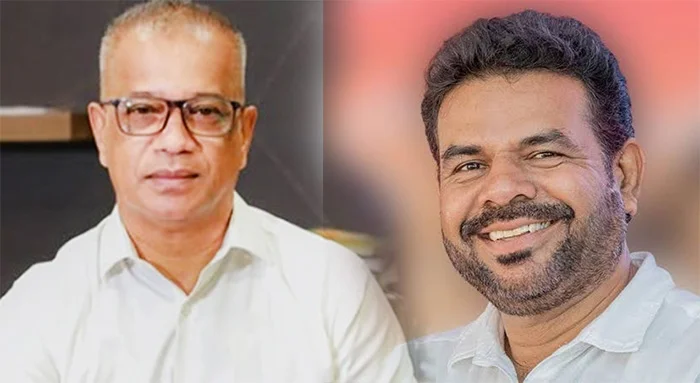
CID summons doctors’ union chief to record statement

Procurement of fake Immunoglobulin:
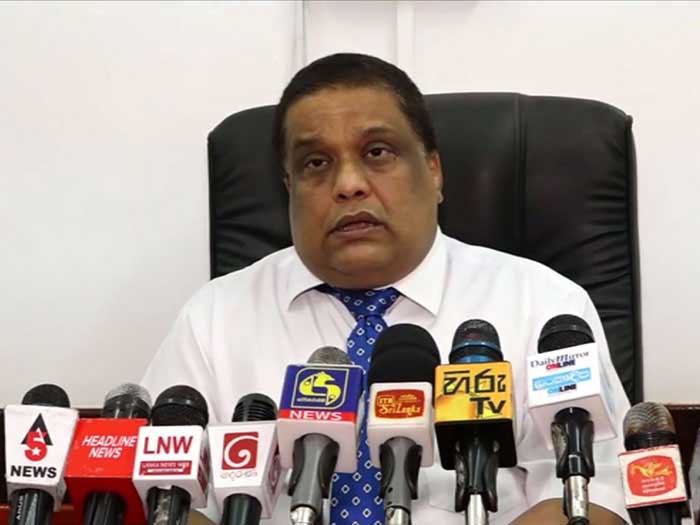
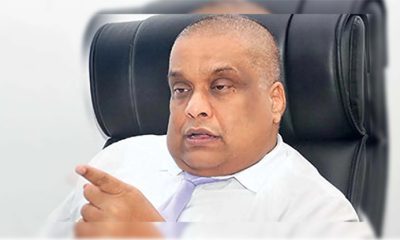
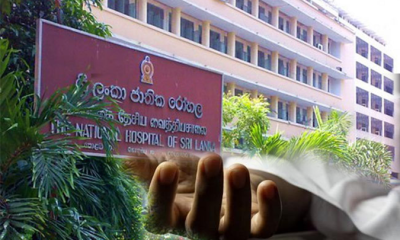
The Criminal Investigation Department (CID) probing procurement of fake Immunoglobulin by the Health Ministry has asked Deputy Director of the National Hospital Dr. Rukshan Bellana to make a statement and furnish evidence he has in respect of the racket.
Dr. Bellana, who is also the President of the Government Medical Officers’ Forum (GMOF), has been asked to be present at the CID today (28) at 10 am.
SSP K. A. Kavinda Piyasekera has, in a letter addressed to the Director of the National Hospital, stressed the need to obtain Dr. Bellana’s assistance to clarify his statements to the media regarding the fraud in the procurement of fake Immunoglobulin at a cost of Rs 130 mn. Among those who have been remanded in this connection is the former Health Secretary Janaka Sri Chandragupta.
The CID official has said that Dr. Bellana in his controversial statements disclosed some important facts relating to the investigations and, therefore, the CID needed to speak with him.
Dr. Bellana, President, College of Medical Laboratory Science Ravi Kumudesh and suspended medical officer Dr. Chamal Sanjeewa are leading a campaign against the Health Ministry over a spate of frauds involving officials of the Ministry, at various levels.
Dr. Sanjeewa was suspended in early Nov., 2022 by the Ministry of Health over a public declaration pertaining to malnutrition rates among children in Suriyawewa in 2022.
Dr. Bellana said that many an eyebrow had been raised when the CID visited former Health Minister Keheliya Rambukwella’s official residence on Dec 26 to record a statement, just a day after his counsel informed the CID of his client’s readiness to furnish a statement.
In a letter addressed to Director, CID, SSP Prasad Ranasinghe, Counsel U. R. de Silva offered documents including the correspondence between the Health Ministry and Gujarat-based Indian company that contradicted local supplier Sudath Janaka Fernando’s claim that the phials of Immunoglobulin were supplied by them. (SF)







By Shamindra Ferdinando
The absence of Agriculture Minister Lal Kantha and his Deputy Namal Karunaratne at the NPP’s farmers’ rally at Polonnaruwa, on Saturday (12) revealed the government’s failure to address the problems faced by the farming community, the SLPP says.
Former Kalutara District SLPP MP Sanjeewa Edirimanna said that politburo member Lal Kantha, who represented the NPP’s highest decision-making body, and his Deputy, Karunaratne, couldn’t face the farmers, and hence their absence at Saturday’s rally. Their absence underscored the gravity of the situation, Edirimanna said, thanking the NPP for openly acknowledging the crisis in the agricultural sector.
Kandy District MP Lal Kantha was not immediately available for comment. When The Island sought an explanation from Deputy Minister Karunaratne regarding their absence, he said that there was no need for all of them to attend each and every NPP rally.
President Anura Kumara Dissanayake addressed Saturday’s gathering on behalf of the party and there shouldn’t be any issue over their absence, MP Karunaratne said.
Karunaratne said so when The Island pointed out that their presence mattered as it was the inaugural farmers’ rally held almost two years after the last presidential election.
MP Karunaratne claimed that the Polonnaruwa rally was not on his schedule for 12 Sept.
Ex-MP Edirimanna pointed out that Minister Lal Kantha had addressed both the Bulathsinhala and Beruwala rallies, held on 6 Sept., which marked the commencement of the NPP propaganda campaign, launched amidst growing dissent over the way the government sought to enact the 22nd Amendment to the Constitution.
Edirimanna said that the NPP couldn’t justify both Ministers in charge of agriculture skipping the Polonnaruwa rally. Responding to another query, Edirimanna said that he wouldn’t attribute their absence to any internal conflict but the NPP’s overall failure to address the growing grievances of the farming community.
Edirimanna said that in spite of promises, the NPP had pathetically failed to ensure a reasonable pricing formula for paddy. The President again promised to implement an efficient paddy purchasing scheme at the next harvesting season, the ex-MP said, adding that the government should be ashamed and accept responsibility.
Edirimanna stressed that the government’s vow to implement a mandatory price for different varieties of paddy remained just a promise.
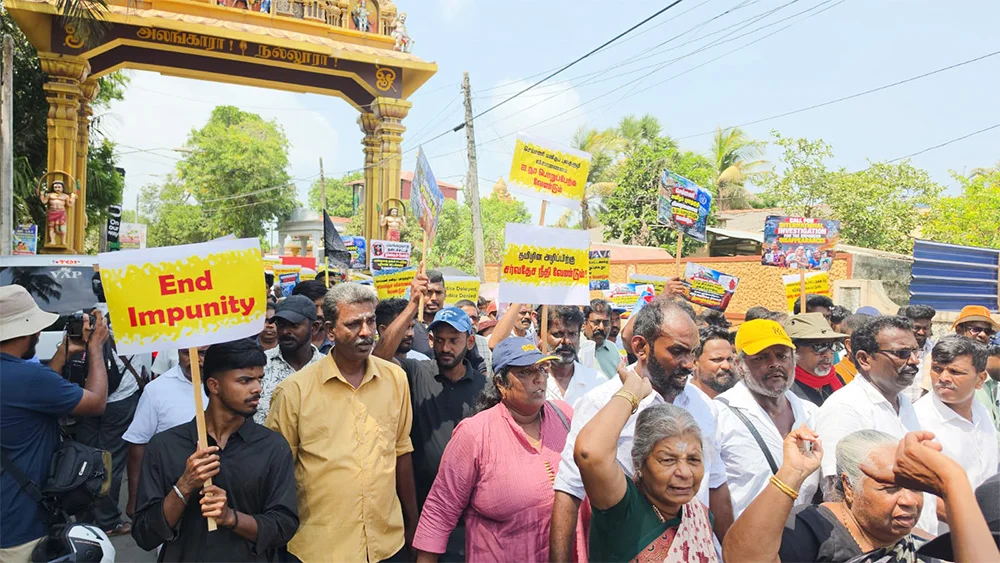
A demonstration was held in Jaffna on Sunday (14) demanding an international investigation into the Chemmani mass grave, which protesters said constitutes evidence of the genocide committed against Tamils, Tamil Guardian HAS reported.
The procession began near the United Nations office, close to the Kailasa Pillayar Temple in Nallur, and proceeded to Kittu Park, where it concluded with a public gathering. Protesters demanded an international inquiry into the 583 sets of human skeletal remains and other evidence recovered from the site.
The rally was organised jointly by the Tamil National Council and civil society organisations, which had called for the excavation, preservation and forensic analysis of Chemmani and other mass graves to be placed entirely under the responsibility of the United Nations, without intervention by the Sri Lankan state.
A party alleged to have been responsible for a crime cannot be expected to exercise exclusive control over the evidence needed to investigate it, the council argued ahead of the demonstration, warning that placing such material under the control of an alleged perpetrator creates a risk that evidence could be damaged or compromised, Tamil Guardian reported.
Alongside the Chemmani demands, the organisers had called for an independent international criminal investigation into the genocide of Tamils, the transfer of evidence to the International Criminal Court, the immediate release of political prisoners held under the Prevention of Terrorism Act and the repeal of that legislation, the withdrawal of the military from the North-East, the return of occupied land, and international recognition of the Eelam Tamil people’s right to self-determination.
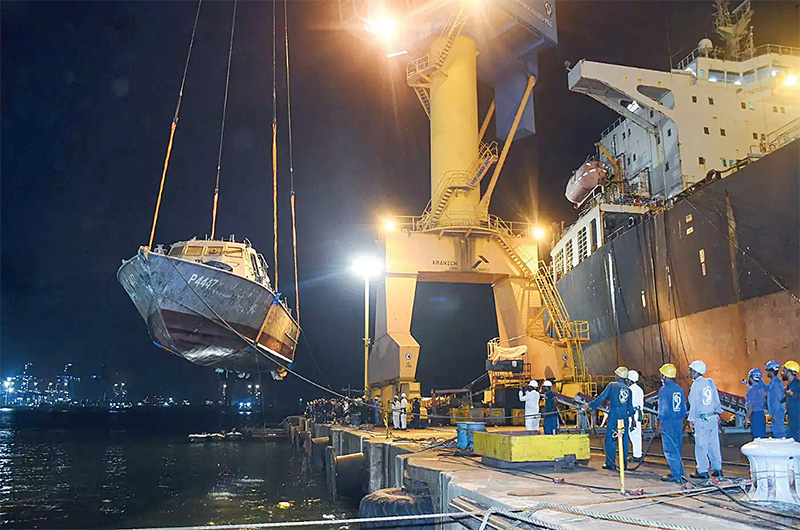
The Sri Lanka Navy recovered its Fast Attack Craft P 4447 following a successful salvage operation, bringing a multi-stage emergency response to a close.
The craft sank during a routine patrol, on 15 August 2026, off Angulana, after colliding with a previously sunken bulk carrier. It was brought to the surface on 11 September from a depth of approximately 80 feet. It was subsequently towed to the Colombo Dockyard premises.
The initial phase of the operation, immediately following the incident, focused on search and rescue. A joint effort, involving the Navy, Air Force, Police, and local fishermen from Angulana, helped rescue of 11 crew members. The search and rescue phase drew to a close with the recovery of the remains of the Second in Command of the craft, on 4th September.
Following the search and rescue phase, specialised Navy diving and salvage teams launched a dedicated recovery phase against rough sea conditions and underwater challenges, adhering to strict safety protocols. The Navy’s marine, hull, electrical, and electronic engineering teams utilised specialised technical know-how and equipment to raise the vessel in stages, the Navy said.
Technical support and specialised expertise were also extended by the Sri Lanka Ports Authority and Colombo Dockyard PLC.
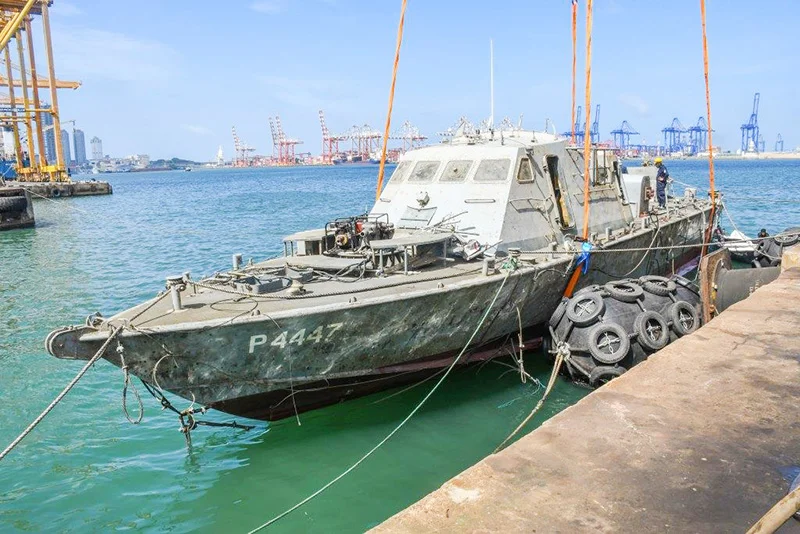
The salvaged FAC (pic courtesy SLN media)

Showers above 100 mm expected at times in the Western, Sabaragamuwa, Central, Uva and Southern provinces, and in Ampara and Batticaloa districts

Controversy over absence of Agriculture Minister, Deputy at NPP’s inaugural farmers’ rally

Thousands march in Jaffna demanding international investigation into Chemmani

FAC that sank last month recovered in salvage operation

Advocata Institute honours Dr. Paikiasothy Saravanamuttu with inaugural Freedom Award for lifelong service to civic freedom in Sri Lanka

Who committed genocide and created mass graves in Sri Lanka?

‘Dates have the highest sugar content to fight Coronavirus’

Sunday Island 27 December – Headlines

#SundayIsland 17th December – Headlines

Sunday Island – 28th March

Sunday Island Headlines – 21 March

Sunday Island – 21st February – Headlines
-

 Sports4 days ago
DDS set to lose Test captaincy
-

 News4 days ago
Sri Lanka faces new grid challenge as rooftop solar surges: former CEB GM
-

 Latest News4 days ago
Shafali, Deepti power India into sixth T20 Asia Cup final
-

 Latest News3 days ago
Sri Lanka thwart Fatima Sana challenge to secure Asia Cup final spot
-
 Opinion6 days ago
Navigating Sri Lanka’s Israeli Dilemma
-
 Features5 days ago
Lost for 90 years: Rare Goby resurfaces in Jaffna
-

 News2 days ago
Gnanasara Thero absconding after SC ruling
-

 News3 days ago
Ammunition cache found in old Kandy bungalow