
News
Ministers of Justice and Health on collision course with association of banks

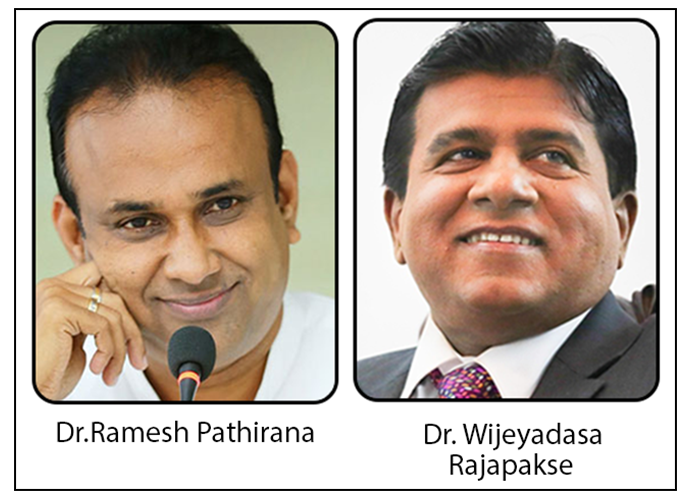
Wijeyadasa pushes for suspension of Parate executions:
‘Country paying heavy price for not having proper tax regime, favourable treatment to some’
By Shamindra Ferdinando
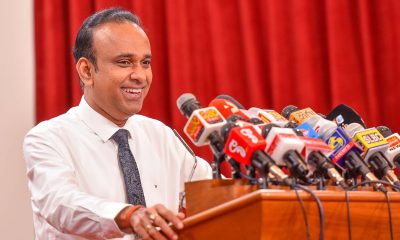
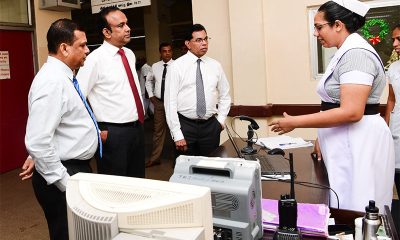
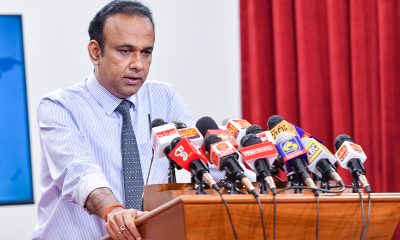
Justice, Prisons Affairs and Constitutional Reforms Minister Dr. Wijeyadasa Rajapakse, PC, has assured the local business community, troubled by parate executions, that laws will be brought in to regulate the practice. The Justice Minister said he would work with Health Minister Dr. Ramesh Pathirana to convince the Cabinet-of-Ministers to change the law.
The assurance was given at a meeting held at the Jasmin Hall, BMICH, where the former President of the Bar Association explained how the law meant to recover unpaid loans and interest thereon was brazenly abused.
The gathering was told that approximately 1,400 businesses were already in distress, especially in Colombo, due to the one-sided swift action taken by banks to recover unpaid loans by seizing and auctioning mortgaged properties without taking into consideration the political-economic-social crisis caused by the 2019 Easter Sunday attacks, followed by the Covid-19 pandemic and the subsequent economic crisis.
Minister Rajapakse said that either the existing law, the Banking Act no 30 of 1988, had to be overhauled or a new Act introduced to prevent the further deterioration of the economy.
Parate execution can be carried out only by the licensed commercial banks of Sri Lanka.
Following Dr. Rajapakse’s declaration, the Sri Lanka Banks Association (SLBA) stressed that the banks exercised what the Association called their legally-enshrined right to parate execution as a last resort. The Association declared that the overarching objective was to protect depositors’ funds that had been lent to borrowers.
The Association emphasised that the parate execution remedy is aimed at recovering mortgaged assets from willful defaulters and businesses that were no longer viable.
The SLBA, which represents all the licensed banks in the country, pointed out that banks have extended moratoriums on debt repayment for a long period exceeding 48 months in some cases, and that in instances of willful default by borrowers, the banks owe a duty to their depositors’ whose funds are at risk, to recover the debts overdue and minimize the losses on loans granted.
Legal sources pointed out that the association never bothered to issue statements when huge amounts of money recklessly lent and overdue from top end borrowers were written off as bad debts.
Minister Rajapakse told Friday’s meeting that before the change of government, in 1977, only the Bank of Ceylon, People’s Bank and State Mortgage and Investment Bank were empowered to carry out parate executions. However, subsequently private banks and financial institutions, having made representations to the then President, secured parliamentary approval to join the club.
The government disregarded the concerns expressed by the Bar Association at that time, the Justice Minister said, alleging there had been many instances of misuse at the expense of the clients experiencing financial difficulties.
Valuable properties that had been seized under parate execution had been bought for a song and then sold keeping a huge profit margin, the Justice Minister said, asserting that a deeply flawed law caused injustice.
Dr. Rajapakse warned unless the continuing manipulation of the law wasn’t stopped through an amendment to the existing Act or by introducing a new Act, the banks, too, would have to face far reaching consequences. The significant depletion of industrial and commercial borrowers under the dire current circumstances and significant weakening of the client base as a whole could have a negative impact on the entire banking system, the Justice Minister warned.
The President’s Counsel also questioned ‘irrevocable power of attorney’ that lenders obtain from borrowers over mortgaged properties while declaring his intention to bring in necessary amendments to restore public confidence in the system. The Minister pointed out that the ‘irrevocable power of attorney’ couldn’t be done away with. “This is wrong and not practiced anywhere in the world,” the outspoken Minister said.
The government couldn’t forget that a section of the business community had been subjected to such unfair practices at a time the people were burdened with taxes and faced further increased levies, such as VAT from January 1, 2024. How could one do business under such difficult circumstances, the Dr. Rajapakse asked?
The MP, who had first entered Parliament, back in 2004, on the then PA National List, found fault with successive governments for failing to adopt a proper tax policy. Declaring that once adopted a particular tax regime should be in place for at least a decade, lawmaker Rajapakse pointed out how the country suffered for want of proper tax strategy.
The Minister told The Island that the way governments had handled the economy was questionable and those responsible owed the country an explanation and apology. Dr. Rajapakse questioned the utter failure on the part of the Central Bank to recover the loans granted to various failed finance companies. “I raised this issue in Parliament recently but unfortunately those responsible are yet to take tangible measures in this regard,” Dr. Rajapakse said.
Referring to a declaration he made in Parliament on November 15, this year, Dr. Rajapakse said that Mercantile Credit, one of the beneficiaries of government grants, was yet to pay back Rs. 30,000 million it owed to the Central Bank.
The Minister said so during the debate on the Second Reading of Budget 2024.
“It is a massive borrowing by a single entity that is more than what his Ministry’s vote amounts to,” Dr. Rajapakse said. Those behind the scheme hadn’t been punished, the Minister charged.







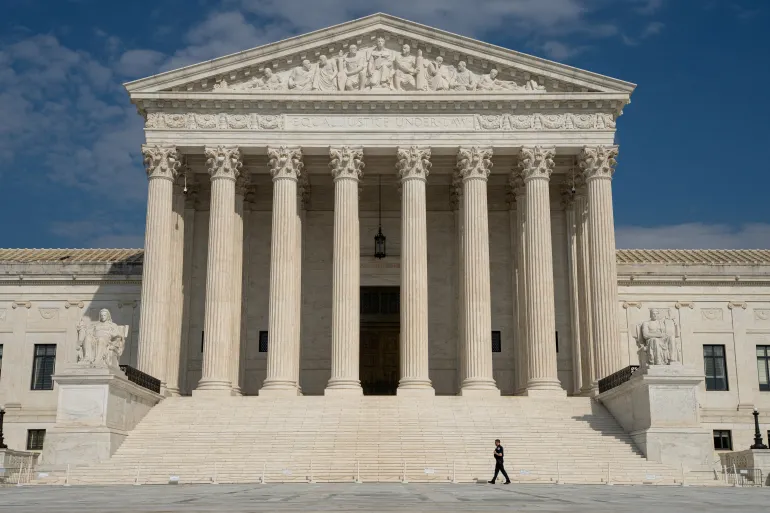
The US Supreme Court has rejected President Donald Trump’s bid to allow the US Postal Service to enforce a rule targeting mail-in ballots.
On Monday, the conservative-majority court refused to lift an order by US District Judge Indira Talwani that blocked the measure, dealing a blow to Trump’s efforts to restrict voting by mail before the November midterm elections.
The postal agency adopted the rule after Trump signed an executive order in March seeking to tighten rules around mail-in voting. Under this measure, states were required to send the Postal Service a list of recipients and use ballot mail envelopes previously approved by the agency.
The Postal Service was allowed to deny ballots if they failed to comply with the new standards or were not associated with registered voters on the lists.
Talwani imposed an injunction blocking the rule, saying that it likely violated the US Constitution and would be impossible to apply given the nearing midterms.
Shortly after, the Trump administration issued an emergency request to the Supreme Court urging it to allow an “important federal policy to protect the mails from being used to commit voter fraud”.
In late August, the Supreme Court had temporarily allowed Trump to move ahead with his executive order on procedural grounds, but did not rule on the legality of the plan.
In the latest decision, the court said in an unsigned order that the administration was “unlikely to succeed on the merits” of its challenge. Justice Samuel Alito and Justice Clarence Thomas dissented, with Alito writing that some plaintiffs lacked standing while the rest were pursuing a claim the court had recently called a “Hail Mary pass”.
[Aljaeera]
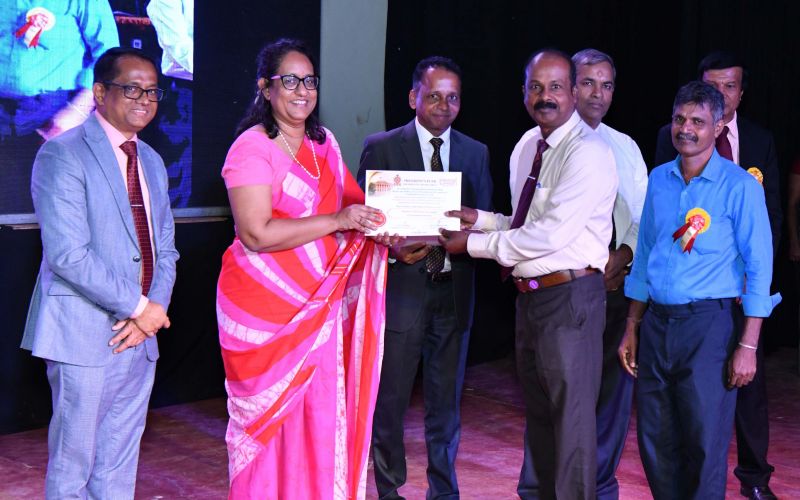
The “Mehewara Pasasum” programme to recognise Divisional Secretariats in the Eastern Province that demonstrated the highest level of performance in 2025 was held recently at the Swami Vipulananda Institute of Aesthetic Studies of the Eastern University, under the patronage of Prime Minister Dr Harini Amarasuriya. The programme was held as part of the initiative to decentralise President’s Fund services to the Divisional Secretariat level, with the aim of providing the public with a more efficient and prompt service.
Of the Divisional Secretariats in the three districts of Ampara, Batticaloa and Trincomalee, nine Divisional Secretariats, three from each district, were selected for recognition based on their efficiency in receiving President’s Fund applications and responding to them promptly.
Accordingly, the Sammanthurai Divisional Secretariat secured first place in the Ampara District, while the Addalachchenai Divisional Secretariat secured second place and the Kalmunai Divisional Secretariat third place.
In the Batticaloa District, first place was secured by the Kattankudy Divisional Secretariat, second place by the Manmunai North Divisional Secretariat and third place by the Koralaipattu Central Divisional Secretariat.
In the Trincomalee District, first place was secured by the Trincomalee Town and Gravets Divisional Secretariat, second place by the Kinniya Divisional Secretariat and third place by the Muttur Divisional Secretariat.
The first “Mehewara Pasasum” programme was held in Colombo, the second in Batticaloa, and this was the third programme.
Speaker Dr Jagath Wickramaratne, Minister of Industry and Entrepreneurship Development Sunil Handunnetti, Senior Additional Secretary to the President and Secretary to the President’s Fund Roshan Gamage, and a number of government officials and others were present at the occasion.
(PMD)
News
Students of Rahmaniya Maha Vidyalaya Eravur visit Presidential Secretariat and President’s House

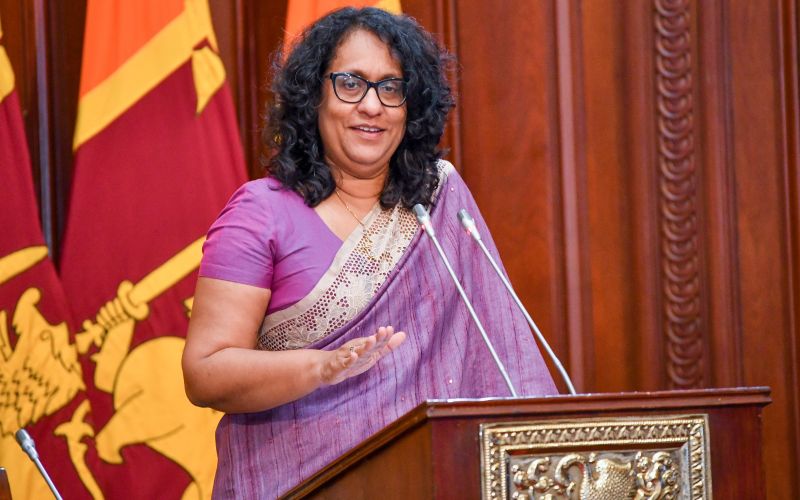
A group of students from Rahmaniya Maha Vidyalaya, Eravur, Batticaloa visited the Presidential Secretariat and President’s House on Monday (14) afternoon .
The students were given this opportunity as part of the “Vision” programme series, jointly implemented by the Presidential Secretariat, the Ministry of Education and the Communication Division of the Parliament of Sri Lanka for schoolchildren.
Prime Minister Dr Harini Amarasuriya stated that nurturing a future generation capable of providing leadership to society and committed to bringing about positive change in the world was an urgent need of the present day. She further stated that the Government’s objective in introducing the new education reforms was to prepare children to acquire knowledge from around the world while nurturing a confident and empowered generation capable of making a meaningful contribution to the country.
Following a visit to the former Parliament building at the Presidential Secretariat, the students were briefed on the history of Parliament.
Senior Additional Secretary to the President Roshan Gamage briefed the students on the role of the President’s Fund and the benefits available to schoolchildren through the Fund.
As part of the programme, valuable plants were also presented to the school as a symbolic gesture highlighting the importance of environmental conservation.
The Director and Assistant Director of the Tri-Forces Security Coordination Unit, the Principal and teachers of Rahmaniya Maha Vidyalaya Eravur and several others were present on the occasion.
(PMD)

US Supreme Court rejects Trump mail ballot restrictions ahead of midterms

Eastern Province Divisional Secretariats recognized for outstanding performance

Students of Rahmaniya Maha Vidyalaya Eravur visit Presidential Secretariat and President’s House

Showers above 100 mm expected at times in the Western, Sabaragamuwa, Central, Uva and Southern provinces, and in Ampara and Batticaloa districts

Controversy over absence of Agriculture Minister, Deputy at NPP’s inaugural farmers’ rally

Thousands march in Jaffna demanding international investigation into Chemmani

‘Dates have the highest sugar content to fight Coronavirus’

Sunday Island 27 December – Headlines

#SundayIsland 17th December – Headlines

Sunday Island – 28th March

Sunday Island Headlines – 21 March

Sunday Island – 21st February – Headlines
-

 Sports4 days ago
DDS set to lose Test captaincy
-

 News4 days ago
Sri Lanka faces new grid challenge as rooftop solar surges: former CEB GM
-

 Latest News4 days ago
Shafali, Deepti power India into sixth T20 Asia Cup final
-

 Latest News3 days ago
Sri Lanka thwart Fatima Sana challenge to secure Asia Cup final spot
-

 Opinion6 days ago
Navigating Sri Lanka’s Israeli Dilemma
-

 Features5 days ago
Lost for 90 years: Rare Goby resurfaces in Jaffna
-

 News2 days ago
Gnanasara Thero absconding after SC ruling
-

 News3 days ago
Ammunition cache found in old Kandy bungalow