
News
Russian Ambassador encourages Sri Lanka to consider nuclear energy collaboration

By Rathindra Kuruwita
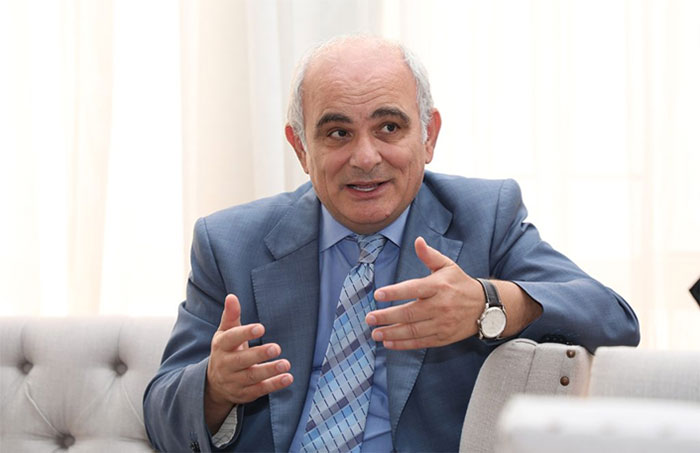
It is up to Sri Lanka to determine whether to collaborate with Russia’s state owned Rosatom State Nuclear Energy Corporation in building a small nuclear power plant or not, says Levan S. Dzhagaryan, Ambassador of the Russian Federation.
Ambassador Dzhagaryan said nuclear energy was a viable alternative for Sri Lanka. He added that he had mentioned the possibility of establishing small nuclear power plants in many meetings with Sri Lankan officials. “This will be a 110 megawatt power plant, and it can be in two blocks, one floating and one on the land, Dzhagaryan said.
“You need an alternative source of power. Don’t rely only on coal, or LNG. We have nuclear cooperation with India, Bangladesh, Myanmar, Türkiye and Iran.”
Dzhagaryan added that there was a high-level delegation from Russia between 06 and 08 December. It was headed by Nikolai Patrushev, Chief Advisor of President Putin on security issues.
“They met President Wickremesinghe. They had very good discussions. Hopefully we will be able to implement some of the ideas that were discussed. We know that Sri Lanka is under pressure from some countries, but as a sovereign country, we think Sri Lanka will carry out its independent foreign policy,” he said.
Dzhagaryan added that he expects 200,000 tourists to arrive in Sri Lanka by February 2024 due to increased flight operations by Russian airlines to Katunayaka and Mattala airports.
Commenting on reports that Russia has floated a proposal to carry out a joint venture to develop Mattala airport, the Russian Ambassador said, a large number of Russian tourists arrive in Sri Lanka. AZUR air, Russia’s largest Charter airline, and Aeroflot, the flag carrier, and the largest airline of Russia, come to Katunayaka. Red Wings, specializing in scheduled and charter passenger transportation, flies to Mattala. Russians enjoy their stay in Sri Lanka. There were different proposals on Mattala and we expressed ours. It’s under consideration. Once again, it’s up to Sri Lanka to decide,” he said.







A specialists committee has been appointed by the Secretary to the Ministry of Agriculture, Livestock, Lands and Irrigation adhering to the decision of the Cabinet of Ministers dated 29.12.2025 for submitting appropriate recommendations analyzing the provisions of the draft bill formulation in regard to Animal Welfare.
Based on the recommendations of the said Committee, the Legal Draftsman has been instructed at the meeting of the Cabinet of Ministers held on 18.05.2026 to prepare the final bill on the animal welfare.
Wherefore, the Legal Draftsman has formulated the draft bill and the clearance of the Attorney General has been received in the connection.
Accordingly, the Cabinet of Ministers granted approval to the resolution furnished by the Minister of Agriculture, Livestock, Lands and Irrigation to publish the said draft bill in the
Government Gazette Notification and subsequently forward the same to the Parliament for its concurrence.
Under the legal provisions for elections in this country since 2004, it is mandatory for voters who come to mark their votes to verify their identity through a valid identity card, and it is also mandatory for all such voters to be marked with an appropriate mark using indelible ink. The dual purpose of these two functions is to prevent a voter from voting more than once in a single election.
It has been observed that having to follow two different
methods at the same time to achieve the same objective hinders the efficiency of the duties performed at the polling stations and also incurs additional costs to the government.
Therefore, it has been deemed appropriate to remove the legal provisions regarding the use of indelible ink and marking the voter with the appropriate mark from all election acts.
Accordingly, the development activities of the province, as well as national security, will benefit. Therefore, the Cabinet of Ministers has approved the resolution furnished by the
President to take necessary steps to remove the legal provisions
• Section 36 of the presidential Election Act, No 15 of 1981
• Section 38 of the Parliamentary Election Act, No 01 of 1981
• Section 36 of the Provincial Council Election Act, No 02 of 1988
• Section 53 A of the Local Government Elections Ordinance (262 Authority)
• Section 21 of the Referendum Act No 7 of 1981
News
Showers will occur in the Western, Sabaragamuwa and North-western provinces and in Galle, Matara, Kandy and Nuwara-Eliya districts

WEATHER FORECAST FOR 24 JUNE 2026
Issued at 05.30 a.m. on 24 June 2026 by the Department of Meteorology
Several spells of showers will occur in the Western, Sabaragamuwa and North-western provinces and in Galle, Matara, Kandy and Nuwara-Eliya districts. Showers or thundershowers may occur at a few places in the Uva province and in Ampara and Batticaloa districts after 2.00 p.m.
Fairly strong winds about (30-40) kmph can be expectedat times over the Western slopes of the central hills, the Northern, North-central, North-western and Southern provinces and in Trincomalee district.
The general public is kindly requested to take adequate precautions to minimize damage caused by temporary localized strong winds and lightning during thundershowers.

Munoz sends Colombia into World Cup knockouts with 1-0 win over DR Congo

Animal Welfare Draft Bill to be Gazetted
Legal provisions on marking voters using indelible ink during elections removed

Showers will occur in the Western, Sabaragamuwa and North-western provinces and in Galle, Matara, Kandy and Nuwara-Eliya districts

Court vacancy row throws Parliament into turmoil; sittings disrupted

Climate, pollution, forest loss now hitting economy: BASL chief

‘Dates have the highest sugar content to fight Coronavirus’

Sunday Island 27 December – Headlines

#SundayIsland 17th December – Headlines

Sunday Island – 28th March

Sunday Island Headlines – 21 March

Sunday Island – 21st February – Headlines
-

 News5 days ago
Creditor receives USD 2.5 mn as Lankan public bears loss from theft of Treasury funds
-

 News4 days ago
Creditor not yet paid
-
 News4 days ago
Consumers bearing 22% tax burden despite 18% VAT claim: Dr. Harsha de Silva
-

 Opinion6 days ago
Beyond diagnosis: A strategic design for 7% growth by 2029 (Part I)
-

 Features4 days ago
Nanda Pethiyagoda Wanasundara as three generations of family saw her
-

 Opinion6 days ago
SriLankan Airbus struck by lightning
-

 Features3 days ago
Sri Lanka developing independent hydrographic capabilities
-

 Latest News3 days ago
Sooryavanshi thumps fastest List A fifty as India A win tri-series