
Business
Nestlé Lanka wins Presidential Export Award for Best Exporter in Coconut Kernel Product Sector


Nestlé Lanka was awarded Best Exporter in the Coconut Kernel Sector for the financial years 2021/2022 and 2022/2023 under the patronage of President Ranil Wickremasinghe, at the 25th Presidential Export Awards held recently. Organized by the Sri Lanka Export Development Board (EDB), these prestigious awards are presented in recognition of companies’ outstanding contributions to the country’s export sector.
“We are deeply honoured to be recognized for our continuous efforts in strengthening national exports. During these challenging times, receiving the award for ‘Best Exporter in the Coconut Kernel Sector’ for three consecutive financial years is a testament to the unwavering commitment and determination of our team. I am humbled that we continue to contribute positively to Sri Lanka’s economy through our operations, supporting and uplifting the local coconut industry and creating sustainable livelihoods for our farming community, while also strengthening the country’s FOREX reserves through the foreign exchange brought in from exports” said Bernhard Stefan, Managing Director, Nestlé Lanka.
Nestlé introduced Maggi Coconut Milk Powder in 1986, and since then, has supported over 6,000 Sri Lankan farmers during 37 years of operations, consistently uplifting their well-being. Last year, the company procured over 96 million fresh coconuts, boosting rural communities with a payout of Rs. 6.2 billion. Further, as one of the largest exporters of Coconut Milk Powder in Sri Lanka, the company contributed Rs. 10.72 billion in export revenue to the Sri Lankan economy in 2022/23. Additionally, the company extends its support to 4,500 rural families in its endeavour to do good of the community through the Nestlé Coconut Plan, offering them free hybrid coconut plantlets, technical guidance, and comprehensive training and development programs.







By Hiran H. Senewiratne
The CSE’s performance yesterday improved over that of the previous day’s but failed to reach the expected level because investors were concerned about the global economy and the Central Bank’s possible stance at today’s policy review meeting.
The All Share Price Index went down by 9.53 points, while the S and P SL20 declined by 12.06 points. Turnover stood at Rs 1 billion with two crossings.
JKH crossed 4 million shares to the tune of Rs 75.2 million; its shares traded at Rs 18.80 and hSenid 1 million shares crossed for Rs 21.6 million; its shares traded at Rs 21.60.
In the retail market companies that mainly contributed to the turnover were; York Arcade Rs 55 million (6.3 million shares traded), Softlogic Capital Rs 51 million (5.6 million shares traded), Sierra Cables Rs 41 million (1.2 million shares traded), Lanka Realty Investments Rs 39 million (806000 shares traded), RIL Properties Rs 35 million (1.6 million shares traded), Overseas Realty Rs 35 million (162,000 shares traded) and Commercial Credit and Finance Rs 34 million (353,000 shares traded). During the day 59.6 million share volumes changed hands in 16095 transactions.
It is said that manufacturing sector counters, especially JKH, performed well while financial sector counters and construction related sectors significantly performed.
Meanwhile, Resus Energy said two of its subsidiaries have submitted bids within the qualifying price range to set up 16 megawatts (MW) or 64 megawatt-hours (MWh) of battery energy storage systems (BESS).
The proposals were submitted under a limited competitive bidding process for systems integrated with existing ground-mounted solar power plants on a 15-year build, own and operate basis.
Resus Solar (Private) Limited submitted a proposal for 14 MW / 56 MWh, while Resus Eastern Solar (Private) Limited submitted a bid for 2 MW / 8 MWh.
Resus Energy estimated the equity capital needed for the projects at Rs 650 million to Rs 800 million. The projects have been officially awarded.
Yesterday the rupee was quoted weaker at Rs 330.90/331.10 to the US dollar in the spot market from Rs 330.90/331.05 the previous day, while bond yields opened broadly steady, dealers said.
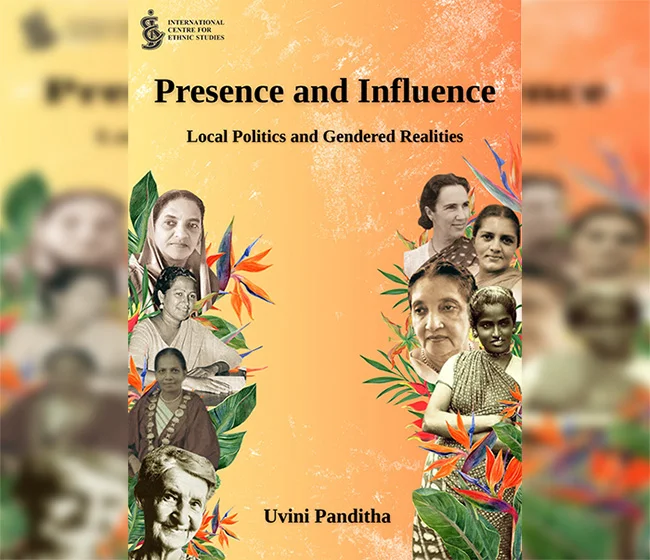
by Professor Ramona Vijeyarasa (Chair in Gender and the Law at the University of Technology Sydney, Australia)
In the November 2024 parliamentary elections, Harini Amarasuriya won 655,289 preferential votes — the second-highest in Sri Lankan electoral history — and became the country’s first female prime minister in twenty-four years. She is not a widow. She is not a daughter of dynasty. She is an academic, a social anthropologist with a doctorate from Edinburgh, a human rights activist who once marched against the Rajapaksa government when doing so carried real risk. Her ascent to the premiership did not follow the well-worn South Asian script of women inheriting power over the dead bodies of male relatives. It followed a different pathway entirely — one built through scholarship, community organising and feminist conviction. That fact alone should be treated as a signal, not merely a story.
Yet inspiring stories can obscure a more difficult reality. New research by Uvini Panditha at the International Centre for Ethnic Studies examines what happened after Sri Lanka’s landmark local government quota brought around 2,000 women into office. Based on 26 interviews with women councillors across ten districts and 14 interviews with academics, activists and civil society representatives, the study finds that while representation increased dramatically, power often did not.
The findings reinforce what earlier research has shown. In my work on Sri Lanka’s local government quota and a comparative study with Tanya Jakimow, Mario Gomez, Nadine Vanniasinkam, Viyanga Gunasekera and colleagues in Indonesia, we documented the barriers between grassroots activism and elected office: party gatekeeping, tokenism and exclusion from decision-making. Even when women reach executive leadership, as I explored in The Woman President, they bear gendered expectations that male leaders escape.
Sri Lanka has nevertheless moved. The quota raised women’s representation in local government from under two per cent to about 23 per cent in 2018. The 2024 parliamentary election also produced the country’s highest representation of women to date. These gains matter. But Panditha’s study shows how institutions can comply with a quota while preserving the power structures beneath it.
The report Presence and Influence: Local Politics and Gendered Realities is available at the International Centre for Ethnic Studies (ICES), 02 Kynsey Terrace, Colombo 08, in English, Sinhala and Tamil. E-copies of the report are available at www.ices.lk
By Ifham Nizam
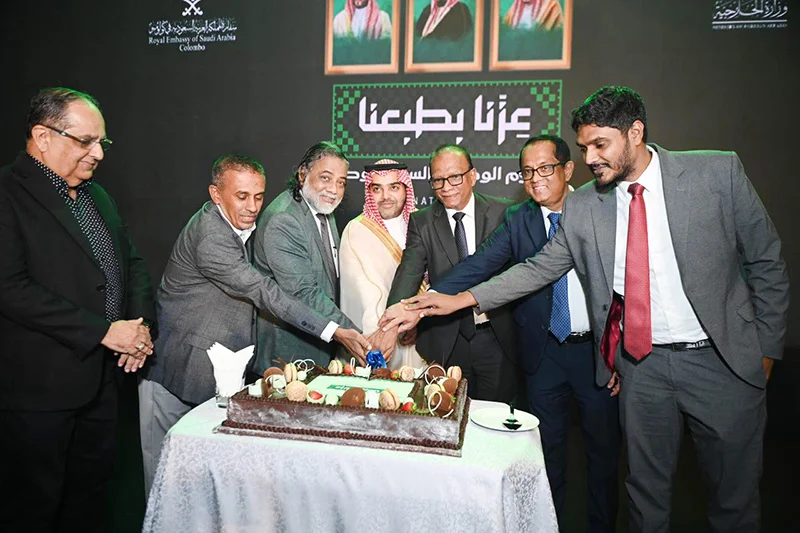
Sri Lanka is pitching Saudi Arabia for greater investment and deeper trade ties, seeking to attract Saudi capital into new development opportunities while aligning bilateral economic cooperation with the Kingdom’s ambitious Vision 2030 agenda, Ports and Civil Aviation Minister Anura Karunathilaka, chief guest at Saudi Arabia’s 96th National Day celebrations in Colombo, said.
Addressing the National Day reception at ITC Ratnadipa, Karunathilaka said Sri Lanka was keen to identify new areas of economic cooperation with the Kingdom and create fresh opportunities for Saudi investors and businesses.
‘We look forward to creating new opportunities for the people of both countries by working in cooperation with Saudi Arabia’s Vision 2030 and its broader development initiatives, he said.
The minister said Sri Lanka wanted to move beyond its existing development cooperation with Saudi Arabia and build a broader economic partnership encompassing investment, trade and new development projects.
He noted that Saudi Arabia had already made a substantial contribution to Sri Lanka’s development. Since 1981, the Kingdom has provided concessional financing amounting to around Saudi Riyals 1.5 billion for 13 projects in Sri Lanka, supporting key sectors including energy, healthcare, education, drinking water and infrastructure.
Karunathilaka said Sri Lanka appreciated this support and was keen to build on the foundation created by those projects by opening further avenues for Saudi investment.
The minister’s investment pitch comes as Saudi Arabia advances its Vision 2030 programme, with the Kingdom seeking to diversify its economy and develop new international partnerships. Sri Lanka, meanwhile, is seeking to attract investment and expand economic opportunities through closer engagement with international partners.
Karunathilaka also highlighted the strong people-to-people links between the two countries, noting that nearly 250,000 Sri Lankans currently work and reside in Saudi Arabia.
‘They serve as an important bridge between our two countries and contribute significantly to strengthening the people-to-people ties between Sri Lanka and Saudi Arabia, he said.
He expressed appreciation for Saudi Arabia’s continued assistance to Sri Lanka and thanked the Saudi government for the facilities extended to Sri Lankan Muslims undertaking Hajj and Umrah pilgrimages.
Karunathilaka said Sri Lanka looked forward to working more closely with Saudi Arabia to strengthen political relations, broaden investment opportunities and enhance development cooperation.
Yaser Abdulrahman Al-Hazme, Chargé d’Affaires of the Royal Embassy of Saudi Arabia to Sri Lanka, said the embassy remained committed to strengthening bilateral relations by promoting political, economic and cultural communication between the two countries.
‘The embassy of the Kingdom of Saudi Arabia in Colombo has been keen during the past period to strengthen bilateral relations between the two countries by playing its role in supporting political, economic, and cultural communication, Al-Hazme said.
Al-Hazme also highlighted the embassy’s role in strengthening communication between Saudi and Sri Lankan institutions and following up on the interests of Saudi citizens in Sri Lanka.
‘On this precious national occasion, I extend my sincere thanks and appreciation to the government and people of the Democratic Socialist Republic of Sri Lanka for the attention and care given to relations between our two countries, and for the constructive cooperation that has contributed to strengthening the bonds of friendship and partnership between the Kingdom and Sri Lanka, he said.

Investor speculation over CBSL’s monetary policy slows CSE

NR re-remanded till 13 Oct

Sri Lanka’s gender quota changed the numbers. It didn’t change the system.

ISSI and SASSRI to strengthen academic and strategic cooperation between Pakistan and Sri Lanka

Foundation stone laid for new housing units under Indian Housing Project in Badulla district

Cabinet nod to increase the number of new automated passenger clearance gates at the Bandaranayake International Airport to 12

‘Dates have the highest sugar content to fight Coronavirus’

Sunday Island 27 December – Headlines

#SundayIsland 17th December – Headlines

Sunday Island – 28th March

Sunday Island Headlines – 21 March

Sunday Island – 21st February – Headlines
-

 News7 days ago
Mastermind Naufer Moulavi among 15 found guilty
-

 Midweek Review7 days ago
Thileepan’s fast unto death: An authentic narrative that many missed
-

 Latest News6 days ago
Showers above 100 mm are likely at some places in the Western, Sabaragamuwa, Central and North-western provinces and in Galle and Matara Districts
-

 Editorial7 days ago
Big Bad Bills
-
Editorial6 days ago
Crimes punished and unpunished
-

 Features5 days ago
Beyond traditional jobs: Why Sri Lanka needs to facilitate the gig economy
-

 News7 days ago
No referendum needed for passage of 22 A: SC
-

 News7 days ago
One clause in Anti-Corruption (Amendment) Bill requires referendu: SC