
Latest News
India see off Wade threat to make it 4-1

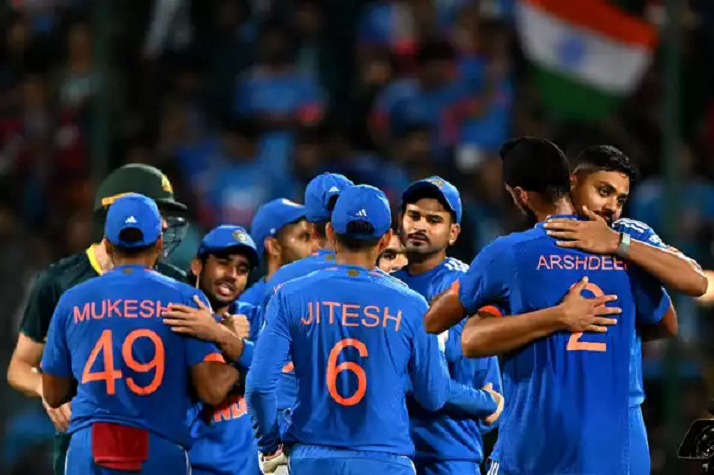
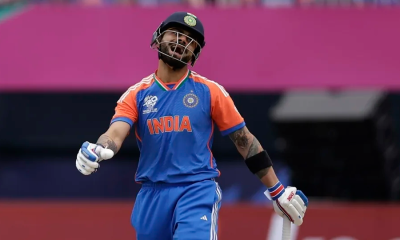
India managed to withstand a late assault from Matthew Wade to pick up another win and finish the T20I series 4-1. The visitors, chasing a consolation win, appeared to be in a very good position when a dangerous-looking Wade was dealing in boundaries. But Arshdeep Singh, making a return to the XI in this contest, delivered an excellent final over to deny the visitors in Bengaluru.
India had only 10 runs on the board off the first 15 balls after Australia opted to bowl. Yashasvi Jaiswal then stepped up with a flurry of boundaries and looked set for more before he got a top-edge while attempting a pull to fall for 21. Ruturaj Gaikwad followed him soon as the right-hander never got going on the night. Ben Dwarshuis then picked up the huge wicket of Suryakumar Yadav as the Indian skipper failed to fire despite walking out to bat fairly early.
A promising partnership was brought to an end by Aaron Hardie in his final over but Axar Patel stepped up for the home side alongside Shreyas. Axar hit a valuable 21-ball 31 before succumbing to a knuckle ball whereas Shreyas at the other end managed to bring up a fighting half-century with a six and a four off successive deliveries again as India managed to finish with a fighting 160 on the board.
While India made only 9 in their first two overs, Australia got off to a flier with Travis Head hammering the first three balls of the run chase to the fence. He added one more in the second over as Australia looked to assert their dominance. But Mukesh Kumar gave India a vital breakthrough as Josh Phillippe dragged one onto his stumps before Ravi Bishnoi did his thing. The legspinner has been very impressive in the powerplay this series and his stocks only grew after he managed to castle Head, who had just smashed him for a six the previous ball. While Australia had knocked off 50 in the powerplay, Bishnoi struck again with another googly to peg them back.
Walking out to bat early, Ben McDermott was only dealing in sixes and those hits ensured Australia kept up with the asking rate. Having pulled just his third delivery for a six, McDermott sent one to the roof before going into a shell with Australia losing wickets. A six from Tim David then appeared to put Australia back on track before McDermott hammered his fourth biggie of the night. Australia appeared to be in a very good position when a fifth six brought the equation down to 60 from 42 before a thrilling climax sealed it for India.
India nudged ahead when David top-edged a pull as Axar finished with excellent figures of 1/14. McDermott then smashed another six, this time off Arshdeep, to bring up a fifty but his wicket in the same over brought India firmly back into the contest. Mukesh then came back to strike twice in one over that stunned Australia and put India on top again. However, Wade’s brilliance in the 18th over changed the entire complexion. Taking on Avesh Khan, Wade managed to hit three back-to-back boundaries and suddenly, the equation was down to 15 off 12. That became 11 off 8 when Wade added to his boundary tally and from thereon, it was definitely Australia’s game to lose. But there was another twist in the offing as Arshdeep delivered an excellent final over. Needing 10 from 6, Wade couldn’t connect the first two deliveries and was dismissed off the next, which ended the chase once and for all.
Brief scores:
India 160/8 in 20 overs (Yashawi Jaiswal 21, Shreya Iyer 53, Jitesh Sharma 24, Axar Patel 31; Aaron Hardie 1-21, Jason Berendorff 2-38, Been Dwarshuis 2-30, Nathan Ellis 1-42, Tanveer Sangha 1-26) beat Australia 154/8 in 20 overs (Travis Head 28, Ben McDermott 54, Mathew Wade 22; Arshdeep Singh 2-40, Mukesh Kumar 3-32, Ravi Bishnoi 2-29, Axar Patel 1-14) by 6 runs



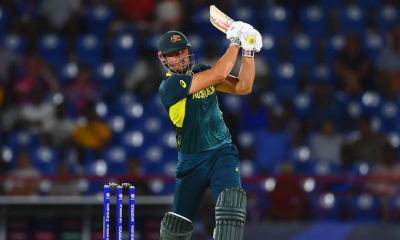


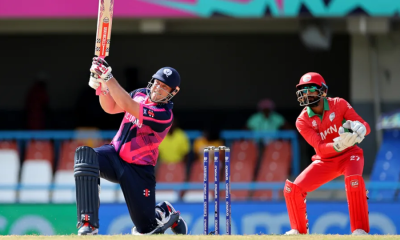




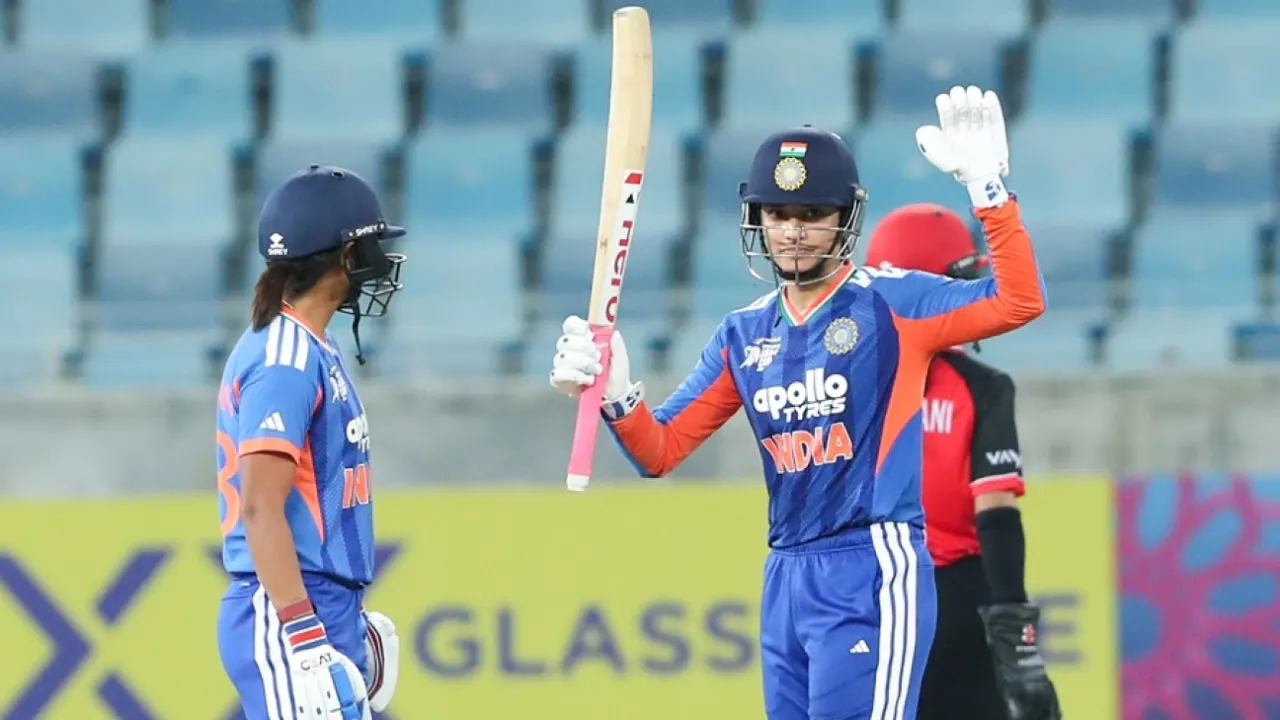
Smriti Mandhana filled her batting coffers with her second T20I century, along the way surpassing Mithali Raj for the record for most runs in women’s internationals, to help India secure a second straight win on Thursday night in Dubai.
Hong Kong’s nerves showed on the field when they fell flat at the first sign of attack from India’s batters, and their timid approach in the chase further exposed the gulf in quality and experience. In the end, they lost by 137 runs – 13 more than what Mandhana managed on her own.
A second straight loss meant Hong Kong will only have some pride to play for, as a berth in the next round is now out of the equation.
India’s cautious start
At the end of five overs, India were 38 without loss – not concerning, but not dominating enough either. They took a while to suss up the lack of pace from the bowlers. Mandhana hogged much of the strike; Shafali Verma faced just six balls in the first five overs. Hong Kong couldn’t have been happier at having kept a lid on the scoring.
Shafali steps up
After a tight first over that went for just seven, offspinner Maria Lamplough was clobbered by Shafali for two fours and two sixes in a 22-run over that helped India take off.
Lamplough struggled for consistency and kept looping the ball up, with Shafali needing no second invitation. The first of the two sixes was a shovel over deep midwicket; the next even better – lofted inside-out over deep extra cover.
Shafali’s brief surge ended on 28 in the eighth over, when Marina took an excellent catch running in and diving full stretch from long-on off Ruchita Venkatesh’s bowling. By then, the openers had put on 74.
Mandhana prances towards record century
As new No. 3 Pratika Rawal took a while to gauge the pace of the surface, Mandhana reached her half-century – her 36th in T20Is – off 40 deliveries with a flat six over deep square. Mandhana’s default setting for much of this period was moving over to the off-side to set herself up for several variations of the slog in the arc between wide long-on and deep square.
Her next fifty came off just 18 deliveries. The century could’ve been nipped in the bud had she been taken at deep square leg in the 16th over off Siu Wai, but she accelerated even more soon after bringing up her century that helped her climb atop the list for most international hundreds in women’s cricket.
In the 18th over, she clobbered Venkatesh for three consecutive sixes, and in the same over also went past Mithali’s record for most international runs. This helped India finish strongly, the second half of their innings brought them 107 despite losing a clutch of wickets.
Nandani’s dream run continues
Coming off a three-for against Thailand, Nandani Sharma’s seam presentation and control was immaculate with the new ball as Hong Kong crawled to 4 for 1 in four overs. The wicket, off Mariko Hill, one of their most experienced batters, came off a superb in-ducker on the back of three successive away-swingers. Nandani added one more wicket to her kitty to finish with 2 for 6 off her three overs.
The collapse
The highest partnership of the innings was the 27 between Yasmin Daswani and Natasha Miles for the second wicket; a period where they hardly threw any caution to the wind, choosing instead to bat overs and gain some match time against an opponent they were playing for the first time in 14 years.
The partnership ended when Daswani’s attempt to heave into the leg side was intercepted by a leaping Bharti Fulmali at midwicket to give Deepti Sharma a wicket. Six balls later, Miles was out attempting to cut Prema Rawat’s sharp leg break, nicking behind to Richa Ghosh.
That was the start of the collapse, as India’s spinners closed in, each one getting onto the scorecard with a bagful. There were eight single-digit scores, with 15 the highest. They lost their last five wickets in 11 deliveries, collapsing from 54 for 5 to 56 all out.
India couldn’t have asked for an easier route into the semi-finals.
Scores:
India Women 193 for 5 in 20 overs (Smriti Mandhana 124, Shafali Verma 28, Pratika Rawal 10, Richa Gosh 11, Harmanpreet Kaur 10; Marina Lamplough 2-46, Ruchitha Venkatesh 1-30, Joyleen Kaur 1-12) beat Hong Kong Women 56 in 16.2 overs (Natasha Miles 15, Yasmin Daswani 11, Marina Lamplough 14; Nandani Sharma 2-06, Shree Charani 2-16, Deepti Sharma 3-09, Prema Rawat 2-12) by 137 runs
[Cricinfo]
Latest News
Sun directly overhead Nittambuwa, Algama, Malwana, Aranayake, Meegahakiula and Panamkadu about 12.09 noon today (04)

The sun is going to be directly over the latitudes of Sri Lanka from 28th of August to 07th of September due to its apparent southward relative motion.
The nearest places of Sri Lanka over which the sun is overhead today (04) are Nittambuwa, Algama, Malwana, Aranayake, Meegahakiula and Panamkadu about 12.09 noon.
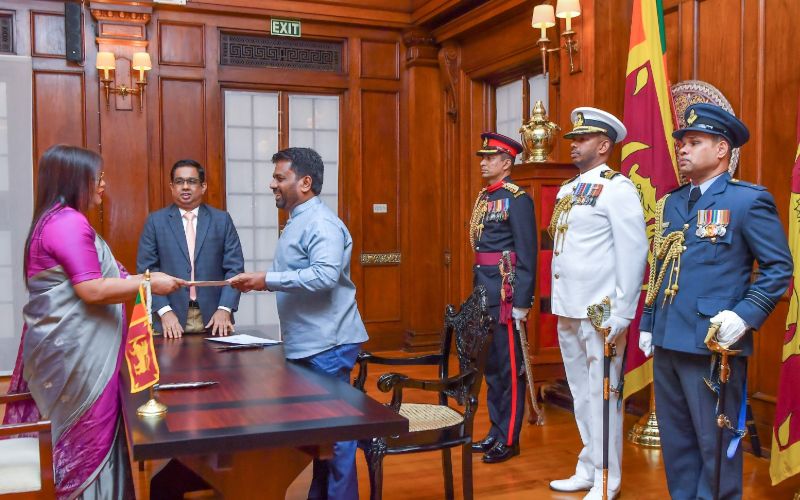
Ms Sajeewani Dilka Lakmali Karunannayake was sworn in as a Judge of the Court of Appeal before President Anura Kumara Dissanayake at the Presidential Secretariat this afternoon (03).
She previously served as an Additional Solicitor General at the Attorney General’s Department.
The appointment has been made to fill a vacancy on the Court of Appeal.
Secretary to the President Dr Nandika Sanath Kumanayake was also present on the occasion.
(President’s Media Division)

Devapathiraja clinch U15 Division I title with 33-run win over Royal

Mandhana’s record ton powers India into semi-finals

Sun directly overhead Nittambuwa, Algama, Malwana, Aranayake, Meegahakiula and Panamkadu about 12.09 noon today (04)

Showers expected in the Uva, Central and Eastern provinces and in Polonnaruwa and Mullaittivu districts after 2.00 p.m

Norochcholai digs into dwindling coal stocks, two units slash generation

22A: BASL decides against making written submissions after SC refuses to grant it right of reply

‘Dates have the highest sugar content to fight Coronavirus’

Sunday Island 27 December – Headlines

#SundayIsland 17th December – Headlines

Sunday Island – 28th March

Sunday Island Headlines – 21 March

Sunday Island – 21st February – Headlines
-

 Features5 days ago
“Wrap Me Up in My Blazer”— A Gentlemanly Bradby Reminiscence
-

 Features4 days ago
When Sri Lankan stories find their own voice
-

 Features5 days ago
JVP/NPP government as seen from outside by Lionel Bopage now domiciled in Australia
-

 News4 days ago
BASL takes exception to Justice Ganepola being denied a place in SC
-

 Editorial6 days ago
Govt. trying to dupe UN Rapporteur?
-
 Features5 days ago
Prof. Savitri Goonesekere: What has she done?
-

 Features5 days ago
World Trade Politics: Canada rebuffs Trump’s tariff blackmail
-

 News5 days ago
Legal avenues explored to bring back Mahendran, aka Harjan Alexander