
Latest News
President Ranil Wickremesinghe advocates bold climate action at COP28

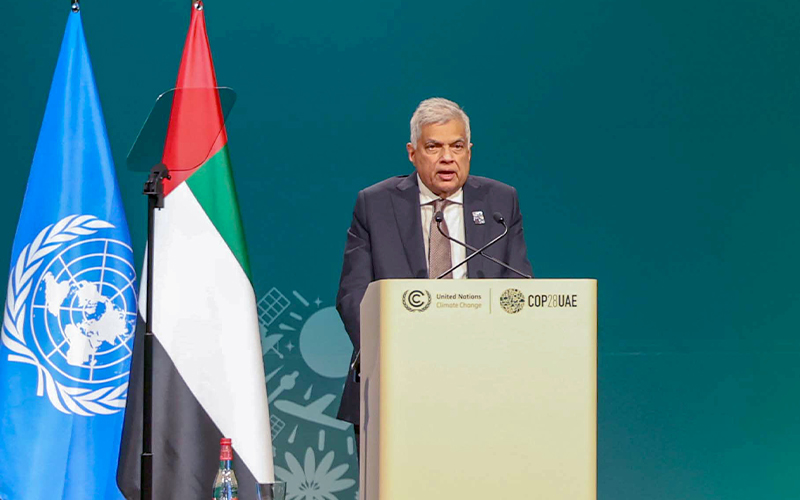
Addressing the 28th session of the Conference of Parties (CoP28) to the United Nations Framework Convention on Climate Change (UNFCCC) in Dubai, UAE on Friday (01), President Ranil Wickremesinghe acknowledged the historical significance of the UN Conference on Human Environment, emphasizing its goal to defend and improve the environment for present and future generations. He referenced the alarming findings of the UNEP Report of 2023, titled “Broken Promises,” which warns of a 3-degree Celsius increase in global temperatures by the end of the century.
Highlighting the challenges faced by developing countries, President Wickremesinghe stressed the disproportionate vulnerability and impact due to lower adaptive capacities in Finance, Technology, and Climate investments. He cited the Independent High-Level Expert Group Report on Climate Finance, which underscored the need for at least a US$ Trillion per annum to combat climate change.
The President commended the Government of the United Arab Emirates for hosting the crucial event and expressed gratitude for their warm hospitality
Expressing concern about the lack of concrete measures in the Transitional Committee’s report on funding arrangements, the President called for a more transparent approach, particularly addressing issues of global debt relief. He questioned the wisdom of avoiding contentious issues, emphasizing the urgency of the climate crisis.
President Wickremesinghe advocated for climate justice accessible to all nations and proposed a resolution for a Climate Justice Forum. This forum, agreed upon at the 5th Forum of the Ministers of Environmental Authorities of Asia Pacific, aims to provide a platform for constructive and proactive engagements, with the proposal scheduled for the UN Environment Assembly on 6th February 2024.
Underlining the critical nature of the current period, the President urged immediate action to find effective solutions, thinking outside the box and investing in the Tropical Belt to tackle the Triple Planetary Crisis. The Tropical Belt, covering 134 countries and 44% of the Earth’s surface, holds rich biodiversity and potential for renewable energy. President Wickremesinghe announced plans for a panel to report on the Tropical Belt Initiative, emphasizing its global impact.
As the current Chair of the Indian Ocean Rim Association (IORA), President Wickremesinghe linked the health of the Indian Ocean to climate change. He stressed the need for a sustainable Blue Economy to counter the adverse effects of rising sea levels, ocean acidification, coral bleaching, and extreme weather patterns.
President Wickremesinghe also revealed plans to establish the International Climate Change University (ICCU) for capacity building and advancing research, operationalizing it next year. The ICCU aims to contribute significantly to global efforts to limit global warming to 1.5 degrees Celsius.
In conclusion, President Wickremesinghe’s address at COP28 outlined a comprehensive approach, blending regional initiatives like the Tropical Belt and the Indian Ocean with global measures, reflecting Sri Lanka’s commitment to climate action and leadership on the international stage.
The speech made by the President at the World Leaders Summit of the COP28:
“Chairperson, Excellencies, Esteemed Delegates, At the outset let me congratulate his highness and the Government of the United Arab Emirates for hosting COP28 and extend to you my gratitude for your warm hospitality.
The UNEP Report of 2023 “Broken Promises” warned that we are facing a 3 degree Celcius increase in global temperatures by the end of the century. It is we; the developing countries are both disproportionately vulnerable and disproportionately impacted due to their lower adaptive capacity when it comes to investments in Finance, Technology and Climate.
The Independent High-Level Expert Group Report on Climate Finance highlighted that at least a Trillion USD per annum is required to combat climate change. The Transitional Committee on the Operationalization of Funding Arrangements in its Report of 4th November 2023 only calls for voluntary contributions to the “Loss and Damage fund”. The Report makes no mention of the funds needed or who the contributors are. It is silent on the issue of global debt relief. These are interconnected’
Nevertheless, four days later, the Technical Dialogue of the First Global Stocktake highlighted the requirements of a minimum of US$ trillion per annum. To arrive at a consensus not to take up a contentious issue is not a solution. Who are we fooling?
Climate justice must be available to all the people and all the countries. In this background, Sri Lanka will propose a resolution for a Climate Justice Forum which was agreed upon at the 5th Forum of the Ministers of Environmental Authorities of Asia Pacific to be moved at the UN Environment Assembly of 6th February 2024.
The Climate Justice Forum will provide us a platform for constructive and proactive engagements. The Secretary General of the UN highlighted, “The era of global boiling has arrived”. The enemy is at the gates. We are still procrastinating. We are still forming our battalions to take the fight to the enemy. Therefore, this fortnight is critical.
It will determine whether we are capable of providing a leadership. Let us prove we can do so by action and delivery.
Sri Lanka is committed to the 1.5 degree Celcius limit. We are facing a drastic situation to await the disaster. We must think outside of the box. We must Invest in the Tropical Belt to tackle the Triple Planetary Crisis.
The Tropical Belt constitutes 134 countries covering 44% of earth’s surface, and will by 2030s be home to roughly 50% of world’s population. Most of the world’s remaining primary forests are tropical, along with its coral reef systems. The rich biodiversity of the Tropical Belt enhances biological carbon sequestration and can shield the world from instabilities in weather.
Furthermore, the energy generation potential from solar, wind and biomass are significantly higher in the tropics than that of other areas on the earth. Yet, anthropogenic activities in the Tropical Belt can easily lead to an imbalance in the equilibrium of this region.
So much so that some scientists predict that the Tropical Rain Belt could shift away from the Equator by the 22nd Century. Large scale investments in Renewable Energy, Pollution Control and Nature-based Solutions will lead to significant transformative changes in the entire world by enhancing carbon sequestration.
Therefore, Sri Lanka and other concerned countries will convene a panel to report on the Tropical Belt Initiative. A multi sector plan distributed not only among the whole tropical region but the whole world. As the current Chair of the Indian Ocean Rim Association (IORA), Sri Lanka is focusing on the interdependence between the Indian Ocean and climate change.
A healthy ocean generates oxygen and absorbs the carbon and heat produced from global warming. Mangroves and sea grasses sink more carbon than land forests. However, the rapid climate change is altering the marine environment with rising sea levels and temperatures, Ocean acidification, coral bleaching, habitat destruction and extreme weather patterns. These phenomenon have a direct impact on human lives by disrupting ocean biodiversity, the Ocean dependent food patterns, and coastal livelihoods. Member states and partners of IORA will work towards ensuring a sustainable, Indian Ocean for future generations.
The Tropical Belt initiative and the Indian Ocean IORA program combined will form the largest global sink for carbon sequestration. Addressing the climate change need, up to date scientific knowledge, and the effective use of these findings
Therefore, at COP27, I proposed to establish an International Climate Change University (ICCU) for capacity building and advancing research, necessary to contribute to the crucial efforts to limiting global warming to 1.5 degrees Celsius. We will be operationalizing the International Climate Change University (ICCU) next year.
Ministers Ali Sabry, Keheliya Rambukwella, Kanchana Wijesekera, and Member of Parliament Madhura Withana represented the government, while Members of Parliament. Champika Ranawaka and Ajith Mannapperuma represented the Opposition. Additionally, Senior Adviser to the President on Climate Change Ruwan Wijewardena, Secretary of the Ministry of Environment Dr. Anil Jasinghe, Director of International Affairs Dinouk Colomboge, Adviser to the Ministry of Finance Deshal De Mel, and President’s Private Secretary Ms. Sandra Perera were also present.
(PMD)










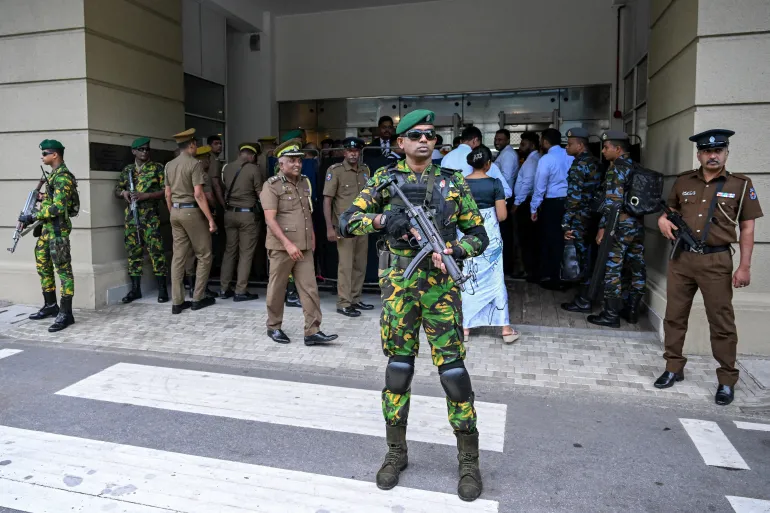
The High Court has convicted 14 of the 24 men accused of being directly involved in the 2019 Easter Sunday bombings, which killed 279 people.
The three-judge bench read out its decision on Tuesday after a five-year trial and said sentencing would take place later, the AFP news agency reported.
The charges included murder and conspiracy to commit terrorism.
Nine others were acquitted, while another defendant was found guilty of only some of the charges, the court said.
[Aljazeera]
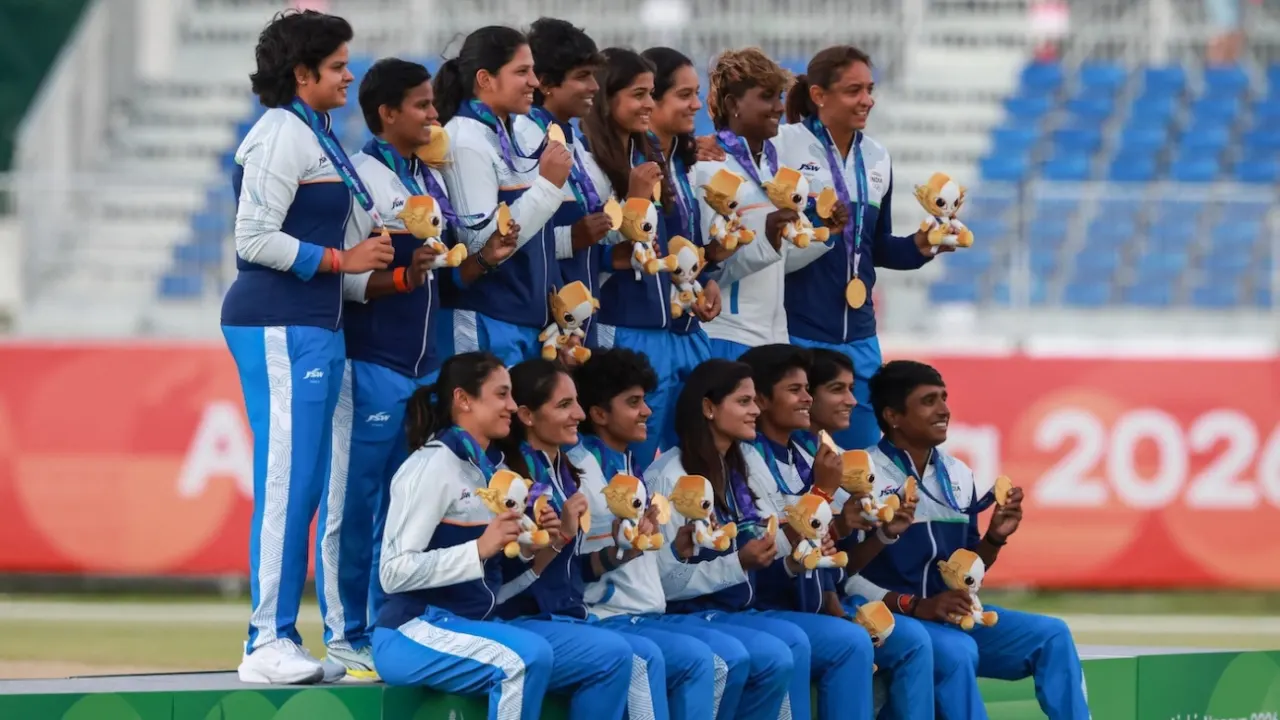
India thrashed Sri Lanka by 147 runs in the Asian Games women’s cricket competition final in Nisshin to win the country’s first gold medal of the multi-sport event, with Smriri Mandhana, Shafali Verma, Richa Ghosh and the bowling group starring in the dominant display. That made it back-to-back gold medals for India in the event after their triumph in 2023.
Mandhana and Shafali laid the foundation of the win for India with a 99-run opening stand after they opted to bat, with Mandhana finishing on 79 off 45 balls. Ghosh then provided the finishing touches, making 49 not out off 22 balls to power India to 216 for 3, the highest Asian Games innings total.
Sri Lanka couldn’t get anywhere near India’s firepower as they struggled against spin. Chamari Athapaththu fought with a 21-ball 29, but they folded for a paltry 69 – just two runs more than what India managed in their powerplay – to lose another final to India in the space of ten days after going down in the Asia Cup title contest.
The match unfolded similarly to that game in Dubai. Mandhana in particular was at her menacing best, starting off with two boundaries off Sugandika Kumari in the first over and then launching three sixes to different parts of the ground. She first rocked back to Sugandika’s short delivery outside off and cleared mid-on with ease. Sugandika then went fuller and strayed onto the pads, allowing Mandhana to whip it over square leg for another six. And in the next over, she stepped down the track and carved Mithali Ayodhya over cover for her third six of the day.
Shafali then joined in the fun, taking Athapaththu for two sixes, pulling a short ball over deep midwicket before driving a floated delivery over mid-off. Mandhana rounded off the over by flat-batting a back-of-a-length delivery just beyond long-on for another six, much to Athapaththu’s frustration. India were going at over 11 at that point, posting 67 for no loss at the end of the powerplay.
Fours and sixes came frequently with Mandhana continuing to be the more aggressive of the two, bringing up her fifty off 30 balls in the tenth over. Shafali survived a stumping scare in the same over but couldn’t cash in on the chance as she top-edged a shot to Kawya Kavindi at short third off Chamudi Praboda for 48 off 29 balls.
Sri Lanka briefly managed to stem the flow of runs, conceding just one boundary in 19 balls, but that period did not last long. Harmanpreet Kaur and Mandhana started finding the gaps soon, though the India captain’s stay did not last long as she departed for a 17-ball 19.
Ghosh walked out at No. 4 and helped India pick up the pace again, taking on Praboda for two boundaries while Mandhana continued to attack at the other end. Mandhana went on to clobber two more sixes before falling in an attempt to go big, miscuing a length delivery from Sugandika while looking to clear deep-backward square-leg.
With 200 in sight, Ghosh took charge as she helped India plunder 19 runs, including two fours and a six, off Kavindi’s over before launching two more sixes off Ayodhya in the next, pulling a half-tracker over deep midwicket before moving across to club another full delivery over cow corner. Ayodhya also conceded five wides in the over. Ghosh capped the innings with another boundary as India finished on 216.
Sri Lanka were facing a daunting target, but it was not the brightest of starts for India on the field either. After Shreyanka Patil dropped a regulation catch off Imesha Dulani at backward point in the first over, Athapaththu looked in good touch as she scored two boundaries off Nandani Sharma in the second.
Harmanpreet then turned to India’s go-to part-time spin option – Shafali – and she delivered instantly, deceiving Dulani in flight, with Ghosh completing the stumping. She claimed her second wicket in her next over, with a loopy delivery that Hasini Perera sliced to cover point.
Sri Lanka found boundaries against the faster bowlers but could barely keep up with the required run rate, moving to 41 for 2 at the end of the powerplay. India then turned to spin for the rest of the innings, and Sri Lanka’s chase quickly unravelled.
Deepti Sharma ended their slim hopes when she had Athapaththu miscuing to long-off in the seventh over. Patil then had Harshitha Samarawickrama caught and bowled for a duck, before N Shree Charani dismissed Hansima Karunaratne for 1 after another miscued slog.
Deepti then added a second wicket when Kavisha Dilhari spooned a drive back to her, leaving Sri Lanka six down and in deep, deep trouble.
The result all but decided by then, and India continued to strike at regular intervals with Sri Lanka offering no resistance, barring a six and a four from Kaushini Nuthyanganam, whose wicket brought Sri Lanka’s innings to an end in the 16th over. Deepti finished with figures of 3 for 6, while Shafali, Shree Charani and Patil bagged two each.
Scores:
India Women 216 for 3 in 20 overs (Shafali Verma 48, Smriti Mandhana 79, Harmanpreet Kur 19, Richa Ghosh 49; SugandikaKumari 1-49, Kavisha Dilhari 1-35, Chamudi Praboda 1-34) beat Sri Lanka 69 in 15.4 overs (Chamari Athapaththu 29, Kavisha Dilhari 11, Kaushini Nuthyangana 14; Deepti Sharma 3-06, Shafali Verma 2-03, Shreyanka Patil 2-9, N Shree Charani 2-13) by 147 runs
[Cricinfo]
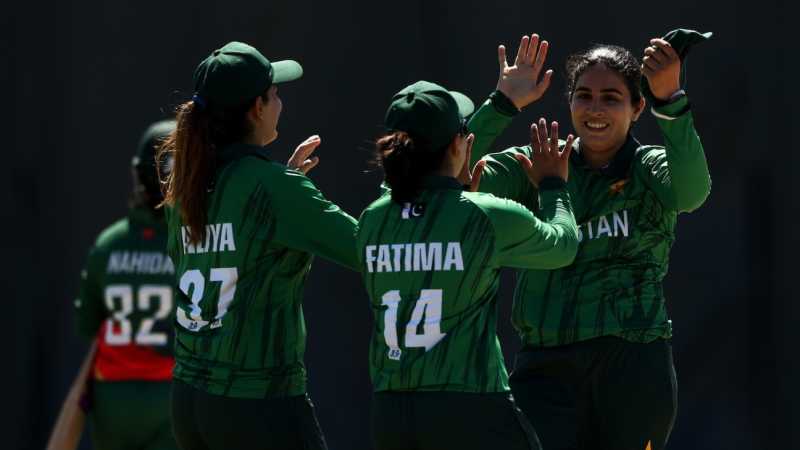
At 67 for 5 in the 12th over, Pakistan were under the cosh against Bqngladesh in their bronze-medal playoff at the Asian Games women’s competition. That’s when Fatima Sana walked out, slammed 45 in 30 balls, and gave Pakistan 145, which was 31 too many for Bangladesh, especially after Umm-e-Hani picked up three top- and middle-order wickets to end with 3 for 10 from her four overs.
Bangladesh’s big concern, of late and in general, has been the number of dot balls they play out in a typical T20 innings. In this game, it was a marginal improvement from the loss to India in the semi-final – they had 43 dot balls here compared to 61 in that game. But it was still fewer than the 48 they bowled to Pakistan in the first half. The difference was Sana, who scored at 150.00 to change the complexion of the contest.
Pakistan’s start had been decent, thanks to Gull Feroza, after they won the toss and opted to bat. Feroza and Shawaal Zulfiqar added 46 in 41 balls before being separated in the seventh over. The one to be dismissed was Feroza, who had scored 31 in 23 balls. Zulfiqar batted on before becoming the third batter to fall, having struggled to 17 off 27 balls. And the wickets kept falling, Shorna Akter picking up two of them to leave Pakistan in a mess with five batters gone.
Sana had a solid stand for the sixth wicket with Aliya Riyaz, who scored 25 in 22 balls and added 67 with Sana in just 43 balls. The control Bangladesh had was gone with the two hitting five sixes between them.
The target for Bangladesh, which looked like it might be in the region of 100, was suddenly closer to 150. And the chase never took off. Umm-e-Hani struck in the third over, then in the fifth over, and again in the 16th over. By then, Bangladesh were floundering: 77 for 5 with under five overs to go.
The resistance came from senior pro Sharmin Akther, who scored an unbeaten 46 in 45 balls, but there was nothing around her, and Pakistan ran out comfortable, 31-run victors.
Scores:
Pakistan women 145 for 8 in 20 overs (Shawaal Zulfiqar 17, Fatima Sana 45, Gull Feroza 31, Aliya Riyaz 25; Sanija Akter Meghla 1-28, Nahida Akter 2-21, Shorna Akter 2-16, Ritu Moni 2-27) beat Bangladesh women 114 for 7 in 20 overs (Dilara Akter 12, Nigar Sultana 25, Sharmin Akhter 46*, Nahida Akter 10*; Tasmia Rubab 1-25, Fatima Sana 1-25, Umm-e-Hani 3-10, Nashra Sandhu 1-19, Ayesha Zafar 1-10) by 31 runs
(Cricinfo)

High Court convicts 14 over deadly Easter bombings

Mandhana, Shafali and Ghosh lead dominant India to Asian Games gold

Fatima Sana and Umm-e-Hani secure bronze for Pakistan in Asian Games

India bat first in Asian games womens cricket final

Showers about 100mm will occur in the Western, Sabaragamuwa, Central and North-western provinces and in Galle and Matara Districts

Govt. confident of 2/3 majority despite NPP split speculation

‘Dates have the highest sugar content to fight Coronavirus’

Sunday Island 27 December – Headlines

#SundayIsland 17th December – Headlines

Sunday Island – 28th March

Sunday Island Headlines – 21 March

Sunday Island – 21st February – Headlines
-

 News6 days ago
US embassy won’t comment on IGP’s probe into joint drug raid
-

 News4 days ago
Shanakiyan urges urgent action over reported death sentence for Lankan in Saudi Arabia
-

 News5 days ago
Bid for Basil’s extradition nears final stage: Police
-

 Business6 days ago
All-new Bolero MaXX unveiled in Sri Lanka
-

 News3 days ago
Namal Rajapaksa Buddhist gambit fails, bail denied
-

 Opinion6 days ago
A journalist who wrote across the divide
-

 Editorial7 days ago
More fuel price shocks shrouded in secrecy
-

 Sports7 days ago
MAS Holdings, official clothing sponsor of Sri Lanka team at Aichi–Nagoya 2026 Asian Games