
Latest News
Oscar Pistorius granted parole a decade after killing girlfriend


South African Paralympic star Oscar Pistorius, jailed in 2014 for killing his girlfriend Reeva Steenkamp, has been granted parole effective from January 5, the Department of Correctional Services says.
Known as the “Blade Runner” for his carbon-fibre prosthetic legs, Pistorius went from a public hero as a Paralympic champion to a convicted killer in hearings that caught the world’s attention a decade ago.
Pistorius, who turned 37 this week, shot and killed Steenkamp on Valentine’s Day in 2013.
He was initially jailed for five years in 2014 for culpable homicide by a high court, but the Supreme Court of Appeal in late 2015 found him guilty of murder after an appeal by prosecutors.
He was sent back to jail for six years in 2016, less than half the 15-year minimum term sought by prosecutors. In 2017, the Supreme Court more than doubled his sentence to 13 years and five months, saying the six-year jail term was “shockingly lenient”.
The hearing held on Friday at a correctional centre outside Pretoria, where he is currently detained, was Pistorius’s second shot at parole in less than eight months. He lost a first bid in March when the board found Pistorius had not completed the minimum detention period required to be let out.
The Constitutional Court last month ruled that was a mistake, paving the way for a new hearing.
Pistorius was at the height of his fame and one of the world’s most admired athletes when he killed Steenkamp. He shot her multiple times in the bathroom of his Pretoria villa in the predawn hours with his licensed 9mm pistol. He had pleaded not guilty and denied killing Steenkamp in a rage, saying he mistook her for a burglar.
Earlier, Steenkamp’s mother told the parole hearing that she did not believe Pistorius was rehabilitated because he had not shown true remorse. “Rehabilitation requires someone to engage honestly with the full truth of his crime and the consequences thereof. Nobody can claim to have remorse if they’re not able to engage fully with the truth,” June Steenkamp said in a statement to the board. “I do not believe Oscar’s version,” she said in her submission to the board, which was read to the media outside the detention centre by a family spokesman.
“My dear child screamed for her life loud enough for the neighbours to hear her. I do not know what gave rise to his choice to shoot through a closed door four times at somebody with hollow-point ammunition when I believe he knew it was Reeva.”
But her spokesman told the board she was not opposing parole for Pistorius, and she said she forgave the sprinter “long ago as I knew most certainly that I would not be able to survive if I had to cling to my anger”.
As part of his rehabilitation, Pistorius met Steenkamp’s parents last year in a process authorities said aims to ensure inmates “acknowledge the harm they have caused”. June Steenkamp was not present at the parole hearing on Friday and was represented by a family spokesman and a lawyer. Steenkamp’s father, Barry, died in September aged 80. “I’ve no doubt that he died of a broken heart,” the widow said in her statement.
(Aljazeera)

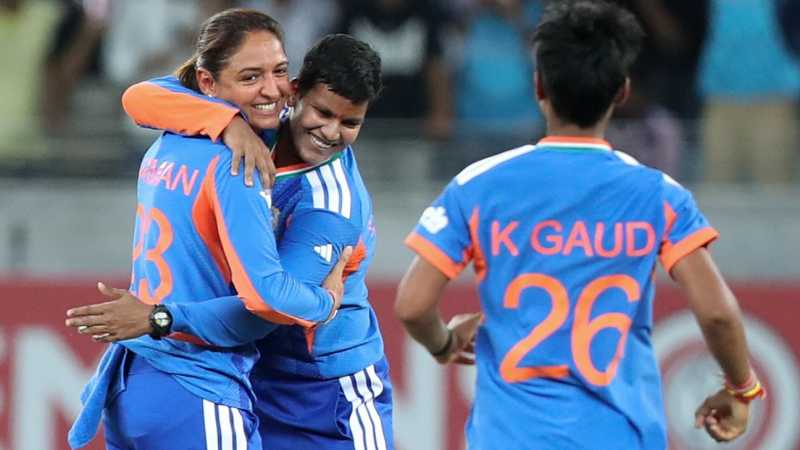
Pakistan were bowled out for 55, their lowest total in T20I cricke. A collapse where they lost six wickets for eight runs in 29 balls set them so far back that they couldn’t even bat out 20 overs. Harmanpreet Kaur, who broke new ground by becoming the first player – male or female – to lead her team 150 times in T20Is, had the time of her life celebrating each wicket and eventually scoring the winning runs as well.
Shree Charani shines
Old-fashioned left-arm spin is having a resurgence. India men have found Manav Suthar. India women already had N Shree Charanin. The No. 1-ranked T20I bowler in the world picked up two wickets in her first over on Saturday.
The flight on the ball drew Gull Feroza out of her crease. The drift in had her looking leg side. The dip and the turn resulted in a leading edge and a simple catch to point. The bowler did everything right. The batter did everything wrong. Shawaal Zulfiqar was the only Pakistan batter to put any kind of pressure on India. Charani had her lbw for 14 off 14 and from there it was a procession.
Pakistan’s batting troubles
Playing their 200th T20I, Pakistan went from 27 for 0 to 35 for 6 before the innings was halfway done. They could not find a risk-free way to score runs, absorbing long periods of dot balls and trying to get out of it by playing low-percentage shots, often against the turn, on a Dubai pitch that was offering plenty of it. Only the openers got to double digits and only Zulfiqar was able to score a run a ball.
Rawat’s support act
Prema Rawat finished with figures of 4-0-9-3. Nineteen of her 24 balls were dots. All of that is remarkable considering she is a legspinner, whose release points tend to be just shy of the perpendicular. Like Shane Warne. From there, they turn their wrist over and it can either be awesome or awful. Rawat’s release point is perpendicular, maybe even beyond it, like Rashid Khan’s. And she doesn’t turn her wrist. For the most part, she just flicks the ball out the front of her hand. This gives her better control at the cost of big turn and in T20Is, that trade-off is well worth it. Nobody could hit Rawat off her line and length and when Sadaf Shamas tried, she got bowled off her pads.
A simple enough chase
Scores:
India Women 57 for 3 in 8.4 overs (Shafali Verma 12, Harmanpreet Kaur 18*, Deepti Sharma 12*; Fatima Sana 3-17) beat Pakistan Women in 18.1 overs 55 (Muneesha Ali 13, Shawal Zulfiqar 14, Shafali Verma 1-10, Shree Charani 3-07, Deepti Sharma 2-05, Prema Rawat 3-09) by seven wickets
(Cricinfo)
Latest News
Sun directly overhead Bentota, Thiniyawala, Iththakanda, Udawalawe, and Kataragama about 12.08 noon t9day (06)

The sun is going to be directly over the latitudes of Sri Lanka from 28th of August to 07th of September due to its apparent southward relative motion.
The nearest places of Sri Lanka over which the sun is
overhead today (06) are Bentota, Thiniyawala, Iththakanda, Udawalawe, and Kataragama about 12.08 noon

Rumesh Tharanga created history in emphatic fashion, winning the men’s javelin at the Diamond League Final in Brussels to become the country’s first Diamond League champion.
The recently crowned Commonwealth champion sealed the prestigious Diamond Trophy with a superb third-round throw of 89.04 metres, producing yet another major performance on the biggest stage.
Tharanga became the first Sri Lakan to win a top position at a global competition conducted under the auspice of World Athletics.
The victory also extended Tharanga’s extraordinary run of form, giving him his 12th victory in his last 13 competitions. His only defeat during that sequence came earlier in the season, underlining the consistency that has made him one of the outstanding performers in world javelin this year.
Tharanga’s winning effort was enough to keep a determined international field at bay, with Poland’s Dawid Wegner producing a lifetime best of 87.47m to take the silver medal. Trinidad and Tobago’s Keshorn Walcott completed the podium in third place.

Shree Charani, Prema Rawat spin Pakistan out for 55 in one-sided contest

Sun directly overhead Bentota, Thiniyawala, Iththakanda, Udawalawe, and Kataragama about 12.08 noon t9day (06)

Showers above 75 mm are likely at some places in the Uva and Eastern provinces.

Tharanga creates history with Diamond League crown in Brussels

UN welcomes Lanka’s anti-graft drive, seeks end to impunity

Dispute which triggered listed company director being detained at BIA resolved

‘Dates have the highest sugar content to fight Coronavirus’

Sunday Island 27 December – Headlines

#SundayIsland 17th December – Headlines

Sunday Island – 28th March

Sunday Island Headlines – 21 March

Sunday Island – 21st February – Headlines
-

 Features6 days ago
When Sri Lankan stories find their own voice
-

 News6 days ago
BASL takes exception to Justice Ganepola being denied a place in SC
-

 News3 days ago
Denied of promotion to SC despite vacancies, justice Gurusinghe retires
-

 Latest News4 days ago
Grade 5 scholarship exam results released
-

 News3 days ago
22A: SC urged to suspend hearing, appoint full bench
-

 Midweek Review4 days ago
The local and global dynamics of Sri Lanka’s 22nd Amendment
-

 Business6 days ago
ADB-funded Thalaiyadi plant serves as blueprint for vulnerable dry zones in Sri Lanka
-

 News4 days ago
Ai-CHA expands Lankan footprint with new Negombo outlet