
Sports
Cricket desperately needs another Sanga


by Rex Clementine
The Cricket administration headed by Shammi Silva is getting roasted these days for the mess they have created and the humiliations the national cricket team has suffered. Together with them the national selection committee and Consultant Coach Mahela Jayawardene, who had a free hand to put cricket right, deserve blame for his failed policies and picking wrong personal. Players should not be spared blame either. They are equally responsible for the current mess.
It took one Virat Kohli to change the culture of Indian cricket. Fitness was alien to most Indian cricketers and when Kohli the fitness freak came into the scene not only did he dominate the sport but others started following his rigid routines. As captain, Kohli kicked out anyone who didn’t meet the fitness standards. Today Indian cricket is in a different level.
We had our own Kumar Sangakkara, whose insane training methods not only made him the highest run getter for Sri Lanka in both Test and ODIs but the world’s number one ranked batsman for a record number of weeks. Sanga left no stone unturned in his bid to go onto become the best in the world. As a result, from an ordinary wicketkeeper batsman he went onto become one of sport’s greats.
Why we have suffered the current mess is that nobody has taken a leaf out of Sanga’s book. Everyone is happy to live the comfortable life of an international cricketer. No one is willing to go out of their comfort zones.
Every time a young player graces the scene and shows promise, you are excited about the future ahead. But soon the team’s culture catches up with him and he becomes part of the problem and not a problem solver. You just hope that Sadeera Samarawickrama doesn’t go the same way for he was one player who was fully focused on his game.
Currently the culture within the Sri Lankan team is not so great. They are all happy go lucky men and no one is prepared to burn the midnight oil to become the best he can.
The term optional training should cease to exist if Sri Lanka were to become a force in the sport again. Optional training maybe a method that is good enough for professional outfits like Australia, England, New Zealand and South Africa, but it doesn’t fit in with our system.
When the training is optional even the reserves who are not supposed to play the game fail to turn up for training, The purpose of optional training is to keep the players fresh. But the system has been abused. To make training optional, the Sri Lankans aren’t covering themselves in glory. The 16 catches that they spilled during the World Cup is proof for that and Sri Lanka were easily the worst fielding unit in the competition.
It is up to the selectors to look beyond players who are not willing to make sacrifices. As for the current panel they have no idea about what it means to groom a player. They have much to learn from men like Michael Tissera, Duleep Mendis and Sidath Wettimuny.
There is a lot of talk about Sri Lanka’s skill levels not being up with rest of the world. Well, that may be true but the players who have been chosen need to show more commitment than this.
The manner in which Kusal Mendis threw away his wicket time after time was a bitter pill to swallow. When the captain sets such standards what more do we have to say about the others. You always had doubts about Mendis the captain. Is he matured enough to take up a role as big as the leadership. Captaincy doesn’t only mean having a good cricket brain and owning a place in the side. A captain also has to be the ambassador of his nation. Be an example for others to follow. Mendis has a long way to get there.
The team’s culture of blaming everyone else for their woes rather than themselves is insane. Yes, Shakib-Al-Hasan was wrong to appeal for time out and not to withdraw his appeal. But what else do you expect from Shakib? He has been always like that, a spoil sport.
However much Angelo Mathews tries to defend his action, let’s not be blinded by the fact that the fault is only the opposition’s. Mathews is a smart bloke and you expected much from him. That can be even forgiven. What can not be forgiven is him endorsing the captain’s refusal to shake hands with the opposition. That was the last straw.
That’s not the way Sri Lankans play their cricket. We have had a captain who recalled a batsman after he had been given out wrongly and another captain who saved a World Cup final from ending in farce after the match officials had got things completely wrong. That’s the Sri Lankan style of playing the game. We need to change. Our culture needs to change.








Sports
David Pieris Group of Companies and Golden Green Plantations vie for Abans Challenge Trophy today

MCA – ABANS PREMIER LEAGUE 2026
David Pieris Group of Companies and Golden Green Plantations will vie for the ‘Abans Challenge Trophy’ in the final of the MCA – Abans Premier League 2026 at the Thurstan College ground today.
In the league stage, David Peiris Group of Companies led by Manjula Gannile defeated DFCC Bank by 154 runs, Nawaloka Hospitals by 8 wickets and lost to Golden Green Plantations by one wicket to lead the league stage with a higher run rate. In qualifier one David Pieris Group of Companies defeated Golden Green Plantations by 55 runs to gain direct entry to the final.
Golden Green Plantations led by T M Sampath defeated Nawaloka Hospitals by 192 runs, David Pieris Group by one wicket and lost to DFCC Bank by 50 runs to take second spot in the league. Qualifier two between Golden Green Plantations and DFCC Bank which was to be played at the DHH Sports Complex was abandoned twice in succession due to rain and bad ground conditions.
David Pieris Group of Companies Team:
Manjula Gannile (C), Ron Chandraguptha, Santhush Gunathilake, Vinuka Rubasinghe, Mineth Premarathne, Asitha Wanninayake, Lahiru Samarakoon, Tharinda Nirmal, Mihiranga Nimsara. Silva, Lakshan De Silva, Dilanka Auwardt, Akila Elabodage, Mayura Dihan, Udara Bandara, Vihara Attanayake, Shehan Rathnayake
Golden Green Plantations Team:
TM Sampath ( c), Gimandu Malkam, Randika Mihiranga, Upul Hettiarachchi, Mohomad Shamaz (wk), Dhanuja Induwara, Heshan Madhushanka, Malith De silva, Vikum Sanjaya, Johan Pathirana, Kovindu Wickramasinghe, Nuwan Dineth, Liviru Senmith, Thivin Vshvika, Lineth Vithana
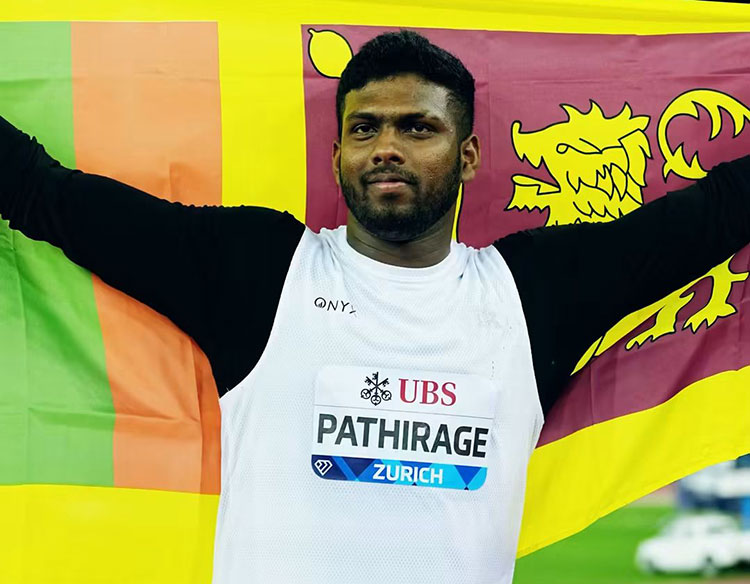
World-leading javelin thrower Rumesh Tharanga underlined his status as the man to beat in world athletics with another sensational performance, winning the men’s javelin at the prestigious Weltklasse meeting in Zurich with a massive 92.07 metres.
Tharanga’s best effort came in the final round and left him just 21 centimetres short of the meeting record of 92.28m, which has stood for three decades
.The 23-year-old first overcame the first round challenge from two-time world champion Anderson Peters of Grenada. Peters took the early lead with a first-round throw of 86.93m, but Tharanga responded in the second round with 88.23m to move ahead.
He then increased his advantage in the third round before producing his best effort of the night in the final round, sending the javelin soaring to 92.07m.
Peters had to settle for second with 86.93m, while Poland’s Dawid Wegner was third with 85.16m. Trinidad and Tobago’s Keshorn Walcott finished fourth with 83.02m, followed by Kenya’s Julius Yego (81.66m) and American Marc Anthony Minichello (80.38m).
The Zurich victory further strengthens Tharanga’s position at the top of the world javelin hierarchy at a crucial stage of the season. With the Wanda Diamond League Final in Brussels just a week away and the World Athletics Ultimate Championship looming, he has emerged as the athlete everyone will be watching.
Tharanga’s latest 92-metre-plus throw also provides a timely reminder of his extraordinary consistency at the highest level, as he continues his remarkable rise among the world’s elite javelin throwers. (RF)


Sometimes all you need is a little push.
The 2024 Asia Cup was a watershed for this young Sri Lanka outfit. Prior to that exhilarating climax in Dambulla , Sri Lanka’s flashes of international brilliance were almost exclusively engineered by Chamari Athapaththu. Sure, they could occasionally trade heavy blows with the world’s elite, but they lacked the collective capacity for a sustained fight. This was a queendom, one where removing Athapaththu early meant the game was as good as won.
That lopsided dynamic had been there ever since Athapaththu’s debut back in 2009. So it was impossible not to share her heartbreak when she bemoaned her team’s failure to make the T20 World Cup semi-finals earlier this year – “It’s a sadness beyond words… I could never get a chance to take my team into a semi-final of a World Cup… I think I’m a failure as a captain.”
The tragedy of that lament lay in the irony of its timing. For the first time in Athapaththu’s career, she wasn’t actually marooned by herself. The world had already been treated to a glorious glimpse of the team’s ceiling in 2024, when Harshitha Samarawickrema and Kavisha Dilhari struck the winning runs against a heavily favoured India side.
But keeping the progress going is rarely that straightforward – think less ladder and more hiking path with troughs and peaks. And it was a truth that Sri Lanka quickly learned. The euphoria of Dambulla was swept aside by a winless group stage exit at the T20 World Cup in 2024, followed by a barren 2025 devoid of series wins.
The year ended in structural upheaval as the team parted ways with head coach Rumesh Ratnayake, whose calming influence and fatherly reassurance had been foundational to their initial breakthrough.
So was it any surprise that in the last throes of an astonishing career, Athapaththu might have felt her time was up? At 36, with retirement on the not-so-distant-horizon, Athapaththu could be forgiven for thinking her last chance had come and gone.
But women’s cricket has shown in recent times that traditional career timelines, calibrated on the men’s game, might not necessarily make sense. Athapaththu has only grown stronger with age. After a quiet 2025 where she scored just 190 T20I runs at a strike rate of 113.77, she has struck 476 at 143.80 in 2026 – her best strike rate in a calendar year.
And if it was motivation that she needed, her younger colleagues are playing their part in keeping the queen locked in for as long as possible.
Imesha Dulani, 24, has had a breakthrough year, becoming the first Sri Lanka woman not named “Chamari Athapaththu” to score a T20I century, while centuries from Vishmi gunerathne, 21, and Samarawickrama, 28, led a successful chase of 275 – Sri Lanka’s third highest in ODIs – against Pakistan earlier this year, with Athapaththu watching on like the rest of us.
This was also the first year that Sri Lanka Cricket’s annual awards, had Athapaththu going without a nomination in the best women’s ODI batter category, as Samarawickrama won over the electric Nilakshika Silva. Athapaththu was still the big winner overall, though. In fact, there is now genuine competition for places at the top of the batting order, with the likes of Dulani, Gunaratne and Hasini Perera all vying for top-order berths.
The arrival of Jamie Siddons as head coach earlier this year has helped. Since he took over in March, Sri Lanka have made a noticeable shift to a more aggressive brand of cricket – something Siddons had signposted upon arrival. Whereas boundary-hitting had taken a back seat previously, Siddons has sought to bring the team’s approach in line with modern practices.
“We win in singles and twos, but we don’t score more boundaries than the opposition, and that’s why we lose against the best teams,” Siddons had said when he took over.
All this is to say that, this Sri Lanka is not the same Sri Lanka that entered the Asia Cup two years ago, nor is it even the one that won it. While they remain distinct underdogs against a formidable India, this is now a side equipped with multiple match-winners and a swelling sense of belief.
It’s also a side that is yet to touch its ceiling. There have been times when Athapaththu has not clicked and others have bailed the team out, but it’s those scintillating periods when it has all come together that this unit has shown its true fire. If they can put together more of those days, then a consecutive Asia Cup crown might well be within their reach.

Trump announces ‘biggest oil deal in world history’ with Venezuela

Sun directly overhead Pallawarayankaddu, Akkarayankulam, Ariviyal Nagar, Puthukkudiyiruppu, Ananthapuram at about 12.11 noon today (29)

Showers will occur at times in the Western, Sabaragamuwa and North-western provinces and in Galle, Matara, Kandy and Nuwara-Eliya districts

FSP fires fresh salvo at Govt.

Dengue cases near 95,000 as death toll reaches 72

Over two million attend Kandy Esala Perahera

‘Dates have the highest sugar content to fight Coronavirus’

Sunday Island 27 December – Headlines

#SundayIsland 17th December – Headlines

Sunday Island – 28th March

Sunday Island Headlines – 21 March

Sunday Island – 21st February – Headlines
-
 Features6 days ago
My secondary schooling after Royal Primary
-

 Features6 days ago
From the First to the 22nd: A short history of Amendment Politics and Reform Frustrations
-

 News4 days ago
Missing doctor’s body found in Mahiyanganaya
-
 Features6 days ago
How Shelton Kodikara became first Professor of International Relations
-
 Features6 days ago
How St. John’s College Shaped Panadura for 150 Years
-
 News4 days ago
Australia declines to release Finance Secy Suriyapperuma’s citizenship details
-
 News6 days ago
Ex- Atamasthanadhipathi uses Magistrate’s gate to enter court
-
 News4 days ago
22A: BASL suggests CJ recuse himself from hearing petitions