
Sports
Let’s not panic


Thursday’s World Cup debacle against India, revived memories of the humiliation of the Asia cup final. The anger of fans, their frustrations and resentments vented on social media, were therefore all perfectly understandable as are the increasingly loud cries for change and accountability.
However, when emotions are given time to subside let us sit back and review objectively the circumstances that led to both events.
Asia Cup Final
In the Asia Cup final, there was no doubt in anyone’s mind that the decision to bat first, in overcast conditions and a helpful pitch as Shastri’s pre match report cautioned, was a grave error in judgment.
While those conditions were exploited to the hilt by Mohamed Siraj in particular, given our own fast bowling talents, one could not be faulted for saying that the roles may well have been reversed if India had batted first.
One only has to recall Sharma’s dismissal by Madushanka in Thursday ‘s encounter in good batting conditions to appreciate the real potential of our pacemen .
World Cup
The circumstances leading to the World Cup debacle on Thursday was no different.
The decision to field first perhaps failed to recognise the dew factor for the side batting second. In fact the Indian captain was certain that he would have batted first if the coin fell his way.
The way the ball moved both in the air, nipped and bounced off the pitch from the very first delivery when we batted showed the impact that dew had on a sun scorched pitch, and knowledgeable commentators attributed three of our early dismissals to ‘unplayable deliveries’.
I would cite Pathum Nissanka, Dimuth Karunaratne and Kusal Mendis in that category.
Madushanka’s heroic efforts in unhelpful conditions earlier in the game and his dismissal of the very accomplished Rohit Sharma who left the arena looking shell shocked gave us a glimpse of what he, Rajitha and Chameera may have delivered in those conditions.
In fact if two sharp chances, one each from Gill and Kohli had been taken India may well have been three down before they reached ten and that too when conditions favoured batting !
So let’s not be too harsh on the team.
It’s a young nucleus and none can doubt their potential After a disappointing World Cup of 2019, India took a step back to focus and build on a balanced cohesive strong combination for 2023.
There are reaping the benefits of that professional planning now. We should take a leaf out of their book and do likewise with World Cup 2027 in mind.
The talent is there, and what’s more it is also still very young. Let’s find the professionals to harness and build on it. There is no cause for Panic!
S. Skandakumar
(A former Hony. Secretary of Sri Lanka Cricket )






World-leading javelin thrower Rumesh Tharanga underlined his status as the man to beat in world athletics with another sensational performance, winning the men’s javelin at the prestigious Weltklasse meeting in Zurich with a massive 92.07 metres.
Tharanga’s best effort came in the final round and left him just 21 centimetres short of the meeting record of 92.28m, which has stood for three decades.
The 23-year-old first overcome first round challenge from two-time world champion Anderson Peters of Grenada. Peters took the early lead with a first-round throw of 86.93m, but Tharanga responded in the second round with 88.23m to move ahead.
He then increased his advantage in the third round before producing his best effort of the night in the final round, sending the javelin soaring to 92.07m.
Peters had to settle for second with 86.93m, while Poland’s Dawid Wegner was third with 85.16m. Trinidad and Tobago’s Keshorn Walcott finished fourth with 83.02m, followed by Kenya’s Julius Yego (81.66m) and American Marc Anthony Minichello (80.38m).
The Zurich victory further strengthens Tharanga’s position at the top of the world javelin hierarchy at a crucial stage of the season. With the Wanda Diamond League Final in Brussels just a week away and the World Athletics Ultimate Championship looming, he has emerged as the athlete everyone will be watching.
Tharanga’s latest 92-metre-plus throw also provides a timely reminder of his extraordinary consistency at the highest level, as he continues his remarkable rise among the world’s elite javelin throwers. (RF)

Less than 40 minutes after Alison dos Santos made history in the men’s 400m hurdles at the Weltklasse, another world record fell at the Wanda Diamond League meeting in Zurich as Masai Russell sped to a 12.09* clocking to win the women’s 100m hurdles.
The Olympic champion, who had come close to the world record twice already this year, produced a flawless run over the barriers and stopped the clock at 12.09 (0.0m/s), taking 0.03 off the previous world record.
Nigeria’s Tobi Amusan, the world record-holder heading into this race, was second in a season’s best of 12.23. European champion Nadine Visser was third in a season’s best of 12.34.
[World Athletics]
by Rex Clementine
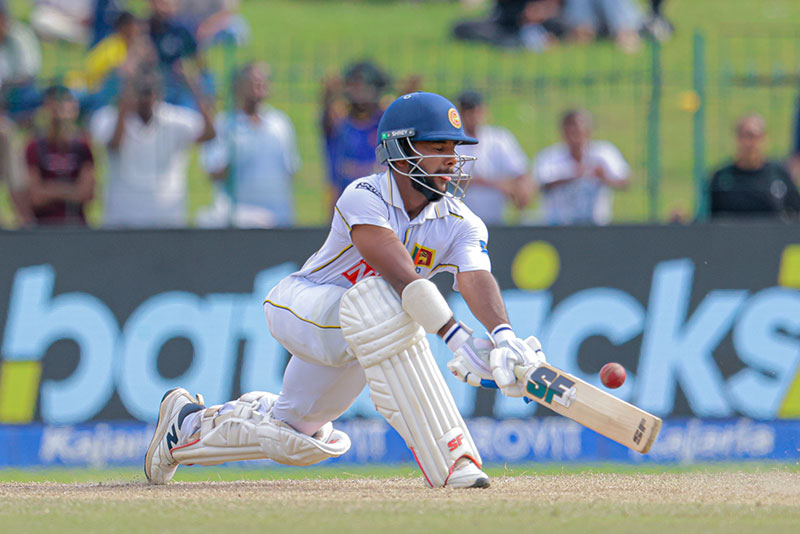
A match saving hundred by Sonal Dinusha helped Sri Lanka salvage a draw in the second Test against India at the SSC yesterday. India won the series 1-0, having claimed the opening Test in Galle by 165 runs.
Sri Lanka were 429 for nine in their second innings, with Dinusha unbeaten on 133, when the teams shook hands and called off the game with the 15 mandatory overs about to begin.
Sri Lanka, who were forced to follow on after conceding a first innings deficit of 213 runs, began the final day staring down the barrel at 229 for six, leading by just 16 runs with three sessions to survive.
In young Sonal Dinusha, however, the hosts seem to have unearthed a gem. He batted superbly under pressure to ensure Sri Lanka earned a draw and picked up some valuable points in the World Test Championship.
Dinusha had been Sri Lanka’s standout performer throughout the series, having made 100 and 84 in the first Test in Galle before following it up with 103 in the first innings at the SSC and an unbeaten 133 in the second essay to finish the series with 420 runs.
It was only the fifth Test for the 25-year-old, but he batted with authority and showed remarkable composure in a back to the wall effort.
India threw everything at him, including the second new ball, but Dinusha remained unmoved as he became only the eighth Sri Lankan to score hundreds in both innings of a Test, joining an exclusive list comprising Duleep Mendis, Asanka Gurusinha, Aravinda de Silva, T.M. Dilshan, Kumar Sangakkara, Kamindu Mendis and Dhananjaya de Silva.
The match saving hundred was Dinusha’s third in Test cricket and also his career-best score.
Dinusha could not have done it all by himself, however, as he received excellent support from Sri Lanka’s lower order.
He added 112 runs from 246 deliveries for the seventh wicket with Keshara Nuwantha as Sri Lanka batted through the entire morning session without losing a wicket.
India finally found the breakthrough in the first over after lunch when Nuwantha departed for a well compiled 46.
Dinusha then added 25 runs for the eighth wicket from 74 balls with Prabath Jayasuriya to keep Sri Lanka afloat. After Jayasuriya’s dismissal, Lahiru Kumara joined Dinusha and the pair added 47 runs for the ninth wicket from 170 deliveries, keeping India in the field for even longer and eating further into the time available for the tourists to force a victory.
Questions will be asked of India’s bowling attack after they were unable to run through Sri Lanka’s lower order on a fifth day pitch despite having the hosts six wickets down at the start of play.

Tharanga storms past 92m in Zurich

Iran, Qatar hold Hormuz talks amid int’l hopes dialogue with US will resume

Russell breaks world 100m hurdles record in Zurich

Sun directly overhead Kokkuvil, Nallur, Kodikamam and Nagar Kovil at about 12.11 noon today (28)

Showers above 75 mm are likely at some places in the Western and Sabaragamuwa provinces and in Kandy, Nuwara-Eliya, Galle and Matara districts

Eight politicians in drug kingpin probe

‘Dates have the highest sugar content to fight Coronavirus’

Sunday Island 27 December – Headlines

#SundayIsland 17th December – Headlines

Sunday Island – 28th March

Sunday Island Headlines – 21 March

Sunday Island – 21st February – Headlines
-

 Business6 days ago
SriLankan Airlines makes ShakthiSAT Mission possible for talented Sri Lankan student
-
 Latest News7 days ago
Imran Khan moved to private hospital amid deteriorating health
-
 Features5 days ago
My secondary schooling after Royal Primary
-

 Features5 days ago
From the First to the 22nd: A short history of Amendment Politics and Reform Frustrations
-

 Latest News6 days ago
Tharanga edges out Chopra in 88m javelin battle
-

 News3 days ago
Missing doctor’s body found in Mahiyanganaya
-
 Features5 days ago
How Shelton Kodikara became first Professor of International Relations
-
 Features5 days ago
How St. John’s College Shaped Panadura for 150 Years