
Sports
When a cricket writer met the don of Bombay


Rex Clementine in Bombay
During Sri Lanka’s first Test tour of India in 1982, not following protocol when the team met former Indian President Zail Singh created quite a stir. Apparently, Board President Gamini Dissanayake was very angry. Some say that the players weren’t aware who Zail Singh was while others say they were too jaded after a long flight.
The post of Indian President is a five year term. Zahil Singh was President from 1982 to 1987. He had succeeded Neelam Sanjiva Reddy. There is a joke that for Zahil Singh’s inauguration when the photographers asked, ‘Mr. President are you ready,’ Zail Singh had replied, ‘I’m not Reddy. I’m Zahil Singh.’
Security is tight in Bombay the day before Sri Lanka’s game against India. The reason being the Chief Minister of Maharashtra Eknath Shinde is expected to be here. He is not coming here to interact with either of the teams. He is here for the unveiling of a statue of Sachin Tendulkar at the Wankhede Stadium.
Tendulkar began his Test career as a 16-year-old and it stretched for 24 long years. His batting exploits are well documented although his captaincy wasn’t spectacular. Some of Sri Lanka’s cricket highlights came when he was leading the Indian team.
During the famous 952 six declared game at RPS, Tendulkar graciously declared, ‘I haven’t seen Don Bradman, but I have seen Sanath Jayasuriya.’
The same year during the Asia Cup final, when Sri Lanka chased down India’s target with plenty to spare, Ravi Shastri at the post-match presentation asks Tendulkar what is a safe total against Sri Lanka. Tendulkar wonders around and declares, ‘Maybe 1000’.
Time was when India feared Sri Lanka like the plague. Many of their bowlers like Manoj Prabhakar and Venkatesh Prasad suffered at the hands of Jayasuriya and Aravinda de Silva.
India in fact had not beaten Sri Lanka in a World Cup fixture until 1999.
You can only reminisce about those glory days and desperately hope that good times will come back. The locals keep asking what ails Sri Lankan cricket. Someone who is really worried for Sri Lankan cricket is G. Viswanath, who has made many visits to Sri Lanka as the chief cricket correspondent of English daily The Hindu.
Many Sri Lankan players are Viswanath’s friends, and he keeps in touch with them regularly.
Viswanath is a curious reporter. Although he writes on sports alone, he keeps himself busy exploring other interesting subjects happening in the city.
Born and bred in Bombay, once in 1982 he had gone to meet Varadarajan Mudaliar, a powerful mob boss. He was adored by the locals, but the law enforcement was after him.
Viswanath had visited the underworld kingpin around lunch time. So Varadarajan requests him to come with him to feed his dogs. As they are feeding the dogs, one of his accomplices turns up to inform that two cops had come to see him. Varadarajan then tells his confidante, ‘I will feed these dogs. You go and feed those dogs.’ Apparently a reference to cops who had come to collect bribes.
There is a movie made on the life of Varadarajan Mudaliyar titled ‘Nayagan’. Leading Indian actor Kamal Hasan plays the role of Varadarajan in the film directed by Mani Ratnam, and it goes onto win several national awards.
To this date, Varadarajan is adored in Bombay by a certain section of the public for he looked after their interests. It’s hard to think that someone who was born and raised in south India will go onto become the leading don of India’s financial capital. And to this date, ‘Nayagan’ remains the best movie of Kamal Hasan.
As for Viswanath, he is still very active writing some fine stories on cricket. If you get to know him, he will kill you with his love. However, you need to make sure that you don’t go on unscheduled trips like the visit to Varadarajan.
The press box in Bombay is named after Bal Thackeray, a local politician and a right-wing Hindu nationalist. He had nothing to do with cricket and that’s why you keep telling the locals that the Bombay press box should be named after Viswanath and not after a politician.
For the World Cup, the Indian board had provided each cricket ground a donation to refurbish facilities at venues. Bombay looks fabulous but the problem with Indian grounds is that they don’t maintain these facilities. That’s where Sri Lanka is far ahead of India as our grounds are very well maintained.
For each match that the grounds host during the World Cup, the ICC gives US$ 700,000. So, if a venue hosts five games, they are walking away with a cool US$ 3.5 million.


by Reemus Fernando
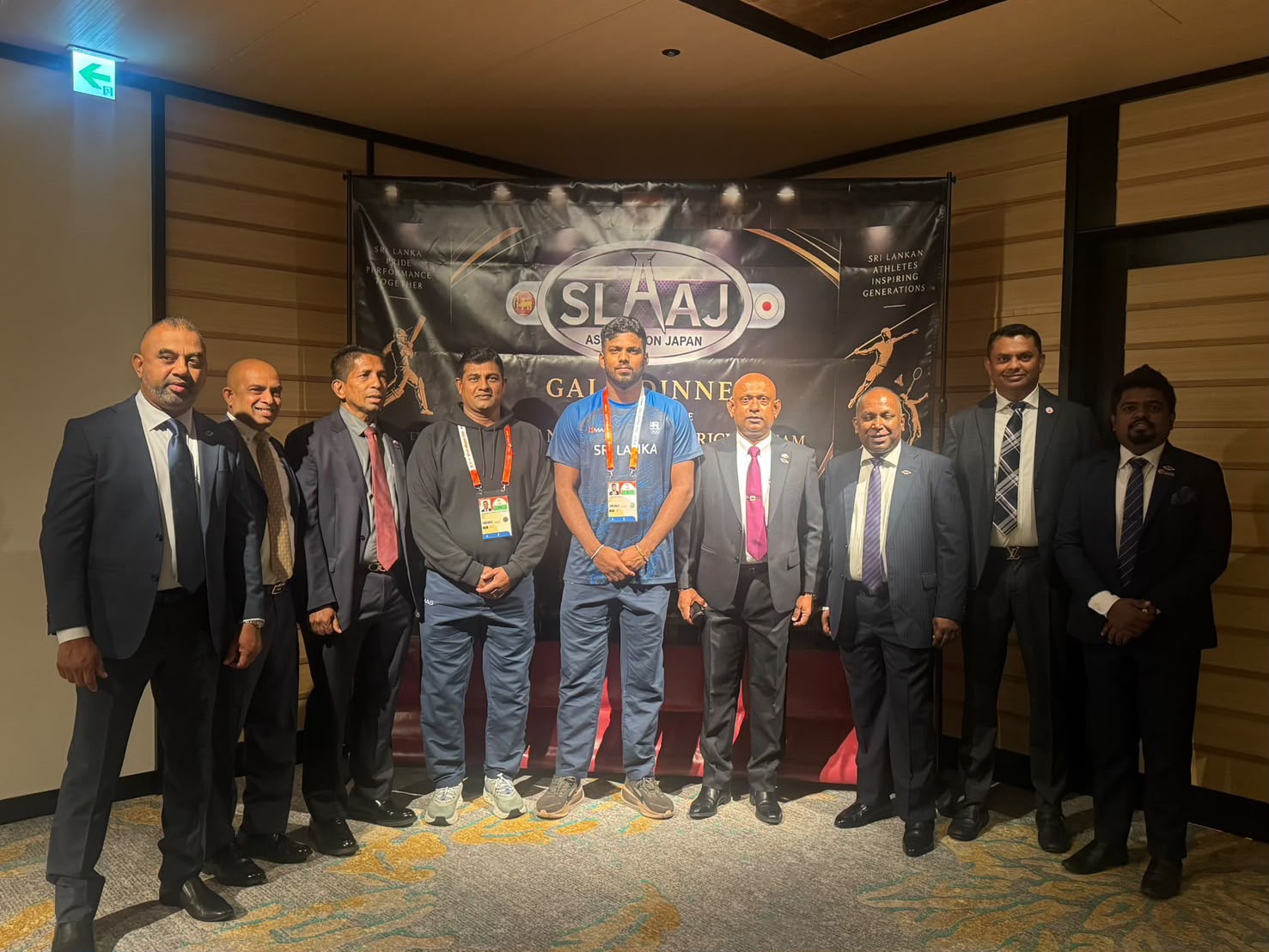
The Sri Lanka Automobile Association in Japan (SLAAJ) has awarded a brand-new Honda Vezel to gold medallist Rumesh Tharanga at a felicitation ceremony for the Sri Lankan team that competed at the Asian Games in Nagoya, Japan.
The gift was announced at the ceremony, held on the eve of the team’s departure from Nagoya.
”We decided to reward every Sri Lankan athlete who wins a gold medal with a brand-new vehicle. We invited all the Sri Lankan athletes taking part in the Games to the felicitation, and at the time of the event, only Tharanga had won gold,”
Nishantha Meegalla, Vice President of the Nagoya Prefecture of the Sri Lanka Business Council of Japan, told ‘The Island’.
Tharanga, the world’s top-ranked javelin thrower this season, won Sri Lanka’s first-ever javelin medal at the Asian Games on Monday, sealing the historic victory with a throw of 88.55 metres.
by Rex Clementine
Every cricket fan remembers that Angelo Mathews was Sri Lanka’s captain when Australia were whitewashed 3-0 in the Test series of 2016. Most will also remember Graham Ford, the master tactician, was Head Coach. But hardly anyone remembers the curator.
Perhaps they are not expected to. Curators rarely make headlines. Yet the truth remains that Godfrey Dabare produced the surfaces tailor made for Rangana Herath to weave his magic and the rest, as they say, is history.
Godfrey breathed his last on Tuesday morning after a brief illness. He was 62.
He had no degree in science or agriculture, qualifications that have become almost mandatory for chief curators these days. His university was the cricket field. His knowledge came from countless hours spent under the sun, studying soil, grass, weather and wickets, learning the craft the old fashioned way.
It is a little known fact that Godfrey spent three months in Galle preparing the venue ahead of its inaugural Test in 1998. He did a similar job in Dambulla before it became an international venue in 2001. He was a loyal lieutenant of former board chief Thilanga Sumathipala and both, Galle and Dambulla, were Thilanga’s treasured projects.
I first met Godfrey in 2000 when he was managing Chilaw Marians, then a club playing Division Three cricket. Within two years, the Marians had climbed into First Class cricket and soon became a thorn in the flesh of many fashionable Colombo clubs.
Did Godfrey occasionally use his influence as national curator to prepare pitches that suited his club? Of course he did. He was no paragon of virtue. But neither was he the villain some tried to paint him as.
He would often complain that he would unearth a rare gem from the beaches of Marawila or Wennappuwa, nurture him and give him a platform, only for one of the posh Colombo clubs to come along and pinch the player. Godfrey took those raids personally. And he was determined to teach them a lesson.
Above everything else, he cared deeply about his players.
Without his tireless work, Chilaw Marians would hardly have survived nearly three decades of First Class cricket. Now that he is gone, you cannot help but fear for the future of the club he built with such devotion, a club that has produced many fine cricketers, the latest being fast bowler Asitha Fernando.
Godfrey also had a soft spot for the press.
When England toured Sri Lanka in 2021, Sri Lanka Cricket kept journalists out of the grounds because of COVID restrictions. The press were not prepared to take it lying down, so several reporters climbed Galle Fort and covered the Tests from there.
That did not go down particularly well with SLC. The issue eventually reached Parliament, where there was rare cross party agreement that journalists should be allowed into the venue.
Relations between the cricket establishment and the press were frosty, to put it mildly. What those running the show did not know was that Godfrey was quietly sending food and drinks from inside the ground to the journalists perched on Galle Fort.
That was Godfrey.
His finest hour, however, came during the Asia Cup in 2023.
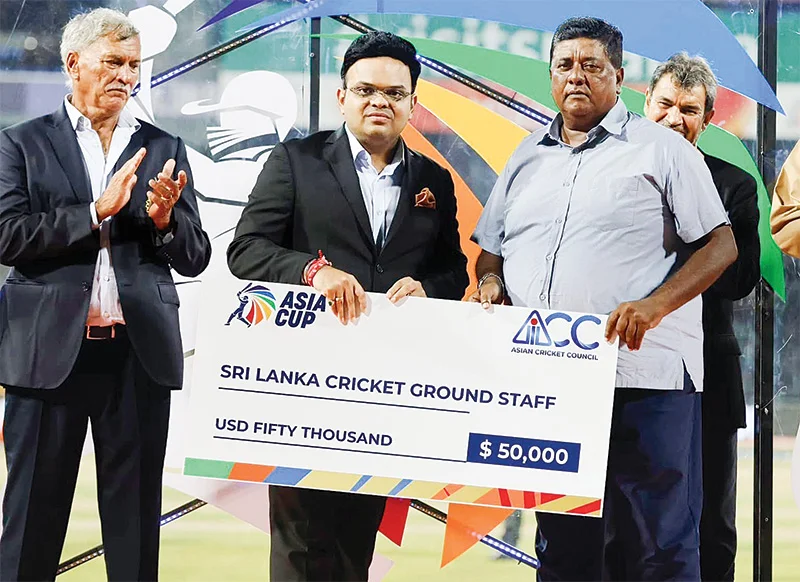
The tournament had been battered by bad weather and the ground staff worked around the clock, often in miserable conditions, to keep it moving. At the end of the tournament, the Asian Cricket Council recognised their extraordinary efforts by awarding the ground staff US$50,000. Godfrey received the cheque from ACC President Jay Shah.
Soon, murmurs began doing the rounds in Colombo. Would all that money actually reach the men who had sweated for it? There were plenty who had their doubts given the questions surrounding SLC’s financial management.
Godfrey made sure there could be no such suspicion.
Every groundsman received an equal share. Godfrey documented the payments, complete with bank and contact details of the recipients, and then, twisting the knife just a little, shared the information with the press.
He was an honest man, although often a misunderstood one.
There was another episode that summed up both Godfrey’s character and the world he occasionally had to navigate.
During a game at the R. Premadasa Stadium, the visiting team’s dressing room door had been smashed with brute force. Nobody quite knew what had happened.
When journalists rang Godfrey, he gave us chapter and verse. Bangladesh star Shakib Al Hasan, furious over an umpiring decision, had taken a bat to the dressing room door. Godfrey said he had CCTV footage and eyewitnesses to back up the claim.
The press went to town.
Shakib was summoned by the Match Referee and a suspension appeared to be looming.
Then, suddenly, Godfrey’s phone went silent.
The following day Shakib escaped with a slap on the wrist. There was apparently insufficient evidence.
A few weeks later, while journalists were watching Sri Lanka train at the R. Premadasa Stadium, Godfrey wandered over, put an arm around me and said: “Sorry, Rex. Bangladesh Cricket Board wanted the matter settled amicably. They agreed to pay for the damage. Board President (go figure who it was), called me and told me to delete the CCTV recording.”
That was Godfrey too.
Loyal to his friends. Loyal to his bosses. Sometimes caught between the two.
Sri Lankan cricket has lost one of those colourful characters who operated away from the television cameras but whose fingerprints were all over the game. Players came and went, administrators fought their battles and coaches collected the applause, but Godfrey was there in the background, preparing the stage on which they performed.
He will be missed.
His remains lie at his residence in Kurukulawa, Ragama. The burial will take place on Thursday in his hometown of Chilaw.

by Reemus Fernando
Since reaching the world number one ranking, javelin thrower Rumesh Tharanga has attained a level no other Sri Lankan athlete has reached. Winning gold at the Asian Games was therefore widely anticipated. What stood out was the way he overcame the wet conditions and, after trailing his rivals for three rounds, showed the composure to come from behind.
Here is why his medal is so special:
Tharanga’s gold at the Asian Games in Japan was Sri Lanka’s 13th in the 75-year history of the Games.
It was the 12th gold won by a Sri Lankan track and field athlete. The only other sport in which the country has won gold is cricket.
He is the first Sri Lankan javelin thrower to win Asian Games gold.
Sri Lanka had won only one previous gold in the field events: Nagalingam Ethirveerasingam’s high jump victory at the 1958 Tokyo Games, the country’s first ever.
Tharanga is also the first Sri Lankan to win gold in any throwing event.
He is the fifth Sri Lankan man to win an individual gold.
Track and Field Athletes who have won gold medals for Sri Lanka are:
Men’s
Nagalingam Ethirveerasingam high jump Tokyo 1958
Lucian Rosa 5,000m and 10,000m in Bangkok 1970
Wickremasinghe Wimaladasa 400m in Tehran 1974
Sugath Thilakarathne 400m in Bangkok 1998
Rumesh Tharanga Javelin Nagoya 2026
Sri Lanka Team inclusive of W. Wimaladasa, Sunil Gunawardana, Kosala Sahabandu and A. Premachandra won 4×400 m relay in Tehran 1974
Women’s
Damayanthi Dharsha 200m, 400m in Bangkok 1998 and 400m in Busan 2002
Susanthika Jayasinghe 100m in Busan 2002
Tharushi Karunaratne 800m in Hangzhou 2023

Gold winner Tharanga gets brand-new Honda Vezel from SLAAJ

Showers above 50 mm are likely at some places inthe Uva, Eastern and Central provinces and in Polonnaruwa and Mullaittivu districts after 1.00 p.m.

Civil society activist accuses govt. of favouring Ven. Gnanasara

More cops than cones

Sajith accuses govt. of using data selectively in crucial report

75 new inmates sent to Bogambara re-establishing it as a correctional facility

‘Dates have the highest sugar content to fight Coronavirus’

Sunday Island 27 December – Headlines

#SundayIsland 17th December – Headlines

Sunday Island – 28th March

Sunday Island Headlines – 21 March

Sunday Island – 21st February – Headlines
-
 Latest News6 days ago
Showers above 100 mm are likely at some places in the Western, Sabaragamuwa, Central and North-western provinces and in Galle and Matara Districts
-

 Editorial6 days ago
Crimes punished and unpunished
-

 Features5 days ago
Beyond traditional jobs: Why Sri Lanka needs to facilitate the gig economy
-

 Editorial4 days ago
Birth of a bad law
-

 News2 days ago
Police remove Thileepan statue in Jaffna
-
 Latest News5 days ago
Kusal, Wellalage star as Sri Lanka defend 322 in Headingley thriller
-
 Latest News7 days ago
Ms. P. M. Jayadeera (Engineer) appointed Director General of Irrigation
-

 News6 days ago
IMF: Sri Lanka on course for 2027 market return