
Editorial
Bombings and bigger picture


Tuesday 12th September, 2023
Even Channel 4 may not have expected its recent programme on the Easter Sunday terrorist bombings to cause such a stir in Sri Lanka. Anyone familiar with western media tropes could see the butler-did-it ending of the much-advertised exposé coming, miles away. Curiously, even those who used to brand Channel 4 as a hireling of anti-sri Lankan forces have chosen to buy into its claims at issue, albeit selectively, in a bid to gain political mileage.
Channel 4 has not made any revelation as such about the Easter Sunday carnage. It has only recycled what is already known with some claims of a Sri Lankan asylum seeker thrown in to give its programme an investigative flavour. It has however succeeded in making its bete noire, the Rajapaksa family, squirm again, and giving a fillip to the ongoing campaign for an international probe into the Easter Sunday attacks. The Catholic Church, and Opposition Leader Sajith Premadasa are prominent among those who are calling for an international investigation.
He that hath an ill name is said to be half-hanged. The Rajapaksas have earned notoriety for covering up numerous crimes. So, it is only natural that they stand accused of having had a hand in the Easter Sunday attacks, which catapulted national security to the centre stage of politics again, much to their advantage ahead of the last presidential election. Most of all, the Rajapaksas reneged on their pledge to have the Easter Sunday attacks thoroughly investigated. But it will be a mistake for those who are seeking justice to take Channel 4 claims as the truth, and allow some vital aspects of the 2019 carnage to go uninvestigated. The bigger picture must not be overlooked.
The call for a probe into the alleged involvement of the Rajapaksas in the Easter Sunday bombings should be heeded, but investigations must not be limited to that aspect of the issue if the truth is to be uncovered. There are some questions that warrant answers. Did Zahran have a handler who manipulated and misled the NTJ (National Thowheed Jamath)? If so, whose interests did he seek to further? Did he work for the Rajapaksas or some foreign powers seeking to destabilise Sri Lanka to further their geopolitical interests? The focus of those who are demanding a fresh probe into the Easter Sunday carnage is on the Rajapaksa family although Archbishop of Colombo Malcolm Cardinal Ranjith himself has said there was an external hand in the terror attacks.
As we have pointed out in a previous comment, some key witnesses who testified before the Presidential Commission of Inquiry (PCoI), which probed the Easter Sunday attacks, insisted that there had been ‘an external hand or conspiracy behind the attacks’. They are Malcolm Cardinal Ranjith, former President Maithripala Sirisena, former Minister Rauf Hakeem, former Minister Rishad Bathiudeen, former Governor Azath Salley, former SJB MP Mujibur Rahman, former SIS Director SDIG Nilantha Jayawardena, former STF Commandant M. R. Latheef, former Chief of Defence Staff Ravindra Wijegunaratne, former SDIG (CID) Ravi Seneviratne and former CID Director Shani Abeysekera, whom Opposition Leader Premadasa considers the best person to head a fresh probe into the Easter Sunday attacks. The PCoI has dismissed their statements as mere ipse dixits (assertions made but not proven), but recommended that certain identified parties be further investigated. This recommendation has gone unimplemented.
The question is whether it will be possible to conduct an international investigation free from external pressure into the Easter Sunday attacks to get at the truth, given the alleged foreign involvement in the carnage. Senior DIG Jayawardena told PCoI that an Indian named Abu Hind ‘may have triggered the attacks’. According to the PCoI report, an ‘international expert on terrorism who testified in camera said, “Abu Hind was a character created by a section of a provincial Indian intelligence apparatus, and the intelligence that the Director SIS received on the 4th, 20th and 21st April 2019 was from this operation and the intelligence operative pretending to be one Abu Hind. Operatives of this outfit operate in social media pretending to be Islamic State figures. They are trained to run virtual personae.” The report goes on to say, “The testimony was that Zahran believed Abu Hind was the Islamic State regional representative. Abu Hind was in touch with both Zahran and his brother, Rilwan, and had spoken to Naufer. This part of the evidence is confirmed by the testimony of Hadiya [Zahran’s wife].”
The need for a high-level probe to ascertain whether an external force was behind the Easter Sunday carnage cannot be overstated.

Tuesday 8th September, 2026
President Anura Kumara Dissanayake has embarked on a nationwide tour to drum up support for his government, whose approval rating has declined, according to a Verite Research opinion survey. It is possible that he has launched his re-election campaign, the way his predecessors did, as some political commentators argue. The Opposition has claimed that the President has launched the ongoing campaign with an eye to a possible referendum on the 22nd Amendment Bill. But he is apparently very confident that he will be able to amend the Constitution without a referendum to raise the retirement ages of the superior court judges.
Addressing a rally in Kalutara over the weekend, President Dissanayake rejected allegations that he was planning to do away with elections with the help of a referendum. He said the parliamentary and presidential elections would not be delayed, and the Provincial Council (PC) polls would be held after clearing some legal obstacles.
Elections to some provincial councils have remained in abeyance since 2017. The Eastern, North Central and Sabaragamuwa Provinces last went to the polls in 2012, followed by the Central, Northern and North Western Provinces in 2013. Elections to the Western, Southern and the Uva Provincial Councils were last held in 2014. There have been two presidential elections, two general elections and two local government elections since 2017 and the country has had four Presidents since then.
The PCs have been functioning without elected representatives all these years, and this amounts to a blatant violation of the Constitution, according to former Chairman of the Election Commission Mahinda Deshapriya.
Deshapriya has gone on record as saying that it is a clear violation of the Constitution for bureaucrats to run the PCs without elected representatives. The blame for this situation should be apportioned to all political parties, Deshapriya has said. The media has quoted him as saying that there is no graver sin than postponing elections, and the PC polls must be held urgently.
If the government is not afraid of facing elections, it need not wait until the so-called legal hurdles are cleared to hold the PC polls. There is an easy way around this problem.
The process of redrawing the boundaries of electorates for implementing the mixed proportional system is bound to drag on indefinitely. The best way out is to hold the PC polls under the Proportional Representation (PR) system so that there will be five long years thereafter for completing the delimitation process, etc. In fact, a private member’s motion has already been presented to Parliament to this effect.
MP Shanakiyan Rasamanickam’s private member’s Bill, titled, “Bill to amend the Provincial Council Elections Act, No. 2 of 1988”, seeking to clear the way for the PC elections, was seconded by MP M. Nizam Kariapper. If ratified, this amendment will provide for holding the PC polls soon under the PR system.
Former Election Commission Chief Deshapriya has said it will be possible to hold the PC elections in four months under the PR system if Parliament passes necessary laws. If they are to be held under the proposed mixed representation system, the PCs will be without elections this year as well, he has said.
The JVP-NPP government has a two-thirds parliamentary majority, which it flaunts at every turn, and therefore it can amend the Provincial Council Elections Act anytime. After all, its election manifesto, A Thriving Nation, A Beautiful Life, promised to hold the local government and provincial council elections within one year of forming a government.


Monday 7th September, 2026
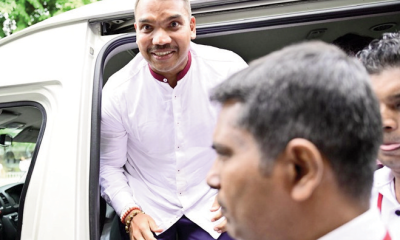
The irony of the JVP and the UNP clashing over last week’s arrest and remand of SLPP National Organiser and MP Namal Rajapaksa over an alleged Rs. 100 million bribe linked to an Airbus deal may not have been lost on political observers. One may recall that during the UNP-led Yahapalana government, arrests were made the way volleyball is played, as it were. The JVP, which was honeymooning with the UNP at the time, raised questions in Parliament about allegations against the common enemies of the two parties, enabling the UNP to make damning statements about them and build a case for their impending arrests, much as a setter places the ball for a hitter to make the approach, jump and spike. The JVP and the UNP have since fallen out, with the latter lambasting the former for having Opposition politicians arrested for political reasons.
Sri Lanka has earned notoriety for politically-motivated arrests under successive governments. Ruling party politicians use arrests to vilify their opponents before or after elections and major political events, such as propaganda rallies. President J. R. Jayewardene misused Emergency regulations to have actor-turned-politician Vijaya Kumaratunga arrested and detained following the 1982 presidential election, falsely accusing him of involvement in what was described as a Naxalite conspiracy to overthrow the UNP government. Kumaratunga was never charged. The SLFP-led government under President Chandrika Kumaratunga was also not immune to allegations of political witch-hunts, the arrest and detention of former UNP Minister Sirisena Cooray being a case in point. President Mahinda Rajapaksa had his main contender in the 2010 presidential election, former war-winning Army Commander Gen. Sarath Fonseka, arrested. The UNP-led Yahapalana also turned arrests into political theatre, with a series of high-profile arrests accompanied by cameras, dramatic police action and publicity. Former head of State Intelligence Maj. Gen. (retd.) Suresh Sallay has been detained since February 2026 under the PTA (Prevention of Terrorism Act) in connection with an investigation into the Easter Sunday terror attacks.
Legislators of the party in power usually abuse their parliamentary privileges to vilify suspects in custody and hold social media kangaroo trials with impunity. They apparently presume suspects guilty until proven innocent. When they do so, the police cannot be expected to conduct impartial investigations. It is no surprise that the police have been accused of fabricating evidence against the political enemies of governments over the decades.
Pretrial arrests, remand or detention should be the exception rather than the rule, especially in a country like Sri Lanka, which cannot even ensure the safety of convicts and remand prisoners. Above all, the conviction rate in this country is as low as 4% to 6%, according to researchers. The police make arrests swiftly but thereafter drag their feet on investigations while objecting to bail for suspects.
Most of the prosecutions under the Yahapalana government collapsed mainly due to lapses on the part of the police and the Attorney General’s Department, which had to make haste under political pressure. The incumbent government stands accused of trying to overcome this problem by manipulating the judiciary through various means instead of resolving the structural problems besetting the legal process. It is only natural that the questionable 22nd constitutional amendment Bill has come to be viewed as part of the government’s strategy to control the judiciary.
Many people have languished in remand prisons due to politically motivated arrests and selective enforcement that the police are notorious for. The police ought to conduct thorough investigations and gather credible evidence before moving to arrest suspects who are not hardcore criminals posing a danger to society. It defies comprehension why so many suspects are arrested and kept in remand prisons for months on end even when there is no reason to suspect that they will flee the country, interfere with witnesses, suppress evidence, commit further serious offences, or pose a significant danger to the public.
Holding a person on remand indefinitely until the conclusion of investigations is not consistent with due process and international best practices; in fact, it amounts to punishment in itself in all but name. The rule of law demands that the police or other investigators establish reasonable grounds to suspect an offence, collect and preserve evidence, interview witnesses, question suspects and assess the facts objectively before depriving anyone of personal liberty. They must not act according to their whims and fancies or at the behest of their political masters.
Premature arrests risk wrongful detention, reputational damage, hardships and expensive legal challenges for suspects, as is public knowledge. They could also compromise public confidence in law enforcement and lead to perceptions that investigations are influenced by political pressure or public sentiment rather than facts. When the rule of law is undermined, the justice system becomes weak.

Hardly a day passes in this country without major drug detections and underworld killings. Inspector General of Police Priyantha Weerasooriya, speaking at this year’s Police Day ceremony in Colombo on Thursday (03), said police had seized large amounts of narcotics, including 1,416 kg of Crystal Methamphetamine, 946 kg of heroin, and 1,282 kg of cannabis and taken into custody 1,612 illegal firearms, including T-56 assault rifles and pistols, so far this year.
Sri Lanka is awash with illegal firearms, which have found their way into the underworld during the past several decades. Protracted armed conflicts led to an exponential increase in the number of lethal weapons in the wrong hands.
Immediately after the 2024 regime change, the MPs who had obtained repeater guns from the Defence Ministry were asked to return those weapons, and they readily complied for obvious reasons. But those guns account for only a fraction of the weapons issued to politicians and others over the decades. In January 2019, the then Defence Secretary Hemasiri Fernando disclosed that about 4,700 pistols and revolvers had been licensed but there was no information about those who had obtained them. Some individuals possessed as many as 15 small firearms each, he said.
One may recall that in 2023, the then State Minister Pramitha Tennakoon informed Parliament that the defence authorities had issued about 700 firearms to 154 politicians in the late 1980s, when the JVP went on a killing spree, but none of them had been returned. That figure cannot be accurate. According to anecdotal evidence, thousands of firearms were issued to politicians under threat during that period, and almost all of them have gone missing.
In the late 1980s, the JVP did not spare anyone who refused to obey its illegal orders. Its death-dealing sparrow units physically eliminated anyone who had the courage to voice dissent. Some political activists threatened by the JVP banded together to protect themselves, and the armed groups they formed, such as the PRRA (People’s Revolutionary Red Army) became as ruthless as the JVP killing squads; they eventually helped beat the JVP at its own game. Some of them switched their allegiance to the UNP, and worked as its shock troops.
The leftist parties and the SLFP, too, had to protect themselves against the JVP hit squads. The UNP set in motion a Caravan of Death, which scoured the country, killing JVP activists and suspects. What happened to the firearms used by pro-UNP vigilantes to carry out those extrajudicial killings?
Chris Smith, an expert on the proliferation of firearms, especially in South Asia has in his report, In the Shadow of a Cease-fire: The Impacts of Small Arms Availability and Misuse in Sri Lanka, has revealed that the weapons given to politicians in the late 1908s numbered more than 11,000. Many of them were not returned. The National Commission against the Proliferation of Illicit Small Arms (NCAPISA), established by President Chandrika Bandaranaike Kumaratunga in 2004, once quoted a senior police officer attached to the Police Central Armoury at the time as having said that 80% of those weapons had been returned. Even if so, going by Smith’s figure, more than 2,200 weapons have gone unaccounted for.
The proliferation of illicit firearms in Sri Lanka can be attributed to several key factors, according to researchers; they include gunrunning, illegal operations carried out by rogue elements in the police and the armed forces, local arms manufacturing, and criminals gaining access to arms caches of the LTTE. It may be recalled that the Colombo Crime Division produced 12 suspects before the Colombo Chief Magistrate on March 22, 2019, for having supplied weapons retrieved from buried LTTE arms caches in Kilinochchi to criminal gangs elsewhere. It was revealed in January 2025 that as many as 73 T-56 assault rifles had gone missing from an unnamed army camp. Soon after the decimation of the JVP’s military wing in 1989, a police sergeant sold a large stock of firearms, seized from the JVP and stored in the Kuliyapitiya police station, to underworld gangs at Rs. 15,000 each. The police could recover only some of those weapons.
The police must go all out to find the illegal firearms used by the JVP during its second uprising (1987-89). Most of the JVP’s arms caches have not been traced. SJB MP Dayasiri Jayasekara told Parliament on 27 Feb. 2025 that more than 2,000 illegal firearms looted by the JVP between 1987 and 1989 had gone missing. The JVP attacked several police stations and military camps and grabbed weapons. In April 1987, it seized the entire arsenal at the Pallekele army camp. Now that the JVP-led NPP has formed a government and launched a campaign to eliminate gun violence, the Defence Ministry may be able to ascertain information about those missing firearms, as we argued in a previous editorial comment.
The NCAPISA dealt extensively with the issue of illegal weapons in circulation in Sri Lanka. Its survey report contains valuable information, which, however, needs to be updated. Defence authorities should study this document thoroughly and commission a fresh survey on illicit firearms while carrying out operations to neutralise criminal gangs and seize lethal weapons in their possession.
The need for the police and the defence bigwigs to adopt a broader and more strategic approach to ridding the country of the scourge of illegal firearms, which snuff out lives almost daily, cannot be overstated.

Showers in the Uva, Central and Eastern provinces and in Polonnaruwa district

22A: Exclusion of 8 petitions questioned, action filed against SC Registrar, others

Thailand shuts door on undesirables from Sri Lanka

Expertise France and the EU launch media project to strengthen environmental journalism in Sri Lanka

CLA questions non-inclusion of senior judges on five-member SC bench hearing 22A petitions

Whatever on earth happened to meritocracy, pragmatism, and honesty in Sri Lanka?

‘Dates have the highest sugar content to fight Coronavirus’

Sunday Island 27 December – Headlines

#SundayIsland 17th December – Headlines

Sunday Island – 28th March

Sunday Island Headlines – 21 March

Sunday Island – 21st February – Headlines
-

 News5 days ago
Denied of promotion to SC despite vacancies, justice Gurusinghe retires
-

 Latest News6 days ago
Grade 5 scholarship exam results released
-

 News5 days ago
22A: SC urged to suspend hearing, appoint full bench
-

 Midweek Review6 days ago
The local and global dynamics of Sri Lanka’s 22nd Amendment
-
 News3 days ago
Namal remanded until Sept. 18 over Airbus deal investigation
-

 Latest News2 days ago
Tharanga creates history with Diamond League crown in Brussels
-
 News5 days ago
Govt. seeks NATO assistance
-

 News6 days ago
40 professional organisations and TU oppose proposed 22A