
News
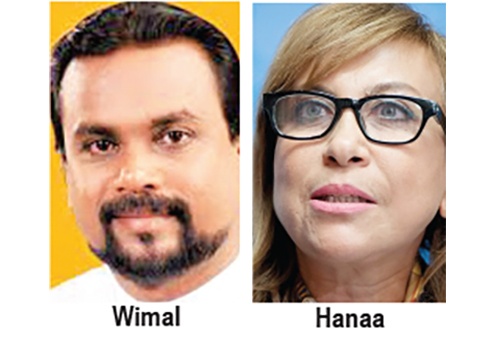
Wimal accuses UN of playing politics

By Shamindra Ferdinando
National Freedom Front (NFF) leader Wimal Weerawansa, MP, yesterday (15) accused the UN of playing politics with the controversy over the cremation of all those who died of COVID-19.
Minister Weerawansa said so when The Island sought his opinion on the UN recently requesting Prime Minister Mahinda Rajapaksa to do away with the existing restrictions.
Minister Weerawansa emphasised that there couldn’t be justification whatsoever in UN intervention as the situation took a turn for the worse over the past several days.
With the death toll now beyond 50 and positive cases over 16,000 the country couldn’t risk a further deterioration, lawmaker Weerawansa said. Responding to another query, Minister Weerawansa pointed out that UN Resident Coordinator in Colombo Ms Hanaa Singer wouldn’t have intervened without consulting New York.
The NFF leader said that Ms. Singer copied her Nov 12 dated missive to Health Minister Pavitra Wanniarachchi, Justice Minister Ali Sabry, PC, and Foreign Minister Dinesh Gunawardena. Minister Weerawansa questioned the UN’s assertion that ‘negative consequences of not allowing burials seem to outweigh any potential epidemiological benefit, the country has gained.’
The NFF has six MPs among 145-member SLPP parliamentary group.
“I fear that not allowing burials is having a negative effect on social cohesion and, more importantly, could also adversely impact the measures for containing the spread of the virus as it may discourage people to access medical care when they have symptoms or history of contact,” Ms Singer said, claiming that she intervened in this matter after receiving many appeals within and outside the Muslim community that the current policy is discriminatory.
Minister Weerawansa compared the UN Resident Coordinator’s claim of having received ‘impassioned appeals’ with moving Geneva resolution on the basis of unverified war crimes accusations. If the UN was so concerned wouldn’t it better for them to make inquiries instead of releasing letters to the public, Minister Weerawansa asked.
Minister Weerawansa alleged that the UN had conveniently forgotten the restrictions affected all communities regardless of faith. Unfortunately, the UN raised the issue with Premier Rajapaksa as if restrictions only affected the Muslim community. The NFF leader said that many an eyebrow was raised recently over the UK condemning the arrest of 2019 Easter Sunday attack suspect, lawyer Hejaaz Hizbullah. Minister Weerawansa said that the contentious issue has been raised at the Geneva-based United Nations Human Rights Council (UNHRC), while the matter was pending before the country’s highest court.
The Cabinet also discussed the British government criticism of Sri Lanka’s withdrawal from the 30/1 accountability resolution and current human rights situation in Sri Lanka et al.
The UK’s International Ambassador for Human Rights, Rita French, in a statement delivered on behalf of Canada, Germany, North Macedonia, Montenegro and the UK alleged that civil society and human rights groups in Sri Lanka experienced an increasingly difficult operating environment.
A British statement quoted Ambassador French as having said: “Instances of intimidation, harassment and surveillance continue, including threats to families of disappeared persons. Individuals are detained indefinitely without appearance before court, such as lawyer Hejaaz Hizbullah.”
Minister Weerawansa said that unless the government successfully countered the latest UN move, Sri Lanka’s corona health guidelines, too, could end up a subject matter in Geneva.
Asked whether the cabinet of ministers discussed the Ms Singer’s letter, Minister Weerawansa said that
Premier Rajapaksa’s Office received the letter after last week’s cabinet meeting.
Minister Weerawansa reiterated that the cabinet could discuss anything though decision on health guidelines was certainly not the prerogative of the cabinet.
“We are in such a crisis, no sane political leadership will pursue political agenda at the expense of the well-being of the country,” lawmaker Weerawansa said.
Minister explained that the UN’s intervention should be examined against the backdrop of the global health community yet to reach conclusive decisions on rampaging coronavirus. The bottom line is that in the absence of consensus on how to tackle the epidemic, Sri Lanka shouldn’t under any circumstances adopt measures that could endanger the overall response to the unprecedented viral threat.
Minister Weerawansa emphasized that the discussion pertaining to the possibility of burying bodies in some isolated spot was absurd. “The health administration, security forces and the police are working overtime, under extremely difficult conditions to bring the situation under control while a section of the population demanded burial rights. This is not fair.”
Minister Weerawansa said that with some parts of the highly populated Colombo district under severe threat with the majority of deaths being reported there, the government would have to further tighten counter measures instead of appeasing opportunists.
The outspoken Minister called for an inquiry into recent claim by the Ceylon Thowheed Jamaat that the government authorized burials as it was denied. Colombo District MP attorney-at-law Premanath C. Dolawatte recently lodged a complaint with the CID in that regard. Claiming that President Gotabaya Rajapaksa never promised to do away with cremation of all corona victims lawmaker Dolawatte requested an inquiry
Minister Weerawansa said that in the wake of UN the intervention, various other international groupings such as the EU, too, could issue statements in that regard. Asked whether he felt a section of the international community adopted a policy hostile towards post-war Sri Lanka, lawmaker Weerawansa alleged those who couldn’t stomach eradication of the LTTE were still campaigning against the country. The return of the war winning administration to power was a headache for some, the minister alleged.
Minister Weerawansa emphasized the pivotal importance of the government addressing this issue in one voice without conceding to what he called politics of religious extremism.

Latest News
Let us all build a society valued with peace and harmony, guided by unity and solidarity beyond all differences – PM

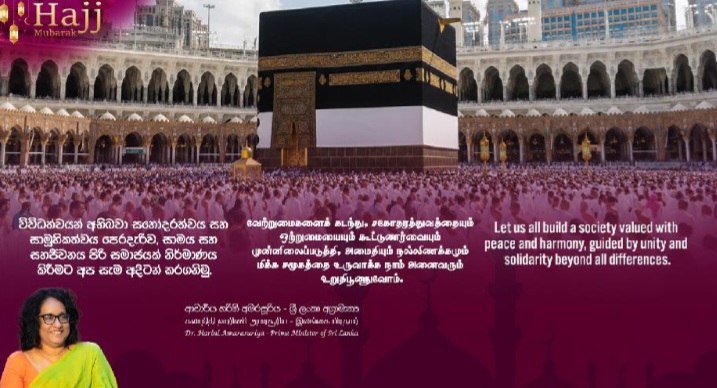
Prime Minister Dr Harini Amarasuriya issuing a message on the occasion of the Hajj festival called upon all Sri Lankans to build a society valued with peace and harmony, guided by unity and solidarity beyond all differences
The Prime Minister’s message:
“On the occasion of “Eid-ul-Adha” or the Hajji Festival, celebrated with great reverence by Muslims across the world upholding the values of selflessness, unity, and compassion, I extend my felicitations to the Muslim community in Sri Lanka and around the world.
On this special Day, the festival of Hajji commemorates the boundless devotion to God and the noble spirit of generosity demonstrated by Prophet Ibrahim. This festival reflects the willingness of humanity to dedicate even its most precious possessions for the greater good of humankind and the devotion towards the God.
On this day, the most important lesson we must all understand is the value of rising above our differences and standing together in unity and solidarity. The message of Eid-ul-Adha, founded upon sharing and compassion, serves as a great example in our journey towards building a strong, peaceful, and prosperous Sri Lanka.
Therefore, setting aside narrow divisions, we must all resolve to act with respect and kindness towards one another and work together to create a society valued with peace and solidarity.
May this Hajji Festival bring happiness, peace, prosperity, and blessings to you all”.
Ranil-led group asks govt. to hold PC polls
Former Cabinet Minister Dr. Rajitha Senaratne yesterday (27) claimed that there was no consensus between the JVP and the NPP regarding the long delayed Provincial Council (PC) polls.
Dr. Senaratne said that though JVP General Secretary Tilvin Silva had declared in Jaffna, over the last weekend, that it wouldn’t be possible to conduct PC polls this year, due to financial constraints and legal impediments, the position of NPP General Secretary Dr. Nihal Abeysinghe was different.
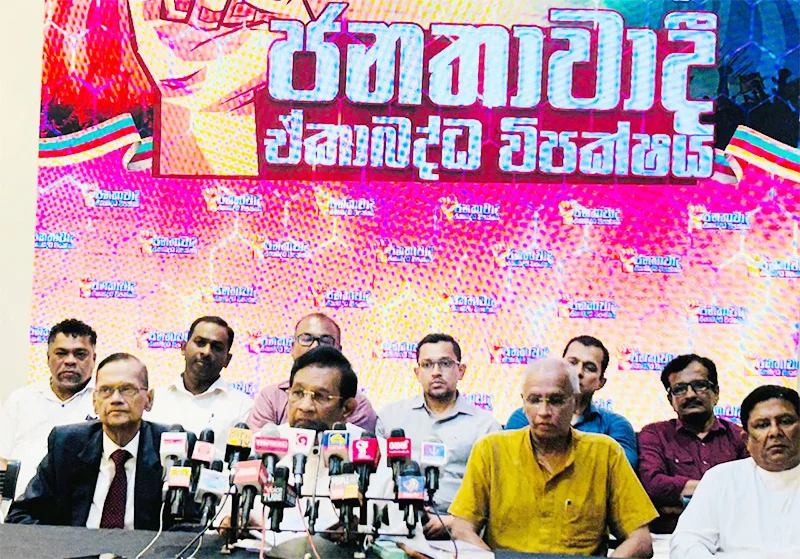
Addressing the media at Hotel Nippon, on behalf of the People’s United Opposition grouping, operating out of Ranil Wickremesinghe’s Flower Road Office, Dr. Senaratne, who represents the UNP, claimed that the JVP/NPP was all out to postpone the long delayed PC polls. The New Democratic Front (NDF) parliamentary group, elected to the current Parliament, received the backing of Wickremesinghe.
The ex-Minister explained how the NPP, with a 159-member parliamentary group, could comfortably secure the approval of the Parliament to conduct the PC polls under Proportional Representation system.
Declaring that they would submit combined candidate lists at the PC polls, Dr. Senaratne declared that those who declined to join them would be considered traitors.
Dr. Senaratne emphasised that there was no need for alliances and their objectives could be achieved through fielding combined candidate lists.
The Illankai Thamil Arasu Kadchi (ITAK) was represented by former lawmaker and acting Secretaray General of ITAK but the Sri Lanka Podujana Peramuna (SLPP) and the main Opposition Samagi Jana Balawegaya (SJB) weren’t represented.
Convenor of the People’s United Opposition Prof. G. L Peiris, at the beginning of the briefing, explained how the people were deprived of their democratic rights by the NPP, through the postponement of PC polls.
On Tuesday (26) MPs Shanakiyan Rasamanikkam, Mano Ganesan, and Nizam Kariapper attended a joint Opposition discussion with SJB and others, organised by PAFFREL. MP Rasamanikkam has criticised the delay in holding PC elections.
The Batticaloa District MP highlighted that he had already presented a private member’s bill to facilitate the conduct of elections, under the earlier system.
Rasamanikkam said:”The four Opposition members representing the Parliamentary Select Committee affirmed their stance to hold the Provincial Council elections under the preferential voting system.
“We noted, however, that the establishment of this committee appears to be a measure to further delay the process.
“Concurrently, an Additional Solicitor General of the Attorney General’s Department presented two proposals for conducting the elections.
“One of these recommendations involves introducing minor amendments concerning women and youth representation to the private member’s motion I tabled in Parliament, which seeks to hold the Provincial Council elections under the previous system.”
Meanwhile, PAFFREL said that altogether 42 political parties and civil society organisations were involved in that discussion.
PAFFREL said that of the 42 political parties and monitoring organisations that participated in the discussion, all but one political party consented to endorse the following joint statement. And it was decided to forward the joint statement to the Parliamentary Select Committee and the government.
“We, the secretaries of political parties and representatives of the other organisations, who attended the meeting organised by PAFFREL at the Hector Kobbekaduwa Agricultural Training and Research Institute, on 26 May, 2026, agreed to the proposal adopted to hold the Provincial Council elections as per the electoral system prevailed prior to the enactment of Act No. 17 of 2017, pending the final outcome of the Parliamentary Select Committee. We also agreed to ensure 25% representation of women and youth on a voluntary basis.”
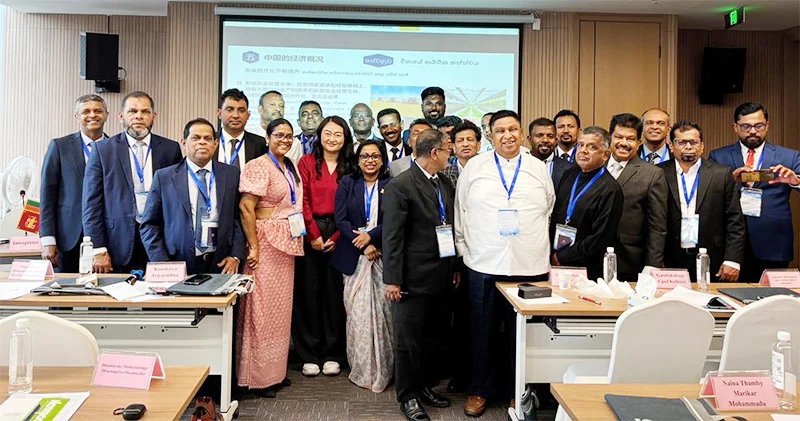
A Parliamentary delegation, comprising 20 Members of Parliament, and four officials, of the Parliament of Sri Lanka, led by Dr. Kaushalya Ariyarathna, Deputy Minister of Mass Media, is in China to participate in a workshop for Members of Parliament of Sri Lanka being held in Beijing and Guangdong.
The programme has been organised by the International Cooperation Centre of the National Development and Reform Commission (NDRC) of China, from 26th May to 5th June, 2026.
The delegation arrived in Beijing, on 25 May, and commenced official engagements on 26th May, with the Opening Ceremony of the Workshop held at the Fenghui Centre in Beijing, Parliament said.

Let us all build a society valued with peace and harmony, guided by unity and solidarity beyond all differences – PM

Showers will occur at times in the Western, Sabaragamuwa and North-western provinces and in Galle, Matara, Kandy and Nuwara-Eliya districts

Rajitha calls for combined lists, denounces those unwilling to join as traitors

20 lawmakers, four officials visiting China

More Japanese funds for demining operations in the north

Clingendael Institute delegation visits Pathfinder Foundation

‘Dates have the highest sugar content to fight Coronavirus’

Sunday Island 27 December – Headlines

#SundayIsland 17th December – Headlines

Sunday Island – 28th March

Sunday Island Headlines – 21 March

Sunday Island – 21st February – Headlines
-

 Business6 days ago
Historic launch of CCWE Fashion Week & International Summit 2026
-

 News4 days ago
All-New GRAVITE launches at LKR 6.99 Mn
-
 Features4 days ago
The NPP’s pivot to the past
-
 News3 days ago
Police probe underway to ascertain links between criminals deported from UAE and local politicians
-
 News2 days ago
Easter Sunday carnage: Court told Maulana’s statement cannot be accepted without cross-examination
-

 Opinion6 days ago
The need to reform Buddhist ecclesiastical order
-
 Features4 days ago
End of Peacekeeping
-
 News3 days ago
Dickoya double murder suspect arrested