
Business
BOC to break negative cycle and grow its SME loan book by Rs. 5 billion-and counting

Rs. 4 billion for SMEs Rs. 1 billion for startups
Interest rates as low as 12.0- 12.5% over 5 years 5% below market rates
By Sanath Nanayakkare
The Bank of Ceylon (BOC) yesterday called a press conference at a short notice to break good news for Sri Lanka’s SME sector, women-led businesses and startups hungry for capital to give impetus to their growth plans after Sri Lanka has gone through a tough cycle of crises.
The Bank has just rolled out an SME fund of Rs. 5 billion at 12.0 -12.5% interest rates which the Bank said would certainly increase if there is more demand from the businesses to take their businesses to the next level.
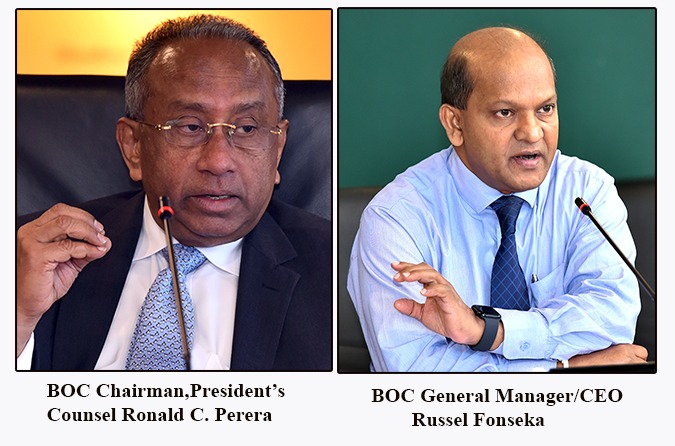
BOC Chairman, President’s Counsel Ronald C. Perera addressing the media at BOC head office said,” As you know the past few years have been a huge challenge for the whole country including the banking sector. The interest rates went up sky-high and now after the domestic debt optimization (DDO) interest rates have started coming down. We are hopeful it will kick off the business sector so that entrepreneurs will be able to borrow funds at reasonable rates to carry out their commercial activities.
We at the Bank of Ceylon have especially thought about the Small and Medium Enterprise sector (SMEs) not only in the western province but also in all other provinces because they are the backbone of the economy of the country. Before the DDO was announced, interest rates hovered around 25-28%, and by August 9, 2023 it had come down to 16.9%. Now we have worked out a special SME loan scheme totaling Rs. 5 billion to be disbursed at 12% which is 5% below the market rate. Each qualifying SME in this loan scheme can seek a loan up Rs. 25 million. If they have collateral, they will get their loan at 12% and those without collateral will get it at 12.5%. According to the demand, we will certainly increase the SME loan volume beyond Rs. 5 billion. Let’s first see how things would turn out in the initial phase.”
“Further, there is another loan scheme to support the startups with up to Rs. 2 million rupees at the same interest rates. Both these loans are given for 5-year periods. We are looking to give priority to young entrepreneurs and businesses headed by women. We have allocated 4 billion rupees for SME loans and 1 billion rupees for the startups. This means a total of Rs. 5 billion will be disbursed in this exercise. We hope it will help drive SMEs catering to the local market as well as export-oriented SMEs and startups that need financing to grow into the next phase. The fund allocation will be implemented in a first-come first-served basis. One customer can get only one loan under this category.
This financing is provided for new businesses and not for settlements or re-pricing of existing businesses. We will abide by the normal banking practices stipulated by the Central Bank such as getting CRIB reports of borrowers and guarantors. The applicants must demonstrate that they have necessary qualifications and experience in the relevant field and have a valid business registration. They need to be able to produce environmental compliance reports etc., in case it would be required.
The borrowers would be required to provide 25% equity of their respective projects. We will not permit the purchase of land or vehicles under this scheme, but the funds can be used to put up infrastructure with the approval and due diligence by the Bank. The applicants have to come up with a business plan to show how he or she will maintain the operational activities of the business and the cashflow in a stable manner.”
“These loan schemes have just rolled out this week. Actually this was initiated after the government and the Central Bank asking us to reduce interest rates and support the economic recovery as the time is right to do so. In fact, we have gone beyond the desired levels and are offering these loans 5% below the market rate.”
“There are already a number of other SME financing facilities given at concessionary interest rates which had started earlier. In addition to that, we provide non-financial assistance to SMEs under the BOC SME Circle. It gives them the know-how to operate their businesses successfully and to expand their businesses,” BOC Chairman said.
BOC General Manager/CEO Russel Fonseka said that the Bank was able to safeguard their customers during the multiple crises and when the interest rates shot up to very high levels, because they didn’t shift that burden on to their customers, but absorbed that loss into the Bank and provided a cushion for the troubled businesses.”
“That was how BOC able to keep its customers battling the economic crisis to survive and to keep our non-performing loans (NPLs) at a very low level. We have always stayed true to our core value of ‘thin margins, high volumes’ which has worked for the benefit of the Bank, its customer base and the overall economy,” the GM said.






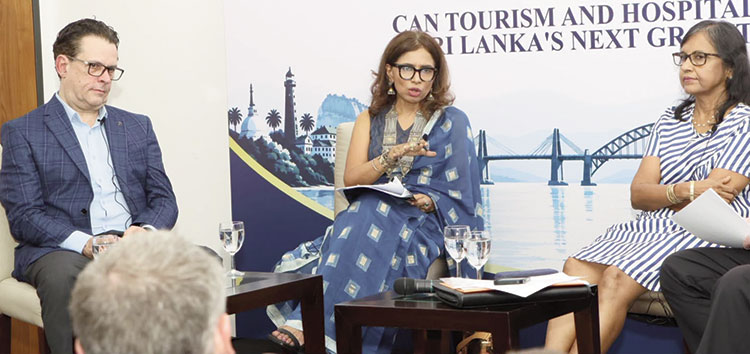
The Australian High Commission in Sri Lanka recently hosted the latest edition of its ConnectED Thought Leadership Series at the Australian High Commissioner’s Residence in Colombo, bringing together senior leaders from Sri Lanka’s tourism, hospitality, travel, events, education and related sectors.
The discussion, themed “Beyond Arrivals: Can Tourism and Hospitality Power Sri Lanka’s Next Growth Phase?”, focused on the role of tourism and hospitality beyond visitor arrival numbers, examining how the sector could contribute to Sri Lanka’s broader economic development.
The distinguished panel comprised Shiromal Cooray, Chairman and Managing Director of Jetwing Travels; Angeline Ondaatje, Chairperson of Tangerine Beach Hotels PLC, Royal Palms Beach Hotels PLC and Tangerine Tours; and Grant Dreher, Chief Executive Officer of William Angliss Institute Australia.
The discussion was moderated by Wayne Crosbie, Director – International and Business Development, William Angliss Institute Australia, who facilitated the conversation around the evolving needs of the tourism and hospitality industry and the importance of connecting education, skills development and workforce readiness with industry demand.
Adding a practical and experiential dimension to the evening, students from the Colombo Academy of Hospitality Management (CAHM) played an active role in delivering the cocktail reception for the distinguished guests.

A high-level discussion on the implementation of Sri Lanka’s Global Destination Marketing and Communication Campaign, supported by the World Bank, was held at the Ministry of Foreign Affairs, Foreign Employment and Tourism. The initiative marks a significant step towards strengthening Sri Lanka’s position as a competitive and attractive destination in the global tourism marketplace.
The meeting focused on the importance of adopting a long-term, data-driven approach to destination marketing, underpinned by comprehensive analysis of tourism demand and supply trends, visitor behaviour, destination branding, and international marketing strategies. Discussions also highlighted the need for a transparent procurement process and institutional capacity-building to ensure the successful implementation and sustainability of the campaign.
Participants welcomed the technical expertise and strategic guidance to be provided by MTI Consulting and Skift Inc./JD, whose support will contribute to the development and execution of a globally competitive destination marketing programme. Through strong collaboration between public and private sector stakeholders, the initiative seeks to establish a sustainable roadmap to guide Sri Lanka’s tourism promotion efforts and enhance the industry’s competitiveness in key international markets.
The campaign is expected to play a vital role in strengthening Sri Lanka’s tourism sector, supporting increased visitor arrivals, generating economic opportunities, and contributing to broader national economic growth.
The discussion was attended by Aruni Ranaraja, Secretary to the Ministry of Foreign Affairs, Foreign Employment and Tourism; Chairpersons and Chairmen of tourism institutions under the Ministry; representatives of SLAITO, TAASL, the Tourism Advisory Committee, the World Bank, MTI Consulting, and Skift Inc./JD; as well as H.P. Somathilaka, Director General of National Planning.
Business
Labour shortages are pushing Plantation Companies towards machines, data and a different kind of worker

Sri Lanka’s plantation sector is entering a new phase of transformation, as technology and innovation reshape how estates operate, manage resources and sustain productivity. Across the country’s tea estates and other plantations, machines are increasingly complementing skilled workers in tasks once done almost entirely by hand, while software and data bring new precision to decisions traditionally guided by experience.
Automated harvesters, pruning machines and drones are being deployed alongside GIS mapping, digital weighing systems and enterprise software. Though the technologies vary, they point to a common shift: plantations are finding smarter ways to meet rising demands with a changing workforce.
Mechanisation, however, is not without challenges. Sloping terrain, fragmented fields and crop variability limit where machinery can be effectively deployed. Still, as operating costs rise and labour availability tightens, the ability to combine human expertise with technology is becoming essential to sustaining productivity, competitiveness and the long-term viability of the industry.
Addressing the labour shortage
Sri Lanka’s plantation companies face a labour market that has changed from the one on which the industry was built. Migration, demographic changes and attraction from other sectors have made it increasingly difficult to retain workers for plantation work.
That is why mechanization is spreading beyond the most obvious applications. At Bogawantalawa Tea Estates PLC, machinery is being used for land preparation, pruning, weeding, harvesting, and agrochemical application. Selective machine harvesting and mechanical pruning have been introduced in tea, while mechanized and semi-mechanized methods are being extended to other crops.
Agarapatana Plantations PLC has taken a similar approach. Fuel-powered and battery-operated harvesters are being used in the field, while backhoes assist with uprooting and levelling new clearings. Drones are being deployed for foliar spraying. In factories, automation and energy efficient machineries are being introduced where production volumes justify the investment.
The changing face of plantation technology
Beyond mechanisation, plantations are steadily evolving into data-driven businesses, with RPC’s increasingly adopting technologies that are reshaping day-to-day operations. Agarapatana Plantations is rolling out automated green-leaf weighing systems with facial recognition and planning fertigation-based irrigation. Ten factories already operate on solar power, with six of them being carbon neutral.
Likewise, Elpitiya Plantations PLC has introduced Ballotronix tea-leaf readers to assess leaf composition, supported by iHarvest and Microsoft Dynamics 365 Business Central, giving managers real-time visibility across thousands of hectares.
Talawakelle Tea Estates PLC has similarly pursued transformation since 1992, introducing hot-water boilers across all factories from 2008, electronic weighing with real time data collection since 2015, as well as tablets, computers and a new payroll system for employees. Rooftop solar along with three in-house hydro power plants located in Palmerston, Radella and Somerset estates provide renewable energy. State of the art, modern colour separators have been provided to its Low Grown factories. Since 2025, drones are been used for chemical/ foliar spraying. These developments highlight how the plantation sector has steadily embraced technology for greater efficiency and sustainability.
The technological shift does not stop at the edge of the field as factories are becoming increasingly automated, giving special emphasis to energy efficient equipment. At Elpitiya, more than 80% of their factories are mechanized with state of the art machineries, with the intention to raise both capacity and efficiency.
On the other hand, Malwatte Valley Plantations PLC illustrates another possibility. After expanding its cinnamon cultivation, the company encountered a shortage of skilled peelers. Its engineers responded by developing and patenting cinnamon-peeling machinery.
That is more than a labour-saving exercise. It shows how a constraint can encourage technological innovation- and potentially allow an industry to expand beyond the limits imposed by the supply of specialised labour.
The company is also investing in automated factory systems and machinery for “matcha” production. Technology, in this case, is being used not merely to reduce costs but to strengthen value addition to products.
Machines will not make workers obsolete
Workers are being trained to use harvesters, pruning equipment and spraying machinery, while new roles are emerging around upkeep, data collection and digital reporting.
Horana Plantations PLC, for instance, has introduced machine plucking to address labour shortages. The company reports improvement in yields, consistency and labour productivity, while technology-driven harvesting has also been used to make plantation work more attractive to younger workers.
“Technology has become a prerequisite requirement for the plantation sector as we deal with labour shortages and the need to improve productivity,” Secretary General of the Planters’ Association of Ceylon, Lalith Obeyesekere stated. He noted that priority should be given to technologies suited to Sri Lankan conditions, supported by training and enabling workers to use them effectively. “That is a more useful way of thinking about mechanisation than simply counting the jobs a machine might replace”, Obeyesekere went on to note. He is confident that these changes will raise the productivity and profitability in the sector.
The next harvest
The direction of travel is becoming clearer. Precision agriculture, digital crop forecasting, automated weather monitoring, smart irrigation, digital traceability and further mechanisation are likely to become more common.
That does not mean the end of the plantation worker, nor the disappearance of generations of agricultural knowledge. It means that both will increasingly operate alongside technology.
For an industry whose competitiveness has long depended on its ability to extract value from land and labour, the new imperative is simpler: create more avenues, waste less and make each worker- and each hectare- more productive.

Namal, Janaki further remanded

Achintha smashes 1,500 metres record at All Island Schools Games

Rare pink diamond goes on display in France 100 years after amateur heist

Nursery owner in China jailed for life after hundreds of children poisoned

Pakistan, Sri Lanka look to find the right mix as World Cup countdown begins

Mumbai Indians and head coach Mahela Jayawardene part ways

‘Dates have the highest sugar content to fight Coronavirus’

Sunday Island 27 December – Headlines

#SundayIsland 17th December – Headlines

Sunday Island – 28th March

Sunday Island Headlines – 21 March

Sunday Island – 21st February – Headlines
-

 News7 days ago
Sri Lanka escalates anti-graft drive with Shiranthi’s jailing
-

 News7 days ago
Iranian ships stranded, Lanka fears US sanctions
-

 Latest News6 days ago
Farhan and Sadaqat help Pakistan seal series in style
-

 Latest News5 days ago
Nissanka’s return headlines Sri Lanka’s Test squad against Pakistan
-

 Features6 days ago
Intake 16: 45 years of duty and honour
-

 News6 days ago
Malwathu Chapter issues statement on talks with President over Gnanasara Thera’s robes
-

 News7 days ago
Navi Pillay’s Lankan affairs in focus as she wins 2026 Nobel Peace Prize
-

 News6 days ago
CP alleges NPP has taken the blame for illegal US sanctions on Iranian vessels