
Foreign News
No respite in sight for heat-stricken southern Europe


Southern Europe will continue to swelter next week as an intense heatwave shows no sign of abating.
Italy, Spain and Greece have been experiencing high temperatures for several days already. The Italian health ministry issued a red alert for 16 cities including Rome, Bologna and Florence for the weekend.
The heatwave is expected to continue well into next week, with 48C (118.4F) possible in Sardinia, according to Italian media. Such a temperature would, however, fall short of the European record high of 48.8C (119.8F) – which was recorded in Sicily in August 2021.The Italian weather service said Sardinia would be at the “epicentre” of next week’s heatwave – which weather forecasters have dubbed Charon, after the ferryman who delivered souls into the underworld in Greek mythology.
“Temperatures will reach a peak between 19 and 23 July – not only in Italy but also in Greece, Turkey and the Balkans. Several local heat records within these areas may well be broken during those days,” Italian meteorologist and climate expert Giulio Betti told the BBC.
Italy’s government has advised anyone in the areas covered by Saturday’s red alerts to avoid direct sunlight between 11:00 and 18:00, and to take particular care of the elderly or vulnerable.
In Rome, tour guide Felicity Hinton, 59, told the BBC the soaring temperatures combined with overcrowding has made it “nightmarish” to navigate the city. “It’s always hot in Rome but this has just been consistently hot for a lot longer than normal,” she said. “My tour guide friends and I are extremely stressed out. People have been fainting on tours and there are ambulances outside everywhere.”
Rome resident Elena, 62 told the BBC that she has noticed a “marked change” in summer temperatures since around 2003, and that they have been growing exponentially since.
Meanwhile, Greece has hit temperatures of 40C (104F) or more in recent days. The Acropolis in Athens – the country’s most popular tourist attraction – was closed during the hottest hours of Friday and Saturday to protect visitors.
In Spain’s Canary Islands, a forest fire that broke out on La Palma on Saturday morning forced the evacuation of at least 2,000 people and has so far destroyed 4,500 hectares (11,000 acres) of land. Fernando Clavijo, president of the Canary Islands regional government, said at least 12 houses had been destroyed and attributed the quick spread of the fire to “the wind, the climate conditions as well as the heatwave that we are living through”. The Spanish army has deployed 150 of its firefighters to help efforts to bring the fire under control, and assistance is also being sent from the neighbouring island of Tenerife.
Europe’s heatwave is set to extend to the Balkans later next week – although several countries, like Serbia and Hungary, are already experiencing daily temperatures hovering around 35C (95F).
(BBC)






The United States military says that two service members have been killed and four medically evacuated following an Iranian missile and drone attack in Jordan.
In a statement shared on Saturday, US Central Command (CENTCOM), which oversees US military operations in the Middle East, said that one service member remains missing following an Iranian strike on Friday.
“On July 17, two US service members in Jordan were killed in action as US Central Command (CENTCOM) and partner forces defended against Iranian ballistic missile and drone attacks. Additionally, one service member is currently missing in action,” the statement reads.
“Four American service members were medically evacuated to Jordanian hospitals. They have since been discharged. Other personnel who were evaluated for minor injuries have returned to duty.
“Out of respect for the families, CENTCOM will withhold additional information, including the identities of the fallen warriors, until 24 hours after the next of kin have been notified.”
The statement appears to be the first US confirmation of fatalities resulting from renewed Iranian strikes on US forces, following the breakdown of a memorandum of understanding (MoU) that temporarily paused fighting between the US and Israel, and Iran.
Responding to the deaths of the two service members, US Defence Secretary Pete Hegseth said that “their sacrifice only stiffens our resolve”.
CENTCOM later announced that it was launching retaliatory airstrikes against Iran at President Trump’s direction.
[Aljazeera]
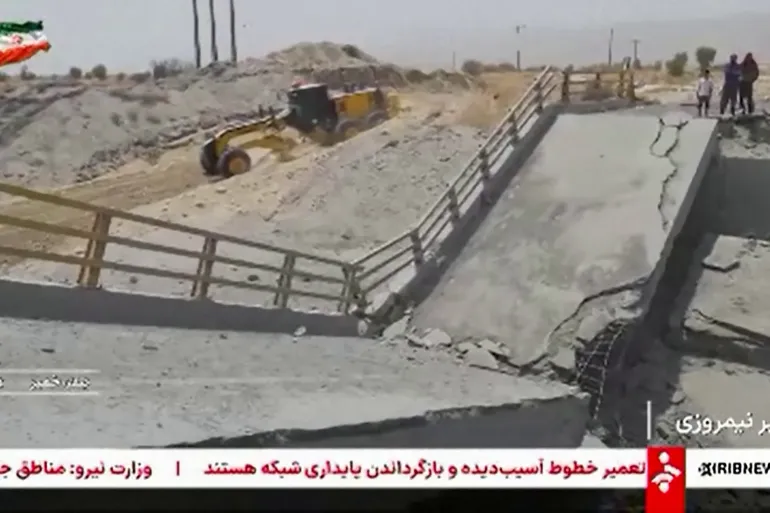
A seventh consecutive night of attacks by United States forces on targets across Iran has left 10,000 people without water after a desalination plant was hit, with Iran retaliating by launching another wave of drones and missiles at US-allied Gulf states.
Hamzeh Pour, chief executive of the Hormozgan Water and Wastewater Company, was quoted by the Tasnim news agency on Saturday as saying that a seawater pumping station and a power transformer at the Bunji desalination plant in Jask in southern Iran were “completely destroyed”, depriving 20 villages of water.
Iran’s retaliation also targeted civilian infrastructure, a war crime under international humanitarian law.
In the early hours of Saturday, Kuwait announced the closure of its airspace and said two power and water desalination plants were hit by Iranian attacks. Several Kuwaiti firefighters were wounded while responding to a fire sparked by the strikes, the country’s firefighting force said.
Air raid sirens also sounded repeatedly in Bahrain, where authorities urged residents to seek shelter.
In Jordan, authorities said they intercepted 10 Iranian ballistic missiles.
Iran’s Islamic Revolutionary Guard Corps (IRGC) said its naval forces had targeted a US military fuel pier at Kuwait’s al-Ahmadi port and a US warplane assembly site at Bahrain’s Sheikh Isa Air Base. The IRGC also said it attacked a US base in Azraq in Jordan, claiming to have destroyed two American fighter jets.
The Iranian attacks came after the US military’s Central Command, or CENTCOM, announced it had carried another wave of overnight strikes targeting “surveillance sites, military logistics infrastructure, underground weapons storage, and maritime capabilities” in Iran.
[Aljazeera]
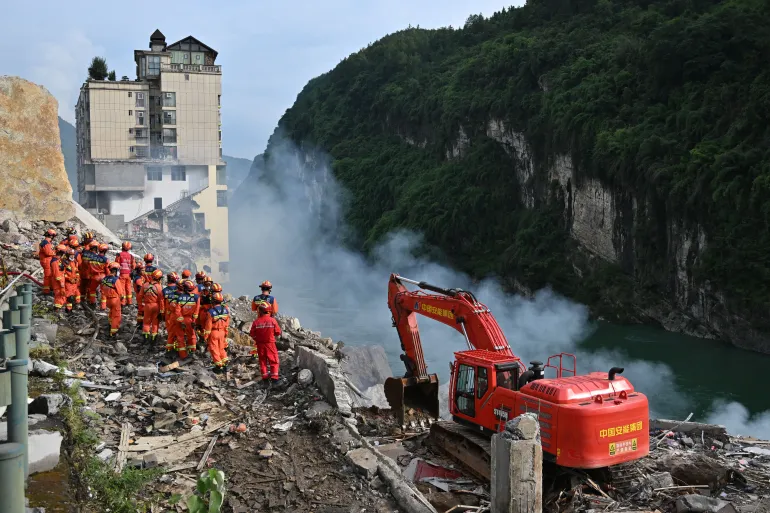
Rescuers are rushing to locate dozens of people missing in the southwestern Chinese city of Chongqing, after a deadly landslide buried homes in the area, according to Chinese authorities.
The landslide took place around 9:10am (01:10 GMT) on Friday in Chongqing’s Pengshui county, killing eight people, leaving 34 unaccounted for and displacing more than 1,100, reported state media.
Footage shared by China’s CCTV broadcaster showed a huge buildup of rocks and dirt covering part of a residential and commercial street at the bottom of a mountain in the region.
Ten people have been rescued from the debris, including two who are seriously injured, reported China’s state-run Xinhua news agency.
Water, electricity and gas supplies were cut off within a one-kilometre (0.6-mile) radius of the landslide to prevent further disruptions. More than 800 rescuers have gone to the site, reported CCTV.

Authorities said they sent more than 8,000 disaster relief items to Chongqing, including tents, folding beds and family emergency kits.
Pengshui county is located in the southeast part of Chongqing, bordering the provinces of Hubei and Guizhou.
The area where the landslide happened is known for “unpredictable” steep terrain, a local official told a news conference, adding that dangerous rocks remain along the sides of the cliff.
The government has allocated 50 million yuan ($7.36m) in natural disaster relief funds to support the rescue and relief operations and to provide assistance to affected residents, the Ministry of Finance and the Ministry of Emergency Management said.
[Aljazeera]

A few showers will occur in the Western, Sabaragamuwa and North-western provinces and in Kandy, Nuwara-Eliya, Galle and Matara districts

Customs asked to resume probe or face legal action

Outgoing Chinese Ambassador Qi Zhenhong bids farewell to Mahanayake Theras

Move to extend retirement age of top judges: BASL asks govt. to stop process pending meaningful consultations

Govt. mum on identities of JVP founder’s wife and children

Three high-profile alleged suicides shaping key investigations

‘Dates have the highest sugar content to fight Coronavirus’

Sunday Island 27 December – Headlines

#SundayIsland 17th December – Headlines

Sunday Island – 28th March

Sunday Island Headlines – 21 March

Sunday Island – 21st February – Headlines
-
 Business3 days ago
‘Giving up was never an option’: The fisherman who fought back after losing millions in SL
-

 Features3 days ago
Two memorable excerpts from a former SLAF commander’s memoir
-

 Latest News4 days ago
Davis cup Asia/Oceania Group IV 2026 to be held in Colombo from 20th to 25th July
-

 Features3 days ago
Erdoğan’s New Republic
-

 Life style3 days ago
Taste of the Swiss Alps comes to Colombo
-

 News4 days ago
Evidence recorded in money laundering case against Yoshitha Rajapaksa
-
 News4 days ago
Dengue outbreak gallops ahead: Infections surpasses 73,455, leaving 50 dead
-

 News5 days ago
Money laundering case against Yoshitha, fixed for pre-trial conference