
Sports
Plight of school coaches Some working as pump attendants

by Reemus Fernando
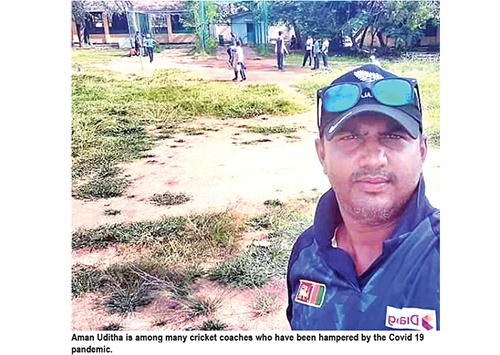
His love for the game of cricket forced Aman Uditha to take up one of the toughest coaching assignments at Vijayaba National School, Hungama (Hambantota District), a place that does not have a strong cricket culture to attract highly qualified coaches. The school which has produced a pace bowler in the Sri Lanka Under-19 team in recent times is one of the many lower division schools struggling to pay their coaches after the outbreak of the COVID-19 pandemic.
Coaches in almost all the Division III and a majority of Division II cricket playing schools and some Division I schools are paid by the School Development Societies (SDS), which largely rely on contributions from parents. Schools have found it difficult to sustain these funds due to the Covid 19 pandemic.
Many such schools have either totally stopped paying their coaches or have reduced their salaries by big margins, forcing them to look elsewhere for a living. Unlike well-established schools, those in the lower divisions depend on a single coach to train all age group teams in the school. Uditha is responsible for coaching the Under-13, 15 and 17 teams of Vijayaba National School.
Affairs in some of the premier Division I cricket playing schools too have fallen to the same level as the underprivileged schools thanks to the pandemic. Many coaches, contacted comment, lamented about the unprecedented salary cuts they had been compelled to bear with in the recent months.
Sri Lanka Schools Cricket Association with the help of Sri Lanka Cricket recently granted some concessions to coaches affected by the pandemic but it is just a short-term measure, and the coaches continue to suffer.
“I have been a cricket coach for years. I do not have experience in any other field and at this age, I cannot train myself for any other job; I am in a dilemma,” a level I coach of a Big Match playing school from the suburbs of Colombo told The Island. The coach of the premier cricket playing school has been training all age group teams (U13, 15, 17 and 19). His salary was first reduced by 25% due to the pandemic; it has been reduced by 50% during the recent months.
A group of coaches mentioned that some of their colleagues from underprivileged schools had been compelled to work at filling stations to keep home fires burning.
Meanwhile, some coaches whose contracts were terminated following the first wave of the pandemic are looking forward to securing new contracts elsewhere for the new season. But a recent Ministry of Education circular, which canceled all sports competitions in schools, has shattered their hopes.
However, a few coaches have been lucky. All coaches contracted by S. Thomas’ College Mount Lavinia continue to receive their full remuneration. The 70 plus coaching staff, training young Thomian sportsmen in 27 sports, are lucky while hundreds of their counterparts, employed by public and private schools are experiencing severe hardships.
A senior sports administrator of S. Thomas’ College told The Island: “We have paid all coaches their full salaries though we had to cancel training following Ministry of Education directives. We are paying them through the budget allocated in December,”
Uditha comes from the same district Suranga Lakmal, who was lucky to find a place in the Richmond College team before earning a place in the Sri Lanka team. Uditha found a place for his medium pace at Devananda College, Ambalangoda before taking up coaching. It is coaches like Uditha who spot talent like that of Lakmal for Sri Lanka Cricket. Sri Lanka Cricket, which is the richest sports body of the country and the Ministry of Education, should, therefore, look into the grievances of coaches and redress them.






Call it beauty, call it cruelty, but this is the reality.
This Indian T20I unit is a GOAT team. They last lost a series or tournament in August 2023. Since the start of the previous T20 World Cup, they have won seven matches for every one they have lost. To the group that won the trophy in 2024 they have added Abhishek Sharma, Tilak Varma, Varun Chakravarthy and loads of intent.
India are so good that they have pivoted twice – first from Shubman Gill to Ishan Kishan just before this tournament began, then to bring back Sanju Samson during the tournament – and the pieces have seamlessly fallen in place.
Yet they won’t be viewed as the GOAT if they don’t win in Ahmedabad on Sunday. We don’t make the rules. This is how cricket works. Anything that involves more than two teams in cricket – even all the “leagues” – are a hybrid of league and knockout.
When you do that in the most fickle format of the sport, where it is the most difficult to establish an association between process and outcome, you can end up having the cagey campaign India have had. They are so good that they only have everything to lose in this tournament.
Kipling’s two impostors are more different for India than any other team. This is not to justify a lack of scientific temperament but there’s been an element of the obsessiveness to India’s journey through the T20 World Cup: regular visits to temples, avoiding training during a lunar eclipse, possible changing of hotels for the final. There aren’t enough controllables in this format, so you start trying to control whatever you can.
On the field, India have still done enough – though not at their absolute best – to make the final. Sanju Samson has found the form of his life, Jasprit Bumrah is still being “played out” even in chases of 254, and Hardik Pandya is the closest you get to two players in one.
Still, India don’t want to be anything less than their best against an opponent whose DNA is to care a lot but play like they don’t care at all. New Zealand don’t have mystery spin, they don’t have a Bumrah like genie , but they are dangerous because they can treat the two impostors almost the same. In India, November 19 is a day of mourning; for New Zealand, whatever happens on March 8 might not dominate conversation the following week.
Like India, New Zealand have also had to pivot, calling in a 34 year old mid-tournament, giving him the new ball, having him take out two dangerous left-hand batters and then not have him do anything for the rest of the semi-final. Since 2019, no team has made more ICC semi-finals than New Zealand’s six. Only India have made more finals than their four. Their best players don’t even want their national contracts; they encourage such a healthy workspace, let them play elsewhere most of the time, but put the band together for the big time.
New Zealand will not make the mistakes England’s bowlers made against India in the semi-final. They will have researched every batter and put plans in place, ready to execute. Now India could still be good enough to beat them, but they will not be fed.
Sunday will be tactical, it will be emotional, it will be full of skill and some luck, and by the end of the night, both teams will have to make peace with whatever impostor they draw. That is the reality of the game.
India have won every match except for the Super Eight contest against South Africa, after which they won the must-win games against Zimbabwe and West Indies, and then beat England in a high-scoring thriller in the semi-final.
New Zealand only barely made it to the semi-final, losing comprehensively to South Africa in the first round and to England in the Super Eight, but then they thrashed the unbeaten South Africans in the semi-final.
He didn’t end up as the Player of the Match in either of them, but Jasprit Bumrah repeated in the semi-final the work he did in the final two years ago. England had brought a chase of 254 down to 69 off the last five, but Bumrah bowled two of those overs for just 14 runs. If he can again put in a performance where New Zealand only take what is on offer, India should win.
Daryl Mitchell has had a quiet tournament. He hardly got to bat in the group stage and then had an ordinary Super Eight round on slower pitches in Sri Lanka. Having steered New Zealand to their first ODI series win in India in January, Mitchell will be vital to his team because he has scored at two a ball against Bumrah in internationals, and 10.18 per over overall. If he can impose on Bumrah a normal day at the T20 office, he will have gone a long way to helping New Zealand’s cause.
Abhishek will not be touched, but India have a Varun Chakravarthy problem. Eight of his leakiest spells in T20Is have come in the last two and a half months. Current form has higher weightage in T20 cricket than in other formats and Varun’s current form is 11.6 per over and four wickets since the start of the Super Eight round. The three alternatives are Kuldeep Yadav, Mohammed Siraj and Washington Sundar in that order of likelihood because India won’t want to diminish their striking ability.
India (probable): Abhishek Sharma, Sanju Samson (wk), Ishan Kishan, Tilak Varma, Suryakumar Yadav (capt), Hardik Pandya, Shivam Dube, Axar Patel, Arshdeep Singh, Jasprit Bumrah, Varun Chakravarthy/Kuldeep Yadav/Mohammed Siraj
For New Zealand, the question is more about structure. They made do against South Africa with just three specialist bowlers, and James Neesham carded at No. 9. With the ball, Neesham went for 42 in three overs, and New Zealand were rescued by Rachin Ravindra’s four overs for 29 runs and two wickets, including that of David Miller, who mishit a slot ball and still got caught only just inside the boundary. You won’t always have such luck. Can New Zealand afford to play with the same structure against India? Jacob Duffy is a choice. Ish Sodhi might not be because the pitch in Ahmedabad is more suited to hit-the-deck bowlers than spinners.
New Zealand (probable): Tim Seifert (wk), Finn Allen, Rachin Ravindra, Glenn Phillips, Mark Chapman, Daryl Mitchell, Mitchell Santner (capt), Cole McConchie, Jimmy Neesham/Jacob Duffy, Matt Henry, Lockie Ferguson

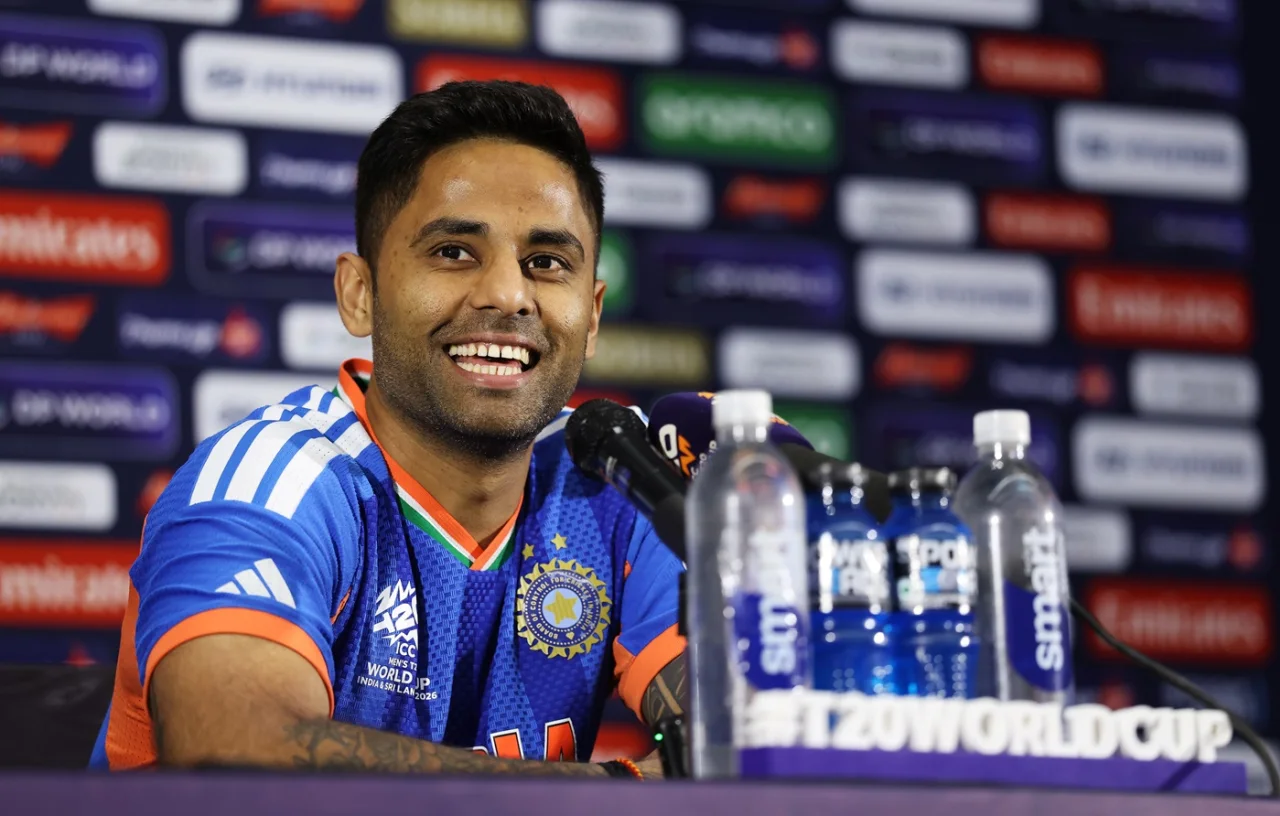
Mitchell Santner addresses the media before the T20 World Cup final [Cricinfo]
[Cricinfo]
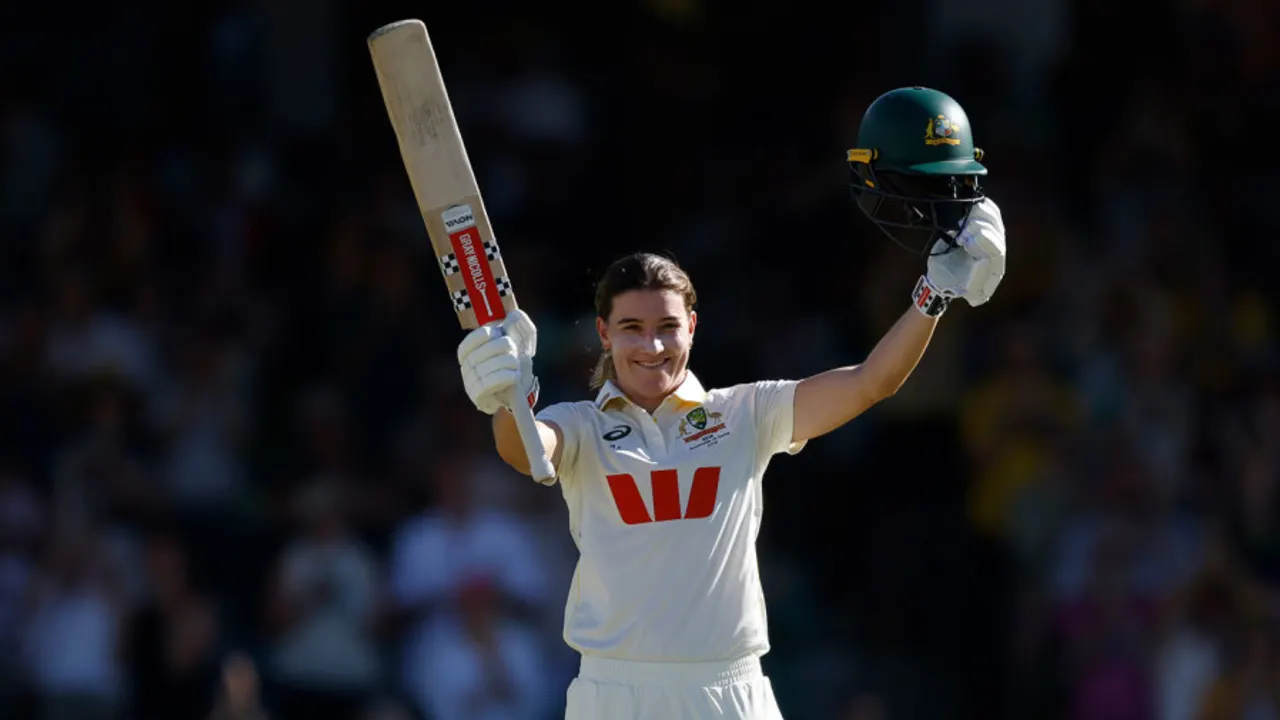
Annabel Sutherland continued to produce heroics on the WACA ground after an imperious century was followed by superb bowling under lights late on day two as Australia moved to the brink of a crushing victory over India in the pink-ball Test.
On what has been a challenging surface, Sutherland made batting look like a breeze with her commanding 129 off 171 balls in Australia’s first innings grinding down India’s attack amid sweltering heat hitting 40 degrees Celsius.
It was her third straight Test ton and continued her affection for the WACA ground having memorably made 210 against South Africa two years ago. Sutherland’s average in Test cricket is now an astonishing 89.37 after 10 innings and her four tons are the most by an Australian.
Australia’s first innings was dominated by Sutherland and Ellyse Perry, with the pair combining for a 128-run fourth-wicket partnership. Perry, playing as a specialist batter after recovering from a quad strain, cracked 76 off 116 balls and in the process became Australia’s all time leading run scorer in Test cricket after passing Karen Rolton, who made 1002 runs from 1995-2009.
She backed up in the final session with the wickets of Jemimah Rodrigues and captain Harmanpreet Kaur as India capitulated in their second innings. There was the slim chance of another two-day Test in this Australian season but debutant Pratika Rawal and Sneh Rana held firm in the last 25 minutes.
Trailing by 125 runs, India’s second innings started disastrously when Darcie Brown claimed a wicket on the second delivery with Smriti Mandhana bowled off the inside edge in shades of her first innings dismissal.
Left-armer Lucy Hamilton continued her outstanding debut when she nicked off Shafali Verma before Rodrigues came out blazing. But she had something of a brain fade after unfurling the ramp shot to disastrous results before Harmpanpreet was caught at third slip.
Hamilton was keen to wrap things up after dismissing Deepti Sharma – a superb set-up with a bouncer followed by a fuller delivery which zipped between bat and pad – and Richa Ghosh within the space of three deliveries.
Even though India hung on to reach stumps, Australia are almost certain to claim victory and a decisive 12-4 triumph in the multi-format series.
There remains an unknown whether skipper Alyssa Healy will bat again in the final match of her legendary international career.
Australia resumed at 96 for 3 at the start of the day’s play and were ominously poised after Sutherland and Perry defied India’s surge under lights on the previous night.
They relished the easier batting conditions under the baking sun as India quickly wilted with their new pace attack unable to conjure the type of rampant swing that troubled the Australia batters late on day one.
Harmanpreet desperately rang the changes, with six bowlers used in the opening hour and she resorted to spin which only accounted for one of the 13 wickets on the first day.
Perry reached a 70-ball half-century in style when she smashed Rana over the deep midwicket boundary for just the second six of her Test career.
She also showed deft touch to pierce gaps in the field and keep a flagging India side feeling flustered. Sutherland also reached her half-century in 70 balls and she was in fine touch with arguably her best stroke of the session being a glorious straight drive that rocketed to the boundary.
It appeared that the pair were in for the very long haul until Perry out of nowhere was hit on the pads by Deepti after playing back to a delivery that didn’t bounce as much as she expected.
India’s catching has been mostly outstanding – the one facet where they’ve bettered their counterparts so far in this match – other than Rana dropping a straightforward chance at slip on Beth Mooney’s second ball.
Mooney was scratchy but still provided support for Sutherland in an important 56-run partnership that soared Australia into a first innings lead. Sutherland went into the tea break unbeaten on 93 and she didn’t have long to wait to reach her milestone although it was reached in ungainly fashion after a top-edge flew to the boundary.
She raised her bat to all parts of the terraces, where her father James Sutherland – the former Cricket Australia chief executive – was beaming with pride just like he did last month at the same ground when Will Sutherland scored a century for Victoria in the Sheffield Shield.
Australia had moved into a commanding position with India looking on the brink of spiralling until they unexpectedly hit back with four quick wickets. Mooney was brilliantly caught at short extra cover by Rodrigues, who snared her third brilliant catch of the innings.
Debutant Kranti Gaud had a tougher time of it in the day conditions after impressing under lights, but her persistence was rewarded when she bowled Ashleigh Gardner.
Sutherland had made batting look far easier than everyone else, but her brilliant knock finally ended when she wearily holed out as Australia were in danger of letting their stranglehold slip.
But Hamilton and Alana King added an important 34-run partnership for the ninth wicket as Australia stretched their innings into the final session. Hamilton showed why she is rated a potential allrounder after making 23 off 54 balls – the third highest score of the innings.
They batted long enough to ensure that India’s batters had to face the music under the lights.
Brief scores:
India Women 198 in 62.4 overs and 105 for 6 in 29 overs (Pratika Rawal 43*; Lucy Hamilton 3-32, Annabel Sutherland 2-15) trail Australia Women 323 in 90.4 overs (Annabel Sutherland 129, Ellyse Perry 76; Sayali Satghare 4-50, Kranti Gaud 2-72. Deepti Sharma 2-67) by 20 runs
[Cricinfo]


Defending champions India produced a splendid show in the World Cup semi-final in Bombay, winning a high-scoring thriller where the margins were wafer thin. England are an equally formidable side and, in the end, it proved to be a contest decided by fine details. Or, as West Indian great Clive Lloyd famously put it, catches win matches.
England captain Harry Brook grassed a sitter at mid-off early in the innings of Sanju Samson and the Indian wicketkeeper-batter made the former champions pay dearly. On the other hand, Axar Patel plucked two blinders in the deep, moments that turned the tide and snatched the momentum away from England just when they were threatening to seize control.
The spectacle had all the ingredients of a classic and, unsurprisingly, the ground was packed to the rafters. Fans queued up hours before the toss, while India’s glitterati turned the venue into something of a red-carpet affair. Bollywood celebrities rubbed shoulders with former greats of the game and the Ambani family, India’s wealthiest, were present alongside the Chief Minister of Maharashtra and several leading politicians.
With the stands awash in blue, the crowd played their part as India delivered a performance worthy of the occasion. The remarkable thing about Indian cricket is how it keeps churning out talent from what seems an endless conveyor belt. Even with stalwarts like Rohit Sharma, Virat Kohli and Ravindra Jadeja having moved on, the cupboard is far from bare.
In fact, the world’s number one ranked batter and bowler are both Indians, a reflection of the depth of their resources. Even though Abhishek Sharma and Varun Chakravarthy endured relatively quiet tournaments, India’s bench strength ensures that there is never a shortage of match-winners waiting in the wings.
For Sri Lanka, there is a lesson somewhere in this story. Our corporate sector may not have the financial muscle of businesses that own Indian Premier League franchises, but there are certainly passionate cricket lovers running large companies who could lend their weight to the Lanka Premier League when it is relaunched. The problem in the past has been expecting profits before the product had time to grow, a flawed business model if ever there was one.
If Sri Lanka are serious about becoming a force to be reckoned with T20 cricket again, a proper relaunch and rebranding of the LPL is not just desirable but essential.
There was also a thought spared for Jacob Bethell after his magnificent hundred went in vain as England fell just short. The young man showed maturity beyond his years. Even after reaching three figures, his celebrations were muted, he knew the job was only half done.
That is something our players could learn from. Too often we see extravagant celebrations after milestones, with batters launching into choreographed routines and bowlers turning into Robin Hoods after a five-wicket haul.
Bethell, though, looks the real deal. Born in the Caribbean and tipped by many as the next big thing in world cricket, he has already offered a glimpse of what the future might hold. If this innings was anything to go by, the youngster is here to stay.
Rex Clementine
in Ahmedabad

UK to charter flight for British nationals out of Dubai

Heavy rains and flooding kills at least 23 in Nairobi

Rapper-politician Balendra Shah unseats Nepal’s ex-PM as he heads for victory

Triumph and disaster: India, New Zealand and a trophy for one

Sutherland’s sublime century and Hamilton’s night-time burst flatten India

Trump says US does not need UK aircraft carriers for Iran war

‘Dates have the highest sugar content to fight Coronavirus’

Sunday Island 27 December – Headlines

#SundayIsland 17th December – Headlines

Sunday Island – 28th March

Sunday Island Headlines – 21 March

Sunday Island – 21st February – Headlines
-

 Features6 days ago
Brilliant Navy officer no more
-

 News2 days ago
University of Wolverhampton confirms Ranil was officially invited
-

 Opinion6 days ago
Sri Lanka – world’s worst facilities for cricket fans
-

 News3 days ago
Legal experts decry move to demolish STC dining hall
-

 Features6 days ago
A life in colour and song: Rajika Gamage’s new bird guide captures Sri Lanka’s avian soul
-

 News2 days ago
Female lawyer given 12 years RI for preparing forged deeds for Borella land
-

 Business4 days ago
Cabinet nod for the removal of Cess tax imposed on imported good
-

 News1 day ago
Wife raises alarm over Sallay’s detention under PTA