
Features
Situlpauwa, Veddas, building a bungalow at Thenaddi Bay on idyllic East coast

Excerpted from te authorized biography of Thilo Hoffmann by Douglas B. Ranasinghe
(Continued from last week)
Thilo continues: “The Ven. Bhikkhu Sumedha, a long-time friend who had grown up in Switzerland, spent his early hermit years as a Buddhist monk at Situlpauwa and at the top of Vedahitikanda. He later obtained higher ordination, and died in Kandy in 2006. On his occasional visits to Colombo, dana was regularly offered at our house. Situlpauwa was then a jungle-covered site with only an occasional hermit monk in residence, and wildlife roaming freely through it. Today, as a result of restoration and development, the jungle has given way to concrete, electric lights, noise and commerce.”
During his time in Sri Lanka Thilo has been dismayed to witness such change, in diverse ways, at countless holy and historical places. He adds one example: “We may perhaps record two different alterations at the famous Koneswaram Temple, on Swami Rock at Trincomalee. The entire temple has been ‘restored’ and renovated, covering under cement and plaster and layers of glossy new paint all traces of its ancient history.
“It is also the site of an act of vandalism. There on a stone pillar was an inscription in high relief recording the death of a young Dutch woman who in the 18th century threw herself over the precipice after watching her lover’s ship sail away. This was chiselled away in the 1980s, a testimony to the prevalent politico-religious chauvinism.”
Veddas
In 1950 Thilo and Mae visited the Pollebedda Veddas in the company of Dr R. L. Spittel. After Thilo finished work at the office on Friday, they drove through the night to Maha Oya, via Haputale, Badulla and Bibile. In the early morning Spittel took them to Pollebedda, deep in the dry zone jungle, where a small and reasonably typical Vedda community was living.
Dr Spittel pointed out two younger men whom he described as “good throwbacks” and who, though of mixed blood, showed external characteristics of the Vedda race. He explained that the pure Veddas had ceased to exist some 20 years earlier as by then they had all been absorbed in the Sinhalese and Tamil populations. Thilo adds that other authorities with first-hand knowledge of the Veddas agree with this view. A dance was performed, and the visitors observed the families in their daily activties. Most had huts to live in, and were cultivating. There was one tent-like hut covered with pieces of tree bark. Rats were an item in the diet.
Twenty-six years later, in July 1976, the Hoffmanns again visited Pollebedda, which is about 15 km south of Maha Oya along the Rambukkan Oya. They camped out in a vain bid to see a rare bird, the broad-billed roller, which had been reported there. The place had changed beyond recognition, the thick forest had been cleared, and chenas had turned it into a ‘scrub desert’. A school building and teachers’ quarters had been put up. There was no trace of the Vedda settlement. Thilo explains:
“Today’s `show-Veddas’ of Dambana (so styled by the Seligmanns even a century ago), led by the offspring of a southern Sinhalese, masquerade as true Veddas for a gullible public. There is the strong impression that an outside ‘guru’ is instructing them in some of the old Vedda facts and customs obtained from the literature, e.g. the present name of the ‘chief, or the offering of bees’ honey to the sacred Tooth Relic. If you discount the costume and appendages (axe, bow and arrow) none of the Dambana villagers even look like Veddas.
Well before the Maduru Oya National Park had been declared, large areas in it north of Dambana and Maha Oya had been cleared of jungle and settled. Village infrastructure had been established, schools and ancillary buildings constructed. ‘Vedda life’ had been greatly restricted and consisted chiefly of poaching (not with bow and arrow) as in all villages in jungle areas.
When the Park was declared all the people living within its boundaries and in the bed of the new reservoir were given alternative land and habitations in newly developed areas. The people of Dambana, although the village itself is not in the Park, were offered irrigable land and houses below the nearby Ratkinda reservoir.
All accepted and moved except the fake Vedda chief Tisahamy, a Sinhalese who had shrewdly adopted the name of Dr Spittel’s hero, and his family. He successfully defied law and authority, lived in a large house in the midst of a banana plantation just inside the National Park boundary, and, with his young offspring play-acted the Vedda for assorted local and foreign tourists. Supported by sponsors and gurus, he even obtained an order from the District Court which forced the Wildlife Department to demolish the gate they had put up at the boundary of the Park.
Time went by and the new Tisahamy died. Recent history was quickly forgotten, and with the help of journalists, gullible politicians, foreign and local anthropologists the Vedda race was miraculously resuscitated. The settlers from Ratkinda now returned to Dambana, as the life of a show-Vedda had become full of promise.
Soon the motley crowd became even the internationally acknowledged representatives of the ‘indigenous people’ of Sri Lanka, and their leaders put in an expenses-paid appearance at the Permanent Forum of Indigenous People of the UN in Geneva, Switzerland. Local intellectuals and politicians recognized this set-up early as a god-sent opportunity to gain status and publicity. The highest authorities were persuaded to accord the “Veddas” privileges not given to any others, such as free movement and hunting, with guns, within the National Park.
This is the story of a scrappy bunch of villagers who by ruse and the cunning ‘PR-ship’ of their leader and his advisors became the `indigenous people’ of Sri Lanka, and as such are being cuddled by the State, the tourists and some of the island’s elite. Others have joined the bandwagon and, true to form, new demands are being presented.
If these, or other, villagers want to re-enact Vedda customs and habits in order to generate attention and income for themselves then that is their business. But they cannot expect nor be given special rights and privileges under the laws of the country.
The East
Few today are aware that the southern part of the Eastern Province, including Batticaloa, was virtually cut off from the rest of the country until the mid 20th century. At the time of Thilo’s first visits the motorable road ended at Polonnaruwa. Then, the railway bridges at Manampitiya and Valaichchenai (which had been opened in 1928) were converted to dual rail and road use, and connecting roads built, which allowed for the first time relatively easy access to that part of the East of Sri Lanka.
Before this Batticaloa could be reached from Colombo by road only via Beragala (below Haputale, at 3,500 ft, or 1,100 m a.s.1.) – Wellawaya – Pottuvil, or even more tediously via Badulla – Passara – Bibile – Eravur; and before the Second World War only by boat. To get to Batticaloa from Trincomalee ferries had to be used at seven places and the 80-mile (130 km) trip needed a full day.
Until the Second World War there had been a coastal shipping service for cargo and passengers. The vessels were named after the wives of past British Governors: Lady Manning, etc. and the line was called ‘the Lady line’. The small steamboats berthed at all coastal towns of some importance: Chilaw, Negombo, Colombo, Beruwela, Galle, Hambantota, Arugam Bay, Batticaloa, Kalkudah, Trincomalee and KKS. Until recently the remnants of the old piers could be seen at Hambantota and Kalkudah.
The East thus very much led a life of its own. It was and is distinctly different from the North. Its coconut industry – this too is not well known – was pioneered by British proprietary planters who settled there in the 19th century. The transformation of the Eastern Province began with the Gal Oya Development Project in the 1950s. Even until the end of that decade there was a change in the direction of milestones near Siyambalanduwa, because the road had been constructed starting from both ends.
The Eastern Province has a great touristic potential, but its development should be undertaken with circumspection and responsibility. Earlier attempts, especially at Kalkudah and Passikudah and to some extent at Arugam Bay and in the wider Trincomalee area, do not inspire much hope that natural and traditional assets will be suitably protected and preserved.
Thenaddi Bay
In the 1960s Thilo purchased a piece of land on the beach at Thenaddi Bay, a few miles north of Valaichchenai. For several years he had been searching for a suitable site on the East coast between Panama and Trincomalee. Then one day Mr S.V.O. Somanader of Kalkudah, who knew of his interest, drew his attention to a plot available at Kayankerni. Thilo had a look at the one-inch map, and instantly bought it without having seen it!
It proved to be a ‘dream’ location, alone in the centre of the wide bay with sandy, tree-fringed beaches and with crystal-clear blue water, except during the north-east monsoon when the sea is rough.
The tiny village of Kayankerni is a stronghold of the so-called Coast Veddas, a group of people who Thilo says are “as racially mixed as their forest-dwelling relatives, who deny any connection”. Here also is a small and simple temple in which the mysterious Kapal-Theivam (Kapalpei) ceremony is celebrated. The powerful deity is a foreigner who arrived in a ship. In the temple compound the wooden model of a ship is displayed atop a high pole.
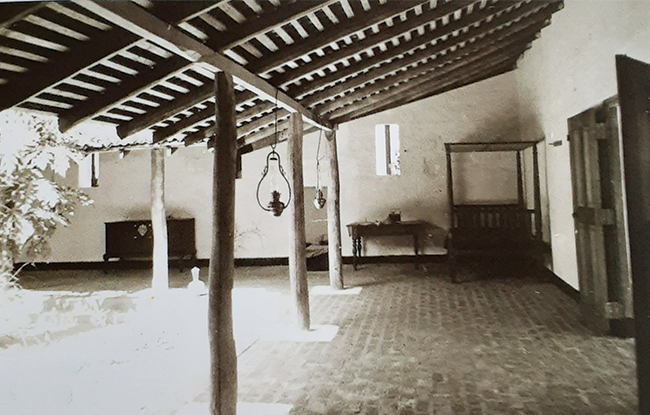
First, the basic unit of the holiday home was constructed: a fortress-like large rectangle of 15-foot high white walls, roofs sloping inward, an open inner courtyard with a well in its centre, and a wide seaward veranda. Thilo received enthusiastic and active assistance from his friend Lalith Senanayake.
In the following years, sporadically, many additions were made: bedrooms, a roof-top veranda with a spiral staircase; a guest-house, separate but connected by a covered passageway, with `meda midula’ and kitchen; a boathouse, a water tower, a garage, and eventually a two-storied rear wing.
Xavier Jobin and Stanley Gnanam, both of Baurs’ Palugaswewa Estate, with their wide experience in building, contributed greatly, also to necessary alterations and repairs; and Mr S. M. Sathiacama, then an engineer at Baurs, was very helpful. The very extensive roofs were covered with country tiles, which were frequently damaged by playful monkeys – who also “harvested” all the coconuts, well before maturity, on the 20-odd palms near the house!
Geoffrey Bawa, who was a friend of the Hoffmanns, called it “the best non-architect house I have seen”. There was no electricity. Kerosene fuelled the lamps at night and the refrigerator.For Thilo, working and sweating in the house and land was a regular and satisfying recreation. There was always something needing repair or maintenance or development. The first and often exasperating task on arrival was to start the fridge and the motor of the water pump. One of the most exhilarating moments of Thilo’s life, he recounts, was when he struck water some 10 or 12 feet down a hot and narrow cement tube. It was the first well on the property, and the main house was then built around it.
In the rear of the property Thilo developed his own little jungle from “the most thorny and impenetrable thicket in the world”. Along the beach he planted wind and salt resistant shrubs and palmyra palms.
For many years the Hoffmanns and their friends spent the most memorable weekends and holidays in this “magical” place, considered by some as the best times of their lives. There were marvellous coral reefs at the northern end of the bay, and others several miles long fringed the bay towards the open sea. These were rich in marine life, and comparable to the Maldives. There was fishing, diving, and snorkeling as well as underwater photography.
They did excursions up and down the coast to Trincomalee, the Baron’s Cap area – Toppigala, later of LTTE fame, locally called Kudumbi Kanda – and other remote inland wildlife areas. In most of these elephants were numerous. There was a fibreglass boat with outboard motor, which was later seized by the LTTE. They often went to Tamankaduwa, where elephants congregate in large numbers at times; up to more than 200 together have been observed by Thilo in that area1. Occasionally elephants even visited his property.
Thilo knew all the unique villus along the Mahaweli Ganga, which are fed and maintained by water from the river. They are part of the great biological diversity in the neglected Flood Plains and Somawathiya National Parks and adjoining protected areas; some of these form beautiful, wide landscapes, known to few. Their restoration now as effective conservation areas is a national duty.
The coast northward of the bungalow to Panichchankerni, Vakarai, Verugal, and especially from Ichchilampatai to Foul Point and Seruwawila, was little affected by any modern influences. Thinly populated – with a temporary migration during the south-west monsoon of fishermen from the west coast – it appeared as it would have centuries ago: lagoons, mangroves, a vast extent of jungle in the hinterland, rocky outcrops in forests and along the shore sticking out of the sea like monuments, coral reefs, the white beaches, venerable old trees, lonely temples and holy places.
From February to October there was almost permanent good weather, turning hot in May with the strong blowing of the warm kachan wind from the land. Blue sky, blue water, wide sandy beaches and the green fringe of ancient forest trees exemplified here the wonder of nearly untouched nature with man a small, well-fitting part of it – man and nature in balance. To add to all this, remarks Thilo, there is a wonderful smell of the flowering goda ratmal (Ixora arborea).
Seasonally the warm and calm water teems with tiny fluorescent organisms. At night the shallow waves running along the smooth shore light up like a moving illumination, and a swimming person is outlined with brightness in the clear water. Again, seasonally, the coastal jungle would be alive with swarms of fireflies sparkling at night, larger than elsewhere in the island.
At times, depending on climate and wind, the coastal water would be invaded by vast numbers of jellyfish. These beautiful, translucent creatures make swimming virtually impossible, not so much because of their sting but the unpleasant sensation of touch. Some, of course, are dangerous such as the Portuguese man-of-war which Thilo has observed on both the west and east coasts.
Also dangerous to bathers are the estuarine stingrays which seasonally bury themselves in the sand along the shallow shore and so become nearly invisible. They can inflict very painful wounds when trod upon.
In the 1970s much fuss was made about the sudden proliferation of the crown-of-thorns starfish, a beautiful blue and black inhabitant of tropical coral reefs. It was feared that the reefs would be destroyed. Panicked countermeasures were taken. The very people who were exploiting the reefs for the live fish trade were employed at great cost to spear and kill the starfish. The effect was the opposite of what was desired. The ‘blue stars’ were everywhere and visibly depleted the corals. In the early 1980s it all just died down, and in 1982 Thilo could not find a single crown-of-thorns in the extensive reefs around Thenaddi Bay.
During the north-east monsoon interesting items were washed ashore, for instance ambergris, a fatty grey substance, derived from sperm whales, and worth its weight in gold. On one occasion the part skeleton of a whale shark was left behind by the tide.
Twice, large fishing boats or rafts from Burma, across the Bay of Bengal, had been washed up on the wide beach near the bungalow. They were made of bamboo well tied together with string. A hut-like upper structure held a fireplace. Thilo found them unbelievably sturdy, intact after being storm-driven thousands of miles across the sea. Eventually both of them disintegrated on the wave-battered beach.
But, increasingly, ugly waste is also being swept ashore. Blobs of tar from boiler waste illegally discharged from passing ships, and literally millions of pieces of plastic in all colours and shapes originating from garbage on land and at sea now litter the sandy beaches.
(To be continued)


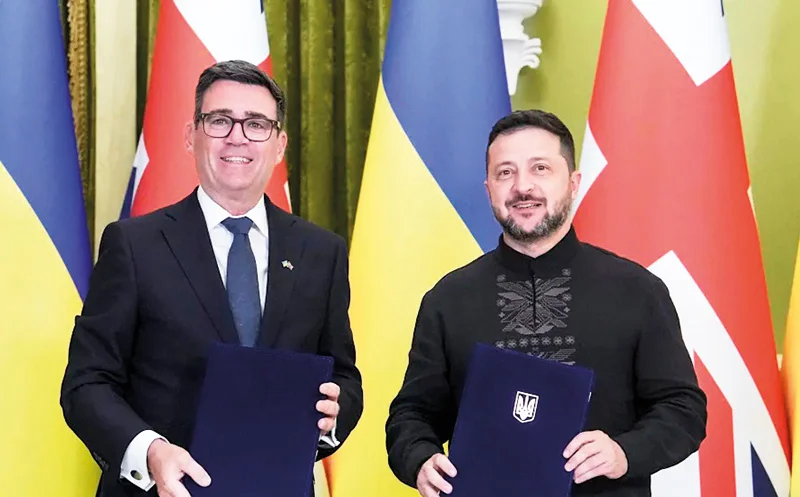
 The present offer by the UK to strengthen Ukraine’s defense capabilities in the missile technology field in particular comes as ‘a stitch in time’ and the initiative is also likely to be appreciated considerably by democratic opinion world wide for the possible morale-boosting effect it would have on Ukraine. Besides continuous arms support, the conviction that the world’s frontline democracies are behind it would prove a huge plus in Ukraine’s eyes in its grinding fightback against the Russian invasion.
While continued US support for Ukraine could not be considered ‘a given’ any more, British Prime Minister Andy Burnham’s words during a recent visit to Kyiv that the UK would stand by Ukraine ‘for as long as it takes’ is the kind of assurance that Ukraine needs at present. For, the conflict in Ukraine is essentially a war of liberation conducted by the latter against an invader and deeply at issue here is the upholding of International Law and its foundational concepts, such as national sovereignty and a nation’s right to political self-determination. The world of democracy is of the firm view that the latter ideals cannot be compromised, come what may.
The UK has its work cut out in this connection. It would find it difficult to convince the Trump administration that it should staunchly stand by Ukraine but it could campaign vigorously with the rest of the West and the EU fold in particular to unflaggingly support the embattled and over-run country.
Ukraine has shown an impressive adeptness in using drone technology in particular against her enemy and has even manufactured her own hardware in this respect but using the relevant blueprints handed over by the UK for the manufacture of more sophisticated cruise missiles, for instance, may prove financially difficult, going forward. It is left to be seen whether the UK and the rest of the West who are with Ukraine will continue to be with her, considering their own rising financial constraints.
The latter impediments could only multiply in the future. Oil, gas and energy prices are on the rise and the latter costs are glaringly reflected in kitchens and meal tables the world over. As we go along consumer discontent would steadily intensify and governments, East and West, would need to figure out with considerable rigour and foresight how such disaffection could be ably managed. Failing which, in most democratic societies, the chances are that publics would be out on the streets demanding that their grievances be redressed forthwith.
These rising concerns are reflected in a recent move by some EU governments to consider imposing what is described as ‘a windfall tax’ on the profits specified major oil companies operating within their shores have made in the wake of the US-Israel war on Iran. The rationale apparently is to use such tax earnings to cushion the rising cost of living of their publics and bolster the respective countries’ social expenditure.
In a recent letter to the president of the EU Council the EU governments referred to said, among other things, while drawing attention to the ‘discontent that is growing over the rising cost of living’: ‘A common approach’ is needed that ‘ensures those who profit from the crisis contribute their share to reducing the burden on the general population.’ Meanwhile, Oxfam with reference to the above development is on record as calling for a ‘permanent windfall tax of at least 50% on profits exceeding a 10% return on investment.’
Such are the rising economic pressures on the majority of Western governments. The question to be posed is how consistent they would be in their assistance to Ukraine if they decide consensually to stand by her. The soaring cost of living in the West compels the conclusion that there could be no guarantee that Western assistance to Ukraine, particularly in the defense and security fields, would be of a longstanding kind.
Of particular concern would be the fact that the weapons systems on offer from the UK to Ukraine could be increasingly costly to manufacture going forward. Besides they would need to be manufactured and put into action without delay.
However, these considerations should in no way deflect Ukraine’s supporters from the principled policy stance of defending her to the extent possible. Because at issue is the defense of International Law and the democratic system of government from their enemies; fascism and authoritarian rule.
While during World Wars 1 and 2 the US was with the major democracies of the West, this time around with regard to Ukraine, the US has chosen to be at cross-purposes with them. For instance, in relation to tariff matters and defense expenditure, in the NATO context, the US is pursuing a hard line which puts it at polar opposites with the West. Thus it is no longer possible to talk unreservedly of a ‘Western democratic alliance’. Put plainly, the cause of democratic development has been weakened.
A measure of relief for the supporters of Ukraine in the West could come by way of the upcoming mid-term polls in the US. If the Democratic Party fares well in them the pressure would be on the Trump administration to defer to opposition opinion at home, accommodate the best interests of Ukraine in its West European policy and perhaps even work towards a diplomatic solution to the Ukraine crisis in cooperation with Russia. Accordingly, the Democratic Party would need to put the Trump administration on the defensive, so to speak.
Until such time Ukraine’s Western supporters have no choice but to remain committed to it, ensure its steadfast defense against the invasion and work judiciously towards keeping the economic pressures at home in check.
Interestingly, at the present juncture in international politics the US could be said to be more weak than strong. For example, it has to some extent been militarily humbled by Iran; so much so it is resorting to economic means to keep Iran in check.
In keeping with this strategy, the US has launched ‘a new big wave of anti-Iran economic sanctions’ at the time of writing, aimed at cutting Iran away from all its major income sources. Some of these relate to digital assets, technology, gold, aviation and shipping. The hoped for result is the complete severance of Iran from the US dollar system.
However, while the UK and EU have no choice but to adhere to their policy of backing Ukraine, going forward they would need to dialogue more closely with the US and ensure that it cooperates with them on outstanding questions, such as Ukraine and the strengthening of democracy. The well being of the world is served when the latter aim is pursued.

OPA 39th Annual Conference calls for Sri Lanka to move Beyond Recovery towards Sustainable Transformation
The Orgnisation of Professional Associations (OPA) successfully concluded its 39th Annual Conference, held recently at the Cinnamon Grand Colombo, under the theme “Envisioning Sri Lanka: Beyond Recovery”.
Held under the patronage of Jayantha Gallehewa, President of the OPA, with the leadership and guidance of Tisara De Silva, President-Elect and Chairman of the 39th Annual Conference, the Conference brought together leading professionals, academics, business leaders and representatives of the public and private sectors to deliberate on Sri Lanka’s next phase of national development.
The Inaugural Session, on August 2026, was graced by Prime Minister Dr. Harini Amarasuriya, as the Chief Guest; Andrew Patrick, British High Commissioner to Sri Lanka, as the Guest of Honour; and Murtaza Jafferjee, Chairman of the Advocata Institute, Sri Lanka, as the Keynote Speaker.
In her address, Prime Minister Dr. Harini Amarasuriya emphasised that overcoming the economic crisis alone should not be Sri Lanka’s ultimate objective, stressing that recovery must serve as the foundation for a broader economic and institutional transformation necessary for sustainable national progress. Reflecting on the difficult period experienced by the country, the Prime Minister noted that Sri Lanka had faced significant economic, social and institutional challenges, which had weakened public confidence and created uncertainty about the country’s future.
She stressed that “recovery only provides the foundation” and that Sri Lanka can move forward sustainably only by using that foundation to bring about meaningful transformation.
The Prime Minister observed that the theme of the OPA’s 39th Annual Conference, “Envisioning Sri Lanka: Beyond Recovery,” aptly encapsulated these national aspirations. She emphasised that Sri Lanka’s objective should not merely be to return to the conditions that existed before the crisis, but to forge a stronger national foundation characterised by robust institutions, a resilient economy, high-quality public services and an enabling environment in which every citizen has the opportunity to thrive.
She further underscored that Sri Lanka’s future development cannot be secured through economic growth and physical development alone. She emphasised that the effective mobilisation of the country’s knowledge, skills and professional expertise, is equally essential to achieving sustainable and inclusive national progress
The Technical Sessions held on 12 August 2026 brought together 19 distinguished experts and professionals representing academia, industry, banking and finance, public health, technology, management and business leadership. Their diverse expertise provided a multidisciplinary platform to examine the critical challenges, emerging opportunities and strategic choices that will shape Sri Lanka’s next phase of development, with particular emphasis on economic transformation, institutional strengthening, digitalisation, private-sector growth, human capital and sustainable development.
The deliberations were structured around four principal sub-themes: “Resilient Recovery and Sustainable Economic Development”; “Future Readiness: Innovation & Transformation”; “Policy for Impact: Advancing Equity, Sustainable Living, and National Well-Being”; and “Leadership, Governance and National Responsibility.”
Across these thematic areas, the sessions explored the structural reforms, institutional requirements and policy choices necessary to move Sri Lanka beyond economic stabilisation towards a more productive, competitive, resilient and inclusive economy. The discussions brought together diverse professional perspectives, enabling participants to examine national priorities through economic, technological, industrial, financial, social and governance lenses.
Particular emphasis was placed on the need to move beyond the diagnosis of problems towards pragmatic, evidence-based and implementable solutions. The deliberations recognised that sustainable national progress requires not only sound policies, but also effective institutions, professional competence, innovation, responsible leadership and the capacity to translate policy into tangible outcomes.
The sessions further underscored the importance of collaboration across sectors, recognising that Sri Lanka’s complex development challenges cannot be addressed in isolation. Stronger engagement among Government, private sector, professional associations, academia and civil society was identified as essential to fostering a coherent national response and ensuring that professional knowledge and expertise are effectively translated into policy and action.
Collectively, the Technical Sessions provided a substantive platform for knowledge exchange, critical reflection and forward-looking dialogue, reinforcing the OPA’s commitment to bringing the country’s professional expertise to bear on the task of building a resilient, innovative, equitable and prosperous Sri Lanka.
The OPA expressed its sincere appreciation to Prime Minister Dr. Harini Amarasuriya, the Chief Guest; Andrew Patrick, British High Commissioner to Sri Lanka and Guest of Honour; and Murtaza Jafferjee, Chairman of the Advocata Institute, Sri Lanka and Keynote Speaker, for their distinguished contributions to the Conference.
Much of what the 39th Annual Conference achieved would not have been possible without the leadership, commitment and generous contributions of Jayantha Gallehewa, President of the OPA; Tisara De Silva, President-Elect and Chairman of the 39th Annual Conference; Eng. Ravi Rupasinghe, General Secretary; Dharshana Wijemanne, Treasurer; Bhanu Wijayaratne, Convener & the Chairman of the Session Planning Committee of the 39th Annual Conference Committee, Past Presidents and Office Bearers; Presidents and representatives of Member Associations; members of the Executive Councils and General Forum; and the distinguished Session Chairmen, Resource Persons and professionals who shared their time, expertise and insights in pursuit of the Conference’s shared vision. The OPA remains immensely grateful to all those whose collective contributions enriched the 39th Annual Conference and strengthened its role as a meaningful platform for professional exchange, informed dialogue and national reflection.

 For Sri Lankans living 14,000 kilometres from home, the sound of home has never felt closer — and that’s thanks to one man and his band.
Since stepping into the spotlight, Gamini Hemalal and the Ceymphony Band have turned into the heartbeat of the Sri Lankan community in Toronto.
Their mission is simple: bring the music, bring the memories, bring the people together. And it’s working.
What turned out to be the talk-of-the-town was their intimate musical evening with Sri Lanka’s legendary crooner Sohan Weerasinghe.

Sohan Weerasinghe: Had
everyone on their feet at the
Angus Glen Golf Club, in
Toronto, Canada
It was a ‘full house’ long before the big date. Tickets vanished within days — demand was that overwhelming.
According to those who were there, it was a truly amazing evening. The hall was packed, the energy electric. Sohan didn’t just sing — he owned the stage.
With his velvet vocals, his charm, and that signature style, he had everyone on their feet. The ladies, especially, couldn’t get enough. No wonder they call him “The Ladies’ Man!”
One attendee summed it up perfectly:
“We had so much fun. It is truly a blessing to have our kids around us, enjoying these beautiful moments together. Thank you, Gamini Hemalal, for such a wonderful evening, with an amazing crowd and an incredible atmosphere. Your hard work and dedication truly made it a special night.
“We also need to say a big thank you to the Ceymphony Band for delivering such an outstanding performance. You all were absolutely amazing! Our entire family had a fantastic time, and we truly enjoyed every moment.

Ceymphony Band: Extremely popular in the scene in Toronto
“Wishing you all continued success. Keep up the amazing work, we can’t wait for the next.”
And the next is already on the cards: ‘Halloween Pissu Baila Party 2026,’ on Friday, 30th October, at the famous Angus Glen Golf Club.
Gamini promises a crazy night of baila, music, dancing and Halloween vibes with the Ceymphony Band. Action runs from 8:00 PM to 12:00 midnight, with plenty of prizes to be won.

Gamini Hemalal: Amazing work for the Sri Lankan community,
in Toronto, Canada
Gamini is also putting together a special event, connected with the 2027 Avurudu celebrations — ‘Avurudu Musical Show 2027,’ a uniquely styled musical Avurudu celebration … Ceymphony Band style.
It’s scheduled to be held on Saturday, 10th April, 2027, also at the Angus Glen Golf Club.
Through music, Gamini Hemalal and Ceymphony are doing what diaspora bands do best — they’re shrinking the distance between two worlds.
One baila beat at a time, one full house at a time, they’re making sure that even in Canada, Sri Lankans feel like home.
Yes, there is plenty of action, indeed, for the Sri Lankan community in Toronto, Canada.

Showers above 50 mm are likely in the Western, Sabaragamuwa and North-western provinces and in Kandy, Nuwara-Eliya, Galle and Matara districts

Patali alleges NPP conspiring to put off elections indefinitely

August 15 Super Dvora tragedy: Search continues for missing officer’s body

Tripartite MoU to expand free cardiothoracic surgeries at KDU Hospital

Jaffna to mark Int’l Day of the Disappeared

Unfolding El Niño and burning issues

‘Dates have the highest sugar content to fight Coronavirus’

Sunday Island 27 December – Headlines

#SundayIsland 17th December – Headlines

Sunday Island – 28th March

Sunday Island Headlines – 21 March

Sunday Island – 21st February – Headlines
-
 News6 days ago
Country’s first woman Surveyor General appointed
-

 Business5 days ago
SriLankan Airlines makes ShakthiSAT Mission possible for talented Sri Lankan student
-
 Features6 days ago
Medical education in Sri Lanka: Then and now
-
 Latest News6 days ago
Imran Khan moved to private hospital amid deteriorating health
-

 Latest News6 days ago
Government has declared 21, 22 and 23 August 2026 as national days of mourning
-
 Features4 days ago
My secondary schooling after Royal Primary
-

 Latest News5 days ago
Tharanga edges out Chopra in 88m javelin battle
-
 News6 days ago
22A: Opp. demands all available SC judges hear petitions