
Sports
Sri Lanka leave for New Zealand without Nissanka

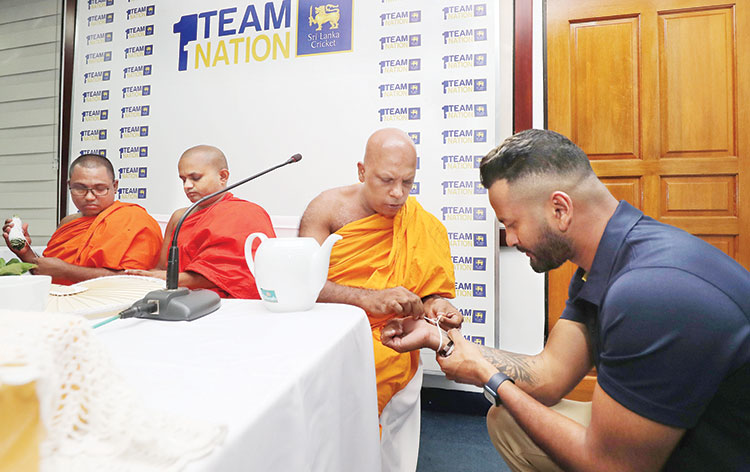
by Rex Clementine
A 17-member Sri Lankan Test squad left for New Zealand Sunday night for a six-week long multi format tour that includes two Tests, three ODIs and three T20 Internationals. There’s a lot at stake during the tour and much has been done to help the team get acclimatized to the conditions but the cold, wind and the moving ball will be quite a challenge to the Sri Lankans.
The tourists will arrive in south island of New Zealand and will be based there for ten days before the opening Test match at the Harley Oval in Christchurch. They’ll play a two day warm-up game against New Zealand XI at the same ground starting Saturday.
New Zealand is a county of two islands. The north island comprises some of its major cities such as Auckland, Wellington and Hamilton. The main city in south island is Christchurch and there are other prominent but smaller cities like Queenstown and Dunedin.
The announcement of the Test squad came via a SLC press release and there was no formal media briefing to explain the selections. Although the current selection panel has been highly praised by some they have worked with little transparency and avoided the press like the plague during their two-year tenure and have got away with too many blunders.
There was no explanation as to why opening batsman Pathum Nissanka was left out but it is learnt that the medical staff haven’t given him a clean bill of health after picking up a back injury in India last month.
Nissanka is easily the finest young talent to emerge in the last five years and has made such a huge impact in all three formats of the game. He may have pulled through for the second Test and anyway since he’s going to be part of the white ball setup, you wonder whether he’d better off in New Zealand acclimatizing to conditions than in Colombo.
Nissanka perhaps faulted by not playing the NSL four day tournament. But have you come across a cricketer with such an unblemished record since Kumar Sangakkara?
Surely, a selection panel that was willing to give the long rope to Danuska Gunathilaka allowing him more time to recover from an injury should have been more considerate about Nissanka.
Sadly, poor Nissanka doesn’t have any godfathers in cricket.
Top order batsman Nishan Madushka has got a maiden call up for the senior team after some big scores in recent times. A product of Moratu Vidyalaya, Madushka slammed a double hundred against England Lions in the first unofficial Test earlier this month in Galle and followed it up with another hundred in the second game.
A 23-year-old wicketkeeper batsman, Madushka averages over 60 in domestic cricket and has been hailed as one of the finest young batsmen in the country.
Uncapped fast bowler Milan Ratnayake is also part of the Test squad.
This is Sri Lanka’s first Test series in eight months. The tour itself is highly important for Sri Lanka. A 2-0 series win will put them on the brink of the finals of the World Test Championship while a 3-0 clean sweep in the ODIs will see them qualifying automatically for this year’s 50 over World Cup.







Sports
David Pieris Group of Companies and Golden Green Plantations vie for Abans Challenge Trophy today


MCA – ABANS PREMIER LEAGUE 2026
David Pieris Group of Companies and Golden Green Plantations will vie for the ‘Abans Challenge Trophy’ in the final of the MCA – Abans Premier League 2026 at the Thurstan College ground today.
In the league stage, David Peiris Group of Companies led by Manjula Gannile defeated DFCC Bank by 154 runs, Nawaloka Hospitals by 8 wickets and lost to Golden Green Plantations by one wicket to lead the league stage with a higher run rate. In qualifier one David Pieris Group of Companies defeated Golden Green Plantations by 55 runs to gain direct entry to the final.
Golden Green Plantations led by T M Sampath defeated Nawaloka Hospitals by 192 runs, David Pieris Group by one wicket and lost to DFCC Bank by 50 runs to take second spot in the league. Qualifier two between Golden Green Plantations and DFCC Bank which was to be played at the DHH Sports Complex was abandoned twice in succession due to rain and bad ground conditions.
David Pieris Group of Companies Team:
Manjula Gannile (C), Ron Chandraguptha, Santhush Gunathilake, Vinuka Rubasinghe, Mineth Premarathne, Asitha Wanninayake, Lahiru Samarakoon, Tharinda Nirmal, Mihiranga Nimsara. Silva, Lakshan De Silva, Dilanka Auwardt, Akila Elabodage, Mayura Dihan, Udara Bandara, Vihara Attanayake, Shehan Rathnayake
Golden Green Plantations Team:
TM Sampath ( c), Gimandu Malkam, Randika Mihiranga, Upul Hettiarachchi, Mohomad Shamaz (wk), Dhanuja Induwara, Heshan Madhushanka, Malith De silva, Vikum Sanjaya, Johan Pathirana, Kovindu Wickramasinghe, Nuwan Dineth, Liviru Senmith, Thivin Vshvika, Lineth Vithana

World-leading javelin thrower Rumesh Tharanga underlined his status as the man to beat in world athletics with another sensational performance, winning the men’s javelin at the prestigious Weltklasse meeting in Zurich with a massive 92.07 metres.
Tharanga’s best effort came in the final round and left him just 21 centimetres short of the meeting record of 92.28m, which has stood for three decades
.The 23-year-old first overcame the first round challenge from two-time world champion Anderson Peters of Grenada. Peters took the early lead with a first-round throw of 86.93m, but Tharanga responded in the second round with 88.23m to move ahead.
He then increased his advantage in the third round before producing his best effort of the night in the final round, sending the javelin soaring to 92.07m.
Peters had to settle for second with 86.93m, while Poland’s Dawid Wegner was third with 85.16m. Trinidad and Tobago’s Keshorn Walcott finished fourth with 83.02m, followed by Kenya’s Julius Yego (81.66m) and American Marc Anthony Minichello (80.38m).
The Zurich victory further strengthens Tharanga’s position at the top of the world javelin hierarchy at a crucial stage of the season. With the Wanda Diamond League Final in Brussels just a week away and the World Athletics Ultimate Championship looming, he has emerged as the athlete everyone will be watching.
Tharanga’s latest 92-metre-plus throw also provides a timely reminder of his extraordinary consistency at the highest level, as he continues his remarkable rise among the world’s elite javelin throwers. (RF)


Sometimes all you need is a little push.
The 2024 Asia Cup was a watershed for this young Sri Lanka outfit. Prior to that exhilarating climax in Dambulla , Sri Lanka’s flashes of international brilliance were almost exclusively engineered by Chamari Athapaththu. Sure, they could occasionally trade heavy blows with the world’s elite, but they lacked the collective capacity for a sustained fight. This was a queendom, one where removing Athapaththu early meant the game was as good as won.
That lopsided dynamic had been there ever since Athapaththu’s debut back in 2009. So it was impossible not to share her heartbreak when she bemoaned her team’s failure to make the T20 World Cup semi-finals earlier this year – “It’s a sadness beyond words… I could never get a chance to take my team into a semi-final of a World Cup… I think I’m a failure as a captain.”
The tragedy of that lament lay in the irony of its timing. For the first time in Athapaththu’s career, she wasn’t actually marooned by herself. The world had already been treated to a glorious glimpse of the team’s ceiling in 2024, when Harshitha Samarawickrema and Kavisha Dilhari struck the winning runs against a heavily favoured India side.
But keeping the progress going is rarely that straightforward – think less ladder and more hiking path with troughs and peaks. And it was a truth that Sri Lanka quickly learned. The euphoria of Dambulla was swept aside by a winless group stage exit at the T20 World Cup in 2024, followed by a barren 2025 devoid of series wins.
The year ended in structural upheaval as the team parted ways with head coach Rumesh Ratnayake, whose calming influence and fatherly reassurance had been foundational to their initial breakthrough.
So was it any surprise that in the last throes of an astonishing career, Athapaththu might have felt her time was up? At 36, with retirement on the not-so-distant-horizon, Athapaththu could be forgiven for thinking her last chance had come and gone.
But women’s cricket has shown in recent times that traditional career timelines, calibrated on the men’s game, might not necessarily make sense. Athapaththu has only grown stronger with age. After a quiet 2025 where she scored just 190 T20I runs at a strike rate of 113.77, she has struck 476 at 143.80 in 2026 – her best strike rate in a calendar year.
And if it was motivation that she needed, her younger colleagues are playing their part in keeping the queen locked in for as long as possible.
Imesha Dulani, 24, has had a breakthrough year, becoming the first Sri Lanka woman not named “Chamari Athapaththu” to score a T20I century, while centuries from Vishmi gunerathne, 21, and Samarawickrama, 28, led a successful chase of 275 – Sri Lanka’s third highest in ODIs – against Pakistan earlier this year, with Athapaththu watching on like the rest of us.
This was also the first year that Sri Lanka Cricket’s annual awards, had Athapaththu going without a nomination in the best women’s ODI batter category, as Samarawickrama won over the electric Nilakshika Silva. Athapaththu was still the big winner overall, though. In fact, there is now genuine competition for places at the top of the batting order, with the likes of Dulani, Gunaratne and Hasini Perera all vying for top-order berths.
The arrival of Jamie Siddons as head coach earlier this year has helped. Since he took over in March, Sri Lanka have made a noticeable shift to a more aggressive brand of cricket – something Siddons had signposted upon arrival. Whereas boundary-hitting had taken a back seat previously, Siddons has sought to bring the team’s approach in line with modern practices.
“We win in singles and twos, but we don’t score more boundaries than the opposition, and that’s why we lose against the best teams,” Siddons had said when he took over.
All this is to say that, this Sri Lanka is not the same Sri Lanka that entered the Asia Cup two years ago, nor is it even the one that won it. While they remain distinct underdogs against a formidable India, this is now a side equipped with multiple match-winners and a swelling sense of belief.
It’s also a side that is yet to touch its ceiling. There have been times when Athapaththu has not clicked and others have bailed the team out, but it’s those scintillating periods when it has all come together that this unit has shown its true fire. If they can put together more of those days, then a consecutive Asia Cup crown might well be within their reach.

Thirty-six naval personnel pass out on successful completion of Marine training

Ex-White House teleprompter operator ordered to pay $172,000 for Trump speech bets

Rescuers on high alert for signs of secondary landslides

More than 600 killed in Nepal flood as search for survivors enters fourth day

Norway mourns King Harald as Haakon VIII ascends throne

Trump announces ‘biggest oil deal in world history’ with Venezuela

‘Dates have the highest sugar content to fight Coronavirus’

Sunday Island 27 December – Headlines

#SundayIsland 17th December – Headlines

Sunday Island – 28th March

Sunday Island Headlines – 21 March

Sunday Island – 21st February – Headlines
-
 Features7 days ago
My secondary schooling after Royal Primary
-

 Features7 days ago
From the First to the 22nd: A short history of Amendment Politics and Reform Frustrations
-

 News5 days ago
Missing doctor’s body found in Mahiyanganaya
-

 Features7 days ago
How Shelton Kodikara became first Professor of International Relations
-
 Features7 days ago
How St. John’s College Shaped Panadura for 150 Years
-

 News5 days ago
Australia declines to release Finance Secy Suriyapperuma’s citizenship details
-
 News7 days ago
Ex- Atamasthanadhipathi uses Magistrate’s gate to enter court
-
 News5 days ago
22A: BASL suggests CJ recuse himself from hearing petitions