
News
22A will transcend 19A: minister

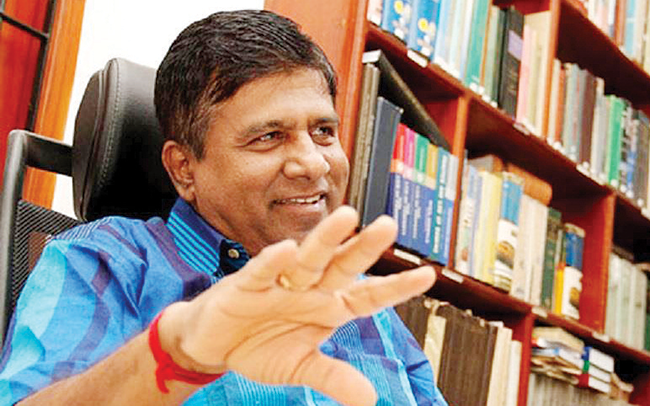
ECONOMYNEXT – Sri Lanka’s newly proposed 22nd amendment to the constitution, while being based on the 19th amendment, will transcend the latter’s democratic features while also retaining the more progressive aspects of the 20th amendment, Justice Minister Wijeyadasa Rajapakshe said.
In a press briefing held on Wednesday August 10, Rajapakshe summarised some key features of the proposed amendment.
“The basic features of the 19th amendment are all there. Mainly, reestablishing the Constitutional Assembly which has the power to approve appointments of High Court judges and higher government officials, and appoint members to Commissions,” he said.
Unlike in the 19th amendment, he said, the three members of the Constitutional Assembly from parliament would not be selected by the Prime Minister and Opposition Leader.
Instead, one member will be appointed by and of the ruling party, one by and of the main opposition, and one member from the majority appointment from and of the other parties.The three civilian members of the Constitutional Council will be appointed by the Speaker with the approval of parliament without intervention by the Prime Minister or Opposition Leader.
“As in the 19th amendment, the Police Commission, Public Service Commission, Election Commission and Bribery Commission will be independent institutions,” he said.
The Public Procurement Commission and Audit Services Commission, which were dissolved by the 20th Amendment, will be re-established by the 22nd Amendment.
“These Commissions were established because most corruption in the governing process happens during audits and procurement processes,” said Rajapakshe.
The Governor of the Central Bank of Sri Lanka (CBSL) is to be appointed by the President with the approval of the Constitutional Council.
“There was justified discourse surrounding the appointment of the Central Bank Governor,” said Rajapakshe.
“[Previous Governors] Arjuna Mahendran and Ajith Nivaard Cabraal worked in an arbitrary manner to destroy the country’s economy, and because the impact on the economy is so great, steps had to be taken [regarding the appointment of CBSL governors],” he claimed.
The 22nd Amendment aims to restrict the president’s ministerial portfolios to just the Defence Ministry via interim arrangements, while the 19th Amendment granted them authority over the Environment and Mahaweli ministries too.Rajapakshe said the Defence Ministry must remain with the President, as the country’s security comes under their responsibility according to previous Supreme Court rulings.
“Under the 22nd Amendment, until a Minster is appointed, the President must take responsibility of the respective Ministry. Additionally, in case of emergency, the President can take over a Ministry on the advice of the PM,” he said.Bills proposed in Parliament can be contested in the Supreme Court, and this can be done within 14 days of the Bill’s presentation.
“The public has the right to contest if a Bill proposed in Parliament is Constitutional or not. To enact those rights, the public must do so within seven days of presentation of the bill. We have increased that to 14 days, to give the people more opportunity to take part in the legislative process,” said Rajapakshe.Under the 22nd Amendment, Sri Lanka will establish laws to carry out the provisions of the United Nations Convention against Corruption and other international conventions regarding bribery and corruption.
“Though there was [a similar provision] in the 19th amendment, no laws were created. The Anti Corruption bill has already been created, it will be further studied in the coming weeks,” said Rajapakshe.
The Bribery and Corruption Commission Law and Declaration of Assets and Liabilities Law will also be updated, he said.


Approval of the Cabinet of Ministers has been granted at their meeting held on 19.05.2025 in order to introduce amendments to the Inland Revenue Act No. 24 of 2017 including the proposed tax revisions to enhance the tax structure paving way for state financial integrity based on revenue.
Accordingly, the revised draft bill has been prepared by the legal draftsman and clearance of the Attorney General has been received.
Therefore, the Cabinet of Ministers has granted approval for
the resolution furnished by the President in his capacity as the Minister of Finance, Policy Planning and Economic Development to publish the aforementioned draft bill in the government gazette notification and subsequently, forward the same to the Parliament for its concurrence.
The National Mineral Policy was prepared for the first time in the year 1999, and the aforementioned policy has been amended in 2023 to cover matters such as preparing an updated data system related to mineral resources, adding value to the export of minerals, encouraging mineral-related industrialists, extracting mineral resources and managing the environment sustainably, and resolving the issues related to the ownership of the land arising in extracting mineral resources.
The revised National Mineral Policy has been reupdated in line with the manifesto “A Sustainable Resource Utilization – Generation of the Highest Benefit” under the policy statement of the current government” A Thriving Nation – A Beautiful Life.”
Accordingly, the Cabinet of Ministers has approved the resolution presented by the Minister of Industries and
Entrepreneurship to implement the so-formulated “National Mineral Policy—2026.”

The Gampaha High Court has sentenced Twelve (12) individuals to death over the 2022 murder of former Polonnaruwa District Member of Parliament Amarakeerthi Athukorala and his security officer.

Heartbreak for Gurbaz and Afghanistan as South Africa win after double Super Over

Amendment of the Inland Revenue Act No. 24 of 2017

Cabinet nod for “National Mineral Policy” – 2026

Twelve sentenced to death by Gampaha High Court
Ten new buses with facilities for people with special needs

Ghosts of 2016 writ large as England, West Indies meet again

‘Dates have the highest sugar content to fight Coronavirus’

Sunday Island 27 December – Headlines

#SundayIsland 17th December – Headlines

Sunday Island – 28th March

Sunday Island Headlines – 21 March

Sunday Island – 21st February – Headlines
-

 Features4 days ago
My experience in turning around the Merchant Bank of Sri Lanka (MBSL) – Episode 3
-

 Business5 days ago
Zone24x7 enters 2026 with strong momentum, reinforcing its role as an enterprise AI and automation partner
-

 Business4 days ago
Remotely conducted Business Forum in Paris attracts reputed French companies
-

 Business4 days ago
Four runs, a thousand dreams: How a small-town school bowled its way into the record books
-

 Business4 days ago
ComBank and Hayleys Mobility redefine sustainable mobility with flexible leasing solutions
-

 Business5 days ago
HNB recognized among Top 10 Best Employers of 2025 at the EFC National Best Employer Awards
-

 Editorial7 days ago
All’s not well that ends well?
-

 Business5 days ago
GREAT 2025–2030: Sri Lanka’s Green ambition meets a grid reality check