
Features
2019 Easter Sunday Carnage: An Intelligence Perspective

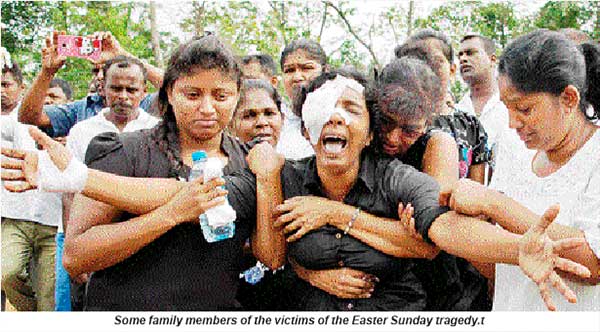
By Merril Gunaratne
Retired Senior DIG
The predicament of those in the highest echelons of defence and police bring to my mind past serious failures, not entirely dissimilar to the massacre on “Easter Sunday” in 2019. Somewhere in the mid 1980s, an LTTE group, led by their Mannar leader Victor Fulgencius ,entered the Anuradhapura sacred city and brutally mowed down a large number of Buddhist pilgrims in broad daylight. The Coordinating Officer of Anuradhapura, SSP of the area and those below them, must have been “deaf and blind”, for they could not have been oblivious to the bursts of gunfire, and the plea of countless witnesses who naturally would have looked upto them for intervention. No positive efforts were made even to stall the retreat of the terrorists after the carnage to Mannar. Nor were inquiries instituted to hold senior army and police officers accountable for their shocking inertia. Likewise in broad daylight, a terror group, the TELO, stormed Chavakachcheri police station and razed it to the ground, killing all police officers in the station. The Coordinating Officer of Palaly, when questioned by the President at the National Security Council meeting following the disaster, stated that in such situations, “each service should look after itself”. The question raised was whether the Army should have engaged in an immediate and timely intervention. Here too no inquiry was initiated to identify accountability for the shocking failures. The “PLOTE” group of Uma Maheswaran came untrammelled up to the Nikaweratiya police station, in the Kurunegala district, attacked it and caused mayhem. No inquiries were held: none were held accountable. In the 1990s, the Katunayake Air Force base was attacked by the LTTE and the JVP, separately, causing death and destruction. None were called upon to shoulder the blame. Again, in the early 90’s, the LTTE ruthlessly killed over 600 police officers in the Ampara sector, because the IGP at the time ordered the fighting officers to surrender on an assurance from political leaders that the LTTE would release them. No Commissions nor inquiries were held in this regard.
There is however an essential difference between these instances and the 2019 Easter Sunday carnage. Ample intelligence from India, backed by a plethora of evidence and reports of dangers from the National Thowheed Jamath [NTJ] stored with the State Intelligence Services [SIS], the CID, and the Terrorist investigation Division [TID], had been in the possession of SIS, well before the disaster took place. Therefore the credibility of intelligence received from India was not in doubt, as also time and space available to adopt schemes to plan arrests and flood the country with optimum security. In such a context, the failure of defence and police officers to evolve plans to nip terror in the bud, differ sharply with previous instances. In previous cases, the security forces were taken by surprise. In the case of the “Easter Sunday” carnage, intelligence was available well in advance, so that ample opportunity was available to forestall terror plans.
THE STATUS OF THE STATE INTELLIGENCE SERVICE (SIS) IN DEFENCE
An aspect that came under scrutiny was whether the Director of the SIS had informed the President about the information received from the Indian counterparts. It may not be inappropriate to deal with two matters which find relevance in seeking to understand what ideally should have been done.
First, the SIS is the premier “Intelligence” service in the country, since it is expected to collect and collate intelligence of the police special branch, the CID and the TID, in addition to their own efforts. It is also responsible to monitor political targets, in addition to those connected with subversion, terrorism and espionage. It also enjoys wiretapping apparatus to enhance its capability.
Second, the Director of the SIS is virtually “primus inter pares” amongst members of the national security council [NSC], when it comes to access to the head of state, and in relation to his vital role of leading deliberations at meetings of the NSC with suitable briefs. Each and every director of the national intelligence service in its long history, will vouch for the veracity of this arrangement. From as far back as 1950’s, even superintendents of police in- charge of national intelligence had far more access to the head of state than the IGP; and the IGP did not often know what the Intelligence head had discussed with the President. The authority of the Director of the SIS therefore at times exceeded that of not only the IGP, but many others in the NSC as well. At the time I was Director of the National Intelligence Bureau, President Jayewardene would see only me before 8.00 am, prior to leaving for Cabinet meetings.
Though in pecking order, the Chief of National Intelligence (CNI) is superior to the Director of the SIS, in actual fact, the latter wields far more authority since all agents and informers are controlled by the SIS. In addition, CNI only plays a supervisory role, while the Director of the SIS is the actual operational head of the intelligence agency.
SUBMISSION OF “SPECIAL”OR “SERIAL” REPORTS BY DIRECTOR SIS TO THE PRESIDENT
Being in a position of such privilege, whenever credible intelligence is received, the Director of the SIS has to take two immediate steps. First, he should immediately, through the shortest possible route, despatch a written, classified report to the President, with copies to the Secretary of Defence and Chief of National Intelligence [CNI]. Traditionally, a special ‘Box’ has been used for such despatch to the President, keys available at both ends to unlock and retrieve reports. The ‘Box’ would impress the president that the document inside was of an urgent nature. Depending on the gravity, nature and the urgency of such intelligence, as with the NTJ of Zahran, the Director may even decide to despatch copies to Secretary to President, IGP and Service Commanders as well. He has to concurrently speak on the telephone to each of the recipients of his report, emphasise the credibility and the grave nature of such intelligence, and also propose that the NSC be convened for discussion without delay. Such a standard arrangement of despatch of reports and telephone calls wherever the intelligence is of a grave and urgent nature, is a precedent in vogue from as far back as 1950s. The role of the SIS is to help the NSC to proact, rather than react. The prototypes of the SIS in the service and the police will play a supportive, rather than a leading role. The Director of SIS therefore can galvanise the National Security Council to act, or “put it to sleep”. There has been no indication from the Easter Sunday Commission findings reported in the media that the Director of SIS had despatched a written, classified report to the President.
FLAWED “INFORMATION” REPORT SENT TO IGP.
The ‘Information report” which the IGP received from the CNI, enclosed a note from the Director of SIS. It referred to the plans of Zahran and the NTJ to commit terror attacks, and suggested that further inquiries should be carried out. This report is “flawed” because it is not an Intelligence report. If the Intelligence received was credible (in this instance it obviously was), the report should have been in two parts. In the first part, the piece of information should have been reflected. The second part titled “Assessment or Analysis” is the far more important one, where the Director , harnessing his knowledge of the reliability of the source of information, along with his acquaintance of the background and history of the NTJ available in the subject and personal files stored in the SIS registry, should have stated with conviction that the information was not only reliable, but should be discussed as early as possible, and plans evolved to nip the threat in the bud without delay. A question that arises is whether the report of the Director sans an assessment was adequate to galvanise his superiors to ponder about the gravity of the piece of intelligence received. Even though flawed, the recipients yet had material in the report to discuss and plan on an urgent basis. Of course, a proper intelligence report may possibly have woken them up from slumber. In short, the report or note of the director of the SIS was not exactly an Intelligence report in the classic context. Adrian Weale in his book, “The Army of Evil” said, “Broadly speaking, intelligence is information that is gathered and analysed before informing decisions. Without the crucial analysis step …it is of no-value”
DEFENCE AND POLICE OFFICIALS TREATING THE INFORMATION WITH LEVITY
It had been unfortunate that senior officials such as the Defence Secretary, Chief of National Intelligence, Director of the SIS, the IGP and his deputies had acted in an amateurish fashion. They were not minions who should have been inactive, amidst such serious information, simply because the President was out of the country. If Defence Secretary , goaded and galvanised by Director of National Intelligence, summoned members of the NSC for discussion, many salutary proposals leading to an effective security plan may have emerged. The Defence Secretary was empowered on his own to summon members of the N.S.C. for discussion at any time. His “inertia” baffles imagination. In an overall context, none of those who received the somewhat “flawed” information in their enclaves considered it prudent to at least ‘put their heads together’ and discuss what should have been done.
ACCESS TO SENSITIVE RECORDS IN THE REGISTRY OF THE SIS.
The SIS, by virtue of being the national intelligence agency, is responsible, apart from ferreting intelligence through it’s own network of agents and informers, to collect and collate all overt and covert information from the CID, the Terrorist Investigation Division (TID), and even from intelligence channels in the armed forces. The comprehensive records that they thereby accumulate, are stored in “subject” and “personal” files in respect of each subversive or terrorist target they monitor. These records are suitably classified ‘secret’ or ‘confidential’ so that only those authorised to see them can have access to such records.
The Director of the SIS, apart from the submission of ‘single piece’ intelligence reports to the Head of State, the Defence Secretary and possibly some other members of the National Security Council, also had to periodically compile periodic reports, based on the comprehensive records stored in respect of a particular target in the registry. Each such report will make a mature analysis of the activities and growth of the target, alert the government to their ramifications and sinister designs, and offer salutary proposals to nip or stall their activities. Such periodic reports are described as ‘special’ or ‘basic’ reports, and are invariably classified secret. This discipline too has been in vogue for a very long time. Such reports help the government to monitor, review and proact against terror threats periodically.
In view of the fact that omissions and lapses of the SIS leading to the massacre of innocents were under scrutiny by the presidential Commission the records in the Registry of the SIS could have been made available to the Commission to assist the probe. Terror groups like the National Thowheed Jamat (NTJ) are extremely clandestine when they plant their underground network in the silent, ‘preparatory’ phase. This is a phase where terrorists are extremely elusive because of their obsession with stealth and secrecy. The activities of this preparatory phase can be discerned only through agents and informers, so that the SIS alone will have records which police, the CID and TID would not possess. The latter are predominantly investigators’ of acts after their occurrence. It is the SIS which should have good intelligence about external and internal links of the NTJ, their financiers, safe houses, military or weapons training etc. This is the kind of intelligence which helps the SIS to submit comprehensive, periodic “special” reports to the government.
Perhaps, the Commission could have been authorised access to the periodic reports and files of the SIS in respect of the NTJ. Such classified material would have been valuable in the quest for the roots and ramifications of the NTJ. Most of the witnesses who appeared before the Commission for evidence may not have possessed the type knowledge of the NTJ and its ramifications which only SIS officers would have possessed.
The SIS usually seeks to protect the identity of their officers as well as their records, for risk of exposure. Such safeguards may be necessary in normal circumstances. However, the carnage and massacre on Easter Sunday in 2019 due mainly to inadequacies of those in Defence and Police echelons, had led to a high level probe by a Presidential Commission, and evoked considerable public concern and interest. The entire tragedy has been in the public domain. It may therefore have been unreasonable if the records of the SIS had been withheld from the probe.


Exchanging greetings and resolving to do something positive in the coming year certainly create an uplifting atmosphere. Unfortunately, their effects wear off within the first couple of weeks, and most of the resolutions are forgotten for good. However, this time around, we must be different, because the nation is coming out of the most devastating natural disaster ever faced, the results of which will impact everyone for many years to come. Let us wish that we as a nation will have the courage and wisdom to resolve to do the right things that will make a difference in our lives now and prepare for the future. The truth is that future is going to be challenging for tropical islands like ours.
We must not have any doubts about global warming phenomenon and its impact on local weather patterns. Over its 4.5-billion-year history, the earth has experienced drastic climate changes, but it has settled into a somewhat moderate condition characterised by periods of glaciation and retreat over the last million years. Note that anatomically modern Homo sapiens have been around only for two to three hundred thousand years, and it is reasoned that this stable climate may have helped their civilisation. There have been five glaciation periods over the last five hundred thousand years, and these roughly hundred-thousand-year cycles are explained by the astronomical phenomenon known as the Milankovitch Cycle (the lows marked with stars in Figure 1). At present, the earth is in an inter glacial period and the next glaciation period will be in about eighty thousand years.
 (See Figure 1. Glaciation Cycles)
During these cycles, the global mean temperature has changed by about 7-8 degrees Centigrade. In contrast to this natural variation, earth has been experiencing a rapid temperature increase over the past hundred years. There is ample scientific evidence from multiple sources that this is caused by the increase in carbon dioxide gas in the atmosphere, which has seen a 50% increase over the historical levels in just hundred years (Figure 2). Carbon dioxide is one of the greenhouse gases which traps heat from the sun and slows the natural cooling process of the earth. This increase of carbon dioxide is due to human activities: fossil fuel burning, industrial processes, deforestation, and agricultural practices. Ironically, those who suffer from the consequences did not contribute to these changes; those who did contribute are trying their best to convince the world that the temperature changes we see are natural, and nothing should be done. We must have no illusions that global warming is a human-caused phenomenon, and it has serious repercussions.
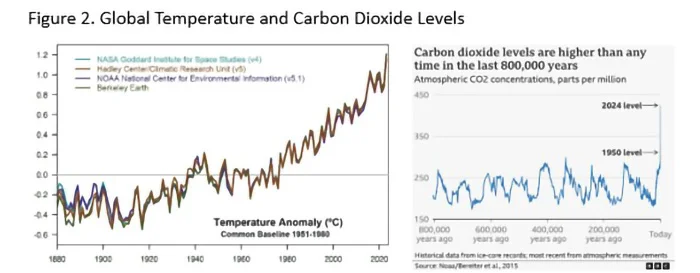
(See Figure 2. Global Temperature and Carbon Dioxide Levels)
Why should we care about global warming? Well, there are many reasons, but let us focus on earth’s water cycle. Middle schoolers know that water evaporates from the oceans, rises into the atmosphere where it cools, condenses, and falls back onto earth as rain or snow. When the oceans warm, the evaporation increases, and the warmer atmosphere can hold more water vapour. Water laden atmosphere results in severe and erratic weather. Ironically, water vapour is also a greenhouse gas, and this has a snowballing effect. The increased ocean temperature also disrupts ocean currents that influence the weather on land. The combined result is extreme and severe weather: violent storms and droughts depending on the geographic location. What is happening on the West coast of the USA is an example. The net result will be major departures from what is considered normal weather over millennia.
International organisations have been talking for 30 years about limiting global temperature increase to 1.5oC above pre-industrial levels by curtailing greenhouse gas emissions. But not much has been done and the temperature has risen by 1.2oC already. The challenge is that even if we can stop greenhouse gas emissions completely, right now, we have the problem of removing already existing 2,500 billion tons of carbon from the atmosphere, for which there are no practical solutions yet. Scientists worry about the consequences of runaway temperature increase and its effect on human life, which are many. It is not a doomsday prediction of life disappearing from earth, but a warning that life will be quite different from what humans are used to. All small tropical nations like ours are burdened with mitigating the consequences; in other words, get ready for more Ditwahs, do not wait for the twelve-day forecast.
Some opined that not enough warning was given regarding Ditwah; the truth is that the tools available for long-term prediction of the path or severity of a weather event (cyclone, typhoon, hurricane, tornado) are not perfect. There are multitude of rapidly changing factors contributing to the behavior of weather events. Meteorologists feed most up to date data to different computer models and try to identify the prediction with the highest probability. The multiple predictions for the same weather event are represented by what is known as spaghetti plots. Figure 3 shows the forecasted paths of a 2019 Atlantic hurricane five days ahead on the right and the actual path it followed on the left. While the long-term prediction of the path of a cyclone remains less accurate, its strength can vary within hours. There are several Indian ocean cyclones tracking sites online accessible to the public.

Figure 3. Forecasting vs Reality
There is no argument that short-term forecasts of this nature are valuable in saving lives and movable assets, but having long term plans in place to mitigate the effects of natural disasters is much more important than that. If a sizable section of the population must start over their lives from ground zero after every storm, how can a country economically develop?
The degree of our unpreparedness came to light during Ditwah disaster. It is not for lack of awareness; judging by the deluge of newspaper articles, blogs, vlogs, and speeches made, there is no shortage of knowledge and technical expertise to meet the challenge. The government has assured the necessary resources, and there is good reason to trust that the funds will be spent properly and not to line the pockets as happened during previous disasters. However, history tells us that despite the right conditions and good intentions, we could miss the opportunity again. Reasons for such skepticisms emerged during the few meetings the President held with the bureaucrats while visiting effected areas. Also, the COPE committee meetings plainly display the inherent inefficiencies and irregularities of our system and the absence of work ethics among all levels of the bureaucracy.
What it tells us is that we as a nation have an attitude problem. There are ample scholarly analyses by local as well as international researchers on this aspect of Sri Lankan psyche, and they label it as either island or colonial mentality. The first refers to the notion of isolated communities perceiving themselves as exceptional or superior to the rest of the world, and that the world is hell-bent on destroying or acquiring what they have. This attitude is exacerbated by the colonial mentality that promoted the divide and conquer rules and applied it to every societal characteristic imaginable; and plundered natural resources. As a result, now we are divided along ethnic, linguistic, religious, political, class, caste, geography, wealth, and many more real and imagined lines. Sadly, politicians, some religious leaders, and other opportunists keep inflaming these sentiments for their benefit when most of the population is willing to move on.
The first wish, therefore, is to get the strength, courage, and wisdom to think rationally, and discard outdated and outmoded belief systems that hinder our progress as a nation. May we get the courage to stop venerating elite who got there by exploiting the masses and the country’s wealth. More importantly, may we get the wisdom to educate the next generation to be free thinkers, give them the power and freedom to reject fabrications, myths, and beliefs that are not based on objective facts.
This necessitates altering our attitude towards many aspects of life. There is no doubt that free thinking does not come easily, it involves the proverbial ‘exterminating the consecrated bull.’ We are rightfully proud about our resplendent past. It is true that hydraulic engineering, art, and architecture flourished during the Anuradhapura period.
However, for one reason or another, we have lost those skills. Nowadays, all irrigation projects are done with foreign aid and assistance. The numerous replicas of the Avukana statue made with the help of modern technology, for example, cannot hold a candle to the real one. The fabled flying machine of Ravana is a figment of marvelous imagination of a skilled poet. Reality is that today we are a nation struggling with both natural and human-caused disasters, and dependent on the generosity of other nations, especially our gracious neighbor. Past glory is of little help in solving today’s problems.
Next comes national unity. Our society is so fragmented that no matter how beneficial a policy or an idea for the nation could be, some factions will oppose it, not based on facts, but by giving into propaganda created for selfish purposes. The island mentality is so pervasive, we fail to trust and respect fellow citizens, not to mention the government. The result is absence of long-term planning and stability. May we get the insight to separate policy from politics; to put nation first instead of our own little clan, or personal gains.
With increasing population and decreasing livable and arable land area, a national land management system becomes crucial. We must have an intelligent zoning system to prevent uncontrolled development. Should we allow building along waterways, on wetlands, and road easements? Should we not put the burden of risk on the risk takers using an insurance system instead of perpetual public aid programs? We have lost over 95% of the forest cover we had before European occupation. Forests function as water reservoirs that release rainwater gradually while reducing soil erosion and stabilizing land, unlike monocultures covering the hill country, the catchments of many rivers. Should we continue to allow uncontrolled encroachment of forests for tourism, religious, or industrial purposes, not to mention personal enjoyment of the elite? Is our use of land for agricultural purposes in keeping with changing global markets and local labor demands? Is haphazard subsistence farming viable? What would be the impact of sea level rising on waterways in low lying areas?
These are only a few aspects that future generations will have to grapple with in mitigating the consequences of worsening climate conditions. We cannot ignore the fact that weather patterns will be erratic and severe, and that will be the new normal. Survival under such conditions involves rational thinking, objective fact based planning, and systematic execution with long term nation interests in mind. That cannot be achieved with hanging onto outdated and outmoded beliefs, rituals, and traditions. Weather changes are not caused by divine interventions or planetary alignments as claimed by astrologers. Let us resolve to lay the foundation for bringing up the next generation that is capable of rational thinking and be different from their predecessors, in a better way.
by Geewananda Gunawardana

For centuries, Sri Lanka’s biological knowledge travelled the world — anonymously. Embedded deep within the pages of European natural history books, Sinhala words were copied, distorted and repurposed, eventually fossilising into Latinised scientific names of snakes, bats and crops found thousands of kilometres away.
Africa’s reptiles, Europe’s taxonomic catalogues and global field guides still carry those echoes, largely unnoticed and uncredited.
Now, a Sri Lankan herpetologist is tracing those forgotten linguistic footprints back to their source.
Through painstaking archival research into 17th- and 18th-century zoological texts, herpetologist and taxonomic researcher Sanjaya Bandara has uncovered compelling evidence that several globally recognised scientific names — long assumed to be derived from Greek or Latin — are in fact rooted in Sinhala vernacular terms used by villagers, farmers and hunters in pre-colonial Sri Lanka.
“Scientific names are not just labels. They are stories,” Bandara told The Island. “And in many cases, those stories begin right here in Sri Lanka.”

Sanjaya Bandara
At the heart of Bandara’s work is etymology — the study of word origins — a field that plays a crucial role in zoology and taxonomy.
While classical languages dominate scientific nomenclature, his findings reveal that Sinhala words were quietly embedded in the foundations of modern biological classification as early as the 1700s.
One of the most striking examples is Ahaetulla, the genus name for Asian vine snakes. “The word Ahaetulla is not Greek or Latin at all,” Bandara explained. “It comes directly from the Sinhala vernacular used by locals for the Green Vine Snake.” Remarkably, the term was adopted by Carl Linnaeus himself, the father of modern taxonomy.
Another example lies in the vespertilionid bat genus Kerivoula, described by British zoologist John Edward Gray. Bandara notes that the name is a combination of the Sinhala words kiri (milky) and voula (bat). Even the scientific name of finger millet, Eleusine coracana, carries linguistic traces of the Sinhala word kurakkan, a cereal cultivated in Sri Lanka for centuries.
Yet Bandara’s most intriguing discoveries extend far beyond the island — all the way to Africa and the Mediterranean.
In a research paper recently published in the journal Bionomina, Bandara presented evidence that two well-known snake genera, Duberria and Malpolon, both described in 1826 by Austrian zoologist Leopold Fitzinger, likely originated from Sinhala words.
The name Duberria first appeared in Robert Knox’s 1681 account of Ceylon, where Knox refers to harmless water snakes called “Duberria” by locals. According to Bandara, this was a mispronunciation of Diyabariya, the Sinhala term for water snakes.
“Mispronunciations are common in Knox’s writings,” Bandara said. “English authors of the time struggled with Sinhala phonetics, and distorted versions of local names entered European literature.”
Over time, these distortions became formalised. Today, Duberria refers to African slug-eating snakes — a genus geographically distant, yet linguistically tethered to Sri Lanka.
Bandara’s study also proposes the long-overdue designation of a type species for the genus, reviving a 222-year-old scientific name in the process.
Equally compelling is the case of Malpolon, the genus of Montpellier snakes found across North Africa, the Middle East and southern Europe. Bandara traced the word back to a 1693 work by English zoologist John Ray, which catalogued snakes from Dutch India — including Sri Lanka.
“The term Malpolon appears alongside Sinhala vernacular names,” Bandara noted. “It is highly likely derived from Mal Polonga, meaning ‘flowery viper’.” Even today, some Sri Lankan communities use Mal Polonga to describe patterned snakes such as the Russell’s Wolf Snake.
Bandara’s research further reveals Sinhala roots in the African Red-lipped Herald Snake (Crotaphopeltis hotamboeia), whose species name likely stems from Hothambaya, a regional Sinhala term for mongooses and palm civets.
“These findings collectively show that Sri Lanka was not just a source of specimens, but a source of knowledge,” Bandara said. “Early European naturalists relied heavily on local names, local guides and local ecological understanding.”
 Perhaps the most frequently asked question Bandara encounters concerns the mighty Anaconda. While not a scientific name, the word itself is widely believed to be a corruption of the Sinhala Henakandaya, another snake name recorded in Ray’s listings of Sri Lankan reptiles.
“What is remarkable,” Bandara reflected, “is that these words travelled across continents, entered global usage, and remained there — often stripped of their original meanings.”
For Bandara, restoring those meanings is about more than taxonomy. It is about reclaiming Sri Lanka’s rightful place in the history of science.
“With this study, three more Sinhala words formally join scientific nomenclature,” he said.
“Who would have imagined that a Sinhala word would be used to name a snake in Africa?”
Long before biodiversity hotspots became buzzwords and conservation turned global, Sri Lanka’s language was already speaking through science — quietly, persistently, and across continents.
By Ifham Nizam

However, the children and their needs may be forgotten after a disaster.
Do not forget that children will also experience fear and distress although they may not have the capacity to express their emotions verbally. It is essential to create child-friendly spaces that allow them to cope through play, draw, and engage in supportive activities that help them process their experiences in a healthy manner.
The Institute for Research & Development in Health & Social Care (IRD), Sri Lanka launched the campaign, titled “Children first,” after the 2004 Tsunami, based on the fundamental principle of not to medicalise the distress but help to normalise it.
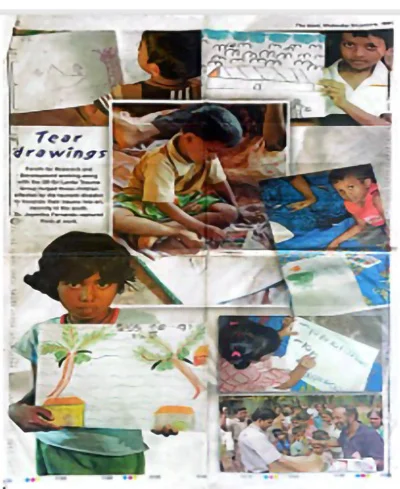
The Island picture page
The IRD distributed drawing material and play material to children in makeshift shelters. Some children grabbed drawing material, but some took away play material. Those who choose drawing material, drew in different camps, remarkably similar pictures; “how the tidal wave came”.
“The Island” supported the campaign generously, realising the potential impact of it.
The campaign became a popular and effective public health intervention.
“A public health intervention (PHI) is any action, policy, or programme designed to improve health outcomes at the population level. These interventions focus on preventing disease, promoting health, and protecting communities from health threats. Unlike individual healthcare interventions (treating individuals), which target personal health issues, public health interventions address collective health challenges and aim to create healthier environments for all.”
The campaign attracted highest attention of state and politicians.
The IRD continued this intervention throughout the protracted war, and during COVID-19.
The IRD quick to relaunch the “children first” campaign which once again have received proper attention by the public.
While promoting a public health approach to handling the situation, we would also like to note that there will be a significant smaller percentage of children and adolescents will develop mental health disorders or a psychiatric diagnosis.
We would like to share the scientific evidence for that, revealed through; the islandwide school survey carried out by the IRD in 2007.
 During the survey, it was found that the prevalence of emotional disorder was 2.7%, conduct disorder 5.8%, hyperactivity disorder was 0.6%, and 8.5% were identified as having other psychiatric disorders. Absenteeism was present in 26.8%. Overall, previous exposure to was significantly associated with absenteeism whereas exposure to conflict was not, although some specific conflict-related exposures were significant risk factors. Mental disorder was strongly associated with absenteeism but did not account for its association with tsunami or conflict exposure.
The authors concluded that exposure to traumatic events may have a detrimental effect on subsequent school attendance. This may give rise to perpetuating socioeconomic inequality and needs further research to inform policy and intervention.
Even though, this small but significant percentage of children with psychiatric disorders will need specialist interventions, psychological treatment more than medication. Some of these children may complain of abdominal pain and headaches or other physical symptoms for which doctors will not be able to find a diagnosable medical cause. They are called “medically unexplained symptoms” or “somatization” or “bodily distress disorder”.
Sri Lanka has only a handful of specialists in child and adolescent psychiatric disorders but have adult psychiatrists who have enough experience in supervising care for such needy children. Compared to tsunami, the numbers have gone higher from around 20 to over 100 psychiatrists.
Most importantly, children absent from schools will need more close attention by the education authorities.
In conclusion, going by the principles of research dissemination sciences, it is extremely important that the public, including teachers and others providing social care, should be aware that the impact of Cyclone Ditwah, which was followed by major floods and landslides, which is a complex emergency impact, will range from normal human emotional behavioural responses to psychiatric illnesses. We should be careful not to medicalise this normal distress.
It’s crucial to recall an important statement made by the World Health Organisation following the Tsunam
Prof. Sumapthipala MBBS, DFM, MD Family Medicine, FSLCFP (SL), FRCPsych, CCST (UK), PhD (Lon)]
Director, Institute for Research and Development in Health and Social Care, Sri Lanka
Emeritus Professor of Psychiatry, School of Medicine, Faculty of Medicine & Health Sciences, Keele University, UK
Emeritus Professor of Global Mental Health, Kings College London
Secretary General, International society for Twin Studies
Visiting Professor in Psychiatry and Biomedical Research at the Faculty of Medicine, Kotelawala Defence University, Sri Lanka
Associate Editor, British Journal Psychiatry
Co-editor Ceylon Medical Journal.
Prof. Athula Sumathipala

Navy seizes an Indian fishing boat poaching in northern waters

Mandhana, Shafali and Ghosh help India edge run-fest to go 4-0 up

Showers predicted in several provinces today (29th December)

Delay in govt. response to UK sanctions on ex-military chiefs, and others causes concern

Sri Lanka outlines seven key vectors of international cooperation at Moscow forum

Sri Lanka third most preferred destination for Indians

‘Dates have the highest sugar content to fight Coronavirus’

Sunday Island 27 December – Headlines

#SundayIsland 17th December – Headlines

Sunday Island – 28th March

Sunday Island Headlines – 21 March

Sunday Island – 21st February – Headlines
-

 News7 days ago
Members of Lankan Community in Washington D.C. donates to ‘Rebuilding Sri Lanka’ Flood Relief Fund
-

 News5 days ago
British MP calls on Foreign Secretary to expand sanction package against ‘Sri Lankan war criminals’
-

 Features7 days ago
General education reforms: What about language and ethnicity?
-
 News7 days ago
Suspension of Indian drug part of cover-up by NMRA: Academy of Health Professionals
-
 Sports5 days ago
Chief selector’s remarks disappointing says Mickey Arthur
-
 News4 days ago
Street vendors banned from Kandy City
-

 Editorial7 days ago
A very sad day for the rule of law
-

 News7 days ago
US Ambassador to Sri Lanka among 29 career diplomats recalled