
News
10 jackals killed to prevent rabies in Milleniya

by Ifham Nizam
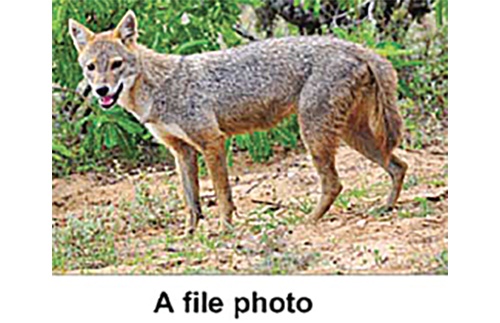
Ten Sri Lankan jackals (Canis aereus naria) have been killed so far with the assistance of the police to prevent rabies in Milleniya, Horana in the Kalutata distinct, a senior official of the Department of Wildlife Conservation said.
“There was no option but to kill the rabies- infected jackals”, he noted.
“We were very systematic in our approach. We don’t like to kill animals but it was beyond our control and with the Covid-19 spread in most parts of the country, we had to act fast,” the official said.
However, villagers were not given the authority to carry out the task, he said. “Some animals did have natural deaths due to rabies infection.”
When jackals are infected with rabies, they have a tendency to attack people and animals, the official explained. “Otherwise, they are generally very shy, especially when it comes to people.”
The threat is under control now, though there’s an ongoing battle between the villagers and jackals especially at nights and early in the morning, he further said.
The Sri Lanka jackal (Canis aereus naria), a subspecies of the golden jackal, is the country’s only wild canid.
Jackals are widespread hunters and scavengers; thus, animal activists strongly believe any attempt to cull them would lead to ecological imbalances across its range.
An animal activist said the Wildlife Department failed to take timely action to neutralize the threat. “This led to dozens of jackals being killed. We were told villagers in Milleniya are now carrying out frequent attacks”.
Dogs are the main source of human rabies deaths, according to the World Health Organization. It accounts for nearly 99 per cent of all rabies transmissions to humans globally.
Dog bites account for about 96 per cent of all animal bites in Sri Lanka, while another 2% come through domesticated cats. Wild animals accounted only for two per cent of reported cases.
Reported cases of rabies in different species in Sri Lanka from 2005 to 2014, based on data from the government’s Medical Research Institute (MRI) and the Department of Animal Production and Health, had not included jackals in the list of 18 animals.
The jackals with rabies in Milleniya must have contracted the disease from dogs, an expert says.
Veterinarians will inoculate the dogs in the area, Director of Wildlife at the Faculty of Veterinary Medicine and Animal Science, University of Peradeniya, Dr. Tharaka Prasad told The Sunday Island.
“We have found dogs with rabies in the area and the jackals must have contracted rabies from them. We are confident the vaccination program could be completed soon. We have ruled out the use of a rabies bait vaccine (a sachet containing a rabies vaccine) for the jackals as it would lead to other complications’, he added.



Teachers, principals up in arms against alleged NGO driven education reforms
Teachers, principals and education professionals on Friday vowed to commence a nationwide campaign against the government’s plans to reform the education sector at the expense of what they described as cultural values.
President of the All-Ceylon United Teachers’ Association Ven Yalwala Pannasekera thera addressing a press conference yesterday said that trade unionists would join forces to urge the government to withdraw its educational reforms.
“We are ready to form a common front with education professionals, teachers and principals against this government. We demand that the government withdraw these reforms or get ready to go home,” Ven Pannasekera said.
“Some modules promote homosexuality. Contents in some of the modules being distributed have been copied from Indian text books.
We ask the government to explain why it had paid the National Education Institute curriculum designers,” Ven Pannasekera said.
Meanwhile, representatives of 16 teachers’ and principals’ unions visited the National Child Protection Authority yesterday to lodge a complaint demanding a probe into the inclusion of materials promoting homosexuality in school books.
Concerns were also raised at a National Sangha Council meeting held in Colombo last week at the Colombo Foundation Institute, organised to discuss the objectives of the proposed reforms.
Addressing the gathering, Professor Venerable Induragare Dhammaratana Thera said the reforms required extensive discussion, consultation with subject experts and consideration of the experience of senior administrators.
He warned that the proposed education reforms could trigger the biggest crisis currently facing the country. “Implementing these reforms in this manner will harm future generations and could even destroy the present government,” he said, likening the process to “forcing a round peg into a square hole.”
The Ministry of Education on Friday decided not to extend school hours for the 2026 academic year, citing the ongoing impact of recent disasters on schools and transport systems in several provinces.
According to the Ministry, school hours for Grades 5 to 13 will remain unchanged at 7:30 a.m. to 1:30 p.m. until both education and transport networks are fully restored.
Government schools, government-approved private schools, and pirivenas are set to begin the first term of 2026 on January 5. Students in Grades from 6 to 13 will have seven 45-minute periods a day.
Education reforms will be introduced for Grades 1 and 6 in 2026.
The Ministry confirmed that activity books for Grade 1 and learning modules for Grade 6 will be distributed before lessons begin. Textbooks for all other grades have already been fully handed out.Meanwhile, the remaining sessions of the 2025 G.C.E. Advanced Level examination are scheduled to take place from January 12 to January 20, 2026.
by Chaminda Silva ✍️

The Sri Lanka Red Cross Society will provide relief funds totaling Rs. 2,420 million to assist 20,000 families displaced and 8,000 families who have lost their livelihoods due to cyclone Ditwah.
Accordingly, the Society has arranged to give Rs. 1,620 million to 20,000 displaced families, at the rate of Rs. 85,000 per family, and Rs. 800 million to 8,000 families who lost their livelihoods, at Rs. 100,000 per family, Sri Lanka Red Cross Communications Head Navindra Senarathne told the Sunday Island on Friday.
He said the funds for the 20,000 displaced families would be distributed in three instalments.
A total of 20,000 families across the country, including 1,505 families in the Trincomalee District, have been selected for this relief, with beneficiaries identified by the decision-makers of the Sri Lanka Red Cross Society, he added.
In addition, the Society is preparing to install toilet systems in 400 safe centers and provide 15,000 sets of school equipment worth Rs. 7.5 million, Navindra Senarathne told the Sunday Island.
By Sirimantha Rathnasekera ✍️

Root and Brook shine before afternoon gloom ends play early

Venezuela’s Maduro arrives in New York after ‘capture’

Showers will occur at times in the Eastern and Uva provinces and in Polonnaruwa, Matale and Nuwara-Eliya district

Teachers’ unions ‘ready to bring govt. to its knees’

Education Ministry drops idea of extending school hours

SLRC to disburse Rs 2420 mn in relief funds to 28,000 families

‘Dates have the highest sugar content to fight Coronavirus’

Sunday Island 27 December – Headlines

#SundayIsland 17th December – Headlines

Sunday Island – 28th March

Sunday Island Headlines – 21 March

Sunday Island – 21st February – Headlines
-

 Sports6 days ago
Gurusinha’s Boxing Day hundred celebrated in Melbourne
-

 News1 day ago
Health Minister sends letter of demand for one billion rupees in damages
-
 News4 days ago
Leading the Nation’s Connectivity Recovery Amid Unprecedented Challenges
-

 Features5 days ago
It’s all over for Maxi Rozairo
-

 Opinion3 days ago
Remembering Douglas Devananda on New Year’s Day 2026
-
 News5 days ago
Dr. Bellana: “I was removed as NHSL Deputy Director for exposing Rs. 900 mn fraud”
-
 News4 days ago
Dons on warpath over alleged undue interference in university governance
-

 Features5 days ago
Rebuilding Sri Lanka Through Inclusive Governance