
News
WB: South Asia needs equitable cooling as heatwaves worsen


*** This spring, temperatures hit nearly 50 degree Celsius across India and Pakistan, while Bangladesh and Sri Lanka sweltered under unusually high heat
Without adequate cooling, these conditions undermine countries’ development. When blistering heat strikes South Asia, the poor and most vulnerable, suffer the worst impacts. When it is too hot to work, wages are lost, pushing families into cycles of poverty. School hours are cut short, depriving children of education and future opportunities, says a World Bank report.
It said: The latest report by the Intergovernmental Panel on Climate Change highlights that climate change is making heatwaves more likely. This spring, temperatures hit nearly 50 degree Celsius across India and Pakistan, while Bangladesh and Sri Lanka sweltered under unusually high heat. A study found that the heatwave across India and Pakistan was 30 times more likely this year than 100 years ago, due to climate change.
At home, where many people in South Asia live in inadequately ventilated buildings without access to cooling, extreme heat harms people’s health. Meanwhile, fragmented cold chain infrastructure leads to the loss of food and vaccines, putting nutrition and public health at risk.
The economic costs are staggering. With a large percentage of the region’s gross domestic product (GDP) reliant on the heat-stressed shoulders of informal workers, extreme heat does not just jeopardise the health and livelihoods of the working poor, but also the economic productivity of the region. By 2030, lost labour due to rising heat and humidity could risk up to 4.5% of India’s GDP – approximately USD 150-250 billion. Pakistan and Bangladesh could suffer losses of up to 5% of their GDP.
As urban populations grow and temperatures rise across South Asia, so too does the demand for cooling. Keeping citizens cool while mitigating the environmental impacts – air conditioners and other cooling equipment release powerful greenhouse gases – is a challenge for governments across South Asia, which must prioritise cooling as a development strategy.
In 2019, India became one of the first countries in the world to launch a comprehensive cooling action plan – the India Cooling Action Plan (ICAP), an ambitious initiative to address the country’s cooling needs while reducing climate impacts. In June 2022, Bangladesh published its own National Cooling Plan, while in October last year Pakistan announced it will adopt one by 2026.
Take South Asia’s cities, for example, many of which are plagued by high levels of poverty and bad housing conditions. More than 200 million new homes need to be built in South Asia before 2050 to meet housing needs. This provides an opportunity to change the course of urban development in the region and adopt strategies that prioritise thermal comfort. India, Pakistan and Bangladesh are responding to this challenge with affordable housing programmes.
In India, where 10 million new homes need to be built annually to keep up with housing demand, the government’s affordable housing scheme has the opportunity to incorporate nature-based solutions and passive cooling techniques – to prevent heat from building up within homes – into construction and urban planning. That means using climate-friendly insulation materials, like straw, combined with materials that have high thermal mass. According to World Bank Group analysis, space cooling in India alone presents a USD 1.5 trillion opportunity by 2040, of which USD 1.25 trillion is earmarked for residential buildings.
Opportunities to scale up affordable space-cooling technologies exist in housing schemes across the region. In Bangladesh, where the urban population grew from 31 million in 2000 to 65 million in 2020, the World Bank estimates that 250,000 new houses need to be built every year to meet existing shortages . In Pakistan, the government launched a housing programme in 2019 to provide five million housing units for poor and middle-income communities by 2030.
Scaling up high-efficiency common household appliances like brushless ceiling, or BLDC, fans can ensure comfort for millions of people. With ceiling fans among the fastest-selling appliances in the Asia-Pacific region, brushless fans require approximately 65% less energy than regular fans and help save around USD 20 per fan each year in household energy bills. This has been done before. India, for instance, has already seen the uptake of transformative energy-efficient technology at scale with nationwide bulk procurement and distribution of LED lightbulbs. Replicating the LED programme to create a viable market for other energy-efficient technologies like brushless fans also creates an opportunity for economic growth in the region.





President Anura Kumara Dissanayake called on the Atamasthanadhipathi, Chief Sanghanayake of Nuwara Kalaviya, Most Venerable Pallegama Hemarathana Nayake Thero, this morning (07) for a brief discussion.
During the meeting, the President apprised the Thero of the measures being implemented by the government to provide relief to the affected people and to restore normalcy in their daily lives.
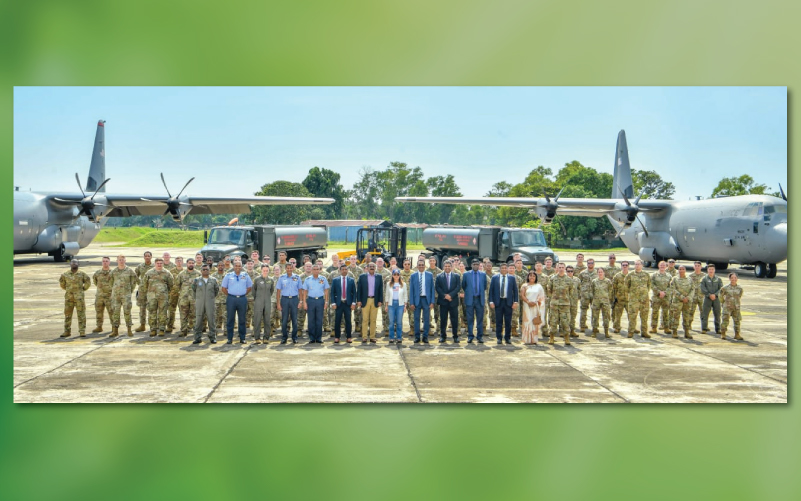
The United States has extended humanitarian assistance to Sri Lanka to support nationwide relief efforts in the aftermath of Cyclone Ditwah, which caused severe damage across multiple regions of Sri Lanka.
The latest round of assistance, included the deployment of two C-130J Super Hercules aircraft, equipment and US Air Force personnel. The US contingent will provide vital transportation and logistics support in areas identified by the Disaster Management Centre.
A formal handover took place this afternoon (07) at the Bandaranaike International Airport (BIA) with the support officially received on behalf of the Sri Lankan government by Minister of Science and Technology Prof. Chrishantha Abeysena, Deputy Minister of Ports and Civil Aviation, Janitha Ruwan Kodithuwakku and Deputy Minister of Defence Maj. Gen. Aruna Jayasekara (Rtd).
The assistance was presented by the United States through Julie Chung, Ambassador of the United States to Sri Lanka, and Lt. Col. Van Pinxteren of the United States Air Force.
As part of the support package, the United States contingent will provide logistics capacities needed to transport humanitarian supplies to affected communities in the Northern, Eastern and Central regions.
Sri Lankan officials expressed their gratitude for the timely support, which will bolster ongoing national efforts to reach displaced families and restore essential services in cyclone-affected areas.

President Anura Kumara Dissanayake instructed officials to prepare the farmers in the Anuradhapura District whose paddy cultivation was destroyed due to floods to re-cultivate during the upcoming Maha season.
Highlighting the need for all relevant institutions to work in proper coordination, treating this as a national necessity, the President instructed the authorities to provide compensation to farmers without delay and to ensure temporary irrigation water supply through provisional repairs.
The President further noted that the government is providing the highest amount of compensation in the country’s history for crop damages, with the expectation that cultivation activities will be commenced again promptly.
President Anura Kumara Dissanayake gave these instructions this morning (07) while attending a special coordination committee meeting at the Anuradhapura District Secretariat to review the programme being implemented to restore normalcy to the lives of people affected by the disaster situation and to rehabilitate damaged infrastructure in the district.
The President instructed officials to present, before this Friday, a report detailing the number of farmers who were completely affected, the extent of damaged farmland and the required financial allocations. He emphasised that compensation must be granted only to those who are genuinely entitled and that no one should receive it unjustly.
The President stated that the government is committed to providing compensation to the farming community and directed officials to foster confidence among farmers so that they will be encouraged to resume cultivation.
The President also inquired, separately, from the relevant institutions about the measures taken for the development of the district’s infrastructure including highways, irrigation and communication networks.
The President examined the programme for reopening obstructed roads and instructed that temporary repairs be expedited to meet the public’s transportation needs until permanent road development plans are implemented.
Officials of the Ceylon Electricity Board informed the meeting that 473 out of the 580 electricity transformers damaged due to the disaster have already been restored and that full electricity supply to the district could be achieved by tomorrow.
They further stated that 49,000 water connections had been affected, of which about 99% have now been restored, while water is being supplied by bowsers to the remaining areas. They noted that total restoration of water supply is expected within the next two days. Damaged community water projects are also being restored.
Well-cleaning activities are currently being carried out with the support of the Navy and the President instructed officials to complete these tasks swiftly through community participation coordinated by Divisional Secretariats.
Discussions were also held regarding the provision of compensation for crops such as Maize, restarting cultivation, restoring the livelihoods of those engaged in animal husbandry, normalising health services and rehabilitating religious sites including damaged temples.
The floods have caused total damage to 228 houses in the district. The President instructed officials to gather accurate information on whether affected families should be resettled on the same land or relocated elsewhere and to begin identifying suitable land for resettlement.
Officials reported that all schools in the district could reopen by 16 December. The President instructed that the Rs. 15,000 allowance promised by the Treasury for schoolchildren affected by the disaster be fully distributed before 31 December and that the list of beneficiaries be prepared without delay.
The President also expressed his gratitude to government officials, the Police and the Tri-Forces for their service in providing relief to the public and restoring infrastructure.
The meeting was attended by Co-Chair of the Anuradhapura District Development Committee, Minister of Trade, Commerce, Food Security and Cooperative Development Wasantha Samarasinghe, Minister of Housing, Construction and Water Supply Susil Ranasinghe , Anuradhapura District MPs Susantha Kumara Navaratna and Sena Nanayakkara, North Central Province Governor Wasantha Jinadasa, Chief Secretary J.M.R.P. Jayasinghe, representatives of local authorities; Secretary to the Treasury Dr Harshana Suriyapperuma, Anuradhapura District Secretary K.G.R. Wimalasuriya, ministry secretaries and other government officials.

President calls on Atamasthanadipathi Thero

US deploys two C-130J Super Hercules aircraft and personnel to assist in relief measures

Government prepares Anuradhapura farmers for Maha Season

Level III landslide warnings issued to the Districts of Kandy, Kegalle, Kurunegala and Matale extended till 1600 hrs on Monday [08]

A mechanism that goes beyond the normal state apparatus is needed to restore public life – President

President calls on the Mahanayake Thera of the Asgiri chapter

‘Dates have the highest sugar content to fight Coronavirus’

Sunday Island 27 December – Headlines

#SundayIsland 17th December – Headlines

Sunday Island – 28th March

Sunday Island Headlines – 21 March

Sunday Island – 21st February – Headlines
-
News5 days ago
Lunuwila tragedy not caused by those videoing Bell 212: SLAF
-
 News4 days ago
Level III landslide early warning continue to be in force in the districts of Kandy, Kegalle, Kurunegala and Matale
-
 Latest News6 days ago
Level III landslide early warnings issued to the districts of Badulla, Kandy, Kegalle, Kurunegala, Matale and Nuwara-Eliya
-
 Features6 days ago
Ditwah: An unusual cyclone
-

 Latest News7 days ago
Updated Payment Instructions for Disaster Relief Contributions
-

 News2 days ago
CPC delegation meets JVP for talks on disaster response
-

 Business2 days ago
LOLC Finance Factoring powers business growth
-

 News2 days ago
A 6th Year Accolade: The Eternal Opulence of My Fair Lady