
Features
Two AI Oracles, two contradictory prophecies


 The Colombo Stock Exchange (CSE) operates in a world where information travels at the speed of light, where fortunes are made and lost in milliseconds, and where the traditional gatekeepers of financial integrity—regulators, auditors, and human oversight—struggle to keep pace. Now, add artificial intelligence (AI) to this volatile mix, and we face an unprecedented threat that demands our immediate attention.
A recent academic article, by Professor Tom C.W. Lin from Temple University’s law school, presents a sobering analysis of how AI-driven misinformation and market manipulation pose existential risks to financial markets, globally.
The May 2023 Wake-Up Call: Markets Too Fast to Police
On a Monday morning in May 2023, AI-generated images showed an explosion near the Pentagon in Washington, D.C. Within nine minutes, before authorities could debunk the fake images, the US stock market lost $500 billion in value. Nine minutes. Half a trillion dollars. Based on completely fabricated content created by artificial intelligence.
If this can happen in the highly sophisticated, heavily regulated American market, with billions spent on surveillance and enforcement, what chance does the CSE have?
The reality is stark: everything that can be manipulated by AI will be manipulated by AI. The technology is accessible, increasingly cheap, and advancing at exponential rates. Meanwhile, our regulatory frameworks, designed for an analog age of human traders and paper trails, are woefully inadequate for this new reality.
When Artificial Intelligence Can’t Even Agree with Itself, Why Should You Trust it with Your Money?
I just conducted an experiment that should terrify every investor in the Colombo Stock Exchange. I asked two different AI systems to analyze the same market and recommend stocks. The results weren’t just different; they were diametrically opposed. And that contradiction reveals something far more dangerous than any single market manipulation scheme. Let me show you exactly what happened.
The Great AI Contradiction
AI Assistant #1’s Stock Picks (Based on a descriptive prompt; fundamentals and technical) – See Table 1

AI Assistant #2’s Stock Picks (Based on a prompt basically on technical analysis) – See Table 2

Notice the problem?
Commercial Bank appears in both lists—but AI #1 says buy at Rs. 193.75 for conservative long-term holding, while AI #2 says wait for a breakout above Rs. 198 for aggressive momentum trading. One AI warns against speculative momentum plays with high RSI readings. The other AI actively recommends buying stocks on breakouts—the very definition of momentum trading.
They’re using the same market data. They’re both “intelligent” systems. Yet they’ve reached completely opposite investment philosophies. But here’s the twist that should concern Sri Lankan investors even more: the same AI technology that created those deepfakes is now being used to generate the stock recommendations you’re reading, including the two contradictory analyses above.
Why This Matters to Your CSE Portfolio Right Now
Let’s ground this in brutal reality. Professor Lin reveals that AI-driven trading algorithms now account for over 60% of US equity transactions. These systems can execute thousands of trades per second, engaging in “spoofing” and “pinging” strategies—placing and cancelling orders in milliseconds to manipulate prices.
Meanwhile, AI recommendation engines are proliferating across investment platforms, each trained on different data sets, using different algorithms, reaching different conclusions. Some tell you to buy. Others tell you to sell. Same stock. Same moment. Contradictory advice. Which one is right? Here’s the terrifying answer: potentially neither.
The Three Layers of AI-Driven Market Chaos
Layer 1: AI Can’t Agree with Itself
: The contradiction between my two AI analyses isn’t a bug, it’s a feature of how these systems work. AI #1 was prompted on both fundamentals and technical tools on market manipulation risks and behavioural finance showing that retail investors destroy wealth through active trading. AI #2 was prompted just on technical analysis patterns and momentum signals. Both are “correct” within their exploring parameters and both are potentially dangerous if followed blindly. Now multiply this by thousands of AI systems making millions of recommendations daily, and you begin to understand the chaos.
Layer 2: AI Can Manipulate Markets Faster Than Humans Can Think
: Consider the stocks in AI #2’s recommendation list. Several show “no recent quote found” meaning there’s insufficient liquidity for reliable trading. Yet these appear on a recommendation table alongside liquid stocks.
An AI system doesn’t care about liquidity constraints the way a human analyst should. It sees patterns in historical data and extrapolates—often disastrously. High-frequency trading algorithms can exploit these gaps, creating fake liquidity that disappears the moment retail investors try to trade. The CSE’s relatively small size means this problem magnifies exponentially. A coordinated AI-driven manipulation of a mid-cap stock could create cascading failures across the entire index.
Layer 3: The Geopolitical Wildcard
: Sri Lanka’s strategic location and economic vulnerabilities make us an attractive target for economic warfare disguised as market manipulation. Nation-states like Russia, China, and Iran have already employed AI-driven disinformation campaigns, as documented in recent intelligence reports.
The “dual use” nature of AI means the same technology powering your stock recommendations could be weaponised to destabilise our markets. And because these attacks occur through global networks at algorithmic speeds, attribution proves nearly impossible even when damage is obvious.
The Liar’s Dividend and the Truthteller’s Tax
Professor Lin introduces two concepts that explain why this gets worse over time:
The Liar’s Dividend:
As AI-generated misinformation proliferates, liars benefit because their denials become more believable. “That video of our CEO announcing losses? Obviously a deepfake.” Even when it’s real.
The Truthteller’s Tax:
Legitimate companies must spend increasing resources proving authenticity—audits, verification systems, blockchain certificates. Honest actors bear costs that dishonest actors avoid.
This erosion of trust doesn’t just create volatility. It fundamentally undermines the information infrastructure that allows markets to function.
What the 2023 Silicon Valley Bank Collapse Teaches Us
Online speculation about a hypothetical bank run, amplified by social media, helped trigger an actual bank run on America’s 16th-largest bank. AI-generated misinformation could replicate this scenario against any Sri Lankan financial institution tomorrow, regardless of underlying soundness. Both my AI analyses recommend Commercial Bank, citing strong fundamentals. But fundamentals become irrelevant when an AI-generated deepfake of the CEO discussing liquidity problems goes viral on WhatsApp before anyone can debunk it.
What Smart Investors Should Do Now
Given these realities, here’s the only rational response:
1. Recognise that all AI recommendations, including this analysis, are probabilistic guesses. Neither AI system “knows” what Commercial Bank will do. Their pattern-matching machines make educated guesses based on historical correlations that may no longer hold in an AI-dominated market.
2. Embrace radical skepticism toward technical indicators. AI #2’s recommendation table shows precise support/resistance levels and breakout triggers. But when algorithms can place and cancel thousands of orders per millisecond, these levels become meaningless. That Rs. 575 “breakout” on LOLC? An AI system could blast through it in seconds if programmed to do so.
3. Default to passive long-term strategies. Warren Buffett’s advice becomes even more relevant. low-cost index funds held for extended periods. This inherently protects against manipulation of individual stocks and reduces vulnerability to AI-induced volatility. The data overwhelmingly shows that active trading by retail investors destroys wealth—they buy high and sell low, reacting to noise rather than fundamentals. In an AI-driven market, this tendency becomes catastrophic.
4. Demand transparency and human accountability. If your broker uses AI for recommendations, demand to know: What data trained the system? How often are recommendations wrong? Who takes responsibility when AI advice loses money?
Most importantly: Always verify through multiple independent sources before trading.
What Regulators Must Do Immediately
The Securities and Exchange Commission faces an impossible task: Regulating AI systems that evolve faster than rules can be written. But within existing authority, they can.
Mandate AI Disclosure
: Any listed company using AI for trading must disclose it publicly, including safeguards against manipulation.
Stress Test for AI Scenarios
: Require financial institutions to simulate AI-driven bank runs, flash crashes, and coordinated attacks.
Invest in Technological Capacity
: The SEC using outdated tools to oversee AI-driven markets is like bringing typewriters to combat machine guns.
Regional Cooperation:
Market manipulation operates across borders. So must our response.
The Uncomfortable Truth
The contradiction between my two AI analyses reveals something profound: we’ve created systems we don’t fully understand, deployed them in markets that govern our collective prosperity, and hoped for the best. The intelligence behind AI may be artificial, but its capacity for damage is very real. We’ve been warned.
For investors contemplating entry into any CSE stock based on AI recommendations, whether it’s the conservative approach of AI #1 or the aggressive technical triggers of AI #2, should be aware that:
You’re not just trading against other humans anymore. You’re competing against algorithms that can process information, execute trades, and manipulate markets at speeds beyond human comprehension. And those algorithms can’t even agree with each other.
The playing field isn’t just uneven, it’s fundamentally broken. Adapt your strategy accordingly, or risk collateral damage in a technological revolution that shows no signs of slowing.
(The writer, a senior Chartered Accountant and professional banker, is Professor at SLIIT, Malabe. The views and opinions expressed in this article are personal.)


That was no ordinary greeting; on the frosty evening of last Thursday, Indian Prime Minister Modi embraced Russian President Vladimir Putin in a bear hug at Delhi airport and, within moments, presented him with a copy of the Bhagavad Gita in Russian. The choice of gift was laden with symbolism—echoes of Robert Oppenheimer, who drew profound philosophical reckoning from the same text, declaring, “Now I am become Death, the destroyer of worlds,” after witnessing the first atomic explosion. Was Modi signaling the weight of nuclear-age responsibility to Putin, or was this a deliberate affirmation of India’s comfort in maintaining ties with a pariah state under global sanctions?
The streets of Delhi, festooned with Russian and Indian flags and dominated by colossal billboards of Modi and Putin, suggested more than ceremonial protocol—it was pageantry of influence, an audacious statement of India’s strategic independence. In that gesture, New Delhi appeared to assert that moral judgment from the West would no longer dictate its choices, and that the Indo-Russian relationship, forged during the Cold War and hardened by decades of defence dependence, remains a pivot capable of unsettling the established order in South Asia and beyond.
Putin’s first visit to India in four years, coinciding with talks in Washington over a possible Ukraine peace framework, came at a time when New Delhi is walking an increasingly delicate tightrope between Moscow and Washington. The optics of the visit—from ceremonial receptions at Rashtrapati Bhavan to summit talks at Hyderabad House—reflected not merely diplomacy but an overt projection of influence. Modi’s presentation of the Bhagavad Gita in Russian was emblematic: a centuries-old text of dharma and duty, layered with the moral weight of choice, now inserted into the theatre of high-stakes realpolitik.
Putin himself, in an interview with India Today, described India as a “major global player, not a British colony,” praising Modi as a “reliable person” who does not succumb to pressure. These words, spoken against the backdrop of US sanctions, EU manoeuvres to leverage frozen Russian assets for Ukraine, and growing Chinese assertiveness, highlight India’s determination to claim agency in a multipolar world where Washington and Brussels no longer set the rules unilaterally.
Historically, the Indo-Russian relationship has oscillated between strategic necessity and opportunism. Declassified CIA documents from the 1980s reveal the delicate dance India played with the USSR during the Cold War. Indira Gandhi’s approach, as the CIA observed, was staunchly nationalist and fiercely protective of India’s regional supremacy. The United States feared that India’s policies towards its neighbours, coupled with its Soviet alignment, could destabilize South Asia while simultaneously granting Moscow a strategic foothold. Today, the echoes of that era reverberate: New Delhi remains Moscow’s top arms buyer, leases nuclear-powered submarines, and maintains energy ties that have drawn ire from Washington, while ensuring that its engagement with Russia does not fully alienate the United States or Western partners.
What is important to note here are the economic metrics. India–Russia trade in FY 2024–25 amounted to approximately USD 68.7 billion, heavily skewed in Moscow’s favour due to energy imports, with a trade deficit of around USD 59 billion. Both Russia and India aim to expand bilateral trade to a target of USD 100 billion by 2030, a goal that falls just two years after the next general elections, when Prime Minister Modi is widely expected to contest again despite the symbolic 75 year age limit for party leadership—a restriction largely treated as political theatre and quickly forgotten. Meanwhile, India continues to negotiate with the United States to mitigate punitive tariffs, including a 25 per cent secondary tariff imposed on India’s purchases of Russian oil. It is also worth noting that India recorded a goods trade surplus of about USD 41.18 billion with the US in FY 2024–25, with exports of USD 86.51 billion and imports of USD 45.33 billion, reflecting strong bilateral trade despite earlier concerns over tariffs. Remittances provide a partial counterweight: total remittances to India reached roughly USD 135.46 billion, including USD 25–30 billion from the US, while Russian remittances are negligible in comparison. This indicates that while India faces challenges in trade metrics, its diaspora injects substantial financial resilience into the economy.
The summit also highlighted defence collaboration in stark terms. India’s $2 billion lease of a Russian nuclear-powered attack submarine, with delivery scheduled for 2028, signals an unprecedented deepening of underwater capabilities. The vessel, unable to enter combat under lease terms, is intended to train crews and refine India’s nuclear submarine operations—a critical step for strategic deterrence in the Indian Ocean amid rising Chinese and US naval competition. Russia, despite sanctions and Western pressure, continues to sustain a military-industrial complex capable of producing tanks, missiles, and drones at accelerating rates. As reports from Ukraine’s Center for Analytical Studies and Countering Hybrid Threats indicate, nearly half of Russian defence enterprises remain unsanctioned, exposing the limitations of Western punitive measures. In this context, India’s engagement with Russian defence capabilities is both a practical necessity and a symbolic assertion that strategic imperatives can outweigh Western orthodoxy.
Sanctions, however, remain a persistent backdrop. The European Union, under Ursula von der Leyen, has attempted to deploy emergency measures to convert frozen Russian assets into loans for Ukraine, challenging EU treaties and raising the prospect of legal confrontations with countries such as Hungary and Belgium. The United States, meanwhile, has explored using the same assets in US-led investment frameworks to facilitate reconstruction or political leverage. India, observing these efforts, has maintained a stance of strategic neutrality—resisting calls to condemn Russia while advocating for diplomacy, and emphasizing that selective sanctioning by Western powers is inconsistent and self-serving. Putin, speaking to India Today, noted that Washington and Moscow presented papers in parallel but reached no compromises, and highlighted that over 90 percent of Russia-India transactions are conducted in national currencies—a subtle yet potent challenge to dollar dominance.
The optics extend into nuclear and high-tech collaboration. India is developing nuclear-capable submarine-launched ballistic missiles, advancing its underwater fleet, and exploring high-tech partnerships with Russia, recalibrating the strategic environment in South Asia. Putin’s rhetoric that “Kiev is the mother of all Russian cities” and his framing of Russia’s role in eastern Ukraine resonate with historical narratives of great power assertion, yet they also serve as a conscious projection of strength aimed at partners like India. Modi’s reception was far from ceremonial; it underlined a shared understanding that global power is increasingly multipolar and that alliances must be flexible, resilient, and insulated from Western censure.
Even in the economic sphere, India challenges conventional assumptions. While the trade deficit with Russia persists due to energy imports, India’s broader engagement with global markets—including remittances from its diaspora and ongoing negotiations with the US—allows New Delhi to balance sovereignty with strategic interest. Putin’s discussions emphasizing bilateral trade growth, high-technology collaboration, and future energy projects further solidify this interdependence. The bottom line is clear: the India-Russia partnership, far from being a relic of Cold War calculations, has evolved into a sophisticated framework for navigating sanctions, economic competition, and regional security challenges, and it may yet redefine the balance of power in South Asia.
by NilaNtha ilaNgamuwa
in New Delhi
Features
Lalith Athulathmudali: an exceptional minister who managed time and got the best out of his team


His hallmark was efficiency, wit and much more
I would now like to devote some space to Minister Athulathmudali and how he ran his Ministry. His was a disciplined approach to work. Everyone knew that he was very happy in his previous portfolio of Trade and Shipping, where in addition to numerous achievements he had steered through Parliament path breaking legislation to modernize these sectors. The Port Authorities Act; the new Companies Act; the Intellectual Property Act; the Consumer Protection Act; and many others were evidence of significant productivity.
Therefore, many thought that he would be unhappy in his new portfolio. In fact some one asked him this question one day, in our presence. His reply was characteristic of his professional approach to work. He said that the Ministry he was given did not matter. Whatever Ministry, hie was given, it was his duty to comprehend the issues and productively address them. “Even if I was given the Buddha Sasana Ministry, I will still find plenty to do to improve matters,” he concluded. This spirit and this approach illuminated the work of the Ministry. I have yet to see anyone, apart from a Minister, who budgeted time so rigorously.
He desired to pack value to every passing minute. He was the only Minister, I knew in nearly 37 years of public service, who always fixed a starting as well as a finishing time for all his meetings. Perhaps the only meeting where he could not have a firm grip on time was the Cabinet meeting. There were no welcoming speeches or votes of thanks in his regime. He came to a meeting and got straight to the point. He despised visibly the sycophantic panegyrics which had become a part of the culture of welcoming speeches and votes of thanks.
He used to say publicly that we had become a society of humbugs and lick-spittles. He wanted none of it. With him performance was all. You either kept to his pace of work and requirement for relevancy in all matters, or you were quickly marginalized. To some of us, who had cultivated a life long habit of hard work, and of being up to date, it was both pleasurable and at times even exhilarating to work with him. The lazy or the unprepared had to encounter him with considerable dread as a companion. Not that he was ever harsh. He did not raise his voice, or even scold. He had the capacity to marginalize and dismiss you with wit and verve.
Mr. Athulathmudali just did not have time for pedlars in excuses or shirkers. Again, this did not mean that he expected us to be superhuman. He was a quick judge of the genuine and the credible. He was well aware that those who work hard and take scores of decisions a day would sometimes make mistakes. That was to be expected, provided however that they were not due to gross negligence or egregious blunder. Reasonable errors of judgment were a different matter provided of course they were not too frequent. With him all the officers knew what to expect.
I often wondered whether in Mr. Athulathmudali’s case, his intense preoccupation with time had something to do with the near death experience he suffered when he was seriously injured in a grenade explosion in Parliament. Those who rushed him to hospital on that day said that they could feel no pulse. He himself later said that he went beyond and then returned. My opportunity to work closely with him as Secretary was after he had undergone this experience. Everyone knew of course that he was a quick decision maker and an efficient Minister even before this incident. But I have no means of telling whether this obsession with time to this degree was a post incident reaction or not.
Linked together with this preoccupation with time was the intensity of his desire to be completely up to date both on matters relating to the subject areas of his Ministry as well as all aspects of current affairs. He regularly read the major current affairs magazines and journals. He read rapidly and was therefore able to pack in more into his reading time. He almost always read in the car, a habit which I shared with him. On one occasion, on a trip outside Colombo, he invited me to join him in his car for the journey back. After about half an hour’s conversation, both of us settled down to read, for I too always carried a stock of reading matter in the car. Some cannot read in a moving vehicle. They get nausea if they try. I have been fortunate that this does not happen to me, because I have finished whole books, whilst commuting to and fro.
The alternative would have been vacantly gazing on familiar sights. To round up this aspect of Mr. Athulathmudali’s character, one thing more needs to be said. He was the only person I knew who nearly always carried a World band radio in his brief case. He used to briefly interrupt meetings some times in order to catch the latest news bulletin from the BBC, Voice of America or some other station. Such was the importance he placed on being completely up to date. I hope all these do not convey an image of some grim automaton. That would be far from the truth.
His was a complex character. It was in fact fun to work with him. We got through discussing serious subjects with a considerable degree of wit, repartee and light banter. He encouraged criticism and dissent. But you had to have an arguable point and be prepared to sustain the argument with him. He also insisted on politeness in conversation and in argument. I myself as well as some of the senior pfficials of our team regularly argued with him. Both sides enjoyed this.
Mr. Athulathmudali created the conditions that made us feel comfortable arguing with him or dissenting. In this process, we were treated as equals. Mrs. Bandaranaike was another one of those persons who welcomed an argument with her officials, and did not try to stamp down dissent. She too, like Mr. Athulathmudali had high regard for such officials, a regard which she carried with her well past her own political vicissitudes.
Main areas of focus
Mr. Athulathmudali focused on two main areas. The first area related to the numerous operations of the Ministry. These Included a close and detailed pursuit of the progress of the two main paddy crops in the seasons of Maha and Yala; the review of the position from time to time of the situation in regard to the production of subsidiary food crops such as chillies, onions and potatoes, the review of issues relating to what were called minor export crops such as coffee, cocoa, cardamoms, cloves and cinnamon; the addressing of major issues relating to timely water distribution, pest control, etc; urgent issues of agricultural marketing and the roles of the Paddy Marketing Board, the Co-operatives and the private sector; problems in regard to food buffer stocking; issues relating to milk production, and so on.
These areas were covered in detail by the overall official team of Additional Secretaries, Directors, Heads of Department and myself. We had a system of regular meetings at various levels, culminating in a few large meetings chaired by me, at which issues that could not be addressed at lower levels were brought up for discussion and resolution. Meetings chaired by the Minister served two purposes. They kept film fully briefed and up to date. Also residual problems that could not be resolved at official level were taken up in these fora. Often, problems discussed with him by us had a political or important policy element. On all other matters we decided freely and without interference. The prevailing environment led to easy information flows and speedy decision making. The Minister would have countenanced nothing less.
His second area of concentration was on research, development and quality improvement. Here, unlike on operational matters we did not have several layers of meetings. These meetings were single overall meetings chaired by the Minister himself with all the relevant actors present. Whatever the subject area discussed at these meetings, the Minister wished to have his four State Ministers present. This was done for two reasons. In the first instance, he wanted his State Ministers exposed to all areas and aspects of the Ministry. They already had some exposure at Mini-Cabinet meetings. But these meetings were generally on operational and co-ordination issues and not on quality and research.
Secondly, the Minister followed a policy of recommending to the President that each one of his State Ministers act in turn for him, when he was out of the country, beginning with the most senior of them, and following subsequently the order of seniority. This was another reason why he wanted them to know everything that was going on in the Ministry. The Minister followed the same principle in regard to the State Secretaries, when I had to be out of the country.
What were some of the areas that the Minister took up for regular discussions at these special meetings? They consisted of issues such as the stagnation in rice yields over a considerable period of time; new varieties of rice being developed; issues such as Nitrogen fixation in plants and the reduction in the use of chemical fertilizers; the possibility of introducing better varieties of maize; issues relating to the fragmentation of cultivable land, especially paddy lands and its impact on production, productivity and long term sustainability; issues relating to the growing and the use of soya, and the question of Sri Lankan food habits in relation to its consumption; issues of post harvest losses and possible remedies; issues relating to growing for a market and the relationship that should be developed between the producer and the buyer; matters relating to quality control at all levels, and a number of other matters.
These meetings were extremely interesting. They were attended by senior scientists, researchers, agricultural economists and marketing experts. The Minister was greatly exercised with the central issues of high quality research, bringing the findings of such research to the field, and obtaining a detailed feedback from between research and growers back into the research process. This was a virtuous circle, he wished to encourage and to improve. But in this, all of us were to suffer bitter disappointment.
The link between research and the field and back to research were the army of agricultural instructors. They were an old and a tried and tested institution. They were a highly trained staff with a high degree of professional pride in their work. In fact, Sri Lanka had the reputation of having one of the best agricultural extension systems in the whole of Asia. But along with the President’s Janasaviya program of poverty alleviation arose the necessity for much larger numbers of Grama Sevakas or village level officers. The agricultural instructors were diverted for this purpose.
In spite of all the reasoning we could adduce, the President and his advisors thought that these officers could function in a dual capacity. The passage of time clearly revealed that as foreseen by us, they couldn’t. Thus was broken a tried, tested and an effective system. The Minister was more cynical than angry. He regarded the action as an act of irresponsibility and vandalism. So did everyone connected with agriculture.
(Excerpted from In Pursuit of Governance, autobiography of MDD Peiris) ✍️
What Sri Lanka’s recent disasters tell us
Sri Lanka has always lived with the moods of the monsoon. For generations, people have grown used to seasonal rhythms of rain, wind and sunshine. Yet what the country has witnessed in recent months feels different. The storms have been stronger, the rainfall more intense, the destruction more widespread and the recovery more painful. The nation has been battered by floods, landslides and hurricane force winds that arrived with little warning and left thousands struggling to rebuild their lives. Scientists say this new pattern is not an accident of nature. It is a direct outcome of the world’s changing climate, which is heating the atmosphere and oceans and turning familiar weather cycles into something far more volatile.
To understand why Sri Lanka is experiencing such severe storms and flooding, it helps to begin with a simple idea. A warmer world holds more energy. When the atmosphere and ocean temperatures rise, they behave like an overheated engine. The monsoon winds strengthen. Rain clouds grow heavier. Sea levels climb. All these changes amplify the forces that produce extreme weather. What used to be occasional, manageable disasters are turning into regular and overwhelming events.
One of the clearest links between climate change and extreme weather is found in rising ocean temperatures. The Indian Ocean is warming faster than most other major bodies of water on the planet. This has serious consequences for Sri Lanka because the surrounding sea regulates the island’s climate. Warm oceans feed moisture into the atmosphere. This moisture then forms clouds that can trigger heavy downpours. When ocean temperatures climb beyond their normal range, the atmosphere becomes supercharged. Rain that once fell steadily over several days can now fall in a matter of hours. This explains why many parts of the country have witnessed sudden cloudbursts that turn roads into rivers and fields into lakes.

Floods in Sri Lanka
Warmer oceans also influence wind patterns. A heated sea surface disturbs air circulation, sometimes producing swirling systems that carry destructive winds and torrential rain. While full scale cyclones are less frequent in Sri Lanka than in parts of India or Bangladesh, the island is increasingly experiencing hybrid storms that bring cyclone like winds without being classified as named cyclones. These storms uproot trees, blow roofs off houses and knock down electricity lines, making post disaster life even harder for affected communities.
Another major factor behind Sri Lanka’s recent extreme weather is the shifting behaviour of the monsoon. For centuries, the island has relied on two monsoons that arrive at predictable times. Farmers, fishermen and traders built their lives around this rhythm. Climate change has disrupted this familiar pattern. The monsoons are becoming erratic. They may arrive later than usual or withdraw too early. In some years they bring too little rain, causing droughts. In other years they arrive with overwhelming intensity, bringing rain far beyond the land’s capacity to absorb. This unpredictability makes it difficult for people to prepare. It also increases the risk of disasters because infrastructure, agriculture and drainage systems were designed for a different climate.
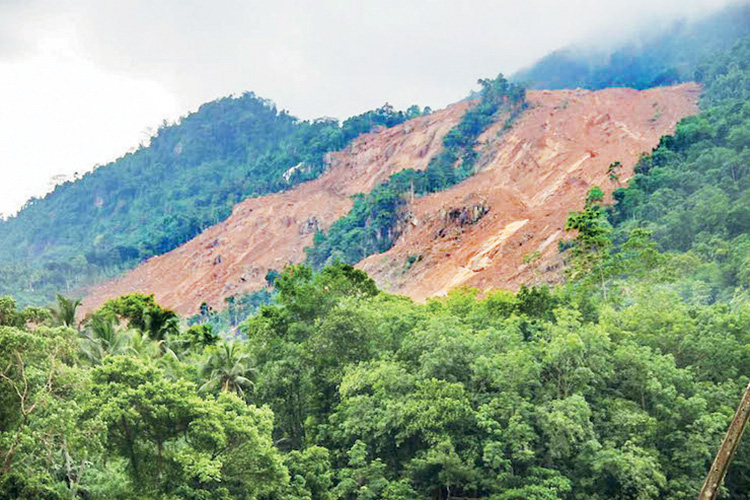
In many regions of Sri Lanka, the land itself has become more vulnerable. Rising temperatures and unpredictable rainfall weaken soil structures. When long dry spells are followed by sudden downpours, the earth cannot hold together. Hillsides become unstable and landslides occur with devastating speed. Villages that once felt safe now face new threats as slopes collapse without warning. These disasters are not simply natural. They are intensified by human activities such as deforestation, poor land management and unplanned construction. Climate change acts as a catalyst, magnifying these risks and turning minor vulnerabilities into life threatening dangers.
The Sea level rise adds yet another layer of concern. The coasts of Sri Lanka are home to millions of people, as well as vital industries such as fishing, tourism and trade. Higher sea levels make coastal flooding far more common, especially when combined with storm surges. During recent storms, waves pushed much farther inland than usual, damaging homes, shops and fishing equipment. Saltwater intrusion also harms soil and freshwater supplies, threatening agriculture in coastal zones. With sea levels continuing to rise, these risks will only grow unless long term protective measures are put in place.
It is also important to recognise the human side of these disasters. Climate change is not only about shifting weather patterns. It is about the people who must confront the consequences. In the aftermath of the recent events, Sri Lankans have shown remarkable courage. Families have worked together to clear debris, rebuild houses, restore livelihoods and comfort those in distress. Yet the burden has not been evenly distributed. Low income households, informal settlements and rural communities often face the greatest hardships. Many of them live in areas more prone to flooding and landslides. They also have fewer resources to recover when disasters strike. Climate change therefore deepens existing inequalities, making vulnerable groups even more exposed.
Children are among the worst affected. Schools often close for days or weeks after floods, interrupting education and adding stress to families already struggling with upheaval. Health risks rise as stagnant water becomes a breeding ground for mosquito borne diseases. Malnutrition can worsen when livelihoods are disrupted and food prices increase. Elderly people face additional risks because they may have difficulty moving quickly during emergencies or accessing medical care after the disaster.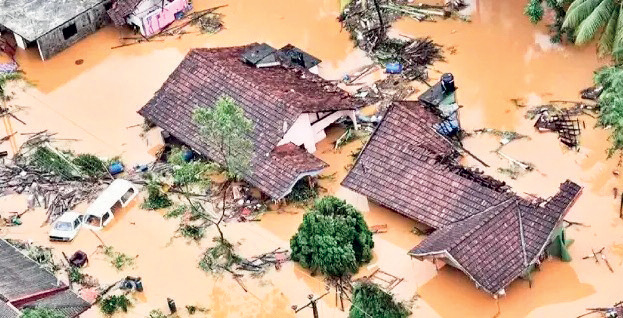
In cities, extreme weather strains essential services. Heavy rains overwhelm drainage systems, causing urban flooding that brings traffic to a halt and damages vehicles and businesses.
Hospitals face sudden influxes of patients. Water treatment plants struggle to maintain supply when rivers overflow or become contaminated. Power outages become common as strong winds damage transmission lines. These disruptions show how deeply interconnected human systems are with the natural environment. When the climate changes, every part of society feels the impact.
Despite the grim realities, there is reason for hope. Sri Lanka has a long history of resilience. Communities have rebuilt after countless storms, droughts and conflicts. Today the country has access to better technology, stronger scientific knowledge and more global support than ever before. What is needed is a clear commitment to prepare for the future rather than react only after disasters strike.
One of the most promising strategies is early warning systems. Accurate forecasts can save lives by giving people the time they need to move to safety. Sri Lanka has already improved its meteorological capabilities, but there is still room to strengthen local communication networks so that warnings reach everyone, including those in remote areas or without internet access. Community education is equally important. When people understand what climate change means for their region, they can make informed choices about housing, farming and water use.
Infrastructure must also evolve. Drainage systems in many towns need upgrading to handle more intense rainfall. Riverbanks require reinforcement to prevent flooding. New buildings, particularly in risk prone zones, must follow safety standards that take climate change into account rather than relying on outdated assumptions about weather patterns. At the same time, restoring natural ecosystems can offer powerful protection. Replanting mangroves, preserving wetlands and maintaining forest cover all help buffer the impact of floods, storms and landslides. Nature is one of the most effective defences against extreme weather when it is allowed to function properly.
On a broader level, Sri Lanka will benefit from global efforts to slow climate change. The island is a small emitter of greenhouse gases compared to many industrialised nations, yet it bears a heavy share of the consequences. International cooperation is essential to reduce harmful emissions, invest in renewable energy and support adaptation in vulnerable countries. Sri Lanka can also strengthen its energy security by expanding solar, wind and other sustainable sources, which reduce dependence on fossil fuels that contribute to climate change.
However, even as governments and scientists work on long term solutions, the experience of ordinary Sri Lankans during the recent storms offers an important lesson. Climate change is not a distant threat. It is happening now. It is felt in flooded living rooms, damaged paddy fields, broken bridges and displaced families. It reshapes the choices parents make for their children and the fears felt by those who live close to rivers or hillsides. It influences food prices, housing stability and health. It is a lived reality, not just an environmental problem.
At its heart, the story of Sri Lanka’s extreme weather is a story about people trying to protect their homes and loved ones. It shows how a global crisis can land with fierce intensity on a small island. But it also reveals the strength of human solidarity. Neighbours rescuing neighbours. Strangers offering food and shelter. Volunteers stepping into danger to help those trapped in rising waters. This spirit of care will be essential in the years ahead as the climate continues to warm and weather events become even more unpredictable.
There is no single solution that will shield Sri Lanka from every future storm. Yet there are many steps the country can take to reduce risk, strengthen communities and build resilience. These efforts will require resources, planning and political will. They will demand cooperation across regions, sectors and generations. Above all, they will require recognising that climate change is not someone else’s problem. It is a shared challenge that demands collective responsibility.
The recent disasters have served as a warning and a call to action. They have shown how quickly weather can turn violent and how deeply it can disrupt daily life. But they have also shown the urgency of preparing for a hotter and more unpredictable world. Sri Lanka has the knowledge and the capability to adapt. Its people have the determination. If these strengths are harnessed with foresight and compassion, the country can chart a safer path through the stormy decades ahead.
Climate change may be reshaping the monsoon, but it does not have to dictate Sri Lanka’s destiny. With the right choices, the island can remain not only a place of natural beauty but also a place of resilience, hope and human connection in the face of a changing planet.
(The writer is an environmentalist.)
by Vincent David ✍️

President calls on Atamasthanadipathi Thero

US deploys two C-130J Super Hercules aircraft and personnel to assist in relief measures

Government prepares Anuradhapura farmers for Maha Season

Level III landslide warnings issued to the Districts of Kandy, Kegalle, Kurunegala and Matale extended till 1600 hrs on Monday [08]

A mechanism that goes beyond the normal state apparatus is needed to restore public life – President

President calls on the Mahanayake Thera of the Asgiri chapter

‘Dates have the highest sugar content to fight Coronavirus’

Sunday Island 27 December – Headlines

#SundayIsland 17th December – Headlines

Sunday Island – 28th March

Sunday Island Headlines – 21 March

Sunday Island – 21st February – Headlines
-
News5 days ago
Lunuwila tragedy not caused by those videoing Bell 212: SLAF
-
 News4 days ago
Level III landslide early warning continue to be in force in the districts of Kandy, Kegalle, Kurunegala and Matale
-
 Latest News6 days ago
Level III landslide early warnings issued to the districts of Badulla, Kandy, Kegalle, Kurunegala, Matale and Nuwara-Eliya
-
 Features6 days ago
Ditwah: An unusual cyclone
-

 Latest News7 days ago
Updated Payment Instructions for Disaster Relief Contributions
-

 News2 days ago
CPC delegation meets JVP for talks on disaster response
-

 Business2 days ago
LOLC Finance Factoring powers business growth
-

 News2 days ago
A 6th Year Accolade: The Eternal Opulence of My Fair Lady