
News
Prez stresses need fo new Constitution

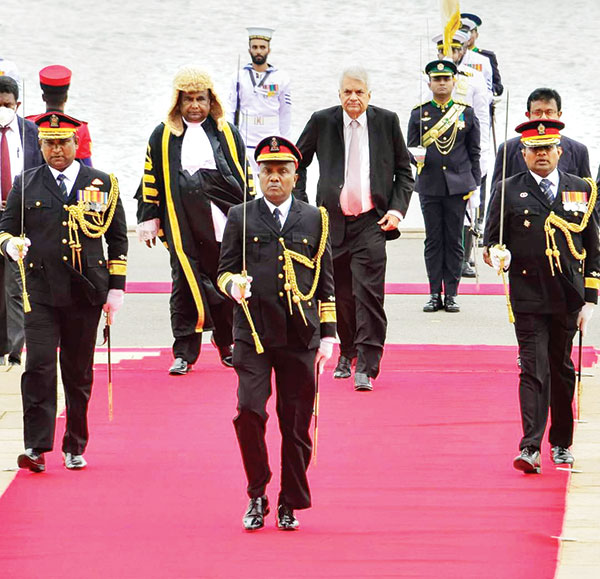
Declaring that the President had received more powers through the Constitution than former kings of Sri Lanka, President Ranil Wickremesinghe yesterday said that the Constitution should be changed immediately.
Delivering his maiden policy statement, President Wickremesinghe said that at present, he had the right to appoint the members of the Election Commission, Public Service Commission, Police Commission, Judicial Service Commission, etc. That was not favourable to democracy, the President said: “We should change that condition. Presently, it has inherited more power to the President than a previous king of Sri Lanka. It should be changed immediately.
“The President of a country does not have to be a King or a God who is exalted above the people. He or she is one of the citizens. Therefore, separate flags, separate logos, separate honour, awards should not be consecrated. I have already taken some necessary measures and will continue to do so.
“As an initiative of the political reform process, we wish to pass the 22nd Amendment to the Constitution, including all the effective elements of the 19th Amendment. I expect the full support of this Honorable House in its adoption.
“The Bill of the 22nd Amendment to the Constitution has now been presented to the Parliament. It is my view that discussing it and reaching a common consensus are most appropriate. We could not achieve everything we want through the 22nd Amendment to the Constitution. It is a fundamental to a series of reforms. It would be a constructive step if we adopt the reforms in one voice.
“As I mentioned earlier, measures are being taken to establish the Parliamentary Sectoral Oversight Committees immediately. All the political parties will have the opportunity to work together, through those Committees. “I have already submitted to this House the report forwarded by the National Movement for Social Justice in this regard.
“Also, I am working to establish a National Assembly consisting of political party leaders. For the next steps, we will be able to arrange a programme with a common minimum programme with the consent of all, through the National Assembly.
“The major commitment presented during the Presidential Election campaign in our country is the abolition of the executive presidential system. However, no one who came to power delivered on that commitment. On the other hand, even if someone abolishes the executive presidential system, the next party that comes to power has the ability to change it. That is the reason we require to reach a common national consensus through a body such as the People’s Assembly.
“The People’s Assembly is a fully independent body with the Government only providing the necessary resources. The Government has no influence on its functions or decisions. We decide in consultation with various parties, regarding the composition of the People’s Assembly.
“Views and proposals in this regard have already been made by the National Movement for Social Justice.
“The People’s Assembly may seek from the nations in our neighbourhood and the wider Asian region together with the relevant international agencies their expertise in the respective areas.
“The responsibility of preparing a National Plan for social, economic and political reforms is assigned to the People’s Assembly, by taking the opinions and advice of all stakeholders and acting with full transparency. The Assembly may wish to prepare this plan.
Highlights of President’s Wickremesinghe policy statement:
* Reiterated appeal for all political parties representing in Parliament to unite in the formation of an All-Party Government to overcome daunting economic challenges. He has already initiated discussions with political parties in forming an All-Party Government.
* Unfavourable international economic factors brought about by the Ukraine war and the collapse of the world’s major economies due to the Covid pandemic exacerbated and complicated our crisis.
* Measures taken to minimise power cuts, procure fertliser, LP gas and prevent food shortages as well as assist industries.
* Appreciation of assistance provided by India
* Restrictions on fuel supply to continue until end of this year.
* Efforts to modernise economy
* Referring to negotiations with the IMF, the parliament was told of moves to finalise the debt restructuring plan in collaboration with Lazard and Clifford Chance, who are international financial and legal experts.
* Efforts to encourage remittances to Sri Lanka through the banking system.
* Attract more tourists to Sri Lanka.
* Criticism of those who opposed valuable foreign investments while turning a blind eye to massive commercial loans at high interest rates. Reference was made to the cancellation of joint Trincomalee oil tank development project with India, protests against ‘Suwaseriya‘ ambulance service donated by India, cancellation of Japanese funded Light Rail Transit (LRT) and Container Terminal in the Colombo port.
* Preparation of National Economic Policy for the next 25 years.
* Need to address long standing land issues in the Northern and Eastern Provinces as part of the overall measures to win hearts and minds of the Tamil speaking community including those living abroad.
* Formulation of a national policy to combat bribery and corruption.



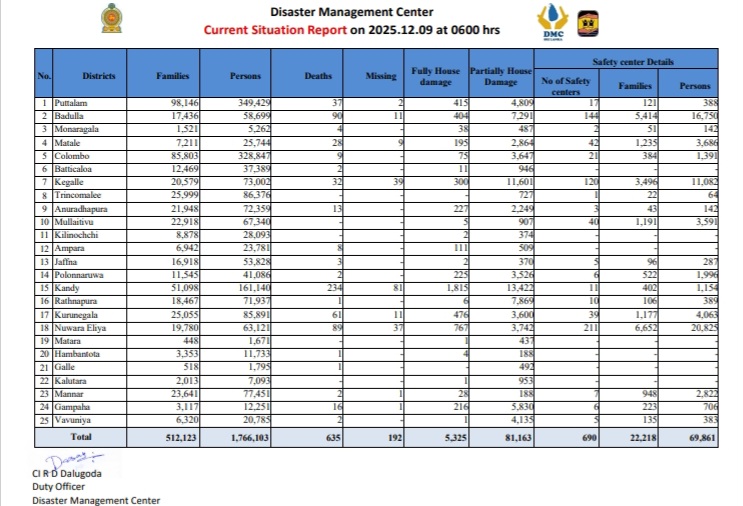
The Situation Report issued by the Disaster Management Center at 06:00 AM today [09th December] confirms that 635 persons have died due to floods and landslides that took place in the country within the past two weeks. The number of persons that are missing is 192.
News
Cyclone Ditwah leaves Sri Lanka’s biodiversity in ruins: Top scientist warns of unseen ecological disaster
Sri Lanka is facing an environmental catastrophe of unprecedented scale in the wake of Cyclone Ditwah, with leading experts warning that the real extent of the ecological destruction remains dangerously under-assessed.
Research Professor Siril Wijesundara of the National Institute of Fundamental Studies (NIFS) issued a stark warning that Sri Lanka may be confronting one of the worst biodiversity losses in its recent history, yet the country still lacks a coordinated, scientific assessment of the damage.
“What we see in photographs and early reports is only a fraction of the devastation. We are dealing with a major ecological crisis, and unless a systematic, science-driven assessment begins immediately, we risk losing far more than we can ever restore,” Prof. Wijesundara told The Island.
Preliminary reports emerging from the field point to extensive destruction across multiple biodiversity-rich regions, including some of the nation’s most iconic and economically valuable landscapes. Massive trees have been uprooted, forest structures shattered, habitats altered beyond recognition, and countless species—many endemic—left at risk.
Among the hardest-hit areas are the Royal Botanical Gardens, Peradeniya, Seethawaka Botanical Garden, Gampaha Botanical Garden, and several national parks and forest reserves under the Department of Wildlife Conservation and the Forest Department. Officials describe scenes of collapsed canopies, destroyed research plots, and landscapes that may take decades to recover.
Prof. Wijesundara said the scale of destruction demands that Sri Lanka immediately mobilise international technical and financial support, noting that several global conservation bodies specialise in post-disaster ecological recovery.
“If we are serious about restoring these landscapes, we must work with international partners who can bring in advanced scientific tools, funding, and global best practices. This is not a situation a single nation can handle alone,” he stressed.
However, he issued a pointed warning about governance during the recovery phase.
“Post-disaster operations are vulnerable to misuse and misallocation of resources. The only safeguard is to ensure that all actions are handled strictly through recognised state institutions with legal mandates. Anything else will compromise transparency, accountability, and public trust,” Prof. Wijesundara cautioned.
He insisted that institutions such as the Department of Wildlife Conservation, the Forest Department, and the Botanical Gardens Department must take the lead—supported by credible international partners.
Environmental analysts say the coming months will be decisive. Without immediate, science-backed intervention, the ecological wounds inflicted by Cyclone Ditwah could deepen into long-term national losses—impacting everything, from tourism and heritage landscapes to species survival and climate resilience.
As Sri Lanka confronts the aftermath, the country now faces a critical test: whether it can respond with urgency, integrity, and scientific discipline to protect the natural systems that define its identity and underpin its future.
By Ifham Nizam
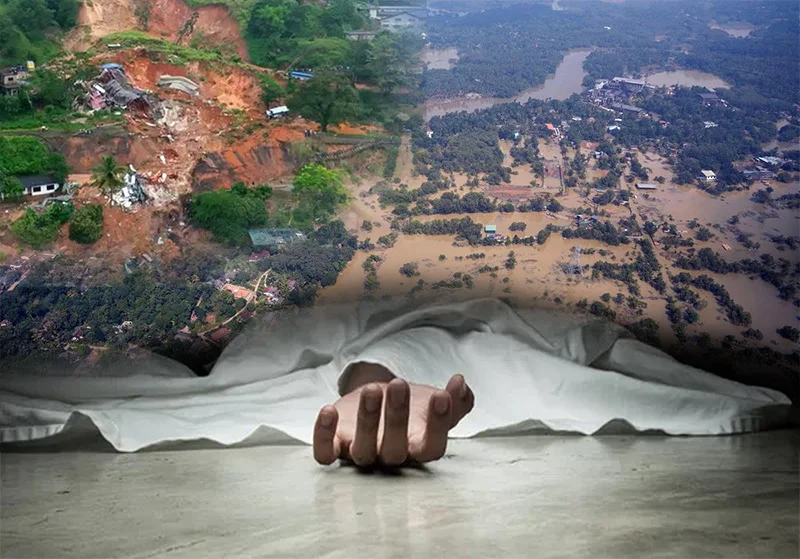
The Disaster Management Centre (DMC) has categorised 192 persons as missing as search operations were scaled down in flood-affected areas.
The death toll has been placed at 635, while the highest number of deaths was reported from the Kandy District. Kandy recorded 234 deaths.
According to the latest data, a total of 1,776,103 individuals from 512,123 families, in 25 districts, have been affected by the impact of Cyclone Ditwah.
The DMC has said that 69,861 individuals from 22,218 families are currently accommodated in 690 shelters established across the country.

Death toll 635 as at 06:00 AM today [09]

Heavy showers above 100 mm are likely at some places in the Northern and Eastern provinces and in Polonnaruwa district

Cyclone Ditwah leaves Sri Lanka’s biodiversity in ruins: Top scientist warns of unseen ecological disaster

Disaster: 635 bodies found so far, 192 listed as missing

More help from Pakistan

H’tota Port says it was fully operational during extreme weather

‘Dates have the highest sugar content to fight Coronavirus’

Sunday Island 27 December – Headlines

#SundayIsland 17th December – Headlines

Sunday Island – 28th March

Sunday Island Headlines – 21 March

Sunday Island – 21st February – Headlines
-
News6 days ago
Lunuwila tragedy not caused by those videoing Bell 212: SLAF
-

 News1 day ago
Over 35,000 drug offenders nabbed in 36 days
-
 News5 days ago
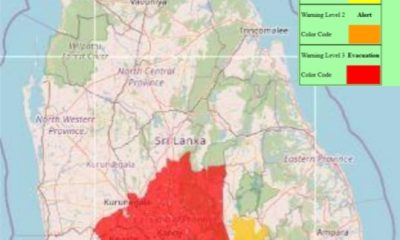
Level III landslide early warning continue to be in force in the districts of Kandy, Kegalle, Kurunegala and Matale
-
 Business3 days ago
LOLC Finance Factoring powers business growth
-

 News3 days ago
CPC delegation meets JVP for talks on disaster response
-
 News3 days ago
A 6th Year Accolade: The Eternal Opulence of My Fair Lady
-

 News1 day ago
Rising water level in Malwathu Oya triggers alert in Thanthirimale
-

 Midweek Review6 days ago
House erupts over Met Chief’s 12 Nov unheeded warning about cyclone Ditwah