
Business
Mediation Boards and youth: the role, need, and implementation of conflict resolution in Sri Lankan school systems


Conflicts are understood differently by young people depending on their experiences in society. As opposed to what society typically perceives as a conflict, it encompasses a much broader spectrum than mere disagreements.
Conflicts often arise as a result of differences in perception in the youth community. Even though individuality is a personal characteristic, it is likely to differ from person to person depending on their social background and environment. These differences are also influenced by nature and the environment, with individuals also having the potential to change in response to factors such as education, experience, religion, and culture, as well as inherited traits from past societies.
Having a better understanding of conflict situations can have a positive effect on a person’s ability to resolve the same while also broadening their perspective.
The role of education in
emotion management
The raising of a well-balanced, responsible personality is neglected in Sri Lanka’s education system, where instead the sole focus is on obtaining employment and maintaining a livelihood. The unreasonable expectations placed on children to become professionals such as engineers or doctors limit their opportunities to grow and discover their own individual talents and interests.
In order to handle conflicts effectively during their school years and throughout their adult lives, students need to be educated about emotional management at school. It is disheartening to observe the behavior of young people in relation to conflict resolution while in college. It reflects the lack of emotional management skills among young people, who are unable to deal with their own problems; instead focusing on fulfilling the agendas of influential individuals.
The tolerance of diversity among youth
First encounters with diversity occur in the school environment. The discipline and lessons from school prepare them for diversity and individuality as adults. Indeed, having sympathy and empathy for other peoples’ sadness, pain, and happiness, can reduce social conflicts.
Often, long-standing conflicts are the result of misinformation, misperceptions, and incorrect attitudes. The conflict becomes more serious as a result of resentment that has developed over time toward the individual, rather than as a result of the incident itself.
The concept of mediation
(Samathakaranya) has been around throughout history as a method of resolving disputes. A mediation process has the ultimate purpose of resolving disagreements by taking ownership of both the problem and the solution that can be agreed upon by both parties. A Mediation Board empowers the parties involved by fostering their sense of self-assurance, confidence, and ability to openly discuss disputes and reach an agreement. Similarly, the mediators remain impartial and do not exhibit any bias towards any of the parties involved in the dispute. Additionally, they avoid coming to predetermined conclusions and ensure that the process is handled humanely and sensitively without harming anyone or creating conflict within the community.
Do Mediation Boards work well to resolve conflict between young people?
Currently, in Sri Lanka, there are 329 Conciliation Boards in operation, each consisting of a minimum of 12 members. A 40-hour course in mediation and communication techniques is required of Mediation Officers, and the final scores after a one-hour exam determine their selection.
Mediation Boards can settle disputes for youth of all ages despite their limited scope, and is the appropriate forum for anyone wanting to represent themselves in their own disputes.
The individual or party responsible for causing a dispute should not be viewed as an adversary during mediation. The principles of mediation teach that the most effective solutions to problems often result from engaging with those who might initially appear to be opponents. Communicating and solving problems in this manner leads to greater success.
An organization that respects the privacy of youth
First and foremost, the Mediation Board is responsible for maintaining the confidentiality of the problem you present. An adult may be able to assist you in discussing the issue freely, even if it is related to a romantic relationship. Following that, they provide the necessary guidance for resolving the dispute.
As a participant in mediation, you have the opportunity to analyze your problem according to your own preferences. The Mediation Board offers young people an excellent opportunity to seek guidance and support for their problems in a safe and open environment. In order to ensure the country’s future health and well-being, the Board is dedicated to listening and providing assistance to individuals while also maintaining their right to privacy.
The integration of mediation into school and university systems
The importance of mediation education in schools and universities cannot be overstated. With the assistance of the British Council, the Mediation Board Commission and the Ministry of Justice developed and launched a program in 2004 to address this need. A Mediation Unit was to be established in schools as part of the program. Essentially, this process involves referring certain disputes among school students to the school’s Mediation Unit which comprises senior students. Consequently, the school will establish a Mediation Unit comprising 25 students and five teachers. The Conciliation Unit consists of senior students who mediate disputes between parties.
It is not sufficient to implement a Mediation Unit at the school level alone. The need for its implementation at the university level has also emerged. University education should not only impart subject knowledge, but also cultivate a well-rounded student body that is acquainted with social issues, exposed to diverse forms of art and culture, and has an appreciation for literature. In addition to academic objectives, this is also a societal responsibility.


HNB Finance PLC has been honoured with two prestigious accolades at the CMA Excellence in Integrated Reporting Awards 2025, reaffirming the company’s commitment to transparency, good governance, and integrated business performance.
At this year’s ceremony, HNB Finance PLC was awarded Second Runner Up – joint in the category of “Best Integrated Report , Finance and Leasing Sector”, and also received a Merit Award in recognition of its continued efforts to enhance reporting quality and strengthen stakeholder communication.
The CMA Excellence in Integrated Reporting Awards, organised annually by the Institute of Certified Management Accountants (CMA) of Sri Lanka, acknowledge organisations that demonstrate superior financial reporting standards aligned with global best practices. Winners are assessed on key criteria such as financial performance and strategic management, corporate governance and compliance, innovation and digital transformation, sustainability practices, and professional excellence.
Chaminda Prabhath, Managing Director/CEO of HNB Finance PLC, commented on the recognition, “These awards reaffirm our commitment to upholding the highest standards of integrated reporting and transparent financial disclosure. At HNB Finance, we remain focused on delivering sustainable long-term value through robust governance frameworks, prudent financial management, and continuous innovation. The acknowledgement by CMA Sri Lanka reflects the disciplined efforts of our teams across the organization and motivates us to further enhance our reporting quality, strengthen ESG integration, and reinforce our stakeholder centric approach.”
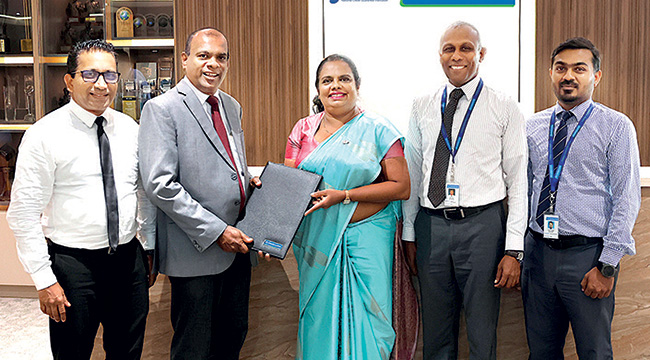
The Commercial Bank of Ceylon has reaffirmed its long-standing commitment to advancing women’s empowerment and financial inclusion, by partnering with the National Credit Guarantee Institution Limited (NCGIL) as a Participating Shareholder Institution (PSI) in the newly introduced ‘Liya Shakthi’ credit guarantee scheme, designed to support women-led enterprises across Sri Lanka.
The operational launch of the scheme was marked by the handover of the first loan registration at Commercial Bank’s Head Office recently, symbolising a key step in broadening access to finance for women entrepreneurs.
Representing Commercial Bank at the event were Mithila Shyamini, Assistant General Manager – Personal Banking, Malika De Silva, Senior Manager – Development Credit Department, and Chathura Dilshan, Executive Officer of the Department. The National Credit Guarantee Institution was represented by Jude Fernando, Chief Executive Officer, and Eranjana Chandradasa, Manager-Guarantee Administration.
‘Liya Shakthi’ is a credit guarantee product introduced by the NCGIL to facilitate greater access to financing for women-led Micro, Small, and Medium Enterprises (MSMEs) that possess viable business models and sound repayment capacity but lack adequate collateral to secure traditional bank loans. Through NCGIL’s credit guarantee mechanism, Commercial Bank will be able to extend credit to a wider segment of women entrepreneurs, furthering its mission to drive inclusive economic growth.
Business
Prima Group Sri Lanka supports national flood relief efforts with over Rs. 300 Mn in dry rations

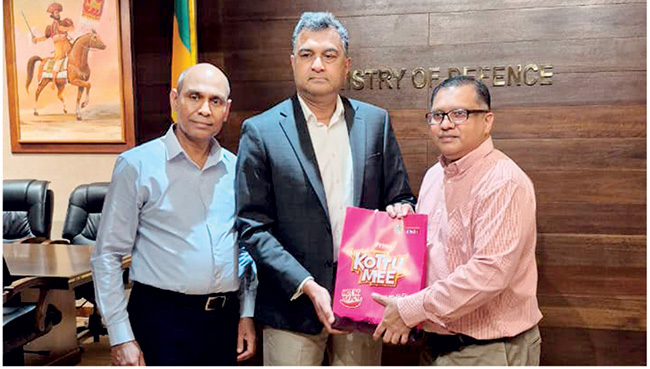
Prima Group Sri Lanka has pledged assistance valued at over Rs. 300 million, providing essential Prima food products to support communities affected by the recent floods across the island. This relief initiative is being coordinated through the Ministry of Defence to ensure the timely and effective distribution of aid to impacted families.
As part of this commitment, Prima Group Sri Lanka donated a significant stock of Prima dry rations to the Government of Sri Lanka on 30 November. The consignment will be distributed across multiple severely impacted districts. These supplies will support families facing disruptions to daily life, ensuring they receive assistance as recovery efforts continue.
The handover took place at the Ministry, where the donation was received by the Secretary of Defence, Air Vice Marshal (Retired) Sampath Thuyacontha. Representing Prima Group Sri Lanka, Sajith Gunaratne – General Manager of Ceylon Agro Industries Limited, and Sanjeeva Perera – General Manager of Ceylon Grain Elevators PLC, officially presented the donation.
Prima Group has been standing with the people of Sri Lanka for over 40 years, and this donation reflects its broader commitment to the nation during challenging times. As relief operations continue across the island, the company remains focused on helping families rebuild their lives and supporting the ongoing recovery process in collaboration with the Government Authorities.

President calls on Atamasthanadipathi Thero

US deploys two C-130J Super Hercules aircraft and personnel to assist in relief measures

Government prepares Anuradhapura farmers for Maha Season

Level III landslide warnings issued to the Districts of Kandy, Kegalle, Kurunegala and Matale extended till 1600 hrs on Monday [08]

A mechanism that goes beyond the normal state apparatus is needed to restore public life – President

President calls on the Mahanayake Thera of the Asgiri chapter

‘Dates have the highest sugar content to fight Coronavirus’

Sunday Island 27 December – Headlines

#SundayIsland 17th December – Headlines

Sunday Island – 28th March

Sunday Island Headlines – 21 March

Sunday Island – 21st February – Headlines
-
News5 days ago
Lunuwila tragedy not caused by those videoing Bell 212: SLAF
-
 News4 days ago
Level III landslide early warning continue to be in force in the districts of Kandy, Kegalle, Kurunegala and Matale
-
 Latest News6 days ago
Level III landslide early warnings issued to the districts of Badulla, Kandy, Kegalle, Kurunegala, Matale and Nuwara-Eliya
-

 Features6 days ago
Ditwah: An unusual cyclone
-

 Latest News7 days ago
Updated Payment Instructions for Disaster Relief Contributions
-

 News2 days ago
CPC delegation meets JVP for talks on disaster response
-

 Business2 days ago
LOLC Finance Factoring powers business growth
-
 News2 days ago
A 6th Year Accolade: The Eternal Opulence of My Fair Lady