
Opinion
Maha Jana Handa at Nugegoda, cyclone destruction, and contenders positioning for power in post-NPP Sri Lanka – I

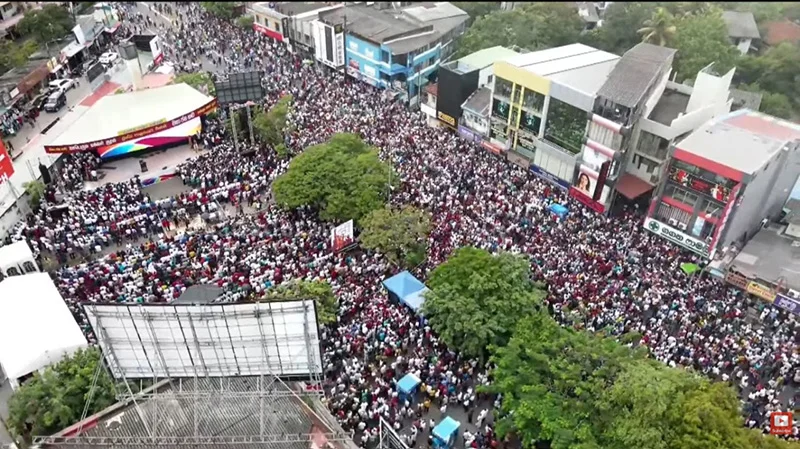
The Joint Opposition rally dubbed the ‘Maha Jana Handa’ (Vox Populi/ Voice of the People) held at the Ananda Samarakoon Open Air Theatre, Nugegoda on 21 November, 2025 has suddenly acquired a growing potential to be remembered as a significant turning point in post-civil conflict Sri Lankan politics, in the wake of the meteorological catastrophe caused by the calamitous Ditwah cyclonic storm that devastated the whole country from north to south and east to west on an unprecedented scale. But the strength of this prospect depends on the collective coordinated success of the future public awareness raising rallies, promised by the participating opposition parties, against the incumbent JVP-led NPP government. They are set to expose what they perceive as the government’s utterly inexperienced and unexpectedly authoritarian stand on certain vitally important issues including the country’s national security and independence, political and economic stability, and the Lankan state’s unitary status. The government is also alleged to be moving towards establishing a form of old-fashioned single party Marxist dictatorship in place of the firmly established system of governance based on parliamentary democracy, which was almost toppled by the adventitious Aragalaya protest of 2022 but saved by the timely intervention of some patriotic elements.
The minefield of policy making that the government must negotiate is strewn with issues including, among others: the seven or so recent agreements or MOUs (?) secretly signed with India; the unresolved controversy over the allegedly illegal clearance of some 323 containers (with unknown goods) without mandatory Customs inspection, from the Colombo Port; the Prime Minister’s arbitrary, apparently ill-considered and hasty education reforms without proper parliamentary discussion; the proposed culturally sensitive lgbtqia+ legislation non-issue (it is a non-issue for Sri Lanka, given its dominant culture); the so-called IMF debt trap; dealing with the unfair, virtually unilateral UNHRC resolutions against Sri Lanka; the inexplicably submissive surrender of the control of the profit-making Colombo Dockyard PLC to India; some government personal assets declarations that have raised many eyebrows, and the government’s handling of anti-narcotic and anti-corruption operations. The opposition politicians relentlessly criticise the ruling JVP/NPP’s failure to come out clean on these matters. But they themselves are not likely to be on an easy wicket if challenged to reveal their own positions regarding the above-mentioned issues.
In addition to those problems, the much more formidable challenge of unsolicited foreign-power interference in Sri Lanka’s internal affairs, in the guise of friendly intervention, remains an unavoidable circumstance that we are required to survive in the geostrategically sensitive region where Sri Lanka is located. Having been active right from the departure of the British colonialists in 1948, the foreign interference menace intensified after the successful ending of armed separatist terrorism in 2009. Such external interferences are locally assisted by latent domestic communal disharmony as well as real political factionalism, both of which are normal in any democratic country.
The war-winning President Mahinda Rajapaksa, as the leader of the SLFP-led United People’s Freedom Alliance (UPFA), was made to suffer a largely unexpected electoral defeat in 2015 through a foreign-engineered regime change operation that tacitly favoured his key rival, UNP leader Ranil Wickremesinghe. Mahinda was betrayed by his most trusted lieutenant Maithripala Sirisena.
The SLFP, a more middle of the way socialist-leaning rival political party, was formed in September 1951—five years after the birth of the UNP—and was elected to power in 1956, ending a near decade under the rather West-friendly latter party. It was deemed to be a ‘revolution’ that started an era of ‘transition’ (from elitist to common citizen rule). From nominal independence in 1948, governing power has to date alternated between these two parties or alliances led by them, except for the last electoral year, 2024. Though incumbent Executive President Anura Kumara Dissanayake may be said to have made history in this sense, the fact remains that he was barely able to scrape just 43% of the popular vote as the head of a newly formed, JVP-led NPP. Dissanayake was sworn in as President in September 2024. But his less than convincing electoral approval triggered a massive victory for the NPP at the parliamentary election that followed in November, giving him a parliament with 159 members, which is unprecedented in Sri Lanka’s electoral history.
In my opinion, there are two main reasons for this outcome. One is that the average Sri Lankan voters trust democracy. Since the president elect is accepted as having won the favour of the majority of the pan-Sri Lankan electorate, the general public choose to forget about their personal party affiliations and tend to vote for the parliamentary candidates from the party of the elected president. This is particularly true of the majority Sinhalese Buddhist community represented by the two mainstream, non-communal national parties, the UNP and the SLFP. The brittle foundation of that victory is not likely to sustain a strong enough administration that is capable of introducing the nebulous ‘system change’ that they have promised in their manifesto, while it is becoming clear that the general performance of the government seems to be falling far short of the real public expectations, which are not identical with the unconscionable demands made by the few separatist elements among the peaceful Tamil diaspora in the West, to whom the JVP/NPP alliance seems to owe its significantly qualified electoral success in 2024.
The Maha Jana Handa reminded me of the long Janabalaya Protest March from Kandy to Colombo where it ended in a mass rally on September 5, 2018. That hugely successful event was organised by the youth wing of the SLPP led by Namal Rajapaksa, who was an Opposition MP during the Yahapalanaya. He has played the same role just as efficiently on the most recent occasion, too. At the end of his address during the Maha Jana Handa, he declared his determination to bring down the malfunctioning JVP/NPP government at the earliest instance possible. Probably, he missed Ranil’s protege Harin Fernando’s speech that came earlier. This was because Namal Rajapaksa joined the rally midway. Harin had brought a message from his mentor Ranil to be read out to the rally audience. But he said he didn’t want to do so after all, saying that it was not suitable for that moment. Anyway, during his speech, Harin said emphatically that the era of heirs apparent or crown princes was gone for good. People knew that he was alluding to Sajith Premadasa and Namal Rajapaksa (sons of former Presidents hopeful of succeeding Anura Kumara Dissanayake). Harin was seen biting his tongue or sticking it out a little as he was preparing to leave the stage at the end of his address. Was he regretting what he had just said or was he cocking a snook at what, he was sure, was Namal’s ambition that would be revealed in his speech, the rally having been organised by the Pohottuwa or the SLPP? (To be continued)
by Rohana R. Wasala


Cyclonic storm Ditwah, named as such by Yemen referring to Detwah lagoon in one of its islands, caused severe devastation in Sri Lanka though it was categorised a weak tropical cyclone. When it hit on Thursday 27th November, the main problem was the unprecedented rain, some areas experiencing over 500 millimetres in 24 hours. Fortunately, wind speeds were not high reaching a maximum of only 45 mph, the sort of wind speed not infrequently encountered in the UK. In contrast, Hurricane Melissa, a category 5 storm which struck Jamaica, just a month ago, had winds reaching 185 mph! Though it was the most powerful storm to hit Jamaica ever, causing extensive damage across the island due to strong winds with added torrential rainfall causing landslides, the death toll was only 54 with further 15 people reported missing. It affected Cuba, Dominican Republic, and Haiti as well, with a further 48 deaths. Jamaicans were forewarned and were well prepared. It looks as if this did not happen in Sri Lanka. Though politicians are fighting over this aspect, despite it being not the priority, it is never too early to learn lessons. My comments that follow should not, in any way, detract from the very positive actions the government has taken and continues to do so, as well as the heroic efforts of volunteers putting their own lives at risk.
I did not realise the enormity till Friday (28) evening, when Ven. Teldeniyaye Amitha, who conducts a fortnightly Mindfulness meditation session over Zoom, told the participants that we should instead do Kindness meditation in view of the catastrophic situation in Sri Lanka. As soon as the session was over, I switched on to YouTube and was shocked by the images of destruction seen. When I contacted a good friend of mine in Kandy on Saturday 29th afternoon, what he told me made me realise that there were no warnings at all.
This lack of warning was not due to information being not available, I learned later. In fact, the DG of Meteorology has warned of an impending catastrophe when inclement weather was discussed on “Big Focus” programme broadcast over Derana TV on 12th November, in the presence of the DG of the Disaster Management Centre (DMC). It also further transpires that BBC World Service, the day before, accurately predicted that Cyclone Ditwah will cause heavy rainfall, up to 500mm, in Sri Lanka. Thus, there is no doubt that the government failed in its duty of adequate warning and taking action to minimise damage. Perhaps, it may have something to do with their labelling the DMC a ‘White Elephant’ in the past and threatening to dismantle it. Meteorological department’s lack of latest radar equipment is no excuse as information could be obtained from many sources. Some scientists whose sympathies are with the governing party seem to pronounce that weather predictions are unreliable. This may be so in the long term but, surely, BBC’s prediction the previous day, as well as the regular warnings sent by the Meteorological Service of India, should have been taken seriously. It is a great shame that the government does not seem prepared to admit that it made a mistake. Without that lessons cannot be learned!
It was disgusting to see a lady MP, who seems to be a loose cannon, having the audacity in parliament to blame Derana TV for broadcasting that programme! If true, it is more worrying that an opposition MP has stated in parliament that the Secretary of Defence has threatened the DG of Meteorology. In the latest turn of events, Deputy Minister Mahinda Jayasinghe has stated that the opposition should be sued for being silent on the weather warning! Does he not realise that by such loose talk he is helping the government to dig its own grave!
The other important question is whether the opening of sluice gates of reservoirs contributed to death and destruction. Some experts opine that had sluice gates been opened in advance to accommodate the expected torrential downpour, a significant amount of destruction and some deaths could have been avoided. This needs careful study, not to apportion blame, but to make sure that any future recurrences could be prevented. Considering the global changes in weather experienced, whatever the reason may be, we need to be prepared for this type of eventuality.
At a time of an unprecedented national emergency when cooperation of all was needed, the mudslinging on social media, both by supporters and opponents of the government, was despicable. There seems to be some truth to the accusations that the governing party goons hindered attempts by the opposition to help the affected, to claim credit for themselves! Do they think people in distress care whether ‘red stars’ are attached to aid packets?
The fact that the government seems incapable of taking criticism was made obvious by the actions of the Deputy Minister of Public Security. Though his Minister and the President subsequently denied that emergency powers would be used to suppress dissent,Watagala’s despicable behaviour, as well stated in the editorial “Emergency turns Jekyll into Hyde” (The Island, 5 December), deserves condemnation. There is a well justified suspicion that the Police are behaving as a paw of the ruling party, as two police officers with shadows over them were, plucked out of retirement, unashamedly appointed to two key positions as a reward for their political campaigning.
Perhaps, the comments made by Jaffna district MP, Dr Archchuna should make the government rethink, leave the past behind and act rationally. He told parliament that he had been rescued by Sinhala war heroes and sheltered in a Navy camp, criticising the government for insulting the armed forces. Considering the yeoman’s service rendered by the tri forces during this catastrophe, it is high time the governing party realised that service personnel are required at other times too, not only during war, and that they deserve the gratitude and the respect of the nation for saving us from terrorism too.
The best way to honour those who died during the recent disasters is by learning lessons from this tragedy so that we would be better equipped for any future emergencies. This could be done only if the government is prepared to eat humble pie and admit that mistakes were made. Do sincerely hope that they are big enough, and humble too, to do so!
By Dr Upul Wijayawardhana


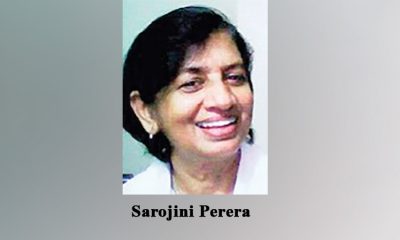
The 6th of December marked the sixth solar cycle since my adored life partner, Dr Malwattage Josephine Sarojini Perera (née Peeris), left this mortal world. Six years have elapsed; a period characterised by a searingly perpetual heartache. However, her inspiring influence is not diminished by the passage of time, and her memory has become more burnished and sublimely potent. It has transformed from a painful void into a sparkling, indestructible legacy that fortifies the hearts of all who were privileged to share her path.
The abyss left by her departure is multitudinous for all of us, including those who benefited from her professional dedication. Nevertheless, the consciousness of her magnificent journey, a spectacular 72 years, 2 months, and 11 days on this planet Earth, remains as a seamless record of a unique chronicle. It was the radiance of her inner spirit that rendered her truly peerless. She epitomised the beautiful words of one of my favourite Sri Lankan lady singers, “Beauty is how you feel inside; you glow from within.” Sarojini was a woman of monumental dignity and benevolence, whose serene, consistent luminosity brought a radiance into every room she entered. Her smile was a glorious spectacle of her lovely inner human nature; a pure expression of her soul’s integrity. That spectacularly radiant smile epitomised the immortal words of the beautiful song by Nat King Cole, “Smile though your heart is aching, smile even though it is breaking, when there are clouds in the sky, you will get by.“
Throughout her tenure on earth, she embodied the highest form of selfless service, dedicating her energies wholly to our family unit, her relatives, and all her acquaintances. She served her patients with an unreserved commitment, functioning as the very milieu of abiding reassurance for them. Her chosen field in medicine was one of profound challenges and pressing needs. She primarily worked ever so tirelessly with individuals afflicted and affected by Sexually transmitted Diseases, HIV and AIDS. They were a cohort frequently marginalised, ostracised, and terribly wounded by societal judgment. Yet, this extraordinary woman approached her work with limitless compassion and an intrinsic, deep-seated sense of humanitarian duty. She held an irrefutable conviction that beyond the stark finality of any medical diagnosis, there was a human being whose entitlement to honour, consideration, respect and warmth was absolute.
Sophocles wisely said: “One word frees us of all the weight and pain of life: That word is love.” Sarojini’s approach to life was built upon this very word ‘love’ as its foundation. She remained steadfastly true to her ethical moorings, never wavering in her commitment to assuage suffering and nurture genuine understanding. Her patients were not mere cases receiving clinical attention; they were embraced into a circle of care that extended beyond the confines of the clinic. Sarojini’s gentle disposition and empathetic spirit captivated all those who came seeking relief and comfort in her ministrations.
She extended not only medical expertise but also essential emotional ballast, serving as a critical beacon of optimism in times of the most profound darkness and utter despair. Her engagement was holistic; she saw the complete person, not just the disease. The philosopher Kahlil Gibran expressed a sentiment that describes the core values of her life: “You give but little when you give of your possessions. It is when you give of yourself that you truly give.” Her affection emanated as a gentle, regenerative anodyne, calming the distressed spirits of those sighing in overwhelming heartache. Her bequest in this vital domain of medicine is not merely a record of treatments, but a register of hearts healed and spirits uplifted by unconditional acceptance and love.
Beyond her professional life, Sarojini was the gravitational centre of our existence; a loving spouse, an undaunted mother, and a precious confidante. The habitat and the canvas of love we built together were a haven of affection and composure, a place where joy thrived, and the air was often vibrant with shared merriment. She cultivated her family with boundless tenderness, sowing and nurturing the essential precepts of benevolence, rectitude, and resilience within us. In return, we never made her cry, but sometimes she cried for others, and some made her cry too.
Her capacity for quiet strength was remarkable; she could maintain perfect equilibrium even when confronted with severe setbacks, always taking deliberate, measured steps to restore serenity and balance. Her affection is a vibrant force that persists in the deepest recesses of our hearts, a covenant that triumphantly surpasses the limitations of physical existence and the transience of life. The deep impact of her role as a matriarch cannot be overstated; she was the silent architect of our moral framework and emotional stability, and the queen of our hearts.
As we reflect on her exceptional life and the vast bounty of goodness she left behind, our determination is not to be subdued by the grief of her physical absence, but rather, to eulogise the radiant splendour of her time amongst us. It is a legacy beyond epithets and the true portrayal of the lilting music of remembrance. We feel the unremitting pain of missing her absolutely and profoundly. She may have transitioned from this worldly realm, but her vital essence remains inextricably bound to ours, steering us with her quiet wisdom and inspiring us with her incomparable dignity. Sarojini’s life stands as an eternal affidavit to the transformative power of enduring love, deep empathy, and sacrificial duty. It remains a boon that richly augments our present and illuminates our future. True beauty, as she demonstrated, is not simply what the eyes can witness, but, more crucially, what the soul can permanently safeguard. What we perceive visually is destined to fade, but the treasures we store within our hearts will remain eternally.
Many, including myself, our daughter Maneesha and our grandchildren, Joshua, Malaika and Jaydon, have endeavoured with every available adjective and hyperbolic utterance to paint a faithful portrait of the superlative person that was Sarojini. Yet, even if we were to compile tomes detailing her excellence, the effort would still fall short of creating a realistic depiction that truly captures her profile. It is simply impossible to confine a description of her magnificence to even a substantial plethora of words.
For my part, I had the wonderful pleasure of the company of that stunning lady for all those blessed years, from the dawn of our courtship in 1973 until her fateful day of final rest. Despite the finality of that separation, memories remain the ultimate constant. I will forever recall her life as an exquisite and enduring strand, a beautiful composition, that will never diminish and will reverberate throughout the balance of my time on this planet Earth.
Sarojini, your loved ones strive daily to revere your memory by actively embodying the virtues you demonstrated so effortlessly: boundless compassion, humane benevolence, unbridled affection, and an unwavering commitment to the welfare of others. This is a matter of seminal importance to us, as it is a pledge towards the continuity of the very matrix of your tapestry of life on Mother Earth.
Darling Sara, I will end with a couple of lines from the 1996 Quadruple Chart Topper, “Because You Loved Me” by Celine Dion, which very concisely sums up what you were to me: –
“You’ve been my inspiration.
Through the lies, you were the truth.
My world is a better place because of you.”
by Dr B. J. C. Perera
(This appreciation appeared in The Island online edition on 06 Dec. 2025)

Sri Lanka is facing one of its worst simultaneous flood and landslide disasters in many decades, with nearly two million people affected and more than 820 reported dead or missing after Cyclone Ditwah unleashed catastrophic flooding and landslides across the island. After 2004 Tsunami tidal wave disaster, this disaster has brought havoc in the life of Sri Lankans.
The human toll of Cyclone Ditwah continues to mount in Sri Lanka, with 481 confirmed deaths and 345 people still missing, according to the latest situation report issued by the Disaster Management Center.
The cyclone has left a trail of devastation across all 25 districts of the country, affecting 509,680 families and 1,814,534 individuals. Matara, Galle, and Hambantota have been less affected by recent heavy rains and flooding in Sri Lanka, with warnings issued and some minor flooding reported in Matara, and landslide risks in all three areas due to heavy downpours from the current monsoon, though some reports suggest they were less severely hit than districts like Kandy, Gampaha and Colombo.
The hardest-hit districts include Kandy, reporting the highest fatalities at 118 deaths and 171 missing, followed by Badulla (83 deaths), Nuwara Eliya (89 deaths), and Kurunegala (56 deaths). Other districts such as Kegalle (30 deaths) and Puttalam (29 deaths) have also suffered significant losses. Beyond the tragic loss of life, the cyclone has caused 1,967 homes to be completely destroyed and 50,173 partially damaged, leaving thousands displaced. Relief efforts are underway, with 1,236 safety centers currently sheltering 48,559 families (171,492 persons).
Infrastructure damage is extensive, with roads, bridges, irrigation systems, and transport networks severely affected or rendered inoperable.
Emergency teams are working tirelessly to restore essential services and prevent secondary crises, such as disease outbreaks.
The people of Sri Lanka have suffered widespread losses and damages in different parts of the country due to the wind and rain associated with Cyclone Ditwah. Stormy winds caused trees to fall and inflicted damage on houses and shops. Hundreds of homes have been partially or completely destroyed due to landslides.
Floodwaters have entered houses, shops, school buildings, hospitals, public buildings, roads, gardens, and agricultural fields, causing extensive damage. Most fatalities resulted from drowning or suffocation caused by injuries sustained in the floods and related landslides. Many people are experiencing trauma and other health impacts.
In addition, floodwaters have rendered mattresses, pillows, and clothing unusable, while electrical appliances and household items, including cooking utensils, have been damaged or destroyed. Thousands of bicycles, motorcycles, cars, vans, trucks, and buses have broken down due to water and mud infiltration, with some vehicles completely lost or missing.
Losses caused by these storms, floods, and landslides are extensive. Accurate information about the affected population and material losses must be collected from reliable local sources, such as mosques, temples, village offices, and community leaders. In many areas, this information is currently unavailable. Data collection must be conducted in such a way assess the immediate requirements and follow up actions and each village wise data collection should include details such as the number of people affected, the extent of material losses, Urgent needs of the affected population, immediate rescue actions to save life.
It is essential to identify measures required to restore communities to their normal state as quickly as possible. The immediate needs of the people must be properly assessed, because rescue and relief operations are the highest priority after a disaster.
Key emergency actions include:
· Saving lives: Injured individuals must receive prompt medical treatment. Survivors trapped in broken houses or collapsed buildings must be rescued.
· Handling the deceased
: The bodies of those who have died should be recovered and cremated according to their respective customs.
· Medical and food support
: Those rescued from rubble should be provided with immediate medical attention and appropriate food and water.
· Rescue operations
: Priority must be given to rescuing people trapped alive inside collapsed or buried buildings.
· Support for the displaced
: Food and water should be provided to individuals displaced by the disaster, whether they are staying in temporary shelters or with friends and relatives. In the early days after the disaster, cooked meals should be prioritised for large numbers of people, continuing as long as they remain in temporary accommodations.
The immediate needs of the people must be properly assessed, because rescue is the priority in the aftermath of a disaster. Saving lives is essential. Providing medical treatment to the injured, rescuing affected individuals, and guiding them to safe areas or shelters must be carried out without delay.
In addition, information must be quickly collected regarding areas where flood levels are dangerously high or above head level, locations affected by landslides, missing persons, the number of houses buried, and the number of people involved. These details should be obtained promptly through places of worship, knowledgeable community members, village officers, and other reliable sources, and then reported to the relevant authorities.
It is the people in the neighbourhood who are the first to be involved in disaster rescue operations. Therefore, essential information must be shared with them so they can act quickly and effectively.
Individuals who are trapped alive in collapsed houses or buildings must be rescued without delay. The bodies of those who have died should be handled and cremated in accordance with their respective religious customs and traditions.
Those rescued from the debris should receive immediate medical attention. While providing food, it is important to avoid giving solid meals to individuals with suspected fractures or injuries that may require urgent surgery. In such cases, only liquids may be given, and even that should be based on medical advice. A qualified doctor must assess the nature of the injury and confirm whether the person can be fed.
Meanwhile, rescue operations must be given top priority during avalanches, with immediate efforts focused on saving people who are trapped alive inside collapsed or buried buildings.
At the same time, food and water should be provided to those who have been displaced by these disasters and are staying in temporary shelters, as well as in the homes of friends and relatives. In the initial days, it is advisable to provide cooked meals, as this is the most practical and efficient way to support large numbers of affected people. Cooked food should continue to be supplied as long as they remain in temporary accommodations.
Once the disaster subsides and the floodwaters begin to recede, people will gradually return to their homes. At this stage too, their health and well-being must be considered. If floodwater has entered their houses, it may take at least three days to clean and restore them. Providing cooked food during these three days will be a considerable relief for the affected families.
If water has entered the homes of returning families, their food supplies, clothing, mattresses, and other items kept at floor level will have become wet and unusable. Therefore mats, pillows, two sets of clothing and adequate dry rations should be provided to those in need. Dry rations should be distributed in quantities sufficient to meet a family’s weekly requirements. If clothing is to be provided, it is best to supply new clothes.
At the same time, houses, schools, and places of worship in disaster-affected areas must be cleaned. Youth groups should take the initiative in assisting with the cleaning of homes. Working in organized teams to clean houses, compounds, and public buildings will help complete the work quickly and efficiently.
Those who participate in cleaning operations must carry proper safety gear such as boots, gloves, soap, adequate drinking water, food items, and adequate number of clothes for their own protection. They should also bring essential tools and equipment, including shovels, pickaxes, hammers, wrenches, garbage pickers, and single-wheel pushcarts. In addition, the use of larger equipment such as small and large backhoe machines, water pumps, wood-cutting tools, knives, garbage collection bags, buckets, and other necessary items will significantly improve the speed and effectiveness of recovery and cleaning efforts.
Carrying a gas cylinder and a portable gas cooker will also be useful for preparing meals during cleaning and recovery operations.
APPRECIATE SUPPORT OF ALL NATIONS
We express our sincere gratitude to all the countries that extended a helping hand during this calamity. India’s immediate relief and rescue assistance is especially commendable. Likewise, on behalf of all Sri Lankans, we convey our heartfelt appreciation to China, the United States of America, Japan, the Maldives, the United Arab Emirates, Qatar, Bangladesh, the Netherlands, and all other nations that stood with us at this critical moment.
We also gratefully acknowledge the contributions of local citizens, volunteers, and foreign nationals who took part in the rescue and recovery operations.
by M. S. M. Jansin
Management Consultant

A wage for housework? India’s sweeping experiment in paying women

Death toll 635 as at 06:00 AM today [09]

Heavy showers above 100 mm are likely at some places in the Northern and Eastern provinces and in Polonnaruwa district

Cyclone Ditwah leaves Sri Lanka’s biodiversity in ruins: Top scientist warns of unseen ecological disaster

Disaster: 635 bodies found so far, 192 listed as missing

More help from Pakistan

‘Dates have the highest sugar content to fight Coronavirus’

Sunday Island 27 December – Headlines

#SundayIsland 17th December – Headlines

Sunday Island – 28th March

Sunday Island Headlines – 21 March

Sunday Island – 21st February – Headlines
-
News6 days ago
Lunuwila tragedy not caused by those videoing Bell 212: SLAF
-

 News1 day ago
Over 35,000 drug offenders nabbed in 36 days
-
 News5 days ago
Level III landslide early warning continue to be in force in the districts of Kandy, Kegalle, Kurunegala and Matale
-

 Business3 days ago
LOLC Finance Factoring powers business growth
-

 News3 days ago
CPC delegation meets JVP for talks on disaster response
-
 News3 days ago
A 6th Year Accolade: The Eternal Opulence of My Fair Lady
-

 News1 day ago
Rising water level in Malwathu Oya triggers alert in Thanthirimale
-

 Midweek Review6 days ago
House erupts over Met Chief’s 12 Nov unheeded warning about cyclone Ditwah