
News
‘Justice for all’ calls for broad democratic movement to protect people’s rights

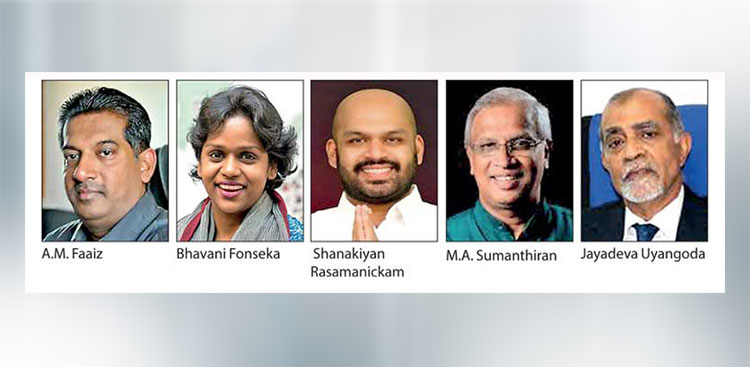
Good governance lobbyist “Justice for All” on Sunday called for fresh initiatives to urgently form a broad democratic movement mobilising the people of the country for a truly meaningful regime change in the near future.
In a statement the organisation said the broad democratic movement can eventually build a robust and inclusive democratic alliance between the politically awakened citizens, political parties and the civil society movements.
“Such a broad democratic coalition is urgently necessary to play the leading role in bringing deep democratic reforms back to the country’s immediate political agenda. Such a coalition will also be best suited to the task of mobilising the people of the country for a truly meaningful regime change in the near future,” the statement issued jointly by A.M. Faaiz, Bhavani Fonseka, Shanakiyan Rasamanikam, M.A. Sumanthiran and Jayadeva Uyangoda said.
In its statement titled “An Independence Day of Reflection, Reckoning and Reform”, the group said Sri Lanka is yet again at crossroads when marking 75 years of independence. A spiraling economic crisis has resulted in over 9 million fellow citizens slipping into poverty, with over 30% of families’ food insecure and 56,000 children facing acute malnutrition.
These startling figures are in the context of shortages of essential items, rising prices and continuing power cuts impacting the most vulnerable communities and exposing Sri Lanka’s deepening inequalities.
Despite the hardships faced by so many in Sri Lanka, the Government of President Ranil Wickremasinghe marked independence with pomp and pageantry reportedly costing Sri Lanka nearly Rs. 200 million, funds that could have been used to meet basic needs of Sri Lankans. Such extravagance must be juxtaposed to the Government’s claim of financial difficulties to hold the Local Government election.
Further, Sri Lanka is yet again confronted with renewed repression. 4th of February dawned with reports of brute force used by the police and thugs against those who participated in a peaceful and non-violent Satyagraha in Colombo and attempts to prevent protests in other parts of Sri Lanka. Such tactics are not new to Sri Lanka, with victims of violence, minorities, critics and political opponents having faced violence and intimidation for decades with no prospect of genuine reckoning. Despite Sri Lanka’s history of repression, the few months of Ranil Wickremasinghe’s presidency has witnessed new levels of repression including attacks on peaceful protesters, the use of national security and counter terror laws to target protests and protesters, creation of a High Security Zone in Colombo, intimidation, harassment and surveillance.
The post-independence period continues with the divide and rule policy, creating ethnic and religious cleavages and producing ethno-nationalism. This has sustained and reproduced root causes of the conflict, contributing to rising intolerance and violence with no genuine efforts at a political solution and reconciliation.
Despite a clear call for political reforms and a system change in Sri Lanka by the citizens since March last year, the authoritarian and militarised governance model continues under the new president, sustaining entrenched corruption, cronyism, nepotism and impunity.
These trends exacerbate the already existing crisis in governance, democratic decay, and the loss of people’s trust in the political class. Coupled with the sharpening economic and social crises, is a growing despair, anguish and loss of hope among the people. Hundreds of Sri Lankans are leaving the country every week in search of economic security and a better future abroad.
Amidst such a context, socio-economic and political reforms that work towards an inclusive, plural and peaceful Sri Lanka are urgently required. Reforms at a system change that reflects the demands of the people must be initiated. Such reforms should entail strengthening democratic institutions and processes in order to rectify the major deficiencies of Sri Lanka’s existing system of representative democracy, governance and politics which the citizens protest movement have highlighted.
This calls for fresh initiatives to form a broad democratic movement that can eventually build a robust and inclusive democratic alliance between the politically awakened citizens, political parties and the civil society movements.
Such a broad democratic coalition is urgently necessary to play the leading role in bringing deep democratic reforms back to the country’s immediate political agenda. Such a coalition will also be best suited to the task of mobilising the people of the country for a truly meaningful regime change in the near future.

Latest News
A mechanism that goes beyond the normal state apparatus is needed to restore public life – President


President Anura Kumara Dissanayake emphasised that a unified operational mechanism, which goes beyond the normal state administration, is required to restore public life after a disaster.
The President stated this while participating in the Kandy District Coordinating Committee meeting held at the Kandy District Secretariat on Saturday (06).morning
During the meeting, the President separately reviewed the progress of the programmes underway to restore essential infrastructure in the district, including the roadways, electricity, water and fuel supply, irrigation systems and communication facilities.
The President instructed officials to utilise the allocated provisions for the next 25 days to complete road clearing activities swiftly, until the permanent reconstruction of roads is completed.
The President also instructed that water supply in the district be fully restored within three days. Until then, the water requirements of the public should be met through bowsers and such activities must be carried out as an emergency measure beyond the usual procedure, with technical support from the Tri-Forces.
Further, he instructed that the cleaning of household wells be carried out under the coordination of Divisional Secretariats and that electricity supply in the district be restored by 31 December through temporary repairs, while major reconstruction work will be carried into the second phase.
The President pointed out the need to identify arable lands and give priority to cultivation. He instructed that cultivable paddy fields be identified urgently and supplied with the required irrigation water and highlighted the importance of coordinated action by the Department of Irrigation, Provincial Irrigation Department and the Department of Agrarian Development.
He also instructed officials to expedite the payment of the Rs. 200,000 compensation allocated to identified farmers and fields and to submit a report on the extent of vegetable cultivation affected in the district within two weeks. Accordingly, Rs. 150,000 per hectare will be paid as compensation to the affected vegetable farmers and necessary amendments will be made to provide the same compensation for losses incurred in banana cultivation.
The impact on the livestock sector due to the disaster was also broadly discussed. The President highlighted the need to maintain updated data regarding the number of farms and livestock.
He explained the need to restart damaged livestock farms swiftly, to restore income sources for the farmers and to meet the country’s food needs, including milk, poultry and eggs.
Discussions were also held regarding restoring fuel supply in the district. Due to road blockage, fuel supply has been disrupted in Pussellawa and Meetalawa. The President instructed that, through coordination between the Road Development Authority, the Tri-Forces and the Police, fuel be supplied to these areas by Saturday [06] evening.
The resumption of schools in the Kandy District was also discussed. The President instructed officials to minimise delays in reopening schools to ensure that examinations are held as scheduled.
The President also examined in detail the steps taken to restore the district’s health services, railways and communication facilities.
Discussions were held regarding housing damage and the resettlement of affected people. The roles of the Geological Survey and Mines Bureau and the required staffing needs were considered.
The President stated that state-owned lands in adjacent areas will be identified and presented for resettlement activities and necessary interventions will be made to release such lands through discussions with relevant institutions. He emphasised that the government’s objective is to resettle people safely and continuous assessment must be carried out to ensure that compensation provided for destroyed and partly damaged houses is used properly for reconstruction.
As all compensation payments will be made under the 2025 Budget, the President stressed the need to complete all payments before 31 December, to avoid a burden on the 2026 Budget. He said the dedication of all state officials is essential to successfully implement the programmes initiated to restore public life.
Attention was drawn to the garbage disposal problem in Gampola. As a long-term solution, the President instructed that, until the relevant Mahaweli land is released, land belonging to the Ceylon Electricity Board be temporarily allocated for the purpose.
Attention was also paid to the damage caused to state institutions due to the disaster situation.
While noting that natural disasters such as floods, storms and landslides cannot be prevented, the President emphasised that the loss of lives and property can be minimised. He stated that a proper study of the Central Highlands is needed and a long-term plan must be prepared to restore the eroding ecological system.
He further highlighted the need to enforce the powers of local authorities to prevent similar disasters in the future, stating that no room should be given for illegal constructions hereafter. He also noted that Ceylon Electricity Board should not provide electricity to such unauthorised locations.
The President stated that although some expected it would take a long time for the country to recover after the disaster, the government has already been able to restore public life to normalcy within a very short period. He added that by working together for a little longer, the desired goals can be achieved.
The President expressed special appreciation for the dedication shown by state officials and the Tri-Forces in carrying out these tasks.
Minister of Agriculture, Livestock, Land and Irrigation K.D. Lal Kantha, Deputy Minister of Transport and Highways Prasanna Gunasena, Deputy Minister of Health Hansaka Wijemuni, Members of Parliament Jagath Manuwarana and Thanura Dissanayake, as well as Central Province Governor Professor Sarath Abeykoon, Chief Secretary G.H.M.A. Premasinha, Kandy District Secretary Indika Udawatta and officials representing all line agencies including the Road Development Authority, Ceylon Electricity Board and the Irrigation Department attended the occasion.

President Anura Kumara Dissanayake on Saturday (06) morning visited the Asgiri Maha Viharaya and paid respects to the Mahanayake Thera of the Asgiri Chapter, Most Venerable Warakagoda Sri Gnanarathana Thera, from whom he received blessings.
The President briefed the Mahanayake Thera on the government’s programmes to provide relief to the people affected by the prevailing disaster situation and engaged in a brief discussion with him.
Thereafter, the President called on the Anunayake Thera of the Asgiri Chapter, Most Venerable Narampanawae Ananda Anunayake Thera and also held a brief discussion with him.

President Anura Kumara Dissanayake on Saturday (06) morning visited the Malwathu Maha Viharaya and paid respects to the Mahanayake Thera of the Malwathu Chapter, Most Venerable Thibbatuwawe Sri Sumangala Thera.
The President briefed the Mahanayake Thera on the government’s programmes to provide relief to the people affected by the prevailing disaster situation and engaged in a brief discussion.

A mechanism that goes beyond the normal state apparatus is needed to restore public life – President

President calls on the Mahanayake Thera of the Asgiri chapter

President calls on the Mahanayake Thera of the Malwathu chapter

Neser five-for trumps England’s belated resistance as Australia take 2-0 lead

Heavy rains hamper recovery as death toll from floods in Asia exceeds 1,750

Staff and tourists among 25 killed in Goa nightclub fire

‘Dates have the highest sugar content to fight Coronavirus’

Sunday Island 27 December – Headlines

#SundayIsland 17th December – Headlines

Sunday Island – 28th March

Sunday Island Headlines – 21 March

Sunday Island – 21st February – Headlines
-
News5 days ago
Lunuwila tragedy not caused by those videoing Bell 212: SLAF
-
 News4 days ago
Level III landslide early warning continue to be in force in the districts of Kandy, Kegalle, Kurunegala and Matale
-
 Latest News6 days ago
Level III landslide early warnings issued to the districts of Badulla, Kandy, Kegalle, Kurunegala, Matale and Nuwara-Eliya
-
 Features6 days ago
Ditwah: An unusual cyclone
-

 Latest News7 days ago
Updated Payment Instructions for Disaster Relief Contributions
-

 News2 days ago
CPC delegation meets JVP for talks on disaster response
-
 News2 days ago
A 6th Year Accolade: The Eternal Opulence of My Fair Lady
-
 Business2 days ago
LOLC Finance Factoring powers business growth