
News
Japan warns of threat of global downturn


Japanese Ambassador in Colombo Akira Sugiyama recently said that although Sri Lanka had been successful in combating Covid-19 pandemic, the continuing global crisis caused serious difficulty to the Sri Lankan economy, especially in export and tourism sectors.
Ambassador Sugiyama said so at the 41st Annual General Meeting of the Sri Lanka-Japan Business Council held recently at the JAIC Hilton where Merrick Gooneratne received the appointment as President of the Sri Lanka–Japan Business Council
The Ambassador said: First of all, on behalf of the Government of Japan, I would like to express our solidarity with the people and the Government of Sri Lanka in combatting COVID-19, while commending the strong leadership of the Government and the business leaders of Sri Lanka in tackling successfully the unprecedented challenges posed by COVID-19. Japan has provided USD9.6M grant aid to help Sri Lanka’s fight against COVID-19, including procurement of essential medical equipment like MRI system and CT scanners and improvement of hospital facilities.
The COVID-19 has had a serious negative impact on the global economy. Both Sri Lanka and Japan, like other countries in the world, are tackling the challenge of resuming and rebuilding economic activities while controlling the spread of the virus.
“Sri Lanka effectively implemented the curfew to contain the spread of the virus, while ensuring the people’s access to basic needs, including food and medicine, and without disrupting essential services in both public and private sectors. Now, the virus infection in Sri Lanka is successfully under control with zero community transmission. This is a commendable achievement. The global pandemic, however, caused serious difficulty to the Sri Lankan economy, especially in export sector and tourism. The Government of Sri Lanka announced several financial and monetary measures to mitigate this economic difficulty, and, most assuredly, they could lead to significant positive impacts on the Sri Lankan economy.
“Japan’s economy is in severe difficulty. The Government of Japan declared a State of Emergency on April 7th to request that the people and business community limit their activities to the minimum, although on a voluntary basis, to contain the COVID-19. Although the state of emergency was lifted on May 25 after pulling off the crisis, we still see new cases of infection every day. As disruption of social and economic activities in Japan and abroad takes a heavy toll on our economy. Japan’s economy contracted by 7.9 % in the second quarter of this year compared with the first quarter, which is equivalent to 28.1 % decline on an annualized basis. Japan is now struggling to strike an appropriate balance between reviving the economy and containing the virus spread. New Prime Minister Yoshihide Suga stressed in his first press conference, the most urgent agenda for the new Government is of course how we will get our economy back on track.
“Let me briefly discuss how consumer habits have changed in Japan after the COVID-19 pandemic, although I have to say that this is my layman’s view.
“As people start to work from home and spend more time at home because of the pandemic, their lifestyle and way of consumption have significantly changed. First, the COVID-19 has brought a considerable shift in the consumer’s style of shopping – from store shopping to on-line shopping. Because of stay-at-home requirement, consumers who were not familiar with online services such as restaurant delivery applications are now experimenting with these new devices. This has stimulated the uptake of digital commerce among more Japanese. Second, we are seeing an increasing demand for the goods and services which make working-from-home easy and efficient and staying-at-home more comfortable and enjoyable, including electronic appliances and online video services. In Japan, such consumption trend is called “nesting consumption”, which means that, like nesting birds, people stay and work at home and buy things online to keep their home tidy and comfortable.
“Next, products essential for the health and wellbeing of people such as masks and alcohol disinfectants are high in demand among consumers since people are now more conscious about hygiene and good health. In this connection, it should be noted that the COVID-19 has caused serious disruptions to global supply chains, resulting in shortages of various products, including such hygiene products. We keenly feel the need to diversify production bases of those products.
“Staying at home and health concerns are also changing payment methods of Japanese people. As some of you may know, Japanese people still have a preference for cash payment in daily lives, but prevalence of online shopping and hygiene concerns about touching money make people go for credit cards or prepaid cards more frequently.
“Since people stay home and do not go out, they do not pay for travel and hospitality services. As in Sri Lanka, in Japan tourism and hospitality business have lost business substantially because of the COVID-19. Since the tourism industry in Japan is increasingly dependent on inbound tourists, the entry ban of foreign tourists has been giving a serious negative impact on the tourism industry, especially local (outside Tokyo) businesses. To address this issue by promoting domestic travel, the Government of Japan has embarked on “Go to Travel Campaign” which gives domestic travelers a discount on travel costs, including hotel accommodations, if hotels or restaurants they use take strict health precautionary measures against the COVID-19.
“Of course, business people like you have much better ideas about these new trends. Having said that, I think that some of these changes will be here to stay even after the COVID-19 threat passes and could even open up new business opportunities.
With the lessons learnt from this pandemic, our two countries should come up with proper strategic moves to convert the global pandemic challenge into opportunities and I hope this would turn a new leaf in Japan-Sri Lanka business relations.”

Latest News
Landslide RED warnings issued to the districts of Kandy, Kegalle, Kurunegala, Matale and Nuwara Eliya extended up to 1600 hrs today [07]


The Landslide Early Warning Center of the National Building Research Organisation [NBRO] has issued landslide early warnings to the districts of Badulla, Colombo, Galle, Gampaha, Kalutara, Kandy, Kegalle, Kurunegala, Matale, Matara, Monaragala, Nuwara Eliya and Ratnapura effective from 16:00 hrs on 06.12.2025 to 16:00 hrs on 07.12.2025.
Accordingly,
LEVEL III RED warnings have been issued to the Divisional Secretaries Divisions and surrounding areas of Pathadumbara, Kundasale, Pathahewaheta, Panvila, Medadumbara, Doluwa, Thumpane, Udunuwara, Deltota, Ganga Ihala Korale, Pasbage Korale, Yatinuwara, Hatharaliyadda, Ududumbara, Minipe, Udapalatha, Gangawata Korale, Akurana, Poojapitiya and Harispattuwa in the Kandy district, Thumpane, Udunuwara, Deltota, Ganga Ihala Korale, Pasbage Korale, Yatinuwara, Hatharaliyadda, Ududumbara, Minipe, Udapalatha, Gangawata Korale, Akurana, Poojapitiya and Harispattuwa in the Kegalle district, Alawwa, Rideegama, Polgahawela, Mallawapitiya and Mawathagama inthe Kurunegala district, Ukuwela, Naula, Yatawatta, Laggala Pallegama, Pallepola, Matale, Rattota, Ambanganga Korale and Wilgamuwa in the Matale district, and Hanguranketha, Mathurata, Nildandahinna and Walapane in the Nuwara Eliya district
LEVEL II AMBER warnings have been issued to the Divisional Secretaries Divisions and surrounding areas of Uva Paranagama, Badulla, Kandeketiya, Bandarawela, Soranathota, Hali_Ela, Meegahakivula, Ella, Welimada, Haputhale, Lunugala, Haldummulla and Passara in the Badulla district, Narammala in the Kurunegala district, Kothmale West, Norwood, Ambagamuwa Korale, Thalawakele, Kothmale East and Nuwara Eliya in the Nuwara Eliya district and Godakawela, Kahawaththa and Kolonna in the Ratnapura district.
LEVEL I YELLOW warnings have been issued to the Divisional Secretaries Divisions and surrounding areas of Seethawaka and Padukka in the Colonbo district, Elpitiya and Yakkalamulla in the Galle district, Mirigama, Divulapitiya and Attanagalla in the Gampaha district, Ingiriya, Bulathsinhala and Horana in the Kalutara district, Pasgoda and Athuraliya in the Matara district, Bibile and Medagama in the Monaragala district, and Kuruwita, Balangoda, Eheliyagoda, Pelmadulla, Kaltota, Kalawana, Openayake, Ayagama, Nivithigala, Imbulpe, Elapatha, Ratnapura and Kiriella in the Ratnapura district.

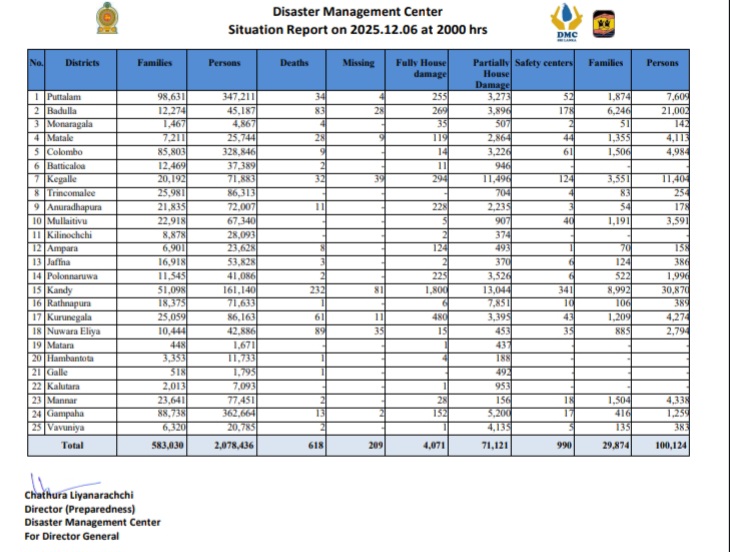
The Situation Report issued by the Disaster Management Center [DMC] at 2000hrs on Saturday [06] confirms that 607 persons have died due to the recent flooding and landslides while another 209 persons were missing.
The death toll in the Kandy district which one of the most affected districts has risen to 232, and 1800 houses have been fully damaged.The number of missing persons reported is 81
100,124 persons belonging to 29,874 families were being housed at 990 safety centers established by the government.


The government’s failure to act on expert warnings, including advance forecasts on Cyclone Ditwah, had led to the worsening of disaster impact, Udaya Gammanpila, leader of the Pivithuru Hela Urumaya, said at a press conference in Colombo yesterday.
Gammanpila accused the NPP government of ignoring 14 key preventive measures, despite alerts from the Meteorology Department, foreign experts, and the media.
Gammanpila said the government had failed to lower the water levels in reservoirs, dredge estuaries, and deploy the armed forces for canal maintenance. Local government bodies were reportedly sidelined, and that led to a delay in cleaning of drains. He said the government had also failed to evacuate people in a timely manner from seven districts identified by the National Building Research Organisation as landslide-prone. It had delayed declaring emergencies or curfews and the deployment of tri-forces to evacuate people in such areas.
Gammanpila said an experienced public official should have been appointed as Secretary to the President to mobilise the state machinery swiftly during the disaster. He said the government had not convened the National Disaster Council.
“These failures worsened the disaster, causing immense hardship, disruption, and loss of life and property to the people,” Gammanpila said.
The government has denied the Opposition’s claims.

Landslide RED warnings issued to the districts of Kandy, Kegalle, Kurunegala, Matale and Nuwara Eliya extended up to 1600 hrs today [07]

Deadly attack on kindergarten reported in Sudan

618 dead, 209 missing as at 2000hrs on Saturday [06]

Showers will occur in the Northern, North-Central, Eastern Uva provinces and in Matale and Nuwara-Eliya districts.

Opposition blames govt. inaction for severity of disaster impact

National Archives seeks freezing capacity to ward off mould from vital water-damaged documents

‘Dates have the highest sugar content to fight Coronavirus’

Sunday Island 27 December – Headlines

#SundayIsland 17th December – Headlines

Sunday Island – 28th March

Sunday Island Headlines – 21 March

Sunday Island – 21st February – Headlines
-
News4 days ago
Lunuwila tragedy not caused by those videoing Bell 212: SLAF
-
 News3 days ago
Level III landslide early warning continue to be in force in the districts of Kandy, Kegalle, Kurunegala and Matale
-
 Latest News6 days ago
Level III landslide early warnings issued to the districts of Badulla, Kandy, Kegalle, Kurunegala, Matale and Nuwara-Eliya
-
 Features5 days ago
Ditwah: An unusual cyclone
-

 Latest News6 days ago
Updated Payment Instructions for Disaster Relief Contributions
-

 News1 day ago
CPC delegation meets JVP for talks on disaster response
-

 News1 day ago
A 6th Year Accolade: The Eternal Opulence of My Fair Lady
-

 Latest News7 days ago
Landslide Early Warnings issued to the Districts of Badulla, Colombo, Gampaha, Kalutara, Kandy, Kegalle, Kurunegala, Matale, Moneragala, Nuwara Eliya and Ratnapura