Sports
Babar, Rizwan power Pakistan to a thumping win


Babar Azam’s second T20I hundred (110* off 66, 11 fours and 5 sixes) came in a record stand with Mohammad Rizwan (88* off 51, 5 fours and 4 sixes) as Pakistan prevailed in a high-scoring encounter at the National Stadium in Karachi on Thursday (September 22) in the second T20I to square the series against England. Moeen Ali’s 23-ball fifty headlined a collective batting show from England as they posted an imposing 199 for 5. But the hosts sprinted to the target, winning with three deliveries to spare thanks to the Babar-Rizwan stand, which was the first double century partnership for Pakistan who became the first team to achieve success in a 200-run chase with all wickets intact.
Pakistan got off to a good start in the chase as the openers raised a half-century stand inside the powerplay. Rizwan set the tone with two fours in the opening over off David Willey while Babar struck two fours off Curran and a boundary off Luke Wood after a slow start. Liam Dawson, coming in for Richard Gleeson, started with an economical over and should have also picked up the wicket of Rizwan but for a back-pedalling Hales to put down the catch in the sixth over. Rizwan went on to hit a six off the spinner, clearing the fence for the second time inside the first six having played a pick-up shot off Willey earlier for a maximum. By the time the powerplay ended, Babar had struck five fours while Rizwan had scored two fours apart from the sixes as Pakistan raced to 59/0.
In comparison to England at the halfway stage of the innings, Pakistan were seven ahead and had all their wickets intact. Rizwan was also reprieved by a stumping chance gone a begging as Salt failed to grab the ball when Adil Rashid went past the outside edge. Rizwan went on to bring up a 30-ball fifty – his 18th T20I half-century – while Babar, who was on 38 off 31 at that stage, got to fifty off 39 deliveries. Both batters then dealt in sixes, making most of the conditions that had improved for the batters in the second innings, as they took Pakistan to 151/0 after 15 overs, bringing down the equation to 48 off 30.
When Babar had reached his fifty in the 12th over, Rizwan had scored three more runs than the Pakistan skipper. But it was a Babar show after that as he raced past his opening partner. Babar took only 22 deliveries from 50-100, blasting four sixes and three fours in his second fifty as he became the first Pakistan player to score two centuries in T20Is. Pakistan needed 20 off the last two overs and they coasted to the target, with Babar adding two more fours to his tally, including the winning four, while Rizwan also struck a boundary.
Alex Hales powered England’s positive start while Phil Salt also managed a couple of boundaries. Barring a three-run opening over from Mohammad Hasnain – who replaced Naseem Shah – England found the fence in every other over in the powerplay. There were a couple of sixes too – with Salt just about clearing the long-off boundary in a Mohammad Nawaz over while Hales edged a Hasnain delivery over the third-man fence. Hales and Salt weren’t always in control of their shots but they managed four fours between them in a quick-fire 42-run stand. Pakistan, however, came back well in the final over of the powerplay as Hales was bowled by Shahnawaz Dahani attempting a pull while Dawid Malan was bowled around his legs. Ben Duckett ended the over with a four as England managed 48/2 in the first six overs.
On a wicket that was on the slower side, with balls keeping low, Pakistan tried to strangle the England batters with spin at both ends. But Duckett was well-equipped to handle them, bringing out the sweeps, reverse-sweep and scoop to ensure regular boundaries. Salt, at the other end, slowed down, not adding to his boundary count after the powerplay. He eventually fell to Haris Rauf, cleaned up for a 27-ball 30. Duckett extended his tally of fours to seven before becoming Nawaz’s only wicket as he deflected a sweep onto the stumps ending a fine 22-ball knock for 43 runs. Harry Brook hit a six off Dahani while Moeen took the attack to Usman Qadir, scoring a four and two sixes in the 15th as England collected 85 runs at a scoring rate of more than 9 in the middle overs.
Pakistan ended up conceding 66 runs in the last five overs. Hasnain was taken for 18 runs in the 16th over which included a four apiece for Moeen and Brook, with the latter also going inside out over extra cover for a six. Brook also top-edged a Rauf delivery over fine leg for another maximum before an attempted reverse scoop led to his downfall. Moeen struck two fours off Dahani on either side of a catch put down by Kushdil Shah in the 18th over while Sam Curran showcased some cheeky shot-making walking across to a Rauf delivery and lapping it over short fine leg for a four. Rauf, though, gave away only 30 runs off his four overs to finish as the most economical of the Pakistan bowlers but the rest weren’t as effective. Hasnain was the most expensive of the lot, conceding 51 runs – including 19 in the final over – as Moeen finished off the innings with two sixes to get to his sixth T20I fifty, which ended up in a losing cause.
Brief scores:
England 199/5 in 20 overs (Moeen Ali 55*, Ben Duckett 43; Haris Rauf 2-30) lost to Pakistan 203/0 in 19.3 overs (Babar Azam 110*, Mohammad Rizwan 88*) by 10 wickets.
(Cricbuzz)











Asian Junior Athletics Championships
by Reemus Fernando
Ambagamuwa Central hurdler Ayomal Akalanka who was included in the team at the eleventh hour qualified for the finals of the men’s 400 metres hurdles as he came almost close to matching his personal best time on day one of the Asian Junior Athletics Championships in Dubai on Wednesday.
Akalanka clocked 52.96 seconds to finish second in his heat and qualify for the finals.
Sri Lanka Athletics decided to drop him from the team after the Commonwealth Youth Game medallist failed to reach qualifying standards at the trials. He was included at the eleventh hour on the request of the Sports Minister who heeded an appeal. Akalanka will compete in the final on Friday.
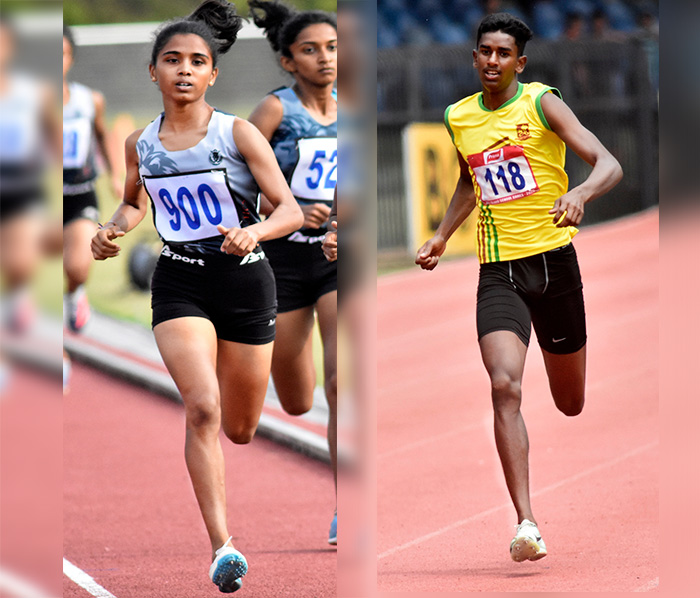
Young Tharushi Abisheka provided the Sri Lankan team a morale boosting start as she qualified for the final of the women’s 800 metres in the morning.
Abisheka is the youngest member in the team and is eligible even to compete at the next edition of this Under 20 event in 2026. The Wickramabahu National School Gampola athlete finished third in her heat and will carry the third fastest time to the final which will be held on Friday.
In the men’s 100 metres, Merone Wijesinghe of Ananda College Colombo finished fourth in his heat.
When this edition went to press women’s team captain Madushani Herath of Nannapurawa MV Bibila was competing in the women’s triple jump.
Sri Lanka fielded a team of 17 athletes including four relay teams for the four-day regional event.

Saneshi Willoraarachchi won three titles at the Bandarawela Open Ranking Tennis Tournament.
The Musaeus College player won the women’s open singles, women’s open doubles and the Under 18 girls’ doubles.
She beat Inuki Jayaweera 6-4, 6-3 in the women’s open singles final and joined the latter to score a 4-2, 5-4 win in the doubles final against Lihini Jayakody and Diyana de Silva.
Saneshi and Inuki overcame a first set defeat to beat Gehansa Methnadi and Sandithi Usgodaarachchi 0-4, 5-4, 10-6 for the Under 18 doubles title.


Hayley Matthews smacked 141 to follow up her unbeaten 140 in the series opener to take an inspired West Indies to a crushing win in the 3rd ODI. The victory sealed a clean sweep over Pakistan.
She powered West Indies to 278 as Pakistan’s bowlers struggled for wickets on a somewhat turgid track in Karachi. Pakistan managed little more than a feeble response, with Muneeba Ali’s 38 the highest score as they were skittled out for a limp 190. Matthews ensured her contribution was all round with figures of 2 for 26 in eight overs as an 88-run win was secured.
This was a dead rubber anyway, but there was little jeopardy in the game from the moment Matthews won the toss and elected to set a target. The captain led from the front as she put the pressure on Pakistan’s bowlers, with the opening attack of Fatima Sana and Nida Dar placed under immediate pressure. First-change spinner Nashra Sandhu, the pick of the attack with 3 for 54, provided an early breakthrough, but it was little more than a speedbump for an unstoppable West Indies side.
Matthews and former West Indies captain Stefanie Taylor combined for a 101-run stand for the third wicket, by which time Matthews brought up her fifth ODI hundred and second this series. As Taylor rotated the strike, Matthews pressed home the visitors’ advantage by hitting 19 fours herself. In contrast, Pakistan managed 21 in their entire innings. Sandhu’s twin strikes in the 46th over to remove Taylor and Chinelle Henry came much too late, with an unbeaten 12-ball 20 from Aaliyah Alleyne helping their side march to 278.
Pakistan’s response saw a bunch of double figures but very little substance. Openers Sadaf Shamas and Sidra Ameen had their stumps knocked back by Shamilia Conell and Henry, and while Muneeba and Bismah Maroof added 45 for the third wicket, the run-scoring was simply too leisurely to trouble the visitors. It took 69 balls for those 45 to be scored before Karishma Ramharack prised Maroof out. Matthews’ twin strikes to get rid of captain Nida Dar and top scorer Muneeba Ali killed the game off for good.
Aalia Riaz and Fatima Sana put on another partnership, but the game was going through the motions by now. West Indies struck at regular intervals, and it all wrapped up in the 48th over when a double strike from Alleyne finished Pakistan off. The two sides will now play a five-match T20I series, with all five games in Karachi.
Brief scores:
West Indies 278 for 6 in 50 overs (Hayley Matthews 141,Shermaine Campbelle 38, Stefanie Taylor 47, Aaliyah Alleryne 20*; Fatima Sana 2-67, Nashra Sandhu 3-54) beat Pakistan 190 all out in 47.5 overs (Muneeba Ali 38, Aliya Riyaz 36, Fatima Sana 23, Tuba Hassan 23; Aaliyah Alleyne 2-10, Hayley Matthews 2-26, Stefanie Taylor 2-29) by 88 runs
(Cricinfo)


Heat Index at Caution level in Northern, North-central, Western, Sabaragamuwa, Eastern, Southern and North-Western provinces and Monaragala district

Spain’s PM Pedro Sánchez halts public duties as wife faces inquiry

Showers may occur in Western, Sabaragamuwa, Central, North-western and Southern provinces


-
 Business4 days ago
CEAT Kelani launches three new radial tyre variants in ‘Orion Brawo’ range
-
Business6 days ago
Dialog-Airtel Lanka merger comes centre stage
-
Business3 days ago
Ceyline Travels and MBA Alumni Association of University of Colombo sign MOU
-
Business6 days ago
SLFEA appoints JAT as a Facilitation Partner for training painters to provide overseas employment opportunities
-
Business4 days ago
Hayleys Fabric celebrates triple triumph at ISPO Textrends Spring/Summer 2026
-
Business5 days ago
Urgent appeal from Sri Lankan exporters on rupee appreciation
-
Business3 days ago
Maldivian to launch direct flights to Colombo
-
Sports4 days ago
Hello Madras, ‘ai api kaluda?’