
News
SJB proposes free transport for teachers, SOE reforms, and support for working women

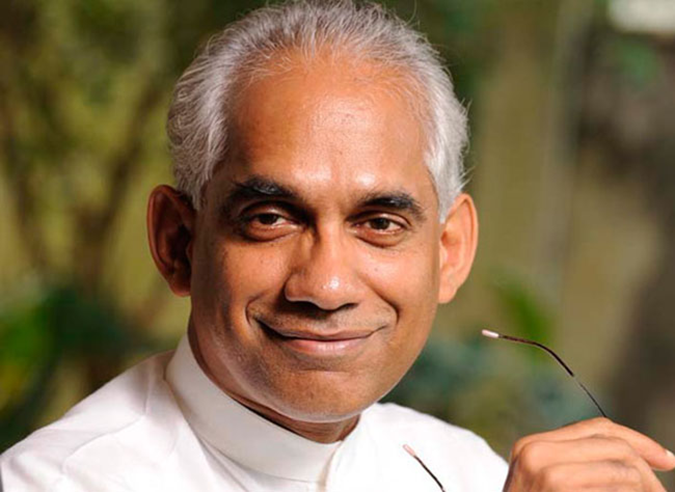
By Saman Indrajith
A Samagi Jana Balawegaya (SJB) government will allow teachers to use state transport services free of charge, SJB MP Eran Wickramaratne said in a televised interview.
“During the past 20 years we have done a lot of infrastructure development. We have built highways, etc. We the SJB believes that we now we need to focus on our human capital. In many countries teachers receive high salaries and they have significant social prestige. We need to make this happen in Sri Lanka,” he said.
By ensuring that teachers have high social prestige, Sri Lanka can attract better qualified and motivated persons into the profession, Wickremaratne said. Sri Lanka needs to increase teachers’ salaries by 300 percent, he stated.
“However, we can’t do this in the short term. What we propose is a minor step only,” he said. The World Bank and UNODC employ the Stolen Asset Recovery Assistance (StAR) system in their joint efforts to retrieve stolen assets. StAR serves as a collaborative initiative between the World Bank Group and the United Nations Office on Drugs and Crime, focusing on preventing the laundering of corruptly acquired funds and facilitating the prompt and systematic return of misappropriated assets. MP Wickramaratne said the SJB will make these laws a part of Sri Lankan laws.
Wickramaratne said that the SJB government will establish a parent company for all state owned enterprises (SOEs). There are hundreds of SOEs and these are under various ministers.
“These have separate director boards. Ministers appoint their friends and family members to these director boards. Often their qualifications are not considered. By establishing the said company, we will manage these appointments centrally,” he said.
The SJB MP added that their administration will also provide medical checkups once in three years for senior citizens. “A lot of Sri Lankans visit the doctor after they become sick. Sometimes, you can prevent these diseases if you can detect them early. Creating a healthier nation also reduces state expenses,” he said.
The SJB MP said that Sri Lankan women were outperforming men academically. Most university students were female, he said. However, female labour force participation remained low, he added.
Wickramaratne said some organisations were hesitant to hire women because they were entitled to maternity leave. “Some countries pay private companies to compensate for the time women take off from work for childbirth. We looked at this proposal about five years ago and it was estimated that this would cost the government about four billion rupees. Now, it will cost the state about seven billion rupees annually,” he said.


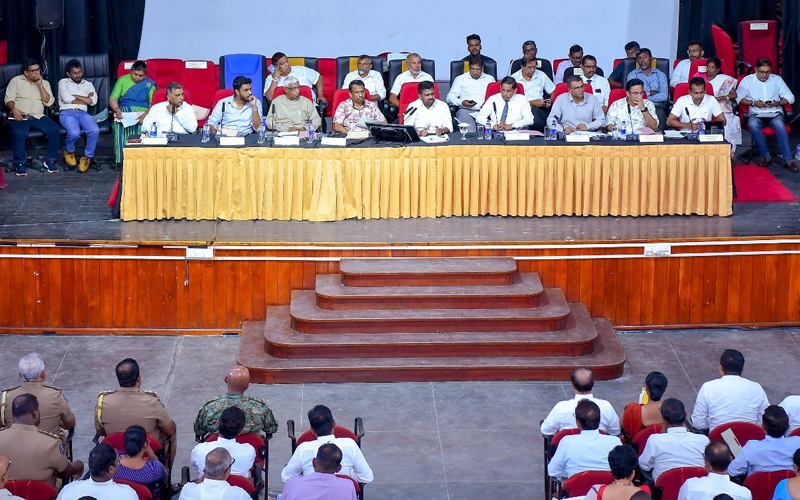
President Anura Kumara Dissanayake stressed that the aim of the Government is to ensure a safe life for every citizen and that it is everyone’s responsibility to act with proper supervision during the resettlement of the people.
The President instructed the relevant sectors to complete all necessary repairs before 31 December by utilising the allocations given by the Government for infrastructure development for this year and not to return any part of those allocations under any circumstances.
The President said that there is no shortage of funds required for relief to the people and for restoring normal life and that what is necessary in this emergency situation is for all institutions to fulfil their responsibilities through proper coordination without limitations.
President Anura Kumara Dissanayake made these remarks while participating on Monday (08) afternoon at the District Coordinating Committee meeting held at the Uva Province Library Auditoriam to review the programme being carried out to restore normalcy in the lives of the affected people in the Badulla District and to develop essential infrastructure. Due to the disaster situation, 64,140 individuals belonging to 19,133 families in the Badulla District have been affected. A total of 418 houses have been completely damaged and 7,703 houses have been partially damaged.
The President inquired separately into the programmes being carried out to restore essential infrastructure such as repairing damaged roads, electricity, water supply, communication, irrigation, restarting agriculture, the livestock sector, inland fisheries and restoring the health and education sectors, among others.
The President pointed out the need to carry out all road repairs simultaneously without dividing them as roads under the Road Development Authority, provincial roads, or local authority roads. He informed officials that if the funds allocated for this purpose are insufficient, they should request the required additional allocations.
The President also instructed that an estimate be prepared and submitted for all roads in the district requiring permanent repairs and noted that funds can be provided to commence this work by January.
Officials stated that, 90% of the district’s damaged electricity supply due to the disaster situation has already been restored and the remaining supply is also being restored swiftly. They further pointed out that steps have been taken to ensure the district’s water supply is provided as required.
The reopening of schools was also discussed and the President instructed that the Government’s allowance of Rs. 15,000 granted to affected schoolchildren be paid promptly through the intervention of Divisional Secretaries.
Due to the disaster situation, 6,711 acres of agricultural land in the Badulla District have been damaged. The President instructed that the relevant farmers and the extent of damaged land be identified, compensation be provided swiftly and they be directed back into cultivation.
He further instructed officials of the Irrigation Department to provide water to agricultural lands at least temporarily, so that the farmers will be able to harvest the Maha season. The President stated that the allowance of Rs. 25,000 provided for the cleansing and restoration of damaged temples and religious sites will be granted through the Department of Cultural Affairs and that a Cabinet decision regarding this matter is expected this week.
Lengthy discussions were held on providing compensation to destroyed and damaged houses and on the resettlement of the affected people. The President also highlighted the need to implement programmes aimed at improving the mental health of people living in camps.
President Dissanayake expressed his gratitude to the Tri-forces, Government officials and the public who are working with immense dedication in all these activities.
Participating in this occasion were the Chairman of the Badulla District Coordinating Committee and Minister of Agriculture and Rural Infrastructure, Samantha Vidyaratne; Chairman of the Badulla District Coordinating Committee and Governor of Uva Province, Attorney-at-Law Kapila Jayasekara; Deputy Minister of Trade, Commerce and Food Security, R. M. Jayawardena; Deputy Minister of Power and Energy, Arkam Iliyas; Deputy Minister of Youth Affairs, H. M. Dinindu Sampath Hennayake; Deputy Minister of Tourism, Professor Ruwan Ranasinghe; Members of Parliament Sarath Kumara, Ravindra Bandara, Sudath Balagalla, Kittnan Selvaraj, Ambika Samuel, Ajantha Gammaddege and Chamara Sampath Dasanayake, along with other ruling and opposition MPs; Chief Secretary of Uva Province, Ms. Anusha Gokula and representatives of Provincial Councils; Secretary to the Ministry of Finance, Dr. Harshana Suriyapperuma, together with senior officials of the Ministry of Finance; Badulla District Secretary Panduka Sri Prabath Abeywardena and other Government officials of the district, as well as representatives of the security services

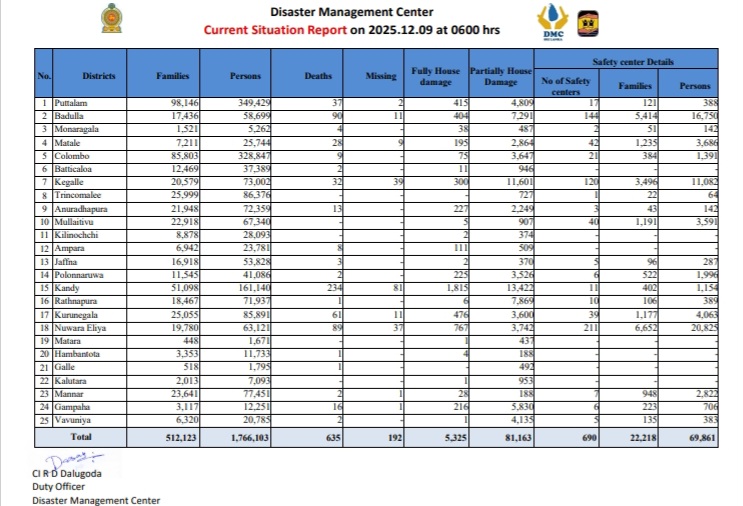
The Situation Report issued by the Disaster Management Center at 06:00 AM today [09th December] confirms that 635 persons have died due to floods and landslides that took place in the country within the past two weeks. The number of persons that are missing is 192.
News
Cyclone Ditwah leaves Sri Lanka’s biodiversity in ruins: Top scientist warns of unseen ecological disaster

Sri Lanka is facing an environmental catastrophe of unprecedented scale in the wake of Cyclone Ditwah, with leading experts warning that the real extent of the ecological destruction remains dangerously under-assessed.
Research Professor Siril Wijesundara of the National Institute of Fundamental Studies (NIFS) issued a stark warning that Sri Lanka may be confronting one of the worst biodiversity losses in its recent history, yet the country still lacks a coordinated, scientific assessment of the damage.
“What we see in photographs and early reports is only a fraction of the devastation. We are dealing with a major ecological crisis, and unless a systematic, science-driven assessment begins immediately, we risk losing far more than we can ever restore,” Prof. Wijesundara told The Island.
Preliminary reports emerging from the field point to extensive destruction across multiple biodiversity-rich regions, including some of the nation’s most iconic and economically valuable landscapes. Massive trees have been uprooted, forest structures shattered, habitats altered beyond recognition, and countless species—many endemic—left at risk.
Among the hardest-hit areas are the Royal Botanical Gardens, Peradeniya, Seethawaka Botanical Garden, Gampaha Botanical Garden, and several national parks and forest reserves under the Department of Wildlife Conservation and the Forest Department. Officials describe scenes of collapsed canopies, destroyed research plots, and landscapes that may take decades to recover.
Prof. Wijesundara said the scale of destruction demands that Sri Lanka immediately mobilise international technical and financial support, noting that several global conservation bodies specialise in post-disaster ecological recovery.
“If we are serious about restoring these landscapes, we must work with international partners who can bring in advanced scientific tools, funding, and global best practices. This is not a situation a single nation can handle alone,” he stressed.
However, he issued a pointed warning about governance during the recovery phase.
“Post-disaster operations are vulnerable to misuse and misallocation of resources. The only safeguard is to ensure that all actions are handled strictly through recognised state institutions with legal mandates. Anything else will compromise transparency, accountability, and public trust,” Prof. Wijesundara cautioned.
He insisted that institutions such as the Department of Wildlife Conservation, the Forest Department, and the Botanical Gardens Department must take the lead—supported by credible international partners.
Environmental analysts say the coming months will be decisive. Without immediate, science-backed intervention, the ecological wounds inflicted by Cyclone Ditwah could deepen into long-term national losses—impacting everything, from tourism and heritage landscapes to species survival and climate resilience.
As Sri Lanka confronts the aftermath, the country now faces a critical test: whether it can respond with urgency, integrity, and scientific discipline to protect the natural systems that define its identity and underpin its future.
By Ifham Nizam

The aim of the Government is to ensure a safe life for every citizen -President

A wage for housework? India’s sweeping experiment in paying women

Death toll 635 as at 06:00 AM today [09]

Heavy showers above 100 mm are likely at some places in the Northern and Eastern provinces and in Polonnaruwa district

Cyclone Ditwah leaves Sri Lanka’s biodiversity in ruins: Top scientist warns of unseen ecological disaster

Disaster: 635 bodies found so far, 192 listed as missing

‘Dates have the highest sugar content to fight Coronavirus’

Sunday Island 27 December – Headlines

#SundayIsland 17th December – Headlines

Sunday Island – 28th March

Sunday Island Headlines – 21 March

Sunday Island – 21st February – Headlines
-
News6 days ago
Lunuwila tragedy not caused by those videoing Bell 212: SLAF
-

 News1 day ago
Over 35,000 drug offenders nabbed in 36 days
-
 News5 days ago
Level III landslide early warning continue to be in force in the districts of Kandy, Kegalle, Kurunegala and Matale
-

 Business3 days ago
LOLC Finance Factoring powers business growth
-

 News3 days ago
CPC delegation meets JVP for talks on disaster response
-
 News3 days ago
A 6th Year Accolade: The Eternal Opulence of My Fair Lady
-

 News1 day ago
Rising water level in Malwathu Oya triggers alert in Thanthirimale
-

 Midweek Review6 days ago
House erupts over Met Chief’s 12 Nov unheeded warning about cyclone Ditwah