
Business
‘Government temporarily takes one step forward after many backward steps on agriculture’

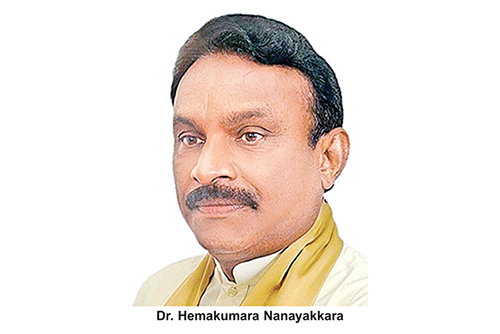
By Dr. Hemakumara Nanayakkara
Ever since April 2021, Sri Lanka’s agriculture and plantation sectors have been beset by needless difficulties as a result of an announcement, seemingly made on a whim, that Sri Lanka would switch to completely organic agriculture – effective immediately.
In doing so, the Government has jarringly halted all progress on efforts to develop these critical sectors, pushing the entire nation back many steps in the decision to ban import and use of all agro-chemicals and inorganic fertilizer.
A conflict of intentions and egos
By issuing such an extreme proclamation without a shred of scientific analysis into how these concepts could be practically implemented in Sri Lanka, they have done more harm than good to the expansion of true organic agriculture.
This is unfortunate because, as a concept, organic agriculture has many benefits. However, unlike what has been portrayed, it is not simply a matter of reverting to ‘ancient practices’. There is a deep and complex science to organic cultivation.
None of these complexities were understood or considered when the imprudent decision to ban all inorganic inputs was first announced. The assumption that ‘organic’ is just adding compost to soil has been the detriment of the directive. Hence, it was decided that imported chemical inputs were not necessary, not because organic agriculture is practical, but because imports require the Government to spend more of the nation’s now dwindling foreign reserves.
A little knowledge is a dangerous thing
In the months that have followed, everyone from academics to industry experts and farmers on the ground have been venting their frustration at the total breakdown of their regular cultivation practices as a result of this dangerously unscientific approach to agricultural reform.
After much condemnation, it was finally announced at the start of August that the Government was reverting their position. While not admitting it and maintaining that the ban is still in effect, probably to save face, the fact that they are relenting on import of chelated minerals, fertilizer mixes and micro-nutrients for specialist applications including for hydroponic cultivation and floriculture”, even if temporary, is a slight relief.
It may be assumed that technicalities of what these terms mean may be enough to dissuade the public from asking too many questions. But anyone with passing knowledge of agriculture would understand that chelated minerals and fertilizer mixes contain the exact same inorganic inputs which the Government is overtly claiming to ban – namely: Nitrogen, Phosphorus, and Potassium (NPK). These are the elements which are essential to plant nutrition and growth.
Prior to the invention of techniques to produce synthetic fertilizer in the early 1900s, guano – the accumulated excrement of seabirds and bats was the only known reliable source of fertilizer with NPK suitable for commercial agriculture at that time. This pressing demand for fertilizer led to many predictions of mass starvation, and it would have come to pass were it not for the invention of the Haber-Bosch technique for the manufacture of synthetic nitrogenous fertilizer.
While it is possible to obtain Phosphorus locally, and organic Potassium could be imported from natural mines – leaving aside the fact that supply chains are not in place to meet the entire national requirement – sourcing Nitrogen is much more problematic. That is because it is extremely difficult to obtain N from plant or animal sources at the levels necessary for commercial scale agriculture.
Currently, we use Urea for tea and paddy, which contains approximately 46% Nitrogen. By contrast, organic sources like Gliricidia offers only 4%, while cattle dung has 3.5% and poultry dung –with 4.5% nitrogen by composition.
Prior to the ban, NPK was used in paddy, tea, rubber and coconut, and after the latest relaxation, these are still the same inputs that are being used, so in practice the Government has taken 3 months to make a bad decision and then reverse it – all the while falsely maintaining that inorganic NPK is not acceptable.
Had the Government simply consulted with relevant experts in the field in an open and transparent manner, they could have avoided all of the detrimental effects which followed from this disastrous decision. While there mention of a “Presidential Task Force for a green socio-economy” at the outset, they have not been forthcoming about their logic or approach in any public forums.
We are aware that there is a person in that task force who has been presented as a professor who made the ludicrous claim that sea-weeds as tall as coconut trees can be harvested from the ocean and used as organic fertilizer. While it is true that such large seaweed growth does exist, it is only found in close proximity to the North Pole, hence it is of no relevance to Sri Lanka. We offer this example in order to shine a light on the absurd and utter lack of credible scientific information behind policy decisions at the highest levels of this Government.
Those who fail to learn from history are doomed to repeat it
If we continue to allow the State to intervene and interfere with the fundamentals of agriculture in Sri Lanka based on the whims of such individuals, what is the worst that could happen? Previously we were told that the import and use of all agrochemicals would be banned immediately. Thereafter, the deadline was pushed back to a period within 3 months – 1 cultivation season. Now they have temporarily reverted back to allowing agro-chemicals, but it is implied that these imports could once again be banned at any moment.
In the interim, the solution that is currently being offered is a “nitrogen extract” that will be used as a spray. No further details have been provided. We don’t know if this extract is organic, inorganic, from the moon or even Mars. All we do know is that the only possible high percentage nitrogenous extracts can only be obtained from a chemical base. If the Government is trying to deceive people, they may use chemically extracted nitrogen, which could in turn be sprayed on organic manure and distributed among farmers.
In effect, the Government is refusing to reveal what exactly we will be adding to our soil through such extracts. Until they do, we must continue to call for more clarity and transparency. This is especially crucial for any agricultural exports – especially tea – whose buyers are sensitive to Maximum Residue Limits (MRLs).
Another fact to consider: no country in the world has ever succeeded in going totally organic. There are however some cautionary examples from history of those who tried. The example of Bhutan has been often cited in recent months. There, it was announced that over a period of 20 years, Bhutan would systematically phase out inorganic inputs. Even after careful and intensive planning with broad stakeholder consultation and preparation, the country was only able to convert 10% of their arable lands into organic agriculture after 30 years of effort in total.
The author is a former State Minister of Agriculture, Former Governor of the Southern Province, and Sri Lanka’s only PhD in Organic Agriculture from the Post-Graduate Institute of Agriculture at the Peradeniya University
To be continued


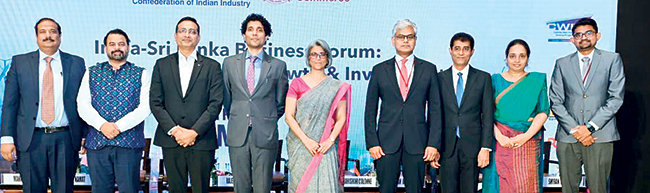
To catalyze bilateral trade and investment and drive regional economic integration, the Consulate General of Sri Lanka in Mumbai facilitated a series of high-level strategic engagements between The Ceylon Chamber of Commerce and leading Indian commercial institutions on May 13 and 14.
The delegation from The Ceylon Chamber of Commerce was led by its Chairman Krishan Balendra, CEO of John Keells Holdings Pvt Ltd and comprised a distinguished group of Sri Lankan industry leaders from Hirdaramani Group, Maliban Biscuit Manufactories (Pvt) Ltd, Sierra Cables PLC, A. Baur & Co. (Pvt) Ltd, Jetwing Travels (Pvt) Ltd, Ceylon Biscuits Ltd, Hayleys PLC, Vidullanka PLC, MAS India Clothing (Pvt) Ltd, Tudawe Brothers (Pvt) Ltd, David Pieris Holdings (Pvt) Ltd, Bank of Ceylon, Aitken Spence PLC, LTL Holdings Ltd. and Orel IT Pvt. Ltd.
On May 13, The Confederation of Indian Industry (CII) and The Ceylon Chamber of Commerce jointly hosted the ‘India–Sri Lanka Business Forum: Partnering in Sri Lanka’s Growth and Investment’ and an exclusive CEO interaction in Mumbai. The forum convened senior government officials, policymakers, and industry leaders from both countries.
These included, among others, High Commissioner of Sri Lanka to India Mahishini Colonne; Consul General of Sri Lanka in Mumbai Priyanga Wickramasinghe; Senior Economic Advisor to the President of Sri Lanka Duminda Hulangamuwa; Secretary (Protocol, FDI, Diaspora & Outreach) and Chief of Protocol Government of Maharashtra Rajesh Ravindra Gawande; Co-chairman, CII Western Region Sub-committee on International Trade & Investment and Chief Executive Officer, Polycab India Ltd. Anurag Agarwal; Chairman, CII Western Region Sub-Committee on Tourism and Hospitality and Executive Director, Kamat Hotels India Ltd Vishal Kamat and Secretary General & CEO of The Ceylon Chamber of Commerce Shiran Fernando.
Conversations centered on accelerating cross-border cooperation across high-priority sectors, including technology, manufacturing, healthcare, renewable energy, and digital transformation.
On May 14, the delegation engaged in productive Business-to-Business sessions with the IMC Chamber of Commerce and Industry, culminating in the formal renewal of the Memorandum of Understanding between The Ceylon Chamber of Commerce and IMC. The delegation also participated in an interactive session hosted by the World Trade Center (WTC) Mumbai and the All India Association of Industries (AIAI).
The two-day mission concluded with a robust exchange of views cementing a strong foundation for sustained bilateral collaboration and paving the way for a new era of industrial synergy between Colombo and Mumbai. (Consulate General of SL, Mumbai)

Demonstrating its commitment to supporting the nation’s next phase of economic transformation, Commercial Bank of Ceylon has become one of the first banks in Sri Lanka to enter into an agreement to establish a fully-fledged branch at Port City Colombo, marking a significant step in the Bank’s strategic expansion into the country’s emerging international financial hub.
The agreement was signed by Sanath Manatunge, Managing Director/CEO of Commercial Bank, and Xiong Hongfeng, Managing Director of CHEC Port City Colombo (Pvt) Ltd. The partnership further reinforces Commercial Bank’s position at the forefront of Sri Lanka’s evolving financial landscape.
The proposed branch will function as a fully-fledged banking branch, offering a full spectrum of products and services tailored to the needs of corporates, investors, businesses and retail customers operating within the Port City Colombo ecosystem. These will include digital banking facilities, trade services, foreign currency transactions, corporate banking solutions, deposits, lending, card services and remittance facilities.
By establishing a presence within Port City Colombo, the Bank said it aims to further strengthen its ability to support cross-border business and investment flows while positioning itself to meet the sophisticated requirements of global investors, multinational corporates and high-net-worth individuals expected to operate within the Special Economic Zone.
Commenting on this ground breaking initiative, Sanath Manatunge, Managing Director/CEO of Commercial Bank said the Bank’s decision to establish a fully-fledged branch within Port City Colombo reflects both its long-term confidence in the project and its readiness to support the evolving needs of a globally integrated financial ecosystem.
“As Sri Lanka’s largest private sector bank with a strong track record in serving corporates, international clients and high-value businesses, we see Port City Colombo as a pivotal development in the country’s economic future,” he said. “Our presence within this Special Economic Zone will enable us to seamlessly support cross-border transactions, facilitate international trade and investment, and deliver world-class banking solutions backed by advanced digital capabilities. Being one of the first banks to formalise plans for a full-service branch within Port City Colombo reaffirms our role as a pioneer in driving financial innovation and supporting national development.”
A 269-hectare extension of Sri Lanka’s central business district, Port City Colombo is being developed as a multi-service Special Economic Zone designed to serve as a regional financial centre, business and lifestyle hub. One of the largest public-private partnership projects in the country, it is envisioned as a catalyst for high-value investments, underpinned by advanced infrastructure, cutting-edge technology and a progressive regulatory framework.
“Our role as master developer goes beyond building the city itself. It is about creating the foundations for a functioning international business and financial hub,” said Mr Xiong Hongfeng, Managing Director of CHEC Port City Colombo (Pvt) Ltd. “The establishment of institutions such as Commercial Bank within Port City Colombo is an important part of that process, because it brings real operational depth and credibility into the ecosystem from an early stage. It reflects the broader momentum behind the project and the growing shift towards a more globally connected, investment-driven economy in Sri Lanka.”
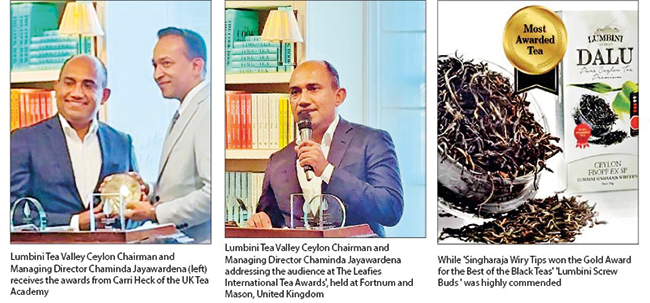
Sri Lanka’s renowned specialty tea brand “Singharaja Wiry Tips,” produced by Lumbini Tea Valley Ceylon, has won two major accolades at the prestigious “The Leafies International Tea Awards” held recently at Fortnum and Mason in the United Kingdom.
The award-winning low-grown Ceylon tea secured the titles of “Best Ceylon Black Tea” and the overall “Best of All Black Teas,” emerging as the top black tea entered at the international competition.
With these latest honours, “Singharaja Wiry Tips” has now earned its 43rd and 44th international awards, further strengthening its reputation as one of the world’s most highly awarded black teas.
Classified as FBOPF EX SP (Flowery Broken Orange Pekoe Fannings Extra Special), the tea is named after its distinctive golden-tipped wiry leaves and unique flavour profile derived from the ecosystem surrounding the UNESCO World Heritage-listed Singharaja Rainforest, which borders the Lumbini plantation.
Lumbini Tea Valley’s latest innovation, “Lumbini Screw Buds,” also received high commendation at this year’s competition, highlighting the company’s continued excellence in producing premium Ceylon teas.
Chairman and Managing Director Chaminda Jayawardena, who accepted the awards in London, credited the achievement to the dedication of the Lumbini workforce and the support of nearly 1,800 tea farmers supplying high-quality green leaf harvested using the traditional “two leaves and a bud” method.
by SK Samaranayake

Suspect killed after shooting at Secret Service agents, officials confirm

Trump says Iran deal ‘largely negotiated’ including reopening Strait of Hormuz

Showers expected in the Western, Sabaragamuwa and North-western provinces and in Galle, Matara, Kandy and Nuwara-Eliya districts

Devine intervention brings New Zealand back from the dead

US police responding to dozens of shots fired near the White House

Sri Lanka cricket finances ‘greater than feared’: interim chief

‘Dates have the highest sugar content to fight Coronavirus’

Sunday Island 27 December – Headlines

#SundayIsland 17th December – Headlines

Sunday Island – 28th March

Sunday Island Headlines – 21 March

Sunday Island – 21st February – Headlines
-
 Features4 days ago
Octopus, Leech, and Snake: How Sri Lanka’s banks feast while the nation starves
-
 News3 days ago
Steps underway to safeguard Sri Lanka’s maritime heritage
-
 Opinion3 days ago
Murder of Ehelepola family, Bogambara Wewa and Sightings of Wangediya
-
 Sports4 days ago
Sri Lanka women’s volleyball team ready for Central Asian challenge
-

 Editorial3 days ago
A play without its protagonist
-

 Midweek Review4 days ago
Overall SLPP failures stressed in new Aragalaya narrative
-

 Opinion2 days ago
The need to reform Buddhist ecclesiastical order
-
 Latest News5 days ago
At least 100 dead in Ebola outbreak in DR Congo, official says