
News
Focus on human rights, media freedom, etc.

US report on SL:
The US dealt with human rights and related issues in its Sri Lanka country report issued this week. Under the section headlined ‘Freedom of the Press,” the State Department said: “The constitution provided for freedom of expression, including for members of the press and other media, but the government sometimes restricted this right. In its report on the human rights situation in the country, the UN Office of the High Commissioner for Human Rights (OHCHR) observed a persistent trend of surveillance, intimidation, and harassment of journalists and civil society actors, especially those working on enforced disappearances, land seizures, environmental issues, and with former combatants in the north and east.
Authorities restricted hate speech, including insults to religion or religious beliefs, through a police ordinance and the penal code. The government requested media stations and outlets refrain from featuring hate speech in their news items and segments. Restrictions on hate speech were applied selectively, with hate speech against Muslims more tolerated than against other groups. There were also reports authorities attempted to intimidate individuals who criticised the government, including through public statements, questioning by security officials, official visits at their homes, and arrests. Civil society accused the government of using the International Covenant on Civil and Political Rights (ICCPR) Act, which Sri Lanka adopted into domestic law, and penal code provisions against hate speech to curtail freedom of expression. In its August 22 report to the UN Human Rights Council (UNHRC), the OHCHR also reported the government misused the ICCPR Act to stifle freedom of expression.
On June 19, the Colombo Fort Magistrate’s Court dismissed comedian Nathasha Edirisooriya’s charges of insulting Buddhism during an April performance, a recording of which was posted to the SLVlog YouTube channel on May 23. Police accused her of violating the ICCPR Act, which criminalised advocacy of “national, racial or religious hatred that constitutes incitement to discrimination, hostility or violence” as well as the Computer Crime Act and hate speech provisions of the penal code. On July 6, the Colombo Fort magistrate granted bail to Edirisooriya. The magistrate discharged her and administrator of SLVlog Bruno Divakara, based on the attorney general’s opinion that hate speech charges could not be pursued in the case.”
The report also addressed the issues relating to physical attacks and imprisonment. The relevant section: “There were reports of harassment and intimidation of journalists covering sensitive topics. Some journalists in the Northern and Eastern Provinces, including citizen journalists, reported harassment, threats, intimidation, and interference from members of state security services, especially when reporting on topics related to the civil war or its aftermath, including missing persons. Tamil journalists reported military officers requested copies of photographs, lists of attendees at events, and names of sources for articles. They also reported the military directly requested journalists to refrain from reporting on sensitive events, such as Tamil war commemorations or land occupation protests, as well as from posting anything related to former Liberation Tigers of Tamil Eelam (LTTE) leaders, and that they feared repercussions if they did not cooperate.
Reporters alleged authorities, sometimes in government vehicles, surveilled journalists, especially those covering protests.
On February 21, Tamil press reported the Army threatened to confiscate and destroy the telephones of three Tamil journalists, Prabhakaran Dilaksan, Sundarampillai Rajeskaran, and Chinnaiya Yogeswaran, as they attempted to cover a gathering of civilians after the military allowed them to visit temples within the “High-Security Zone” in Jaffna. On June 13, a group of unidentified individuals vandalised the house of Tamil freelance journalist Thambithurai Pradeepan in Jaffna, set his motorbike on fire, and damaged his three-wheeler. The damage caused to his property was reported to be more than one million Sri Lankan rupees ($3,420). Jaffna police deployed four teams, but there was no progress in the investigation. In June, Pradeepan lodged a complaint to the HRCSL regarding the lack of progress in the investigation.”



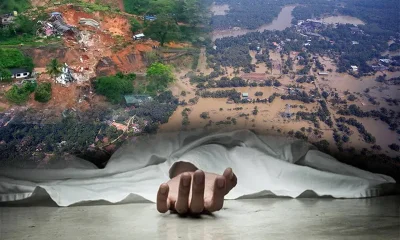


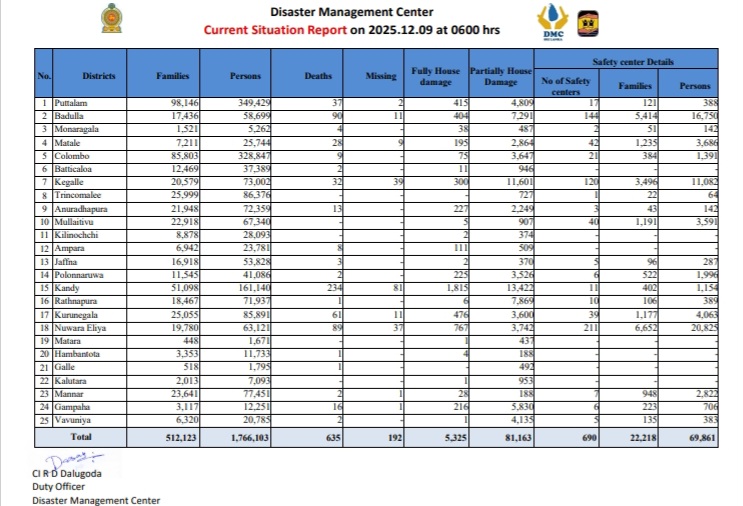
The Situation Report issued by the Disaster Management Center at 06:00 AM today [09th December] confirms that 635 persons have died due to floods and landslides that took place in the country within the past two weeks. The number of persons that are missing is 192.
News
Cyclone Ditwah leaves Sri Lanka’s biodiversity in ruins: Top scientist warns of unseen ecological disaster
Sri Lanka is facing an environmental catastrophe of unprecedented scale in the wake of Cyclone Ditwah, with leading experts warning that the real extent of the ecological destruction remains dangerously under-assessed.
Research Professor Siril Wijesundara of the National Institute of Fundamental Studies (NIFS) issued a stark warning that Sri Lanka may be confronting one of the worst biodiversity losses in its recent history, yet the country still lacks a coordinated, scientific assessment of the damage.
“What we see in photographs and early reports is only a fraction of the devastation. We are dealing with a major ecological crisis, and unless a systematic, science-driven assessment begins immediately, we risk losing far more than we can ever restore,” Prof. Wijesundara told The Island.
Preliminary reports emerging from the field point to extensive destruction across multiple biodiversity-rich regions, including some of the nation’s most iconic and economically valuable landscapes. Massive trees have been uprooted, forest structures shattered, habitats altered beyond recognition, and countless species—many endemic—left at risk.
Among the hardest-hit areas are the Royal Botanical Gardens, Peradeniya, Seethawaka Botanical Garden, Gampaha Botanical Garden, and several national parks and forest reserves under the Department of Wildlife Conservation and the Forest Department. Officials describe scenes of collapsed canopies, destroyed research plots, and landscapes that may take decades to recover.
Prof. Wijesundara said the scale of destruction demands that Sri Lanka immediately mobilise international technical and financial support, noting that several global conservation bodies specialise in post-disaster ecological recovery.
“If we are serious about restoring these landscapes, we must work with international partners who can bring in advanced scientific tools, funding, and global best practices. This is not a situation a single nation can handle alone,” he stressed.
However, he issued a pointed warning about governance during the recovery phase.
“Post-disaster operations are vulnerable to misuse and misallocation of resources. The only safeguard is to ensure that all actions are handled strictly through recognised state institutions with legal mandates. Anything else will compromise transparency, accountability, and public trust,” Prof. Wijesundara cautioned.
He insisted that institutions such as the Department of Wildlife Conservation, the Forest Department, and the Botanical Gardens Department must take the lead—supported by credible international partners.
Environmental analysts say the coming months will be decisive. Without immediate, science-backed intervention, the ecological wounds inflicted by Cyclone Ditwah could deepen into long-term national losses—impacting everything, from tourism and heritage landscapes to species survival and climate resilience.
As Sri Lanka confronts the aftermath, the country now faces a critical test: whether it can respond with urgency, integrity, and scientific discipline to protect the natural systems that define its identity and underpin its future.
By Ifham Nizam
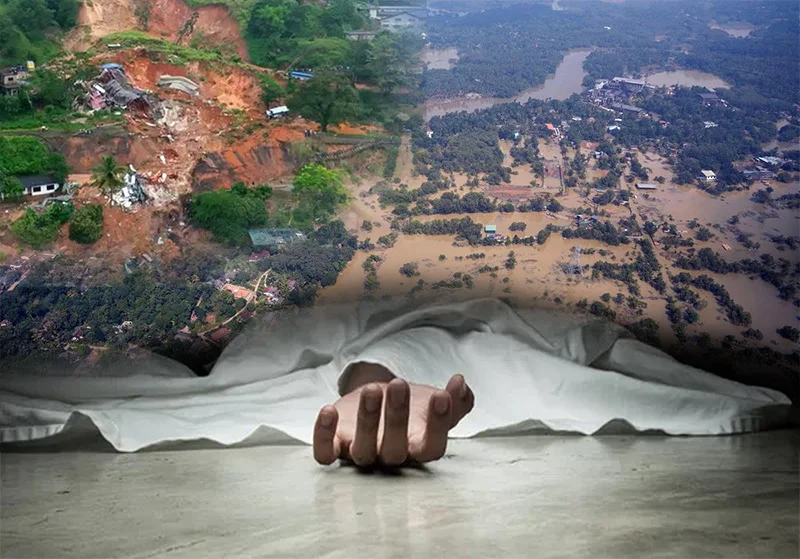
The Disaster Management Centre (DMC) has categorised 192 persons as missing as search operations were scaled down in flood-affected areas.
The death toll has been placed at 635, while the highest number of deaths was reported from the Kandy District. Kandy recorded 234 deaths.
According to the latest data, a total of 1,776,103 individuals from 512,123 families, in 25 districts, have been affected by the impact of Cyclone Ditwah.
The DMC has said that 69,861 individuals from 22,218 families are currently accommodated in 690 shelters established across the country.

A wage for housework? India’s sweeping experiment in paying women

Death toll 635 as at 06:00 AM today [09]

Heavy showers above 100 mm are likely at some places in the Northern and Eastern provinces and in Polonnaruwa district

Cyclone Ditwah leaves Sri Lanka’s biodiversity in ruins: Top scientist warns of unseen ecological disaster

Disaster: 635 bodies found so far, 192 listed as missing

More help from Pakistan

‘Dates have the highest sugar content to fight Coronavirus’

Sunday Island 27 December – Headlines

#SundayIsland 17th December – Headlines

Sunday Island – 28th March

Sunday Island Headlines – 21 March

Sunday Island – 21st February – Headlines
-
News6 days ago
Lunuwila tragedy not caused by those videoing Bell 212: SLAF
-

 News1 day ago
Over 35,000 drug offenders nabbed in 36 days
-
 News5 days ago
Level III landslide early warning continue to be in force in the districts of Kandy, Kegalle, Kurunegala and Matale
-

 Business3 days ago
LOLC Finance Factoring powers business growth
-

 News3 days ago
CPC delegation meets JVP for talks on disaster response
-
 News3 days ago
A 6th Year Accolade: The Eternal Opulence of My Fair Lady
-

 News1 day ago
Rising water level in Malwathu Oya triggers alert in Thanthirimale
-

 Midweek Review6 days ago
House erupts over Met Chief’s 12 Nov unheeded warning about cyclone Ditwah