
Features
Felicitation of an internationally reputed Buddhist Scholar

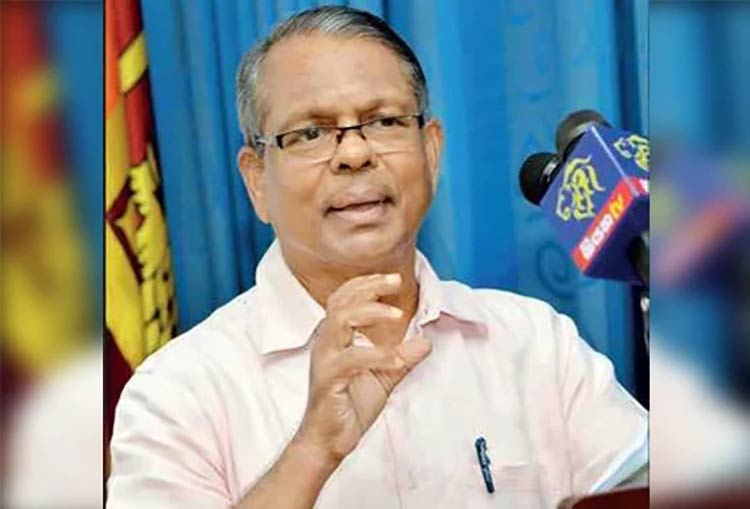
By Ven. Siri Vajiraramaye Ñāṇasīha
On February 2, 2025, many academics, researchers and well-wishers of all faiths will be gathering at the Jasmine Committee Room of the Bandaranaike Memorial International Conference Hall to felicitate a renowned, internationally reputed Buddhist scholar of recent times. He is Emeritus Professor Asanga Tilakaratne, in the lineage of eminent scholars of recent times commencing with late Professors G.P. Malalasekera, O.H. de A. Wijesekera, K.N. Jayatilake, Jotiya Dhirasekera (later Venerable Prof. Dhammavihari) followed by Professor Y. Karunadasa, Professor David J. Kalupahana, Professor P.D. Premasiri to name only a few. I am privileged to have associated with all of them during my university days at Peradeniya in late 1950s and later.
It was late Professor Jotiya Dhirasekera, serving then as the Chief Editor of the Buddhist Encyclopedia, who introduced a very bright spark who had joined the editorial staff as his Research Assistant. That was young Asanga Tilakaratne, soft spoken, much loved with a sharp mind bent on research. His later academic achievements, surpassing those of his own teachers, were more than adequate to justify the remarks made. To his credit are articles on Kamma, Kathâvatthu, Logic, Mysticism, Nihilism, Pragmatism and Sacca appearing in the monumental Buddhist Encyclopedia of which the first Chief Editor was late Professor G.P. Malalsekera. Since 2021, he holds the post of Chief Editor of the Buddhist Encyclopedia.
Emeritus Professor Asanga Tilakaratne comes from the deep South. Born in 1952, he had his secondary education at the H/Debarawewa Central College, close to his parental home in Tissamaharamaya. He received monastic education at Mallikaramaya, Ratmalana, and at Siri Vajirañâṇa Dharmayatanaya, Maharagama, ending with the Prâcîna Pandit degree. For further studies, he entered the Buddha Sravaka Dharma Pîṭhaya, Anuradhapura (known today as Sri Lanka Bhikkhu University) as a first batch student. He completed his four-year Tripiṭakavedî course of studies with a First Class. Soon after, he entered the University of Peradeniya and on completing his studies there, he received the East-West Center Graduate Fellowship from the University of Hawaii, where he studied Western Philosophy. The thesis for his doctoral degree in comparable philosophy is now printed with title, ‘Nirvana and Ineffability: A Study of the Buddhist Theory of Reality and Language’. That was in 1992 when he was 40 years of age, the beginning of the paññâ dasaka, the wise decade, according to the Visuddhimagga classification of life of a person in decades.
In Professor Asanga’s voyage of academic life, he himself being very learned (bahussuto), it was the beginning of a career with the learned. In 2000, he was at the Oxford University as a Commonwealth Fellow and a visiting scholar at Wolfson College. In 2012 he received the Research Excellence Award in Arts and Humanities Division of the University of Colombo, and two years later the Council of Vice-Chancellors and Directors Sri Lanka (CVCD), awarded Professor Tilakaratne the Excellence Award as most outstanding Senior Researcher in the Field of Humanities, Aesthetics and Social Sciences.
In the academic world he will always be remembered for his achievement in getting the Buddhist Studies Unit of the University of Colombo developed to a full-fledged department of the University. With the shifting of the University of Ceylon, which was the only university in Sri Lanka then, to Peradeniya in 1952, and the beginning of the university obsession in the 1960s with universities mushrooming to 17, the newly established University of Colombo lost the Department of Pali to the University of Kelaniya. A seed was planted by Professor Y. Karunadasa, when he spent his sabbatical at the University of Colombo by starting a Buddhist Studies Unit. To the credit of Professor Asanga Tilakaratne it has developed to the current high standard academically. He was the Senior Chair Professor of that department at the time he retired from university service in 2018.
He is recognized world-wide as a Buddhist scholar of repute and has been Visiting Professor of many foreign Universities. During the academic year 2007-2008, he was Visiting Professor, Department of Sociology, Yonsei University, Korea; and in 2015, he was Visiting Professor at the Department of Theology and Religion, University of Otago, New Zealand. In 2017, he was the Khyentse Visiting Professor at Department of Pali, Savitribai Phule Pune University, Maharashtra, India. More recently, during 2018/2019 he was at Sitagu International Buddhist Academy, Sagaing and in 2020 at Nalanda University, Rajgir, India.
Nearly 200 papers have been presented by him at seminars and conferences worldwide. These include keynote addresses, position papers, memorial lectures and orations, inter-religious dialogues etc. mainly at Universities and Research Institutes in India, Myanmar, Thailand, Japan, Spain, Italy, Norway, Germany, Korea and Indonesia. Very distinctive was his participation as the Invited Buddhist Guest at the International Conference on Religious Dialogue held in October, 2000, in the Vatican City, Rome, to mark the 2000 Millennium.
Thanks to the efforts of some of his colleagues and pupils, much of the writings of Professor Asanga Tilakaratne are available in print. The Editorial Committee has done an excellent job by grouping them under specific disciplines before printing. There are 69 articles published in Sinhala in three volumes of 300 pages each and grouped under Bauddha Darśanaya hā Ācāravidyāva, Bauddha Sāhityahā Saṅskrutiya, and Bauddha Nūtanatva Adyayanaya. The articles in English are published in five volumes. Volume I relates to Buddhist Philosophy (400 pgs.), Volume II to Buddhist Ethics (343 pgs.), Volume III to Theravāda Studies (204 pgs), Volume IV to Buddhism and Modernity (361 pgs.) and Volume V to Inter-Religious Understanding (171 pgs.). Articles in English printed thus total 103. Both Sinhala and English volumes include references to primary and secondary sources; subject and proper name indexes, thereby increasing their value to future researchers. The Editorial Note has this to say: “Although Professor Tilakaratne had his professional academic training in the Buddhist philosophy of language and philosophy of religion, his wide range of interests and the needs of the Buddhist academic field in the country have made him venture into many aspects of Buddhist studies as this multi-volume collection would testify.”
A true scholar has no retiring age. One may retire from a job on reaching the age specified, but it is not a retirement from one’s academic pursuits. I find that Professor Tilakaratne is engaged in academic work more than when in university service. He has converted his retirement to his advantage. As Visiting Scholar of Infosys (a global leader in next generation digital services and consulting) at Bhandarkar Oriental Research Institute, Pune, he completed a study on the Kathâvatthu, which has been published and will be introduced at the felicitation function. At Pune University he delivered ten lectures on the Milindapaṇha and is being prepared as a book. In 2023, India Sahitya Academy granted him the Ananda Coomaraswamy Fellowship under which he delivered lectures at universities in different parts of India. Most recently he was appointed Dean of Graduate Studies, at Nâgânanda University, Manelwatta, Kelaniya, Sri Lanka.
Professor Tilakeratne is the founder and now chairman of a unique organisation he started in 2003: Damrivi Foundation, Isipatana Mawatha, Colombo 05. I asked him what made him conceptualise such an organisation. His reply: “Two things: one was that many Buddhist organizations do only some types of social work while they duplicate what monks do and are more concerned about positions, not trying to use Buddhist teaching/insights for daily life. The other is that professionals and academics are hesitant to identify with Buddhism.” He has succeeded in his endeavours and today Damrivi Foundation is undoubtedly recognised for its work as ‘an effort to create by making use of the teachings of the Buddha, a society of people with inner stability, compassion and wisdom.’ It offers a range of services including Studies in the Dhamma; counselling with Buddhist insight; guided meditation; academic programs and Buddhist tours in Sri Lanka, India, and elsewhere. It is a not-for-profit organisation that is operated by a Board of Trustees who serve totally voluntarily, assisted by paid staff and volunteers. Its services are available to all irrespective of religious, ethnic or cultural differences. I would say that the vision and mission of Professor Asanga Tilakaratne has become the vision and mission of Damrivi Foundation, a boon to this country.
Emeritus Professor Asanga Tilakaratne, a rare personality with rare qualities, will be felicitated at the BMICH Jasmine Committee Room, on February 2. A special event will be the conferring of an honorific title by the Râmañña Maha Nikâya. He is still young at 72 and has 18 more years to equal my age. May I wish him long life, good health and peace of mind to continue with his good work for the welfare and benefit of all, including himself, and the perpetuation of the Buddhasâsana. He is both a kalyanamitta and a sappurisa in the definition of the Buddha.

“The elephant is crashing about in the room, trampling people to death, and politely ignoring it is no longer an option”.
AC Grayling (To Set Prometheus Free)
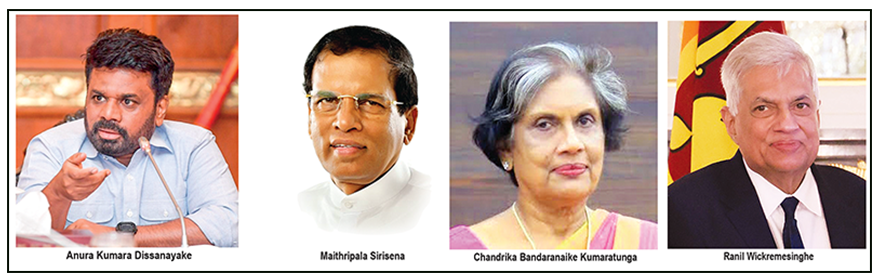
Before Anura Kumara Dissanayake promised a renaissance, Maithripala Sirisena promised good governance. The restoration of the rule of law was a key aspect of the different, better Sri Lanka Candidate Sirisena (and his chief supporter Ranil Wickremesinghe) offered in 2015. In that promised land, all wrongdoers will be brought before the law; justice will cease being a luxury only the rich and the powerful can afford and become a fact of ordinary life.
Chandrika Bandaranaike Kumaratunga’s elevation of the singularly unsuitable Sarath Silva to the august position of chief justice (an appointment some sought to justify on the irrelevant grounds that he was a Buddhist) had severely undermined judicial independence. Mahinda Rajapaksa dispensed with the rule of law entirely, enshrining in its stead the law of the ruling family. The illegal (and thuggish) impeachment of chief justice Shirani Bandaranayake destroyed even the pretence of judicial independence.
Today, Namal Rajapaksa is a born-again advocate of judicial independence and the rule of law. He seems to not remember the measure of the man his father and family picked as chief justice once they booted out Shirani Bandaranayake. Just one example would suffice to demonstrate Mohan Peiris’ suitability to be enthroned as the Rajapaksa chief justice. In November 2011, responding to a question about the disappearance of Prageeth Ekneligoda, Mr Peiris told the UN Committee against Torture, “Our current information is that Mr. Ekneligoda has taken refuge in a foreign country… It is something we can be reasonably certain of” (BBC– 25.11.2011). When summoned before the Homagama magistrate court (where the Ekneligoda case was being heard), he did a volte face. He rejected “the transcript of the statement he made in Geneva last year,” and said “he could not remember the source that revealed to him the whereabouts of Prageeth Ekneligoda,” adding that “I have no information that the corpus is alive or not and I do not think the government does either and that God only knows where Ekneligoda is” (Ceylon Today – 6.6.2012).
With Mohan Peiris controlling the judiciary, the law of the Rajapaksas could stalk the land unimpeded. For many voters who flocked to Maithripala Sirisena’s side in 2015, restoring the rule of law was not an abstract slogan but a vital necessity.
The Sirisena-Wickremesinghe administration did not betray that promise. Restoring judicial independence was the best – and the most enduring – achievement of an administration which violated the bulk of its promises and betrayed a large part of its mandate.
Unlike Maithripala Sirisena, Anura Kumara Dissanayake did not inherit a debased and a cowed judiciary. He inherited a strong judiciary confident enough to take on an executive president, a judiciary unafraid to stand up to a saffron mob and put a stop to the misuse of the International Covenant on Civil and Political Rights (ICCPR) as a blasphemy law. Today, the judiciary remains one of the very few relatively undebased and uncompromised (plus popular) institutions in the country. Consequently, President Dissanayake’s task does not involve any doing. His task is to refrain from doing. His May Day remark concerning an upcoming verdict is an example of what he should not to.
While the judiciary has been a beacon of hope in dark times (despite occasional backsliding), the same cannot be said of the police, an essential component in maintaining the rule of law. If the police fail to carry out investigations impartially and speedily, if they favour powerful suspects over powerless victims, then the rule of law is violated at the foundational level, a wrong that cannot be righted even by the most independent judiciary.
Is the saffron robe above the law?
Addressing a District Development Committee meeting last week, President Dissanayake said that his government has ended the impunity of those who believed that the law would never apply to them.
Does the president live in a parallel universe where a powerful monk accused of raping a 12-year-old child is being protected by a non-divine hand?
The crime is so horrendous it would have sufficed to cause the most powerful politician or the wealthiest businessman to fall from grace. Despite the necessary presumption of innocence, any political or economic leader accused of ‘purchasing’ a small child from her parents and raping her would have been arrested immediately, kicked out from whatever positions he occupied, and ostracized societally. If the government was dragging its foot, if the police were bending the law, the opposition and the media would have been on them like a tonne of bricks. If the accused had any connection with the opposition, the government would talk of little else for days. There would be parliamentary debates and press conferences, media exposes and public protests.
Not when the accused is Pallegama Hemaratana thera, the head of Atamasthana. Then the only sound from the usually garrulous political, economic, and religious leaders is silence.
Human Rights Council and Euro-Med Human Rights Monitor have published extensive reports of how Israel systematically uses sexual violence against Palestinians ( and ). Last week, The New York Times carried its own expose detailing these atrocities. In his commentary on the findings, Nicholas Kristoff, a two-time Pulitzer winning journalist, wrote, “It’s a simple proposition: Whatever our views of the Middle East conflict, we should be able to unite in condemning rape” ().
Indeed. Similarly, we should be able to unite in condemning child abuse, whatever the identity of the alleged perpetrator. But when it comes to the Pallegama Hemaratana case, government and opposition, religious and economic leaders, most of the media and societal luminaries have united in wilful blindness and wilful deafness. Had it not been for judicial action and the effort made by the National Child Protection Authority, the monk would still be lording it over in Atamasthana. Even after the court ordered his arrest, he managed to evade prison and spend days in the Nawaloka hospital.
The Minister of Children and Women’s Affairs issued an anodyne statement after the judicial order rendered police inaction impossible. Nothing, though, from the president, the many would-be presidents, the PM, the leader of opposition, party leaders. Nothing also from the Mahanayake theros or the Cardinal. Just announce that children will be taught how to identify and protect themselves from child abusers and mark how quickly the silence ends and the cacophony of outrage begins.
In his autobiography We don’t know ourselves – A personal history of modern Ireland, Irish author Fintan O’Toole writes of a priest-teacher who abused his students, “openly, constantly, shamelessly…” The perpetrator picked his victims carefully, “the vulnerable boy, the kid who got into trouble, the kid whose father had died.” Mr O’Toole calls clerical child-abuse “…the open secret, the thing that everybody knew and nobody grasped, the truth that could be seen but never identified. We were adepts at epistemology. Most of us could walk like circus performers across tightropes that were strung between private knowledge and public acknowledgement. The only ones who ever looked down were those who were badly abused, and they became even better at suppressing reality.” For decades, individual acts of resistance went nowhere. A friend calls out the abusive priest-teacher in class. The priest ignores him and tells the class to turn to another page in the Latin grammar, which they do. “David was defeated. He just sat down again and everything went on as if his accusations had never been voiced.”
In Sri Lanka too, clerical child-abuse is obfuscated by a ‘cloud of unknowing’. Occasionally, the cloud lifts, when the victim has parents who care, who are able to protest and protect. This week, the Appeal Court confirmed the seven-year sentence passed on Hambegamuwe Chandananda by the High Court for abusing a nine-year old novice monk the day after he was ordained. If we ignore or tolerate such horrors in the name of Sasana, then we cannot be adherents of The Buddha.
Like any suspect, the monk Pallegama Hemaratana is innocent until and unless proven guilty by a court of law. But for him to be proven innocent (or guilty), there has to be a proper investigation and a speedy trial. How can there be any hope of a fair and a transparent investigation and a speedy trial given how hard various authorities tried first to keep the story under the wraps, then not to arrest the monk, and finally to keep him in the Nawaloka Hospital?
Given the range and magnitude of this preferential treatment, the involvement of the political authority up to and including the president cannot be ruled out. The Opposition’s complicity in this matter has given the government-enabled impunity wings. Suddenly, it’s as if the Rajapaksas never left.
The first step down the abyss
In his 1968 article The Territories, Israeli philosopher Yeshayahu Leibowitz issued a warning to his own countrymen and women. “Rule over the occupied territories could have social repercussions… The corruption characteristic of every colonial regime would also prevail in the state of Israel.” In his 1988 essay 40 years after, he returned to the theme. “That a subjugated people would fight for its freedom against the conquering ruler, with all the means at its disposal, without being squeamish about their legitimacy, was only to be expected. This has been true of wars of liberation of all peoples… We are creating – and have already created – a political atmosphere affecting the public as well as its individual members… In this same atmosphere one hears of cases of soldiers attempting to bury Arab boys alive; the Attorney General tries to distinguish between torture and ‘reasonable’ torture; those in charge of the army distinguish ‘burial alive’ from the burying alive of bodies without interring the heads.”
Consider the end. Resist the beginnings. In Sri Lanka, warnings about the danger of clerical impunity were made as far back as the 1930’s when the country was still Ceylon. One such Cassandra-figure who foresaw the future, whose words went unheeded was Munidasa Kumaratunga. In his 2 October 1934 editorial in Lakmini Pahana, he wrote, “If a monk engages in wrongdoing, we should not close our eyes. Instead, we should ensure that the monk is given the punishment appropriate for his wrongdoing.” Ignoring that sage warning, we developed into a fine art the devise of worshipping the robe irrespective of the quality of the wearer.
The police while treating an alleged child-rapist with kid gloves publicly arrested a monk in Rajanganaya for insulting a minister and two top cops. That differential treatment points to two dangerous developments which, if not nipped in the bud, can take us right back to the Rajapaksa days. One is the reincarnation of impunity. The other is the politicisation of the police.
The undermining of the police at the institutional level reached its zenith under Rajapaksa rule. Two examples from the South and the North would suffice to show the consequences of this debasement.
In July 2009, a coordinating secretary of the Minister of Human Rights, Mahinda Samarasinghe was abducted. The minister eventually uncovered that the victim had not been abducted by criminals (as was supposed initially) but ‘arrested’ by the police. He protested saying that the “police cannot simply barge into people’s houses without appropriate documents and take people away” (Bottom Line – 5.8.2009). The police’s response was, yes we can; the abduction was the work of a ‘special squad that had wide powers to arrest anybody in any part of the country” (The Island – 7.8.2009).
On 20 September 2011, Antony Nithyaraja, a man wanted by the police, appeared before the Jaffna magistrate through his lawyer. “The Magistrate after considering the police submissions and court documents released him. However, seven police officers in civilian clothes arrested him and started beating Antony in the presence of the Magistrate, lawyers, court staff and a large number of people. He was dragged to the Jaffna Headquarters Police Station for detention” (Asian Human Rights Commission – 23.9.2011).
The police could take the law into their own hands because the rulers created an enabling environment for such illegalities. The rot was begun by politicians, and can only be ended by politicians. Reforming the police was a key promise of Maithripala Sirisena in 2015 and Anura Kumara Dissanayake in 2024. Mr Sirisena broke it. Mr Dissanayake is breaking it. The carcinogen has returned to the body.
by Tisaranee Gunasekara ✍️
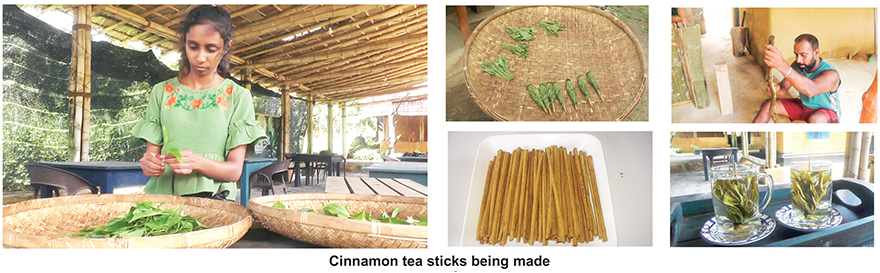
On a humid tea-growing slope in Sri Lanka’s south-western highlands, where mist drifts over the edges of the Sinharaja Forest Reserve, a quiet experiment is attempting to reimagine one of the country’s most enduring export lifelines.
For generations, tea has been both livelihood and legacy for thousands of smallholders across Sri Lanka. Yet beneath the global reputation of Ceylon Tea lies a persistent grievance. Growers say their earnings have remained largely stagnant even as value-added tea products fetch premium prices in overseas markets.
It is against this backdrop that entrepreneur Sarathchandra Ramanayake is promoting a new product he believes could shift more value back to the farmer. The product is called the Cinnamon Green Tea Stick, designed as a portable, bag-free infusion format aimed at premium and health-conscious consumers.
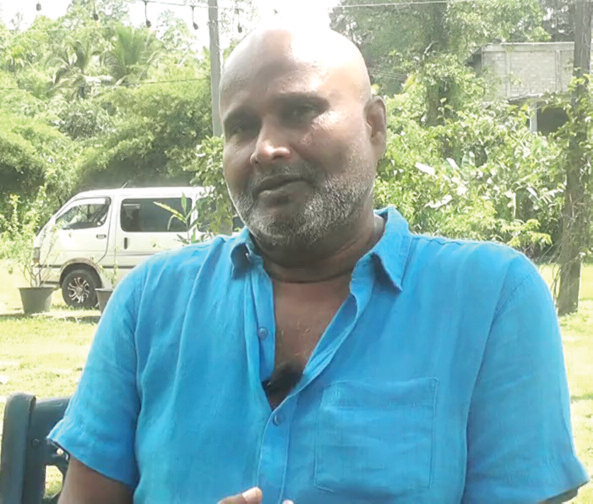
Sarathchandra Ramanayake
World Tea Day, observed on the 21st of this month, adds context to a wider debate about who benefits most from the global tea economy, the planter or the processor.
Ramanayake’s proposal is ambitious. He argues that while tea leaves currently fetch modest farm-gate prices, a redesigned value chain built around specialty processing could generate significantly higher returns. In his model, a kilo of finished product could translate into substantially improved earnings for growers, particularly through export-oriented niche markets.
He said the aim is to move away from bulk commodity pricing and toward value-driven tea consumption. The concept replaces conventional tea bags with a solid stick format infused with cinnamon, sourced from Sri Lanka’s spice-growing regions.
The Kalawana area in the Ratnapura District, where small tea holdings dominate the agricultural landscape, has been identified as a potential production base. In these communities, tea remains the backbone of rural livelihoods and sustains entire families.
Ramanayake said the initiative is not intended to replace traditional supply chains but to complement them. Farmers would continue supplying factories while also contributing selected high-quality leaves for the new production process.
Regulatory approval has been obtained under handmade tea production guidelines from the Tea Board, and a patent application has been submitted under intellectual property provisions.
Early signs of commercial interest are emerging. According to Ramanayake, small export orders have already been received from markets including the United Kingdom, suggesting tentative international interest in the product’s positioning.
The project also highlights long-standing structural issues within Sri Lanka’s tea economy, where value addition, branding and export margins are often concentrated far away from the farmer who produces the leaf.
Ramanayake’s pitch is both economic and social. By incorporating cinnamon, another of Sri Lanka’s globally recognised agricultural exports, the product also seeks to strengthen rural spice growers and diversify farm-level income.
Still, questions remain over whether such boutique innovations can meaningfully shift earnings at scale in an industry shaped by established auction systems and large processors.
For now, the Cinnamon Green Tea Stick sits at the intersection of tradition and innovation, carrying an ambition to reprice the leaf, reframe the farmer’s role and reimagine Sri Lanka’s iconic tea industry for a changing global market.
Text and Pix By Upendra Priyankara Jathungama ✍️

LESSONS FROM MY CAREER: SYNTHESISING MANAGEMENT THEORY WITH PRACTICE – PART 37
In today’s episode, I will relate several incidents from my final years at Dankotuwa Porcelain and the lessons I learned from them. Looking back now, I realise that these years taught me not only about management, finance, labour relations, and corporate survival, but also about human emotions, loyalty, fear, stubbornness, and resilience. They also marked the gradual end of a very long line of executive appointments that had consumed most of my adult life.
The contract labour issue
Because of the uncertainty of export demand, we had adopted a flexible system of recruiting some employees on fixed-term contracts or through labour suppliers. However, unlike many organisations, we took great care to ensure that these employees were not treated as second-class workers. In practice, they enjoyed almost all the benefits of permanent employees. If they served beyond a stipulated period, they were entitled to gratuity as well. We also had to comply with stringent labour and ethical compliance standards imposed by our foreign buyers, many of whom conducted regular audits.
A group of these employees had completed their two-year fixed-term contracts. Due to the uncertain external environment and fluctuating orders, we were unable to offer permanency. Instead, we offered another fixed-term contract for two years.
To our surprise, all of them refused and wanted permanent jobs which were too risky to offer in a volatile environment.
Despite repeated discussions and assurances from the Head of Human Resources, they insisted on nothing short of permanency. They would not budge. Finally, and very reluctantly, I instructed security not to permit them into the premises from the following day, because technically their contracts had expired.
The next morning, the entire group gathered outside the gate. They remained there until around ten o’clock before dispersing. Later, I heard that they were gathering at the residence of a Member of Parliament who lived nearby. This continued for several days.
The MP telephoned me repeatedly and urged me to make them permanent. I refused. The company simply could not absorb that level of rigidity at such an uncertain time. Then matters took an ugly turn.
One morning, some members of the group harassed the Chief Operating Officer while he was entering the premises. They sat on the bonnet of his car and forcibly opened the door. Security identified the main culprits immediately. I made up my mind that, regardless of future developments, those directly involved in intimidation and misconduct would never be taken back.
After nearly a month, the MP contacted me again. He said the matter had become a stalemate and that the group was now willing to accept the original contract terms. I replied immediately: “We now have only one-year contracts available. Anyone interested may report for work.” Some accepted. Others stubbornly refused.
Later, a few of those who had not been re-employed met me privately. They admitted they had been inexperienced young men and women who had merely followed the advice of union leaders. They confessed that it was the unions that had encouraged them to reject the original offer and even urged them to obstruct the COO’s vehicle. They pleaded with me to show mercy, saying they had been misled.
I genuinely felt sorry for them. But I stood firm.
Management sometimes requires compassion, but it also requires consistency. If discipline collapses, organisations collapse soon after.
The incident reinforced one of the most important lessons I learned in labour relations: leaders must distinguish between firmness and cruelty. A manager who constantly bends under pressure may temporarily avoid conflict, but in the long run loses credibility and control.
Thoughts of Retirement
By this time, I was just past 60 years of age. The stress of corporate life had begun taking a visible toll on my health. I often recalled my earlier days at the Employees’ Trust Fund under President Ranasinghe Premadasa, when relentless pressure had caused severe gastritis and ulcers. I still remember how those symptoms vanished within days of leaving the ETF.
I began dreaming of retirement, peace, and perhaps a quieter life devoted to agriculture, which had always fascinated me. But the Japanese directors would hear none of it.
They told me that in Japan, life begins at sixty. They pointed out that many Chairmen—Kaicho, as they are called in Japan—continue well into their seventies. One of the local directors was even sent to meet me personally and persuade me to abandon thoughts of retirement.
So I remained. The COLA problem
One of our biggest internal challenges was the Cost of Living Allowance (COLA) system that had been introduced years earlier. During periods of high inflation, it spiralled out of control. In some months, increases amounted to nearly one thousand rupees—a very substantial figure at that time.
No other industry was granting such increases monthly.
The situation became unsustainable. Worse still, the COLA had been incorporated into calculations for overtime, provident fund contributions, and other benefits. The compounding effect was enormous. We were unable to correct this mistake at the current time.
After prolonged discussions with the unions, we finally managed to restructure the arrangement. The frozen COLA and increases were consolidated into the basic salary structure.
I regarded this as a major breakthrough.
The Labour Department admitted privately that mistakes had been made by the company when the scheme was originally designed, but said nothing could legally be altered retrospectively.
This episode taught me another important lesson: poorly designed compensation systems can haunt organisations for decades. A Board and Chairman must examine compensation schemes very carefully before implementation. A benefit introduced during prosperous times may become a crushing burden during difficult periods.
The search for a new investor
The Japanese shareholders eventually made it clear that they were unwilling to invest further funds into the company. A new investor had to be found if the company was to survive.
Once again, my retirement plans were postponed. The Board insisted that I remain until a suitable investor was secured.
One prospective investor came close to finalising a deal but withdrew suddenly due to uncertainty surrounding the GSP+ concession. Another investor emerged later, but with very strict conditions. One of their key demands was a freeze on salaries and allowances for three years. Negotiations with the unions dragged on for days and weeks. At times, it appeared we were on the verge of success. Then suddenly the unions would withdraw cooperation.
Meanwhile, our financial position was deteriorating rapidly. The Head of Finance confirmed in writing that we could no longer meet obligations as they fell due.
I realised we had reached a dangerous legal and ethical point.
Under the Companies Act, if directors continue operating while knowing the company is insolvent, they may become personally liable for further erosion of assets. This was no longer merely a corporate issue—it threatened my own personal assets accumulated over a lifetime.
I informed the Board that we had no option but to seriously consider winding up the company. The local directors agreed. The Japanese directors requested one week to obtain instructions from Tokyo.
Because of Stock Exchange requirements, we made a disclosure to the Colombo Stock Exchange regarding the possible winding up.
That announcement changed everything.
Copies were displayed throughout the factory and office. Over the weekend, I was inundated with telephone calls from employees.
Some pleaded emotionally with me to save the company. Many had spent their entire working lives there and felt deeply attached to the factory. One group telephoned to say they were conducting a Bodhi pooja at a temple for the company’s survival. Another group called from a church where special prayers were being offered.
Those calls affected me deeply. To all of them, however, I gave the same answer:
“The future of the company is in your hands. If the investor’s conditions are accepted, the company can survive.”
The Minister’s intervention
On Sunday, I received a call from Minister Anura Priyadarshana Yapa asking me to come to his residence immediately.
I went with the COO and found that he had also summoned the General Manager of Noritake Porcelain, whom he knew personally. After hearing my explanation, the Minister called for the union representatives as well.
We waited several hours for them to arrive. During that waiting period, the Minister spoke candidly about politics, privatisation, nationalisation, and the mistakes successive governments had made. It was an unexpectedly educational afternoon.
When the unions finally arrived, the Minister was direct and blunt.
He told them that many workers came from his electorate and that if the factory closed, they should not expect him to find employment for them elsewhere.
The mood changed.
After lengthy discussion, the unions agreed in principle, though they requested a small amendment to the proposed terms. The Minister supported their request.
I said I could not promise anything but would speak to the investor. Fortunately, after difficult negotiations, the investor agreed.
On Tuesday, we met at the Labour Department and signed the settlement. We then informed the stock exchange that an agreement had been successfully reached.
The sense of relief was immense.
The SEC hearing
Even after securing the investor, another obstacle remained. Since the investment involved a fresh issue of shares, approval from the Securities and Exchange Commission of Sri Lanka was required.
That process became another nightmare.
The agreed share price had been based on the prevailing market price, but speculation had driven the market upward rapidly. During the hearing, I faced intense questioning regarding the pricing.
I explained that we could not ethically change the agreed terms after giving our word. More importantly, I stressed that this was the only serious investor available. Losing them could doom the company.
I made a detailed presentation supported by charts and figures. I also spoke frankly.
I admitted that I was suffering sleepless nights worrying about the company’s future.
After the hearing, I stepped outside exhausted and had barely begun packing my laptop when I was summoned back in.
As I entered, the Chairman smiled and said: “Mr. Wijesinha, you can sleep tonight. We have approved your proposal.”
And indeed, that night, I slept peacefully.
Retirement at last
The new investors eventually assumed control. Initially there were difficulties because they came from strong financial and investment backgrounds and required time to understand manufacturing operations and export markets. I personally introduced them to foreign buyers to help them understand the realities of the industry.
The Japanese shareholders became minority stakeholders.
At last, I felt the time had truly come to retire. The new investors requested that I remain for another year to help stabilise the transition. I agreed.
Finally, on June 30, 2012, I retired with mixed feelings.
I had enjoyed the challenges enormously, but they had undeniably affected my health. Yet the experiences proved invaluable later when I served on many Boards. I realised that Dankotuwa had excellent systems, disciplined processes, and an outstanding product. The difficulty was not inefficiency. It was surviving intense global competition in a highly unforgiving industry.
Looking back now, I realise that management theories often sound neat and logical in classrooms and seminars. Real life is rarely so tidy. In practice, leadership involves balancing compassion with discipline, ethics with survival, and long-term strategy with short-term crises.
Perhaps the greatest lesson I learned at Dankotuwa was this: organisations are not saved by systems alone. They are saved by people—their sacrifices, emotions, loyalty, courage, and sometimes even their prayers.
More lessons from my Board experiences will follow in future episodes.
(Sunil G. Wijesinha is a Consultant on Productivity and Japanese Management Techniques
Former Chairman / Director of several listed and unlisted companies
Recipient of the APO Regional Award for Promoting Productivity in the Asia-Pacific Region
Recipient of the Order of the Rising Sun, Gold and Silver Rays – Government of Japan
Email: bizex.seminarsandconsulting@gmail.com)
By Sunil G. Wijesinha ✍️

Showers expected in the Western, Sabaragamuwa and North-western provinces and in Galle, Matara, Kandy and Nuwara-Eliya districts

Devine intervention brings New Zealand back from the dead

US police responding to dozens of shots fired near the White House

Sri Lanka cricket finances ‘greater than feared’: interim chief

Police roll out countrywide security plan for Vesak Week

India, Lanka boost air power ties as IAF Chief visits Colombo

‘Dates have the highest sugar content to fight Coronavirus’

Sunday Island 27 December – Headlines

#SundayIsland 17th December – Headlines

Sunday Island – 28th March

Sunday Island Headlines – 21 March

Sunday Island – 21st February – Headlines
-
 Features4 days ago
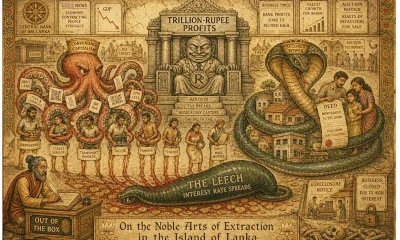
Octopus, Leech, and Snake: How Sri Lanka’s banks feast while the nation starves
-
 News3 days ago
Steps underway to safeguard Sri Lanka’s maritime heritage
-
 Opinion3 days ago
Murder of Ehelepola family, Bogambara Wewa and Sightings of Wangediya
-

 Editorial3 days ago
A play without its protagonist
-
 Sports4 days ago
Sri Lanka women’s volleyball team ready for Central Asian challenge
-
 Midweek Review4 days ago
Overall SLPP failures stressed in new Aragalaya narrative
-

 Opinion2 days ago
The need to reform Buddhist ecclesiastical order
-
 Latest News5 days ago
At least 100 dead in Ebola outbreak in DR Congo, official says